Seventy Years of Fractal Projections
Seventy years ago, John Marstrand published a paper which, among other things, relates the Hausdorff dimension of a plane set to the dimensions of its orthogonal projections onto lines. For some time this paper attracted little attention, but over th…
Authors: Kenneth J. Falconer
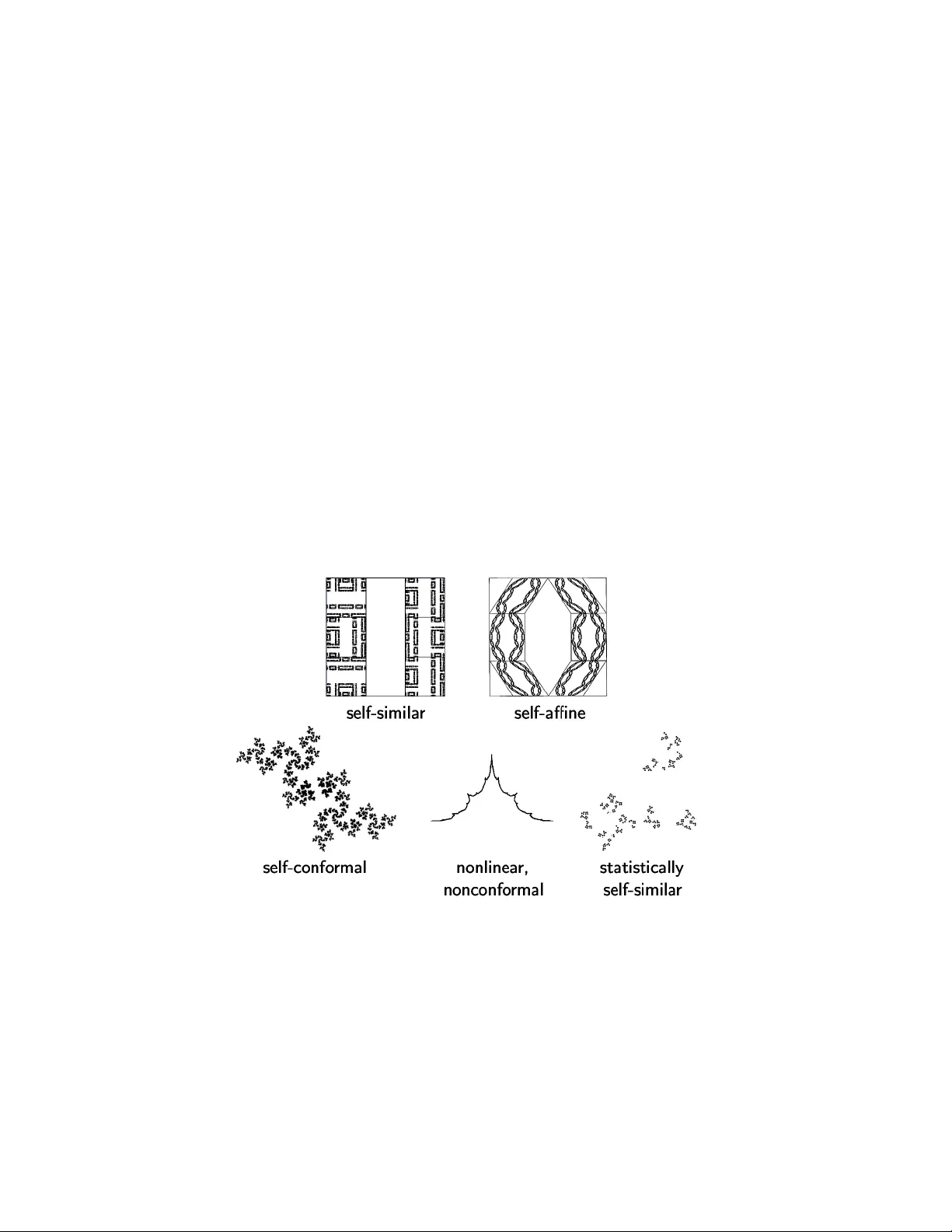
Se v enty Y ears of Fractal Projections Kenneth J. F alconer [ 0000 − 0001 − 8823 − 0406 ] 1 Introduction At the conference F ractal Geometry and Stoc hastics V held in T abarz in 2014, I ga ve a surve y talk entitled ‘Sixty y ears of fractal projections ’ , a v ersion of which, written with Jon Fraser and Xiong Jin [31], appeared in in the conference proceedings [8]. This marked the sixtieth anniv ersary of the publication of John Marstrand’ s 1954 paper [89] ‘Some fundamental g eometr ical properties of plane sets of fractional dimensions ’ in the Proceedings of the London Mathematical Society . For a long time the paper attracted little attention, but since the 1980s, Marstrand’ s projection theorems ha ve become the prototype f or man y results in fractal geometry with numerous v ar iants and applications. This area is no w more intensivel y researched than ev er , drawing on modern techniq ues from ergodic theory , CP processes, Fourier transf or ms, discretisation of problems and additive combinator ics, tog ether with a lot of ingenuity . My talk ‘Se v enty y ears of fractal projections ’ at F r actal Geometry and Stoc hastics VII held in 2024 in Chemnitz highlighted some of the very considerable prog ress in the area o ver the pas t 10 years. This account also surv ey s some of this more recent w ork and is a sequel to [31] where man y ear lier results and ref erences ma y be f ound. There are many e x cellent ar ticles and books which provide other substantial o vervie ws of projection proper ties, including ref erences [52, 92, 93, 94, 95, 96, 134]. Also, volumes of conf erence proceedings, in par ticular of the Ger man ‘Fractal Geometry and Stoc hastics ’ and the French ‘Fractals and R elated Fields ’ meetings, contain man y enlightening surve ys on this and many other aspects of fractal geometry . Kenneth J. F alconer School of Mathematics and Statis tics, Univ ersity of S t Andre ws, N or th Haugh, S t Andre ws, F ife KY16 8NS, UK, e-mail: kjf@st.andre ws.ac.uk 1 2 Kenneth J. F alconer 1.1 General remar ks Most of this ar ticle concer ns or thogonal projections of sets in the plane onto s traight lines or from R 𝑛 onto 𝑚 -dimensional subspaces. In the plane w e let 𝐿 𝜃 be the line making angle 𝜃 ∈ [ 0 , 𝜋 ) with the 𝑥 -axis, and write proj 𝜃 : R 2 → 𝐿 𝜃 f or or thogonal projection onto 𝐿 𝜃 , see Figure 1. By slight abuse of notation we will write L for Lebesgue measure on an y line 𝐿 𝜃 , identified with R in the obvious w a y . Figure 1: Projection of a set 𝐸 onto a line in direction 𝜃 . In the higher dimensional setting, we write 𝐺 ( 𝑛 , 𝑚 ) for the Grassmanian of 𝑚 -dimensional subspaces of R 𝑛 , where 1 ≤ 𝑚 < 𝑛 . Then 𝐺 ( 𝑛, 𝑚 ) is an 𝑚 ( 𝑛 − 𝑚 ) - dimensional compact manifold which car ries a natural in variant measure 𝛾 𝑛, 𝑚 that is locally equivalent to 𝑚 ( 𝑛 − 𝑚 ) -dimensional Lebesgue measure. When we wr ite ‘f or almost all 𝑉 ∈ 𝐺 ( 𝑛 , 𝑚 ) ’ this is taken to be with respect to 𝛾 𝑛, 𝑚 . For 𝑉 ∈ 𝐺 ( 𝑛, 𝑚 ) let proj 𝑉 : R 𝑛 → 𝑉 be or thogonal projection onto the 𝑚 -dimensional subspace 𝑉 , writing L 𝑚 f or 𝑚 -dimensional Lebesgue measure on 𝑉 which w e identify with R 𝑚 . W e make the conv ention that we use proj 𝜃 specifically f or the planar setting and proj 𝑉 f or the more general 𝐺 ( 𝑛, 𝑚 ) conte xt. Here our main interest is in projections of sets rather than measures, though man y results f or projections of sets hav e measure analogues, indeed many proofs concerning projections of sets depend on consideration of projections of suitable measures suppor ted by the sets. Low er and upper Hausdor ff and packing dimensions of measures can be defined in terms of local dimensions, and ma y all be equal for dynamically defined measures. Then often the dimension of projected measures can be e xpressed in ter ms of entropies and L yapuno v e xponents. W e will assume, sometimes without mentioning it specifically , that the subsets of R 𝑚 with which w e w ork are all Borel or analytic, indeed f or many results little is lost b y assuming them to be compact. W e a void consideration of completely general sets that do not hav e analytic or measurable str ucture; they may behav e strang ely depending on the axioms of logic that are assumed. Ne vertheless we note that recently Lutz and Stull [86] hav e used effectiv e dimension and computational Sev enty Y ears of Fractal Projections 3 comple xity to obtain some results on projections with no requirement on sets to be Borel or analytic. 1.2 Marstrand’s pr ojection theorem Marstrand’ s projection theorem in the plane [89] ma y be stated as f ollo ws. Theorem 1.1. Let 𝐸 ⊂ R 2 be a Bor el or analytic set. Then (i) dim H proj 𝜃 𝐸 ≤ min { dim H 𝐸 , 1 } with equality f or almost all 𝜃 ∈ [ 0 , 𝜋 ) , (ii) if dim H 𝐸 > 1 then L ( proj 𝜃 𝐸 ) > 0 for almost all 𝜃 ∈ [ 0 , 𝜋 ) . The natural higher dimensional analogue of Marstrand’ s theorem was first pre- sented b y Mattila [90] in 1975. Theorem 1.2. Let 𝐸 ⊂ R 𝑛 be a Bor el or analytic set. Then (i) dim H proj 𝑉 𝐸 ≤ min { dim H 𝐸 , 𝑚 } with equality for 𝛾 𝑛, 𝑚 -almost all 𝑉 ∈ 𝐺 ( 𝑛, 𝑚 ) , (ii) if dim H 𝐸 > 𝑚 then L 𝑚 ( proj 𝑉 𝐸 ) > 0 for 𝛾 𝑛, 𝑚 -almost all 𝑉 ∈ 𝐺 ( 𝑛, 𝑚 ) . Since or thogonal projection is a Lipschitz map that does not increase distances betw een points, the inequalities in (i) of Theorems 1.1 and 1.2 f ollo w easil y from the definition of Hausdor ff measure and dimension, but sho wing that equality holds f or almost all 𝜃 or 𝑉 is more inv ol ved. In his or iginal paper, Marstrand [89] used intr icate estimates in vol ving plane geometry and measure theor y , but in 1968 Kaufman [80] ga v e a new proof of Theorem 1.1(i) using potential theor y and of Theorem 1.1(ii) using Fourier transforms bef ore Mattila [90] used this approach in higher dimensions to obtain Theorem 1.2. Briefly , the potential-theoretic method depends on the characterisation of Haus- dorff dimension in ter ms of energy integrals. W e wr ite M ( 𝐸 ) f or the positiv e finite Borel measures supported on 𝐸 ⊂ R 𝑛 . For 𝑠 > 0 we write: 𝐼 𝑠 ( 𝜇 ) : = 𝑑𝜇 ( 𝑥 ) 𝑑𝜇 ( 𝑦 ) | 𝑥 − 𝑦 | 𝑠 (1.1) f or the 𝑠 - ener gy of the measure 𝜇 ∈ M ( 𝐸 ) . Then dim H 𝐸 = sup 𝑠 : there e xists 𝜇 ∈ M ( 𝐸 ) such that 𝐼 𝑠 ( 𝜇 ) < ∞ . Theorem 1.1(i) ma y then be prov ed by noting that f or all 0 < 𝑠 < dim H 𝐸 there is a measure 𝜇 ∈ M ( 𝐸 ) such that 𝐼 𝑠 ( 𝜇 ) < ∞ , and v er ifying that 𝐼 𝑠 ( 𝜇 𝜃 ) 𝑑𝜃 ≤ 𝑐 𝑠 𝐼 𝑠 ( 𝜇 ) , where 𝜇 𝜃 is the projection of the measure 𝜇 onto the line 𝐿 𝜃 in direction 𝜃 , giv en b y 𝜇 𝜃 ( 𝐹 ) = 𝜇 ( proj − 1 𝜃 𝐹 ) for 𝐹 ⊂ 𝐿 𝜃 . The higher dimensional case, Theorem 1.2(i), ma y be prov ed in a similar w ay . Theorem 1.1(ii) ma y be obtained using Fourier transf orms. W r iting 𝜇 ( 𝑧 ) : = 𝑒 − 2 𝜋 𝑖 𝑥 . 𝑧 𝑑𝜇 ( 𝑥 ) ( 𝑧 ∈ R 𝑛 ) for the Fourier transform of 𝜇 , applying Parsev al’ s theorem and the con volution f ormulae to the energy e xpression in (1.1) giv es 4 Kenneth J. F alconer 𝐼 𝑠 ( 𝜇 ) = 𝑐 𝑛, 𝑠 R 𝑛 | 𝜇 ( 𝑧 ) | 2 | 𝑧 | 𝑛 − 𝑠 𝑑 𝑧 ( 0 < 𝑠 < 𝑛 ) , (1.2) where 𝑐 𝑛, 𝑠 depends only on 𝑛 and 𝑠 , see [95, Theorem 3.10]. Then if 𝐸 ⊂ R 2 and dim H 𝐸 > 1 we ma y find 𝜇 ∈ M ( 𝐸 ) and 1 < 𝑠 < dim H 𝐸 suc h that 𝐼 𝑠 ( 𝜇 ) < ∞ . W riting (1.2) in radial coordinates this implies that | 𝜇 𝜃 ( 𝑡 ) | 2 𝑑 𝑡 𝑑 𝜃 < ∞ , so that f or almost all 𝜃 , the projected measure 𝜇 𝜃 on 𝐿 𝜃 is absolutely continuous with respect to L and is a square integrable function, so in pa rticular 𝐸 has suppor t of positiv e L -measure. Energy and Fourier methods and their generalisations and extensions hav e been used widely across fractal geometry and in par ticular in work on projections. Further e xamples will be encountered in this sur v e y , but f or thorough treatments see, for e xample, [26, 31, 90, 91, 93, 94, 95] Marstrand’ s theorem is the prototype f or a great deal of w ork in fractal g eometry . If, in some setting, a dimensional proper ty of parameterised images of a set is tr ue f or almost all parameters, perhaps f or almost all 𝜃 or 𝑉 , w e say that a ‘Marstrand-type theorem holds ’ . W e will see man y instances of this in the sections that f ollo w . 2 Ex ceptional sets of pr ojections Whilst Marstrand’ s Theorem giv es that the Lebesgue measure of the ‘ex ceptional set’ of projection directions 𝜃 f or which dim H proj 𝜃 𝐸 < min { dim H 𝐸 , 1 } has Lebesgue measure 0, often the set of e xceptional directions must be some what smaller than this. Indeed Kaufman ’ s potential theoretic approach [80] also yields an upper bound f or the dimension of the ex ceptional set in Theorems 1.1(i) and 1.2(i), namel y that if 𝐸 ⊂ R 𝑛 and 0 ≤ 𝑠 < dim H 𝐸 < 𝑚 then dim H { 𝑉 ∈ 𝐺 ( 𝑛, 𝑚 ) : dim H proj 𝑉 𝐸 < 𝑠 } ≤ 𝑚 ( 𝑛 − 𝑚 ) − ( 𝑚 − 𝑠 ) . (2.1) (This bound is written in this form f or comparison with 𝑚 ( 𝑛 − 𝑚 ) , the dimension of the Grassmanian 𝐺 ( 𝑛 , 𝑚 ) ) . Using Fourier transforms, Falconer [23] in 1982 obtained bounds f or the e xceptional sets of an alternativ e form: if 0 ≤ 𝑠 ≤ 𝑚 ≤ dim H 𝐸 then dim H { 𝑉 ∈ 𝐺 ( 𝑛, 𝑚 ) : dim H proj 𝑉 𝐸 < 𝑠 } ≤ max { 𝑚 ( 𝑛 − 𝑚 ) − ( dim H 𝐸 − 𝑠 ) , 0 } , (2.2) and if 𝑚 ≤ dim H 𝐸 ≤ 𝑛 , dim H { 𝑉 ∈ 𝐺 ( 𝑛, 𝑚 ) : L 𝑛 ( proj 𝑉 𝐸 ) = 0 } ≤ 𝑚 ( 𝑛 − 𝑚 ) − ( dim H 𝐸 − 𝑚 ) ; (2.3) the idea here is the greater the ‘ex cess dimension’ dim H 𝐸 − 𝑠 or dim H 𝐸 − 𝑚 , the smaller the set of ex ceptional 𝑉 . Estimates f or the dimensions of e xceptional sets in the spirit of (2.1), where there is a direct estimate, and (2.2)–(2.3), where the bound depends on by ho w much the dimension of a set ex ceeds a threshold, hav e become kno wn as ‘Kaufman-type’ and ‘F alconer -type ’ estimates respectiv ely . Sev enty Y ears of Fractal Projections 5 One fur ther estimate, due to Peres and Sc hlag [119] in 2000, completes this quartet. If dim H 𝐸 > 2 𝑚 then dim H { 𝑉 ∈ 𝐺 ( 𝑛, 𝑚 ) : proj 𝑉 𝐸 has empty interior } ≤ 𝑚 ( 𝑛 − 𝑚 ) − ( dim H 𝐸 − 2 𝑚 ) . (2.4) Examples sugges ted that the bounds for ex ceptional projections in (2.1)-(2.2) w ere not in general optimal for all parameters, and various improv ements were obtained particularly in the plane case, for ex ample Bourgain [16] used discretised methods to sho w that when dim H 𝐸 < 1, dim H { 𝜃 : dim H proj 𝜃 𝐸 < 1 2 dim H 𝐸 } = 0 . (2.5) Such results and various ex amples led to ‘Oberlin ’ s Conjecture’ [102] proposed by Oberlin in 2012 f or the optimal upper bound: f or 𝐸 ⊂ R 2 and 0 < 𝑡 ≤ dim H ≤ 1, dim H 𝜃 : 𝜃 : dim H proj 𝜃 𝐸 < 1 2 ( 𝑡 + dim H 𝐸 ) ≤ 𝑡 , or equiv alently dim H { 𝜃 : dim H proj 𝜃 𝐸 < 𝑠 } ≤ max { 2 𝑠 − dim H 𝐸 , 0 } , f or 0 ≤ 𝑠 ≤ min { dim H 𝐸 , 1 } , see Figure 2. Oberlin [102] noted the analogy betw een Figure 2: U pper bounds for dimensions of e x ceptional directions of projections dim H { 𝜃 : dim H proj 𝜃 < 𝑠 } in cases dim H 𝐸 < 1 (broken line) and dim H 𝐸 > 1 (solid line). this conjecture and the Furstenberg set conjecture. (This concer ns the minimum Hausdorff dimension of a set 𝐸 f or whic h there is a f amily of lines L that all intersect 𝐸 in sets of Hausdor ff dimension at least 𝑠 , where the line-set L has dimension at least 𝑡 in the natural parameter isation of lines.) Progress to wards Oberlin ’ s conjecture was made by a number of authors including [104, 107, 113, 114] but it was finally 6 Kenneth J. F alconer fully es tablished by R en and W ang [129] in 2023 as a corollar y to their proof of the Furstenber g set conjecture. Theorem 2.1. [129] Let 𝐸 ⊂ R 2 be Bor el and 0 ≤ 𝑠 ≤ min { dim H 𝐸 , 1 } . Then dim H { 𝜃 : dim H proj 𝜃 𝐸 < 𝑠 } ≤ max { 2 𝑠 − dim H 𝐸 , 0 } , (2.6) and this bound is sharp. For projections of subsets of R 𝑛 onto 𝑚 -dimensional subspaces f or 𝑛 > 2 kno wl- edge is less complete. W e ha ve already noted upper bounds for dimensions of e xceptional projections in (2.1)–(2.4) but these bounds are not optimal f or all param- eters and better estimates are kno wn in some cases, see [95] f or a discussion. F or an e xample, He [66] used a discretised approac h to e xtend (2.5) to projections from R 𝑛 to 𝑚 -dimensional subspaces: dim H 𝑉 ∈ 𝐺 ( 𝑛, 𝑚 ) : dim H proj 𝑉 𝐸 ≤ 𝑚 𝑛 dim H 𝐸 ≤ 𝑚 ( 𝑛 − 𝑚 ) − 1 . As an aside, we show that inequality (2.6) leads to a v er y shor t proof of the Erd ˝ os- V olkmann conjecture, that there are no Borel subrings of R , with the usual addition and multiplication, that ha ve Hausdor ff dimension s tr ictl y betw een 0 and 1; this w as prov ed in 2003 independentl y b y Edgar and Millar [22] and Bourg ain [15]. For 𝑎 ∈ R define 𝜓 𝑎 : R 2 → R in coordinate form, also expressible as a ‘dot ’ product with the v ector 𝜃 = ( 𝑎, 1 ) , by 𝜓 𝑎 ( 𝑥 , 𝑦 ) = 𝑎 𝑥 + 𝑦 ≡ ( 𝑥 , 𝑦 ) · 𝜃 . Geometrically , 𝜓 𝑎 is or thogonal projection onto a line in direction 𝜃 = ( 𝑎, 1 ) together with a scaling of ratio ( 𝑎 2 + 1 ) 1 / 2 . Suppose 𝑅 is a r ing such that 0 < dim H 𝑅 < 1. Let 𝜖 > 0 be such that dim H 𝑅 + 𝜖 < min { dim H ( 𝑅 × 𝑅 ) , 1 } . (W e may do this since dim H ( 𝑅 × 𝑅 ) ≥ 2 dim H 𝑅 , using the product r ule f or Hausdor ff dimension that dim H 𝐸 + dim H 𝐹 ≤ dim H ( 𝐸 × 𝐹 ) for Borel 𝐸 and 𝐹 .) Since 𝑅 is a r ing, 𝜓 𝑎 ( 𝑅 × 𝑅 ) ⊂ 𝑅 f or all 𝑎 ∈ 𝑅 , so 𝑅 ⊂ { 𝑎 : dim H 𝜓 𝑎 ( 𝑅 × 𝑅 ) < dim H 𝑅 + 𝜖 } . Applying (2.6) with projections represented as 𝜓 𝑎 , taking 𝐸 = 𝑅 × 𝑅 and 𝑠 = dim H 𝑅 + 𝜖 , dim H 𝑅 ≤ dim H { 𝑎 : dim H 𝜓 𝑎 ( 𝑅 × 𝑅 ) < dim H 𝑅 + 𝜖 } ≤ max { 2 ( dim H 𝑅 + 𝜖 ) − dim H ( 𝑅 × 𝑅 ) , 0 } ≤ 2 𝜖 , using the product rule again. This holds for arbitrar il y small 𝜖 , contradicting that 0 < dim H 𝑅 < 1. Sev enty Y ears of Fractal Projections 7 3 Other definitions of dimensions Whilst many problems inv olving projections w ere first considered for Hausdor ff dimension, it is natural to ask similar q uestions using alternative definitions of dimension. In this section w e look at projection proper ties relating to other f orms of fractal dimension. 3.1 Bo x-counting dimensions The low er and upper bo x-counting dimensions of a non-empty and compact 𝐸 ⊂ R 𝑛 are giv en by dim B 𝐸 = lim inf 𝑟 → 0 log 𝑁 𝑟 ( 𝐸 ) − log 𝑟 and dim B 𝐸 = lim sup 𝑟 → 0 log 𝑁 𝑟 ( 𝐸 ) − log 𝑟 where 𝑁 𝑟 ( 𝐸 ) is the least number of sets of diameter 𝑟 co vering 𝐸 , see [26, 91]. If dim B 𝐸 = dim B 𝐸 w e wr ite dim B 𝐸 f or the common value, termed the box-counting , bo x , Minkow ski or Minkow ski-Boulig and dimension of 𝐸 . It is easy to see that dim H 𝐸 ≤ dim B 𝐸 ≤ dim B 𝐸 f or all 𝐸 ⊂ R 𝑛 . It is natural to ask whether there are Marstrand-type theorems f or bo x-dimensions. J ¨ arven p ¨ a ¨ a [78] constructed compact sets 𝐸 ⊂ R 𝑛 with dim B 𝐸 taking an y prescribed value in ( 0 , 𝑛 ] and such that dim B proj 𝑉 𝐸 = dim B 𝐸 1 + ( 1 / 𝑚 − 1 / 𝑛 ) dim B 𝐸 f or all 𝑉 ∈ 𝐺 ( 𝑛 , 𝑚 ) , which is str ictl y less than min { dim B 𝐸 , 𝑚 } . Further more, in 1996 F alconer and Ho wroyd [33] sho wed that this lo wer bound was best possible and obtained a Marstrand-type theorem by showing that almost all projections of a set 𝐸 ⊂ R 𝑛 must ha ve the same lo wer , and the same upper, box dimensions. Their e xpressions for these values were awkw ard and difficult to work with and Falconer revisited the q uestion in 2020 [27, 28] using a potential-theoretic approach. W e define kernels 𝜙 𝑠 𝑟 ( 𝑥 ) for 𝑠 > 0 , 0 < 𝑟 < 1, 𝑥 ∈ R 𝑛 b y 𝜙 𝑠 𝑟 ( 𝑥 ) = min 1 , 𝑟 | 𝑥 | 𝑠 . (3.1) The capacity 𝐶 𝑠 𝑟 ( 𝐸 ) of a compact 𝐸 ⊂ R 𝑛 with respect to 𝜙 𝑠 𝑟 is giv en by 1 𝐶 𝑠 𝑟 ( 𝐸 ) = inf 𝜇 ∈ M 0 ( 𝐸 ) 𝜙 𝑠 𝑟 ( 𝑥 − 𝑦 ) 𝑑𝜇 ( 𝑥 ) 𝑑 𝜇 ( 𝑦 ) , (3.2) where M 0 ( 𝐸 ) is the set of Borel probability measures suppor ted by 𝐸 . (For non- compact 𝐸 the capacity is taken to be the supremum of 𝐶 𝑠 𝑟 ( 𝐹 ) o ver compact subsets 𝐹 of 𝐸 .) It ma y be shown that f or 𝐸 ⊂ R 𝑛 , 𝑐 1 𝐶 𝑠 𝑟 ( 𝐸 ) ≤ 𝑁 𝑟 ( 𝐸 ) ≤ 𝑐 2 log ( 1 / 𝑟 ) 𝐶 𝑠 𝑟 ( 𝐸 ) if 𝑠 = 𝑛 𝑐 2 𝐶 𝑠 𝑟 ( 𝐸 ) if 𝑠 > 𝑛 , 8 Kenneth J. F alconer where 𝑐 1 , 𝑐 2 depend on 𝑠 and the diameter of 𝐸 . In par ticular it follo w s that f or 𝐸 ⊂ R 𝑛 , dim 𝑛 B 𝐸 : = dim B 𝐸 = lim inf 𝑟 → 0 log 𝑁 𝑟 ( 𝐸 ) − log 𝑟 = lim inf 𝑟 → 0 log 𝐶 𝑛 𝑟 ( 𝐸 ) − log 𝑟 , and dim 𝑛 B 𝐸 : = dim B 𝐸 = lim sup 𝑟 → 0 log 𝑁 𝑟 ( 𝐸 ) − log 𝑟 = lim sup 𝑟 → 0 log 𝐶 𝑛 𝑟 ( 𝐸 ) − log 𝑟 . (3.3) T aking 𝑠 = 𝑚 in the kernel (3.1) leads to the bo x dimensions of almost all projections. Theorem 3.1. [27, 28] Let 𝐸 ⊂ R 𝑛 be non-empty and compact. Then for all 𝑉 ∈ 𝐺 ( 𝑛, 𝑚 ) , dim B proj 𝑉 𝐸 ≤ lim inf 𝑟 → 0 log 𝐶 𝑚 𝑟 ( 𝐸 ) − log 𝑟 = dim 𝑚 B 𝐸 , and dim B proj 𝑉 𝐸 ≤ lim sup 𝑟 → 0 log 𝐶 𝑚 𝑟 ( 𝐸 ) − log 𝑟 = dim 𝑚 B 𝐸 , with equality f or 𝛾 𝑛, 𝑚 -almost all 𝑉 ∈ 𝐺 ( 𝑛, 𝑚 ) . Note that the almost sure dimensions of projections dim 𝑚 B 𝐸 and dim 𝑚 B 𝐸 ma y be strictly less than min { dim B 𝐸 , 𝑚 } and min { dim B 𝐸 , 𝑚 } respectivel y . For 𝐸 ⊂ R 𝑛 , when the capacities are defined with respect to the kernel (3.1), w e term dim 𝑠 B 𝐸 = lim inf 𝑟 → 0 log 𝐶 𝑠 𝑟 ( 𝐸 ) − log 𝑟 and dim 𝑠 B 𝐸 = lim sup 𝑟 → 0 log 𝐶 𝑠 𝑟 ( 𝐸 ) − log 𝑟 (3.4) the lower and upper 𝑠 -bo x-dimension profiles of 𝐸 , which should be thought of as the ‘bo x-dimension of 𝐸 when reg arded from an 𝑠 -dimensional vie wpoint’ . There is a parallel with Hausdorff dimensions, where one might define a ‘dimension profile ’ simply as dim 𝑠 H 𝐸 = min { 𝑠 , dim H 𝐸 } which, b y Mars trand’s theorem, giv es the Hausdorff dimension of projections onto almost all 𝑠 -dimensional subspaces. The underlying reason wh y the kernels (3.1) are central in studying projections is that there are numbers 𝑎 𝑛, 𝑚 > 0 depending only on 𝑛 and 𝑚 such that for 𝑥 , 𝑦 ∈ R 𝑛 , 𝑟 > 0, 𝜙 𝑚 𝑟 ( 𝑥 − 𝑦 ) ≤ 𝛾 𝑛, 𝑚 𝑉 ∈ 𝐺 ( 𝑛, 𝑚 ) : | proj 𝑉 𝑥 − proj 𝑉 𝑦 | ≤ 𝑟 ≤ 𝑎 𝑛, 𝑚 𝜙 𝑚 𝑟 ( 𝑥 − 𝑦 ) see [91, 95]. This enables the integral o ver 𝑉 of the 𝑚 -energies of the projected measures 𝜇 𝑉 to be bounded b y the 𝑚 -energy of 𝜇 , f or suitable measures 𝜇 on 𝐸 . Ho we v er, bo x dimensions cannot drop too much under projection: f or almost all 𝑉 ∈ 𝐺 ( 𝑛, 𝑚 ) dim B 𝐸 1 + ( 1 / 𝑚 − 1 / 𝑛 ) dim B 𝐸 ≤ dim B proj 𝑉 𝐸 ≤ min { dim B 𝐸 , 𝑚 } (3.5) with similar sharp inequalities for dim B , see [27, 28, 33, 78]. Sev enty Y ears of Fractal Projections 9 As well as giving the almost sure box dimensions of the projections, the profiles pro vide upper bounds for the dimension of the e xceptional sets of directions f or which the dimensions fall belo w the almost sure value. In the ne xt theorem the Kaufman-type bound (i) is analogous to (2.1) f or Hausdorff dimension, and the F alconer -type bound (ii) should be compared with (2.2); these bounds are unlikel y to be sharp in general. Theorem 3.2. [27, 28] Let 𝐸 ⊂ R 𝑛 be a non-empty bounded Bor el set. Then (i) f or 0 ≤ 𝑠 ≤ 𝑚 , dim H { 𝑉 ∈ 𝐺 ( 𝑛, 𝑚 ) : dim B proj 𝑉 𝐸 < dim 𝑠 B 𝐸 } ≤ 𝑚 ( 𝑛 − 𝑚 ) − ( 𝑚 − 𝑠 ) , (ii) f or 0 ≤ 𝛾 ≤ 𝑛 − 𝑚 , dim H { 𝑉 ∈ 𝐺 ( 𝑛, 𝑚 ) : dim B proj 𝑉 𝐸 < dim 𝑚 + 𝛾 B 𝐸 − 𝛾 } ≤ 𝑚 ( 𝑛 − 𝑚 ) − 𝛾 . (The bound in (ii) is trivial unless 0 ≤ dim 𝑚 + 𝛾 B 𝐸 − 𝛾 ≤ 𝑚 .) Dir ectly analogous in- equalities hold with dim B 𝐸 and dim 𝑠 B 𝐸 replaced by dim B 𝐸 and dim 𝑠 B 𝐸 respectiv ely. The follo wing more tractable but weak er bound is obtained in [27, 34] using estimates of the k er nels. Corollary 3.3. Let 𝐸 ⊂ R 𝑛 be a non-emp ty bounded Bor el set. Then f or 0 < 𝑠 ≤ 𝑚 , dim H 𝑉 ∈ 𝐺 ( 𝑛, 𝑚 ) : dim B proj 𝑉 𝐸 < dim B 𝐸 1 + ( 1 / 𝑠 − 1 / 𝑛 ) dim B 𝐸 ≤ 𝑚 ( 𝑛 − 𝑚 ) − ( 𝑚 − 𝑠 ) , with a similar estimat e where dim B 𝐸 is r eplaced by dim B 𝐸 . 3.2 Pac king dimension Pac king measures and packing dimension were introduced by T ricot [141] in 1982 as a sort of dual to their Hausdorff counterpar ts, see [26, 91]. Whils t packing measures require an e xtra step in their definition, the gap of ov er sixty y ears betw een the tw o concepts seems with hindsight v er y sur prising. As with Hausdor ff dimension, packing dimension of a set 𝐸 is f or mall y defined as the number 𝑠 at which the 𝑠 -dimensional packing measure of 𝐸 chang es from ∞ to 0. W e recall that dim H 𝐸 ≤ dim P 𝐸 ≤ dim B 𝐸 f or all 𝐸 ⊂ R 𝑛 . Follo wing R en and W ang’ s [129] proof of Oberlin ’ s conjecture, Theorem 2.1, w e immediately get a bound f or projections in the plane with e x ceptional small packing dimensions: f or 𝐸 ⊂ R 2 , dim H { 𝜃 : dim P proj 𝜃 𝐸 ≤ 𝑠 } ≤ max { 2 𝑠 − dim H 𝐸 , 0 } . This supersedes earlier bounds in [109, 113]. 10 Kenneth J. F alconer Man y projection properties f or box-counting dimensions transfer relativ ely easily to packing dimensions since the packing dimension of a Borel or analytic 𝐸 ⊂ R 𝑛 ma y alternativ ely be e xpressed in terms of the upper bo x dimensions of sets in countable co verings of 𝐸 : dim P 𝐸 = inf sup 1 ≤ 𝑖 < ∞ dim B 𝐸 𝑖 : 𝐸 ⊂ ∞ 𝑖 = 1 𝐸 𝑖 with 𝐸 𝑖 compact . In particular we ma y define the packing dimension pr ofile of 𝐸 ⊂ R 𝑛 f or 𝑠 ≥ 0 by dim 𝑠 P 𝐸 = inf sup 1 ≤ 𝑖 < ∞ dim 𝑠 B 𝐸 𝑖 : 𝐸 ⊂ ∞ 𝑖 = 1 𝐸 𝑖 with 𝐸 𝑖 compact , where dim 𝑠 B is as in (3.4), so immediately dim P 𝐸 = dim 𝑛 P 𝐸 . With packing dimension defined in this wa y , the direct analogues of Theorem 3.1 and the bounds (3.5) on dimensions of projections are easily established with dim B 𝐸 and dim 𝑠 B 𝐸 replaced b y dim P 𝐸 and dim 𝑠 P 𝐸 respectiv ely , see [27, 28, 34]. Theorem 3.4. Let 𝐸 ⊂ R 𝑛 be a Bor el or analytic set. Then dim P proj 𝑉 𝐸 ≤ dim 𝑚 P 𝐸 , with equality f or 𝛾 𝑛, 𝑚 -almost all 𝑉 ∈ 𝐺 ( 𝑛, 𝑚 ) . As with bo x-dimensions, the packing dimension profiles provide upper bounds f or the Hausdor ff dimension of the e xceptional set of directions f or which the packing dimension falls belo w the almost sure value. Ag ain bounds on the dimensions of e xceptional directions are giv en by Theorem 3.2(i) and Corollar y 3.3 where dim B 𝐸 and dim 𝑠 B 𝐸 are replaced b y dim P 𝐸 and dim 𝑠 P 𝐸 . Since their introduction, packing dimension profiles hav e cropped up in other conte xts, notably to giv e the almos t sure packing dimension of images of sets under fractional Bro wnian motion [81, 142]. In the case of measures as opposed to sets, there is a refined low er bound f or the packing dimension of a measure for projections in almost all directions that incorporates both the Hausdor ff and packing dimensions of the measure, see [38]. Orponen [107] notes that if 𝜃 1 ≠ 𝜃 2 then the product rule f or pac king dimensions implies that dim P 𝐸 ≤ dim P proj 𝜃 1 𝐸 + dim P proj 𝜃 2 𝐸 f or any Borel 𝐸 ⊂ R 2 , from which it is immediate that, if dim P 𝐸 > 0, dim P proj 𝜃 𝐸 < 1 2 dim P 𝐸 (3.6) f or at most one direction 𝜃 . Ho w ev er , replacing ‘ < ’ by ‘ ≤ ’ he giv es an e xample of a compact 𝐸 ⊂ R 2 such that dim P { 𝜃 : dim P proj 𝜃 𝐸 ≤ 1 2 dim P 𝐸 } = 1 Sev enty Y ears of Fractal Projections 11 Since the packing dimension of a set is alwa ys at least its Hausdor ff dimension, obtaining bounds f or the packing dimension of ex ceptional sets of directions is harder than f or Hausdor ff dimension bounds. Or ponen [107] has some nice bounds in the plane: f or analytic 𝐸 ⊂ R 2 with dim H 𝐸 ≤ 1, dim P { 𝜃 : dim P proj 𝜃 𝐸 ≤ 𝑠 } ≤ 𝑠 dim H 𝐸 dim H 𝐸 + 𝑠 ( dim H 𝐸 − 1 ) if 0 ≤ 𝑠 ≤ dim H 𝐸 , ( 2 𝑠 − dim H 𝐸 ) ( 1 − dim H 𝐸 ) dim H 𝐸 / 2 + 𝑠 if 1 2 dim H 𝐸 ≤ 𝑠 ≤ dim H 𝐸 . 3.3 Intermediate dimensions Intermediate dimensions were introduced by Falconer , Fraser and K empton [32] in 2020 to interpolate between Hausdorff dimensions and bo x dimensions. For 0 ≤ 𝜗 ≤ 1 we define the upper 𝜗 -intermediate dimension of a non-empty bounded set 𝐸 ⊂ R 𝑛 b y dim 𝜗 𝐸 = inf 𝑠 ≥ 0 : for all 𝜖 > 0 and all sufficiently small 𝛿 > 0 there is a co ver { 𝑈 𝑖 } of 𝐸 s.t. 𝛿 1 / 𝜗 ≤ | 𝑈 𝑖 | ≤ 𝛿 and | 𝑈 𝑖 | 𝑠 ≤ 𝜖 . The low er 𝜗 -int er mediat e dimension dim 𝜗 𝐸 is defined in the same wa y e xcept the conditions are only required to hold for a sequence of 𝛿 approaching 0. Below we just consider the upper definition, but ev erything goes across directly to the lo wer intermediate dimension case. The intermediate dimension dim 𝜗 𝐸 interpolates betw een Hausdorff and bo x dimensions, that is 𝜗 ↦→ dim 𝜗 𝐸 is increasing f or 𝜗 ∈ [ 0 , 1 ] and dim H 𝐸 = dim 0 𝐸 ≤ dim 𝜗 𝐸 ≤ dim 1 𝐸 = dim B 𝐸 . The function 𝜗 ↦→ dim 𝜗 𝐸 is continuous on ( 0 , 1 ] and ma y or may not be continuous at 0. The basic proper ties of inter mediate dimensions are descr ibed in [29, 32] and f or 𝜗 ∈ ( 0 , 1 ] behav e more lik e box-dimensions than Hausdorff dimension. Analogously to bo x-counting dimension (3.4), f or 𝐸 ⊂ R 𝑛 , 𝑠 ≥ 0 and 𝜗 ∈ [ 0 , 1 ] , w e define the dimension profiles dim 𝑠 𝜗 𝐸 in terms of energy integrals with respect to the kernels 𝜙 𝑠 , 𝑚 𝑟 , 𝜗 ( 𝑥 ) = 1 0 ≤ | 𝑥 | < 𝑟 𝑟 | 𝑥 | 𝑠 𝑟 ≤ | 𝑥 | < 𝑟 𝜗 𝑟 𝜗 ( 𝑚 − 𝑠 ) + 𝑠 | 𝑥 | 𝑚 𝑟 𝜗 ≤ | 𝑥 | . Then f or 𝐸 ⊂ R 𝑛 and 𝜗 ∈ [ 0 , 1 ] , dim 𝜗 𝐸 = dim 𝑛 𝜗 𝐸 . Moreo v er, as with bo x- dimensions, other values of 𝑠 give the intermediate dimensions of projections of 𝐸 . The f ollowing Marstrand-type theorem was obtained by Burrell, F alconer and Fraser [19], see also [29, 52]. 12 Kenneth J. F alconer Theorem 3.5. Let 𝐸 ⊂ R 𝑛 be a Borel or analytic set. Then for 𝛾 𝑛, 𝑚 -almost all 𝑉 ∈ 𝐺 ( 𝑛, 𝑚 ) , dim 𝜗 proj 𝑉 𝐸 = dim 𝑚 𝜗 𝐸 . f or all 𝜗 ∈ [ 0 , 1 ] . 3.4 Assouad dimension Recall that w e wr ite 𝐵 ( 𝑥 , 𝑟 ) ⊂ R 𝑛 f or the ball of centre 𝑥 and radius 𝑟 and 𝑁 𝑟 ( 𝐹 ) f or the least number of sets of diameter 𝑟 > 0 that can cov er 𝐹 ⊂ R 𝑛 . The Assouad dimension of 𝐸 ⊂ R 𝑛 is giv en by dim A 𝐸 = inf 𝑠 : there exists 𝑐 > 0 s.t. for all 0 < 𝑟 < 𝑅 and 𝑥 ∈ 𝐸 , 𝑁 𝑟 ( 𝐵 ( 𝑥 , 𝑅 ) ∩ 𝐸 ) ≤ 𝑐 𝑅 𝑟 𝑠 . Assouad dimension has attracted a great deal of interest in recent y ears; its character differs from most other fractal dimensions in that it has a local nature, highlighting the ‘thicker ’ par ts of a set. Assouad dimension and its v ariants ha v e interes ting relationships with other f or ms of dimension, and are useful tools in embedding theory and in studying the regularity of mappings. The book b y Fraser [48] pro vides a comprehensiv e treatment. Assouad dimension does not share all the ‘standard’ proper ties of other fractal dimensions. In par ticular the Assouad dimension of a Lipschitz image of a set can be less than or greater than that of the set, although Assouad dimension is preser v ed under bi-Lipschitz mappings. The absence of a Lipschitz proper ty is manifes t in its beha viour under projections. There is no ‘almost sure’ Marstrand-type result f or Assouad dimension. Let 𝐸 𝑠 be the 𝑠 -dimensional r ight Sier pi ´ nski tr iangle, that is the self-similar set based on three homotheties (similar ities without rotations) of ratio 3 − 1 / 𝑠 , where 0 < 𝑠 < 1, so dim H 𝐸 𝑠 = dim A 𝐸 𝑠 = 𝑠 , see F igure 3. Theorem 3.6. Let log 3 / log 5 < 𝑠 < 1 . Then ther e is 𝜖 > 0 such that dim A proj 𝜃 𝐸 𝑠 = 1 f or almost all 𝜃 ∈ ( − 𝜖 , 𝜖 ) and dim A proj 𝜃 𝐸 𝑠 = 𝑠 < 1 f or all 𝜃 ∈ ( 𝜋 / 4 − 𝜖 , 𝜋 / 4 + 𝜖 ) . This ex ample, due to Fraser and Or ponen [54], depends on the f act that a self-similar 𝐸 ⊂ R 2 defined b y contracting homotheties has dim A proj 𝜃 𝐸 = dim H proj 𝜃 𝐸 if H dim H proj 𝜃 𝐸 ( proj 𝜃 𝐸 ) > 0 1 if H dim H proj 𝜃 𝐸 ( proj 𝜃 𝐸 ) = 0 , where H 𝑠 is 𝑠 -dimensional Hausdor ff measure, so the construction is equiv alent to finding a set of homotheties f or which the IFS attractor 𝐸 has projections with positive or zero (proj 𝜃 𝐸 )-dimensional Hausdorff measure in the appropr iate directions. Sev enty Y ears of Fractal Projections 13 Figure 3: The set 𝐸 𝑠 with projections of Assouad dimension 1 or 𝑠 < 1 in different ranges of directions. Fraser and K ¨ aenm ¨ aki[53] sho w ed that Assouad dimensions of projections can be ev en more bizarre: f or any upper semi-continuous 𝑔 : [ 0 , 𝜋 ) → [ 0 , 1 ] , there exis ts a compact 𝐸 ⊂ R 2 such that dim A proj 𝜃 𝐸 = 𝑔 ( 𝜃 ) f or all 𝜃 . At least, in almost all directions, Assouad dimension does not drop under projec- tion. Fraser and Orponen [54] and Fraser [47] show ed that f or 𝐸 ⊂ R 𝑛 dim A proj 𝑉 𝐸 ≥ min { 𝑚 , dim A 𝐸 } (3.7) f or almost all 𝑉 ∈ 𝐺 ( 𝑛, 𝑚 ) and Or ponen [110] obtained a much strong er bound on the e xceptional set of directions in the plane: dim H 𝜃 : dim A proj 𝜃 𝐸 < min { 1 , dim A 𝐸 } = 0 . Just as for packing dimension (3.6), the inequality for the Assouad dimension of a product implies that f or 𝐸 ⊂ R 2 that dim A proj 𝜃 𝐸 < 1 2 dim A 𝐸 can occur f or at most one direction 𝜃 . V ariants on Assouad dimension include the Assouad spectrum dim 𝜗 A 𝐸 ( 0 < 𝜗 < 1 ) of 𝐸 ⊂ R 𝑛 giv en by dim 𝜗 A 𝐸 = inf 𝑠 : there exists 𝑐 > 0 s.t. for all 0 < 𝑟 < 1 and 𝑥 ∈ 𝐸 , 𝑁 𝑟 ( 𝐵 ( 𝑥 , 𝑟 𝜗 ) ∩ 𝐹 ) ≤ 𝑐 𝑟 𝜗 𝑟 𝑠 , and the related quasi-Assouad dimension which may be e xpressed as dim qA 𝐸 = lim 𝜗 → 1 dim 𝜗 A 𝐸 . It seems unkno wn whether there are Marstrand-type projection results f or dim 𝜗 A 𝐸 f or each 0 < 𝜗 < 1 and f or dim qA 𝐸 . 14 Kenneth J. F alconer 3.5 F ourier dimension W e define the F ourier transf or m of a finite measure 𝜇 on R 𝑛 b y 𝜇 ( 𝑧 ) = 𝑥 ∈ R 𝑛 𝑒 − 2 𝜋 𝑖 𝑥 · 𝑧 𝑑𝜇 ( 𝑥 ) ( 𝑧 ∈ R 𝑛 ) . Then the F ourier dimension dim F 𝐸 of 𝐸 ⊂ R 𝑛 is giv en by dim F 𝐸 = sup 𝑠 ≤ 𝑛 : there exis ts 𝑐 > 0 and 𝜇 ∈ M ( 𝐸 ) such that | 𝜇 ( 𝑧 ) | ≤ 𝑐 | 𝑧 | − 𝑠 / 2 f or all 𝑧 ∈ R 𝑛 , reflecting the rate of deca y of the Fourier transform of measures suppor ted b y 𝐸 . Then dim F 𝐸 ≤ dim H 𝐸 b y the F our ier characterisation (1.2) of dim H 𝐸 , since f or all probability measures 𝜇 and 0 < 𝑡 < 𝑠 < dim F 𝐸 , | 𝜇 ( 𝑧 ) | 2 𝑑 𝑧 | 𝑧 | 𝑛 − 𝑡 ≤ | 𝑧 | < 1 𝑑 𝑧 | 𝑧 | 𝑛 − 𝑡 + | 𝑧 | ≥ 1 𝑐 2 | 𝑧 | − 𝑠 𝑑 𝑧 | 𝑧 | 𝑛 − 𝑡 < ∞ , implying that dim H 𝐸 ≥ 𝑡 f or all 𝑡 < dim F 𝐸 . Fourier transf or ms behav e well with respect to projections: for a measure 𝜇 on R 𝑛 𝜇 𝑉 ( 𝑧 ) = 𝜇 ( 𝑧 ) for 𝑧 ∈ 𝑉 ∈ 𝐺 ( 𝑛, 𝑚 ) , (3.8) where 𝜇 𝑉 is the projection of the measure 𝜇 onto 𝑉 given b y 𝜇 𝑉 ( 𝐹 ) = 𝜇 ( proj − 1 𝑉 ( 𝐹 ) ) f or 𝐹 ⊂ 𝑉 . Then f or ev er y 𝑉 ∈ 𝐺 ( 𝑛, 𝑚 ) , min { 𝑚 , dim F 𝐸 } ≤ dim F proj 𝑉 𝐸 ≤ dim H proj 𝑉 𝐸 ≤ min { 𝑚 , dim H 𝐸 } , (3.9) where the left-hand inequality f ollow s on consider ing decay rates in (3.8) and the right-hand one is the upper bound from Marstrand’ s theorem. In particular, if 𝐸 is a Salem set , that is if dim F 𝐸 = dim H 𝐸 , there is equality throughout (3.9), so that dim F proj 𝑉 𝐸 = dim H proj 𝑉 𝐸 = min { 𝑚 , dim H 𝐸 } f or all 𝑉 ∈ 𝐺 ( 𝑛, 𝑚 ) , that is there are no e xceptional directions. In general, only a limited amount of information on projections can be gleaned from the Fourier dimension of a set alone, indeed it is unknown whether there is a Marstrand-type result f or dim F proj 𝑉 𝐸 . Fourier dimension itself does not giv e extra inf or mation about the ex ceptional directions f or Hausdor ff dimensions of projections. Fraser and de Orellana [55] constructed compact sets 𝐸 ⊂ R 2 with dim H 𝐸 = 𝑠 ∈ ( 0 , 1 ] and dim F 𝐸 = 𝑡 ∈ ( 𝑠 / 2 , 𝑠 ) such that { 𝜃 : dim H proj 𝜃 𝐸 ≤ 𝑢 } = ∅ if 𝑢 < 𝑡 dim H { 𝜃 : dim H proj 𝜃 𝐸 ≤ 𝑢 } = 2 𝑡 − 𝑠 if 𝑢 ≥ 𝑡 Sev enty Y ears of Fractal Projections 15 so that the dimension of the ex ceptional set has a jump discontinuity at 𝑡 from 0 to the larg est v alue per missible b y (2.6). T o pro vide more inf or mation, Fraser [51] introduced the F ourier spectrum dim 𝜗 F of a set 𝐸 ⊂ R 𝑛 that inter polates between dim F 𝐸 when 𝜗 = 0 and dim H 𝐸 when 𝜗 = 1, which leads to man y fur ther inequalities, see [51, 52, 54]. Bounds f or the size of ex ceptional sets for the Fourier spectr um of projections ma y be obtained f or 𝜗 ∈ ( 0 , 1 ] : f or all 0 ≤ 𝑠 ≤ min { 𝑚 , 𝑠 − dim 𝜗 F 𝐸 } : dim H { 𝑉 ∈ 𝐺 ( 𝑛, 𝑚 ) : dim 𝜗 F proj 𝑉 𝐸 ≤ 𝑠 } ≤ max 0 , 𝑚 ( 𝑛 − 𝑚 ) + inf 𝜗 ′ ∈ ( 0 , 1 ] 𝑠 − dim 𝜗 ′ F 𝐸 𝜗 ′ . Setting 𝜗 = 1 gives an upper bound for dim H { 𝑉 ∈ 𝐺 ( 𝑛, 𝑚 ) : dim H proj 𝑉 𝐸 ≤ 𝑠 } which, by taking a suitable value of 𝜗 ′ in the infimum, can under some circumstances giv e a better bound than (2.6), see [54]. 4 Projections in r estricted directions A general question that has been around for many y ears asks under what circum- stances can one get projection results for projections onto families of lines or sub- spaces that f or m proper subsets of 𝐺 ( 𝑛, 𝑚 ) . For instance, if { 𝑉 ( 𝑡 ) : 𝑡 ∈ 𝑃 } is a smooth cur v e or submanif old of 𝐺 ( 𝑛, 𝑚 ) smoothl y parameter ized b y a set 𝑃 ⊂ R 𝑘 , then what can we conclude about dim H proj 𝑉 ( 𝑡 ) 𝐸 for L 𝑘 -almost all 𝑡 ∈ 𝑃 , where L 𝑘 is 𝑘 -dimensional Lebsegue measure? For an easy e xample, let 𝜃 : [ 0 , 1 ] → 𝑆 2 (the 2-sphere embedded in R 3 ) be a smoothly parameterised curve of directions and write proj 𝜃 ( 𝑡 ) f or or thogonal projection onto the line in direction 𝜃 ( 𝑡 ) . Then f or almost all 0 ≤ 𝑡 ≤ 1 w e ha ve dim H proj 𝜃 ( 𝑡 ) 𝐸 ≥ min { dim H 𝐸 − 1 , 0 } , with L 1 ( proj 𝜃 ( 𝑡 ) 𝐸 ) > 0 if dim H 𝐸 > 2, since by (2.2) and (2.3) the set of directions f or which these low er bounds fail has Hausdorff dimension less than 1, the Hausdor ff dimension of the curve. The f ollowing lo w er bounds were obtained J ¨ arven p ¨ a ¨ a, J ¨ arven p ¨ a ¨ a and Keleti [74] f or parameter ized families of projections from R 𝑛 to 𝑚 -dimensional subspaces, see also [75]. For 0 < 𝑘 < 𝑚 ( 𝑛 − 𝑚 ) define the integers 𝑝 ( 𝑙 ) = 𝑛 − 𝑚 − 𝑘 − 𝑙 ( 𝑛 − 𝑚 ) 𝑚 − 𝑙 ( 𝑙 = 0 , 1 , . . . , 𝑚 − 1 ) , where the ‘floor’ symbol ‘ ⌊ 𝑥 ⌋ ’ denotes the larg est integ er no g reater than 𝑥 . Theorem 4.1. Let 𝑃 ⊂ R 𝑘 be an open paramet er set and let 𝐸 ⊂ R 𝑛 be a Borel or analytic set. Let { 𝑉 ( 𝑡 ) ⊂ 𝐺 ( 𝑛, 𝑚 ) : 𝑡 ∈ 𝑃 } be a family of subspaces such that 𝑉 is 𝐶 1 with the derivativ e 𝐷 𝑡 𝑉 ( 𝑡 ) injective for all 𝑡 ∈ 𝑃 . Then, for all 𝑙 = 0 , 1 , . . . , 𝑚 and L 𝑘 -almost all 𝑡 ∈ 𝑃 , 16 Kenneth J. F alconer dim H proj 𝑉 ( 𝑡 ) 𝐸 ≥ dim H 𝐸 − 𝑝 ( 𝑙 ) if 𝑝 ( 𝑙 ) + 𝑙 ≤ dim H 𝐸 ≤ 𝑝 ( 𝑙 ) + 𝑙 + 1 𝑙 + 1 if 𝑝 ( 𝑙 ) + 𝑙 + 1 ≤ dim H 𝐸 ≤ 𝑝 ( 𝑙 + 1 ) + 𝑙 + 1 . Mor eov er , if dim H 𝐸 > 𝑝 ( 𝑚 − 1 ) + 𝑚 then L 𝑚 ( proj 𝑉 ( 𝑡 ) 𝐸 ) > 0 for L 𝑘 -almost all 𝑡 ∈ 𝑃 . These are the best possible bounds f or general parameter ised families of pro- jections. The same paper [74] includes e xtensions of these results to smoothly parameterised families of 𝐶 2 -mappings. Better bounds may be obtained if there is curvature in the mapping 𝑡 ↦→ 𝑉 ( 𝑡 ) . This is a difficult area but there has been impressive prog ress in recent y ears on projections from R 3 to lines or planes, with many contr ibutions including [41, 52, 60, 61, 64, 65, 66, 79, 102, 103, 104, 107, 108, 113, 114, 116, 121] br inging in a host of ne w methods, including techniques from Fourier and har monic analy sis, discretisation, additiv e combinator ics and decoupling. Let 𝜃 : [ 0 , 1 ] → 𝑆 2 be a famil y of directions given b y a 𝐶 3 -function 𝜃 . W e say that the curve of directions is non-deg ener ate if span { 𝜃 ( 𝑡 ) , 𝜃 ′ ( 𝑡 ) , 𝜃 ′′ ( 𝑡 ) } = R 3 f or all 𝑡 ∈ [ 0 , 1 ] , f or instance the curve 𝑡 ↦→ 1 √ 2 ( cos 𝑡 , sin 𝑡 , 1 ) satisfies this condition. As before proj 𝜃 ( 𝑡 ) denotes orthogonal projection onto the line in direction 𝜃 ( 𝑡 ) . The f ollo wing theorem, which includes a Marstrand-type theorem and bounds on the dimension of 𝑡 for which images under proj 𝜃 ( 𝑡 ) are ex ceptionally small, summar ises recent progress. Theorem 4.2. Let 𝐸 ⊂ R 3 be a Bor el or analytic set and let 𝜃 : [ 0 , 1 ] → 𝑆 2 be a non-deg enerat e family of dir ections. Then dim H proj 𝜃 ( 𝑡 ) 𝐸 = min { dim H 𝐸 , 1 } f or almost all 𝑡 ∈ [ 0 , 1 ] , (4.1) and if dim H 𝐸 > 1 then L ( proj 𝜃 ( 𝑡 ) 𝐸 ) > 0 f or almost all 𝑡 ∈ [ 0 , 1 ] . (4.2) Concerning exceptional dir ections, if 0 ≤ 𝑠 ≤ min { dim H 𝐸 , 1 } then dim H { 𝑡 : dim H proj 𝜃 ( 𝑡 ) 𝐸 < 𝑠 } ≤ 𝑠 , (4.3) and if 0 ≤ 𝑠 ≤ 1 then dim H { 𝑡 : proj 𝜃 ( 𝑡 ) 𝐸 < 𝑠 } ≤ max 0 , 1 + 1 2 ( 𝑠 − dim H 𝐸 ) , (4.4) and dim H { 𝑡 : L ( proj 𝜃 ( 𝑡 ) 𝐸 ) = 0 } ≤ 1 3 ( 4 − dim H 𝐸 ) . (4.5) Pramanik, Y ang and Zahl [121] pro ved (4.3) using a circular maximal function and Gan, Guth and Maldague [60] used a decoupling method to obtain (4.4). The Sev enty Y ears of Fractal Projections 17 Marstrand-type result (4.1) f ollow s from either of these. Har ris [64, 65] separately obtained (4.2) and (4.5). As a complementary operation we may project from R 3 onto planes rather than lines and ag ain there has been considerable recent progress on the almos t sure dimensions of projections onto parameter ised f amilies of planes, alongside bounds f or ex ceptional sets. In this case we wr ite proj 𝑉 𝜃 : R 3 → 𝑉 for projection onto the plane per pendicular to the vector 𝜃 ∈ 𝑆 2 . W ork including [41, 108, 116] led to the f ollo wing result pro ved b y Gan et al [58] using the ‘high-lo w’ method. The values (4.6)–(4.8) should be compared with the non-restricted projection results in Theorem 1.2 and (2.1)–(2.3). Theorem 4.3. Let 𝐸 ⊂ R 3 be a Bor el or analytic set and let 𝜃 : [ 0 , 1 ] → 𝑆 2 be a non-deg enerat e family of dir ections. Then dim H proj 𝑉 𝜃 ( 𝑡 ) 𝐸 = min { dim H 𝐸 , 2 } f or almost all 𝑡 ∈ [ 0 , 1 ] . (4.6) Mor eov er , if dim H 𝐸 > 2 then L 2 ( proj 𝜃 ( 𝑡 ) 𝐸 ) > 0 f or almost all 𝑡 ∈ [ 0 , 1 ] . (4.7) F or exceptional dir ections, if 0 ≤ 𝑠 ≤ 1 then dim H { 𝑡 : dim H proj 𝜃 ( 𝑡 ) 𝐸 < 𝑠 } ≤ max { 1 + 𝑠 − dim H 𝐸 , 0 } . (4.8) A higher dimensional v ersion of this theorem w as recently dev eloped b y some of these authors [59]. The y show ed that if 𝜃 : [ 0 , 1 ] → R 𝑛 is a smooth non-deg enerate curve and 𝑚 ≤ 𝑛 , then the projection of 𝐸 to the 𝑚 th order tang ent space of 𝜃 at 𝑡 ∈ [ 0 , 1 ] has Hausdor ff dimension min { dim H 𝐸 , 𝑚 } for almost all 𝑡 . This tur ns out to ha v e applications to Diophantine appro ximation. The Oppenheim conjecture, f or mulated by Alex Oppenheim in 1929 and or iginall y prov ed by Margulis [88] in 1987, states that if an indefinite nondegenerate quadratic f or m of three or more variables is not propor tional to a rational quadratic f or m, then its set of v alues at the integers is dense in the real numbers. A deep paper [83] obtains a quantitativ e v ersion of the Oppenheim conjecture with a polynomial er ror term, improving earlier estimates; a ke y step in the proof uses this restr icted projection result taking 𝑛 = 5 and 𝑚 = 2. Also in higher dimensions, Mattila [97] has obtained some nice inequalities f or a restricted class of projections from R 2 𝑛 to R 𝑛 f or 𝑛 ∈ N . 5 Projections of IFS attractors: self-similar and self-affine se ts One of the drawbac ks of the projection theorems and e xceptional set results is that the y tell us nothing about the dimension or measure of the projection of a set 𝐸 in any prescr ibed direction. Ho we ver , if 𝐸 has som e regularity , f or e xample some f or m of self-similarity or self-affinity , then more can often be said. There has been 18 Kenneth J. F alconer considerable recent interest in e xamining the dimensions of projections in specific directions f or particular sets or classes of sets, and especially in finding sets f or which the conclusions of Mars trand’ s theorems are v alid f or all, or virtually all, directions. Recall that an iter ated function syst em (IFS) is a famil y of contractions { 𝑓 1 , . . . , 𝑓 𝑘 } with 𝑓 𝑖 : R 𝑛 → R 𝑛 (or sometimes with 𝑓 𝑖 : 𝐷 → 𝐷 f or some closed domain 𝐷 ⊂ R 𝑛 ). An IFS deter mines a unique non-empty compact 𝐸 ⊂ R 𝑑 (or 𝐸 ⊂ 𝐷 ) such that 𝐸 = 𝑘 𝑖 = 1 𝑓 𝑖 ( 𝐸 ) , (5.1) called the attract or of the IFS, see, for e xample, [26, 72]. Moreo ver , 𝐸 can be realised by a hierarc hical construction. Let 𝐴 ⊂ R 𝑛 be nonempty and compact such that 𝑓 𝑖 ( 𝐴 ) ⊂ 𝐴 f or all 1 ≤ 𝑖 ≤ 𝑘 . W r iting 𝐴 𝑖 1 , 𝑖 2 , .. . ,𝑖 𝑗 = 𝑓 𝑖 1 ◦ 𝑓 𝑖 2 ◦ · · · ◦ 𝑓 𝑖 𝑗 ( 𝐴 ) and 𝐹 𝑗 = 1 ≤ 𝑖 1 , .. . ,𝑖 𝑗 ≤ 𝑘 𝐴 𝑖 1 , 𝑖 2 , .. . ,𝑖 𝑗 the attractor is giv en by 𝐸 = ∞ 𝑗 = 0 𝐹 𝑗 . (5.2) In this section we consider sev eral impor tant classes of attractors, see Figure 4, including self-similar and self-affine attractors f or which the recent book b y B ´ ar ´ an y , Simon and Solom yak [11] is e x cellent reference. Figure 4: A ttractors of IFSs of mappings of different types. Sev enty Y ears of Fractal Projections 19 5.1 Self-similar sets If the 𝑓 𝑖 in the IFS are all similarities, that is of the form 𝑓 𝑖 ( 𝑥 ) = 𝑟 𝑖 𝑂 𝑖 ( 𝑥 ) + 𝑎 𝑖 ( 1 ≤ 𝑖 ≤ 𝑘 ) , (5.3) where 0 < 𝑟 𝑖 < 1 is the contraction ratio, 𝑂 𝑖 is an or thonormal map, i.e. a rotation or reflection, and 𝑎 𝑖 is a translation, the attractor 𝐸 is termed self-similar . An IFS of similarities (or sometimes more general mappings) satisfies the str ong separation condition (SSC) if the union (5.1) is disjoint, the open se t condition (OSC) if there is a non-empty open set 𝑈 such that 𝑘 𝑖 = 1 𝑓 𝑖 ( 𝑈 ) ⊂ 𝑈 with this union disjoint, and the strong open set condition (SOSC) if such a 𝑈 can be chosen so 𝑈 ∩ 𝐸 ≠ ∅ . If either SSC or OSC hold then dim H 𝐸 = 𝑠 , where 𝑠 is the similarity dimension giv en b y 𝑘 𝑖 = 1 𝑟 𝑠 𝑖 = 1, where 𝑟 𝑖 is the similarity ratio of 𝑓 𝑖 , and moreo v er 0 < H 𝑠 ( 𝐸 ) < ∞ where H 𝑠 is 𝑠 -dimensional Hausdor ff measure. The ro tation gr oup 𝐺 = ⟨ 𝑂 1 , . . . , 𝑂 𝑘 ⟩ g enerated by the or thonormal components of the similar ities pla ys a crucial role in the behaviour of the projections of self-similar sets, with conclusions depending on whether 𝐺 is finite or not. It is easy to construct self-similar sets with a finite rotation g roup 𝐺 for which the conclusions of Marstrand’ s theorem fail in cer tain directions. For ex ample, let 𝑓 1 , . . . , 𝑓 4 be homotheties (that is similarities with 𝑂 𝑖 the identity in (5.3)) of ratio 0 < 𝑟 < 1 4 that map the unit square 𝑆 into itself, each 𝑓 𝑖 fixing one of the f our corners. Then dim H 𝐸 = − log 4 / log 𝑟 , but the projections of 𝐸 onto the sides of the sq uare ha ve dimension − log 2 / log 𝑟 and onto the diagonals of 𝑆 ha ve dimension − log 3 / log 𝑟 , a consequence of the alignment of the component squares 𝑓 𝑖 ( 𝑆 ) under projection. In f act, when the rotation group is finite, there are alw ay s some projections under which there is a drop in dimension, as the f ollo wing theorem of F arkas [39] asser ts. Theorem 5.1. If 𝐸 ⊂ R 𝑛 is self-similar with finite rotation gr oup 𝐺 and similarity dimension 𝑠 , then dim H proj 𝑉 𝐸 < 𝑠 f or some 𝑉 ∈ 𝐺 ( 𝑛, 𝑚 ) . In particular , if 𝐸 satisfies 𝑂 𝑆 𝐶 and 0 < dim H 𝐸 < 𝑚 then dim H proj 𝑉 𝐸 < dim H 𝐸 f or some 𝑉 . A rather different situation occurs if the IFS has dense ro tations , that is the rotation group 𝐺 is dense in the full group of rotations 𝑆𝑂 ( 𝑛, R ) or in the g roup of isometr ies 𝑂 ( 𝑛 , R ) . (Note that an IFS of similarities in the plane has dense rotations if at least one of 𝑂 𝑖 in (5.3) is an ir rational multiple of 𝜋 .) In this case there are no e x ceptional projections. Theorem 5.2. [35, 70, 120] If 𝐸 ⊂ R 𝑛 is self-similar with dense ro tation gr oup 𝐺 then dim H proj 𝑉 𝐸 = min { dim H 𝐸 , 𝑚 } f or all 𝑉 ∈ 𝐺 ( 𝑛, 𝑚 ) . (5.4) Mor e g enerally , dim H 𝑔 ( 𝐸 ) = min { dim H 𝐸 , 𝑚 } f or all 𝐶 1 mappings 𝑔 : 𝐸 → R 𝑚 without singular points, that is t he derivativ e matrix of 𝑔 everywhere has full r ank . 20 Kenneth J. F alconer Note that it is quite typical f or results such as Theorem 5.2 where there are no e x- ceptional directions projections of full dimension to be e xtendable by appro ximation to images under 𝐶 1 mappings without singular points. Peres and Shmerkin [120] prov ed (5.4) in the plane without requir ing any separa- tion condition on the IFS. T o sho w this they set up a discrete v ersion of Mars trand’ s projection theorem to construct a tree of intervals in the subspace (line) 𝑉 f ollow ed b y an application of W e yl’ s equidistribution theorem. Hochman and Shmerkin [70] pro ved the theorem in higher dimensions, including the extension to 𝐶 1 mappings, f or 𝐸 satisfying the open set condition. Their proof uses the CP-c hains of Fursten- berg [56, 57], see also [67], and has three main ingredients: the low er semicontinuity of the e xpected Hausdor ff dimension of the projection of a measure with respect to its ‘micromeasures ’ , Marstrand’ s projection theorem, and the inv ar iance of the dimension of projections under the action of the rotation group. Falconer and Jin [35] ga v e a proof using a compact group extension ar gument. In the dense rotation case, if dim H 𝐸 > 𝑚 then dim H proj 𝑉 𝐸 = 𝑚 f or all 𝑉 ∈ 𝐺 ( 𝑛, 𝑚 ) b y Theorem 5.2, but we might also hope that all projections also hav e positiv e Lebesgue measure. Shmerkin and Solom yak [137] sho w ed that in the plane this is the case f or all but a set of directions of Hausdorff dimension 0, see Theorem 5.3(ii) belo w , but Rapaport [127] constr ucted an e xample with dense rotations in R 2 such that L 1 ( proj 𝜃 𝐸 ) = 0 for a dense 𝐺 𝛿 set of 𝜃 ∈ [ 0 , 𝜋 ) . The f ollowing theorem summarises what is known in the plane, including (iv) and (v) which give packing dimension bounds f or the e xceptional direcetions, see [134] f or a detailed discussion. Theorem 5.3. Let 𝐸 be the self-similar attr actor of an IFS of similarities (5.3) on R 2 . (i) If 𝐸 has dense ro tations then dim H proj 𝜃 𝐸 = min { 1 , dim H 𝐸 } for all 𝜃 . [35, 70, 120] . (ii) If dim H 𝐸 > 1 then dim H { 𝜃 : L 1 ( proj 𝜃 𝐸 ) = 0 } = 0 [137] . (iii) If the 𝑎 𝑖 and the entries in the matrices 𝑟 𝑖 𝑂 𝑖 in the IFS (5.3) ar e all alg ebraic numbers then { 𝜃 : dim H proj 𝜃 𝐸 < min { 1 , dim H 𝐸 } } is countable [68] . (iv) dim P { 𝜃 : dim H proj 𝜃 𝐸 < min { 1 , dim H 𝐸 } } = 0 [68, 107] . (v) If 0 ≤ 𝑠 < dim H 𝐸 then dim P { 𝜃 : dim H proj 𝜃 𝐸 ≤ 𝑠 } ≤ 𝑠 [107, 123] . Recentl y Algom and Shmerkin [1] g av e a nice cr iterion that guarantees that the projection of a self-similar 𝐸 onto a giv en subspace 𝑉 ∈ 𝐺 ( 𝑛, 𝑚 ) satisfies Marstrand’ s theorem; this depends on the curve { 𝑔𝑉 : 𝑔 ∈ 𝐺 } where 𝐺 is the closure of the group generated b y the or thonormal components 𝑂 𝑖 in the IFS. 5.2 Self-affine sets If the IFS consists of affine maps on R 𝑛 of the f or m 𝑓 𝑖 ( 𝑥 ) = 𝐴 𝑖 ( 𝑥 ) + 𝑡 𝑖 ( 1 ≤ 𝑖 ≤ 𝑘 ) , (5.5) Sev enty Y ears of Fractal Projections 21 where the 𝐴 𝑖 are non-singular linear maps with supremum nor m ∥ 𝐴 𝑖 ∥ < 1 and 𝑡 𝑖 are translations on R 𝑛 , the attractor 𝐸 defined b y (5.1) is termed self-affine . (W e assume that at least one of the 𝐴 𝑖 is not a similarity , otherwise 𝐸 would be self-similar .) There is a natural f or mula f or the dimension of 𝐸 that reflects the distor tion of a ball under compositions of the { 𝐴 𝑖 } . Recall that the singular v alues 𝛼 1 ≥ 𝛼 2 ≥ · · · ≥ 𝛼 𝑛 of an 𝑛 × 𝑛 matr ix 𝐴 (or cor responding linear map) are the lengths of the pr incipal semi-ax es of the ellipsoid 𝐴 ( 𝐵 ( 0 , 1 ) ) , equivalentl y the positive square roots of the eigen v alues of 𝐴 𝐴 𝑇 . W e define the singular value function of 𝐴 f or 𝑡 > 0 by 𝜙 𝑡 ( 𝐴 ) = 𝛼 1 · · · 𝛼 𝑡 − ( 𝑘 − 1 ) 𝑘 if 0 ≤ 𝑘 − 1 < 𝑡 ≤ 𝑘 ≤ 𝑛 ( 𝛼 1 · · · 𝛼 𝑑 ) 𝑡 / 𝑛 if 𝑡 ≥ 𝑛 where 𝑘 = ⌈ 𝑡 ⌉ is the least integer g reater than or equal to 𝑡 . Then the affinity dimension of the IFS attractor 𝐸 is defined b y a pressure-type expression: dim aff 𝐸 = dim aff ( 𝐴 1 , . . . , 𝐴 𝑘 ) : = inf 𝑡 > 0 : ∞ 𝑟 = 1 1 ≤ 𝑖 1 , .. . ,𝑖 𝑟 ≤ 𝑘 𝜙 𝑡 ( 𝐴 𝑖 1 𝐴 𝑖 2 · · · 𝐴 𝑖 𝑟 ) < ∞ . (5.6) (Strictly , dim aff 𝐸 depends on the linear par ts of the IFS mappings 𝐴 𝑖 that define 𝐸 , though this rarely causes confusion.) Noting that for 0 < 𝑡 ≤ 𝑛 with 𝑘 = ⌈ 𝑡 ⌉ the singular value function 𝜙 𝑡 ( 𝐴 ) is, to within a bounded multiple, the number of pieces of diameter 𝛼 𝑘 into which 𝐴 ( 𝐵 ( 0 , 1 ) ) can be cut multiplied b y 𝛼 𝑡 𝑘 , and using co verings b y such pieces, it is easily seen that dim H 𝐸 ≤ dim B 𝐸 ≤ dim B 𝐸 ≤ min { 𝑛, dim aff 𝐸 } . (5.7) As w ell as pro viding this universal upper bound, it has been kno wn for sometime that the affinity dimension equals the Hausdor ff and bo x dimensions f or ‘typical’ self- affine sets, in the sense that if ∥ 𝐴 𝑖 ∥ < 1 2 f or all 𝑖 (or more generall y if ∥ 𝐴 𝑖 ∥ + ∥ 𝐴 𝑖 ∥ < 1 f or all 𝑖 ≠ 𝑗 , see [11]) there is equality in (5.7) f or L 𝑘 𝑛 -almost all translation v ectors ( 𝑡 1 , . . . , 𝑡 𝑘 ) ∈ R 𝑘 𝑛 , with the notation of (5.1) and (5.5), see [11, 24, 25, 140]. Feng, Lo and Ma [43] hav e in ves tigated projections in this context, and obtained natural results f or the Hausdor ff, pac king and bo x dimensions of proj 𝑉 𝐸 f or L 𝑘 𝑛 -almost all translations, with bounds on the Hausdor ff dimension of the set of vectors ( 𝑡 1 , . . . , 𝑡 𝑘 ) f or which the projections ha ve e x ceptionally small dimensions. The dimension theory of self-affine sets has recently dev eloped rapidly using techniques from ergodic theory , and equality throughout (5.7) has been established f or large classes of ‘specific’ self-affine sets, s tar ting with R 2 , see, for ex ample, [10, 11, 101]. W e call an IFS of affine maps (5.5) on R 2 str ong ly irreducible if there is no finite collection of lines { 𝐿 𝑗 } through the origin whose union is preser v ed b y all the matrices 𝐴 𝑖 , that is f or all { 𝐿 𝑗 } , 𝐴 𝑖 ( 𝑗 𝐿 𝑗 ) ≠ 𝑗 𝐿 𝑗 f or some 𝑖 = 1 , . . . , 𝑘 . Theorem 5.4. If the self-affine IFS { 𝑓 𝑖 } 𝑚 𝑖 = 1 on R 2 satisfies the str ong open set condition and is str ong ly irreducible, then f or the attr actor 𝐸 , (i) dim H 𝐸 = dim B 𝐸 = dim aff 𝐸 , 22 Kenneth J. F alconer (ii) dim H proj 𝜃 𝐸 = min { dim H 𝐸 , 1 } for a ll 𝜃 ∈ [ 0 , 𝜋 ) . Theorem 5.4 w as prov ed by B ´ ar ´ an y , Hochman and Rapaport in 2021 [10], though the projection par t (ii) had already been established b y F alconer and Kempton in 2017 [37] in the case where the matrices 𝐿 𝑖 ha ve all entr ies strictly positiv e. Hoc hman and Rapaport [69] hav e since sho wed that the strong open set condition can be replaced b y the weak er condition of exponential separation. The 3-dimensional analogue of Theorem 5.4 has now been established. Rapapor t ’s w ork [128] on self-affine measures and their projections together with results by Morr is and Ser t [99] on positiv e subsys tems enable Theorem 5.4 to be e xtended to IFSs of affine maps on R 3 satisfying the strong separation condition. Morr is [98] has since shown that suc h projection results are not necessarily valid f or self-affine sets in 4-dimensions. He constr ucts affine IFSs in R 4 that are totally irreducible and satisfy the strong separation condition with attractor 𝐸 for which there is a 1-parameter famil y of 2-planes 𝑉 𝑡 such that dim H proj 𝑉 𝑡 𝐸 < dim H 𝐸 f or all 𝑡 . The e xample depends on the fact that the IFS mappings do not act strongl y irreducibly on ev ery e xter ior po wer of R 4 . Some remarkable progress has been made very recently on projections of self- affine sets in R 𝑛 f or 𝑛 ≥ 4. For an affine IFS (5.5) with ∥ 𝐴 𝑖 ∥ + ∥ 𝐴 𝑖 ∥ < 1 f or all 𝑖 ≠ 𝑗 , in papers posted on the arXiv on the same da y , F eng and Xie [44] and Morr is and Sert [100] define a variant dim aff ( 𝐴 1 , . . . , 𝐴 𝑘 ; 𝑉 ) of the affinity dimension (5.6) which additionall y depends on the subspace 𝑉 ∈ 𝐺 ( 𝑛, 𝑚 ) as w ell as on the 𝐴 𝑖 . The y sho w that dim H proj 𝑉 𝐸 = dim H proj 𝑉 𝐸 = dim aff ( 𝐴 1 , . . . , 𝐴 𝑘 ; 𝑉 ) f or L 𝑘 𝑛 -almost all translations ( 𝑡 1 , . . . , 𝑡 𝑘 ) . Moreov er , dim aff ( 𝐴 1 , . . . , 𝐴 𝑘 ; 𝑉 ) can take just finitely man y different values for 𝑉 ∈ 𝐺 ( 𝑛, 𝑚 ) ; indeed Mor ris and Ser t sho w that there is a finite filtration ∅ = 𝑊 𝑝 + 1 ⊂ 𝑊 𝑝 ⊂ · · · ⊂ 𝑊 1 = 𝐺 ( 𝑛, 𝑚 ) of algebraic varieties, each in variant under the linear group generated b y the { 𝐴 𝑖 } , such that dim H proj 𝑉 𝐸 is constant f or all 𝑉 ∈ 𝑊 𝑗 \ 𝑊 𝑗 + 1 . In a different direction, a recent paper by Lai and Patil [82] characterises when ev ery projection of a self-affine set coincides with the cor responding projection of its conv e x hull. Let { 𝑓 𝑖 } 𝑘 𝑖 = 1 be an IFS of affine maps on R 𝑛 with attractor 𝐸 and consider the projections of 𝐸 onto lines. Suppose that 𝑘 𝑖 = 1 𝑓 𝑖 ( con v 𝐸 ) = 𝐾 1 ∪ · · · ∪ 𝐾 𝑟 where the { 𝐾 𝑗 } 𝑟 1 are the disjoint connected components of this set and con v denotes a conv e x hull. Then proj 𝜃 ( con v 𝐸 ) = proj 𝜃 𝐸 for all directions 𝜃 ∈ 𝑆 𝑛 − 1 if and only if f or all proper par titious 𝐼 ∪ 𝐼 𝑐 of { 1 , 2 , . . . , 𝑟 } , con v 𝑖 ∈ 𝐼 𝐾 𝑖 ∩ con v 𝑖 ∈ 𝐼 𝑐 𝐾 𝑖 ≠ ∅ . This elegant paper contains man y e xamples and ideas related to this notion of ‘v ery thick shado w s in ev ery direction’ f or sets that ma y themselv es be v er y thin. Iterated function sys tems with contractions of the f or m Sev enty Y ears of Fractal Projections 23 𝑓 𝑖 ( 𝑥 , 𝑦 ) = ( 𝑎 𝑖 𝑥 + 𝑐 𝑖 , 𝑏 𝑖 𝑦 + 𝑑 𝑖 ) (5.8) are called diagonal IFSs, since the linear par ts are represented b y diagonal matr i- ces, and the attractors are ter med self-affine carpets . Such affine transf or mations lea ve the hor izontal and v er tical directions in variant, so these IFSs do not fit into the ‘ir reducible ’ setting mentioned abov e. W ell-kno wn e xamples include Bedford- McMullen, Gatzouras-Lalle y or Bara ´ nski carpets, see [25, 31, 49] for definitions and details. Of course, by Mars trand’ s theorem, dim H proj 𝜃 𝐸 = min { dim H 𝐸 , 1 } f or almost all 𝜃 , but f or man y self-affine car pets this holds f or all directions other than those parallel to the axes, though often there is a requirement that the ratio of the logs of cer tain of the scaling parameters should be ir rational. Such results, including f or the abo ve car pets, were giv en by Ferguson, Fraser and Sahlsten [46]. Recentl y , f ol- lo wing w ork on measures b y Py ¨ or ¨ al ¨ a [122], Feng [45] has sho wn that the Mars trand conclusion holds f or all but the axes directions in a v er y general setting, namely f or diagonal IFSs f or which the one-dimensional IFSs induced on each coordinate axis satisfies the e xponential separation condition, subject to a w eak ir rationality condition on the contraction ratios. Rather little is known about the bo x and packing dimensions of projections of self-affine car pets. One strang e result has come to light from projection proper ties of intermediate dimensions. For car pets f or which the inter mediate dimensions are continuous at 0 (see Section 3.3), whic h include Bedf ord-McMullen car pets, if 𝐸 ⊂ R 2 with dim H 𝐸 < 1 ≤ dim B 𝐸 then dim B proj 𝜃 𝐸 < 1 f or all 𝜃 . Thus the bo x-dimensions of the projections of 𝐸 are restricted by a condition inv olving the Hausdorff dimension of 𝐸 , see [19]. 5.3 Self-conf ormal sets Let { 𝑓 𝑖 } 𝑘 𝑖 = 1 be an IFS of conformal 𝐶 1 + 𝜖 -mappings 𝑓 𝑖 : 𝑈 → 𝑈 on some con ve x open 𝑈 ⊂ R 𝑛 satisfying the open set condition. Thus 𝑓 ′ 𝑖 ( 𝑥 ) = 𝑟 𝑖 ( 𝑥 ) 𝑂 𝑖 ( 𝑥 ) where 𝑂 𝑖 ( 𝑥 ) are rotations and w e assume that 0 < 𝑟 − ≤ 𝑟 𝑖 ( 𝑥 ) ≤ 𝑟 + < 1 f or 𝑥 ∈ 𝑈 ; thus the der iv ativ es 𝑓 ′ 𝑖 ( 𝑥 ) are scalar multiples of rotation matr ices. The set determined b y (5.1) is then ter med a self-conf or mal attractor . W e need a condition that corresponds to ‘dense rotations ’ in this non-linear conte xt. W e code the points of the attractor in the usual wa y as 𝑥 ( i ) = lim 𝑝 →∞ 𝑓 𝑖 1 ◦ · · · ◦ 𝑓 𝑖 𝑝 ( 0 ) , where i = 𝑖 1 , 𝑖 2 , . . . ( 1 ≤ 𝑖 𝑗 ≤ 𝑘 ) . W e wr ite 𝐺 : = 𝑆 𝑂 ( 𝑛, R ) f or the rotation group and define 𝜙 : { 1 , 2 , . . . , 𝑘 } N → 𝐺 by 𝜙 ( i ) = 𝑂 𝑖 1 ( 𝑥 ( 𝜎 i ) ) , where 𝜎 is the shift map; thus 𝜙 ( i ) is the local rotation at 𝑥 ( 𝜎 i ) effected b y 𝑓 − 1 𝑖 1 . W e then define the ske w product 𝜎 𝜙 : { 1 , 2 , . . . , 𝑘 } × 𝐺 ◀ ⊃ b y 𝜎 𝜙 ( i , 𝑂 ) = ( 𝜎 i , 𝑂 𝜙 ( i ) ) . (5.9) 24 Kenneth J. F alconer The dynamical system 𝜎 𝜙 : { 1 , 2 , . . . , 𝑘 } N × 𝐺 is ergodic if 𝜎 𝜙 has a dense orbit. Using this ergodicity Br uce and Jin [18] de veloped the CP chain and compact group e xtension theorem approach in [35] to obtain the f ollo wing nice theorem. Theorem 5.5. Let 𝐸 be t he attr actor of a conf ormal IFS as abo ve. If 𝜎 𝜙 in (5.9) has a dense orbit then dim H proj 𝑉 𝐸 = min { 𝑚 , dim H 𝐸 } for all 𝑉 ∈ 𝐺 ( 𝑛 , 𝑚 ) . Mor eov er , dim H 𝑔 ( 𝐸 ) = min { dim H 𝐸 , 𝑚 } for all 𝐶 1 mappings 𝑔 : 𝐸 → R 𝑚 without singular points. Julia sets of comple x mappings provide an impor tant class of self-conf ormal sets. For ℎ : C → C giv en b y ℎ ( 𝑧 ) = 𝑧 2 + 𝑐 with | 𝑐 | > 1 4 ( 5 + 2 √ 6 ) = 2 . 475 . . . , let 𝑓 1 , 𝑓 2 be the IFS defined by the two (contracting) branches of ℎ − 1 on a suitable domain. The self-conformal attractor 𝐸 of this IFS is precisely the (repelling) Julia set of ℎ , see Figure 5. Pro vided 𝑐 is such that ar g ( 1 + √ 1 − 4 𝑐 ) / 𝜋 is irrational then 𝜎 𝜙 in (5.9) has a dense orbit, so Theorem 5.5 implies that all projections hav e dimension equal to dim H 𝐸 . Figure 5: A self-conf ormal Julia set. 6 Radial projections Rather than projecting a set 𝐸 ⊂ R 𝑛 onto lines or subspaces one can consider the projection at points. The projection at 𝑥 ∈ R 𝑑 of 𝐸 ⊂ R 𝑛 is the set of directions of the half-lines emanating from 𝑥 that intersect 𝐸 (looking at the sky at night one obser v es a radial projection of the s tars). Thus wr iting 𝑆 𝑛 − 1 f or the ( 𝑛 − 1 ) -dimensional unit sphere embedded in R 𝑛 , w e define radial projection at 𝑥 to be the mapping proj 𝑥 : R 𝑛 \ { 𝑥 } → 𝑆 𝑛 − 1 giv en by proj 𝑥 ( 𝑦 ) = 𝑦 − 𝑥 | 𝑦 − 𝑥 | , 𝑦 ∈ R 𝑛 \ { 𝑥 } . Sev enty Y ears of Fractal Projections 25 [W e remark that some proper ties equivalent to radial projections may be found in Marstrand’ s 1954 paper [89].] A Marstrand-type result f or radial projections in the plane f ollow s from Theo- rem 1.1 by extending the plane to include the line at infinity 𝐿 ∞ corresponding to directions of parallel lines in the plane. There is a projectiv e transf ormation 𝜓 𝐿 that maps lines to lines with any giv en line 𝐿 mapped to 𝐿 ∞ and lines through each point on 𝐿 mapped to parallel lines in some direction 𝜃 . Provided a set 𝐸 is such that dim H ( 𝐸 \ 𝐿 ) = dim H 𝐸 it follo w s that dim H 𝜓 𝐿 ( 𝐸 ) = dim H 𝐸 , so Marstrand’ s theorem giv es that dim H proj 𝑥 𝐸 = min { dim H 𝐸 , 1 } at L -almos t all 𝑥 ∈ 𝐿 . By choosing a suitable set of parallel lines f or 𝐿 , it f ollow s using Fubini’ s theorem that dim H proj 𝑥 𝐸 = min { dim H 𝐸 , 1 } for L 2 -almost all 𝑥 ∈ R 2 . Bounds on the dimensions of ex ceptional points 𝑥 at which the radial projection of 𝐸 is smaller than the ‘expected’ min { dim H 𝐸 , 𝑛 − 1 } were recently obtained b y Orponen, Shmerkin and W ang [115] f or the planar case and Br ight and Gan [17] in higher dimensions. For a Borel set 𝐸 ⊂ R 𝑛 with dim H 𝐸 ∈ ( 𝑘 − 1 , 𝑘 ] where 𝑘 ∈ { 1 , . . . , 𝑛 − 1 } , they obtained a sharp Kaufman-type bound dim H { 𝑥 ∈ R 𝑛 \ 𝐸 : dim H proj 𝑥 𝐸 < dim H 𝐸 } ≤ 𝑘 . (6.1) For dim H 𝐸 ∈ ( 𝑘 , 𝑘 + 1 ] where 𝑘 ∈ { 1 , . . . , 𝑛 − 1 } and 0 ≤ 𝑠 ≤ 𝑘 , there is a F alconer -type bound dim H { 𝑥 ∈ R 𝑛 \ 𝐸 : dim H proj 𝑥 𝐸 < 𝑠 } ≤ max { 𝑘 + 𝑠 − dim H 𝐸 , 0 } . (6.2) The ineq uality (6.1) had been conjectured b y [84] and (6.2) by Lund, Pham and Thu [85]. The paper [115] pro vides a good ov erview and ref erences f or earlier w ork. Pinned distance maps are a sor t of dual to radial projections. For 𝑥 ∈ R 𝑛 w e define dist 𝑥 : R 𝑛 → [ 0 , ∞) by dist 𝑥 ( 𝑦 ) = | 𝑦 − 𝑥 | . Thus for each 𝑥 ∈ R 𝑛 , dist 𝑥 𝐸 is the aggregate of the distances of points of 𝐸 from 𝑥 . The relationships betw een the dimensions of 𝐸 and of dist 𝑥 𝐸 are a matter of intense study in relation to the distance set problem. In one v ersion this asks whether dim H 𝐸 > 𝑛 / 2 implies that L ( 𝑥 ∈ 𝐸 dist 𝑥 𝐸 ) ≡ L ( { | 𝑥 − 𝑦 | : 𝑥 , 𝑦 ∈ 𝐸 } ) > 0. The pinned distance problem is ev en strong er: if dim H 𝐸 > 𝑛 / 2 can one find a point 𝑥 ∈ 𝐸 (or indeed many such points) suc h that L ( dis t 𝑥 𝐸 ) > 0? W e do not pursue these ques tions here; there is an enormous literature on these problems, see, for e xample, [135]. 7 Some other aspects of fractal projections There are man y other aspects of projections of sets that are activel y being researched. W e end with a v er y br ief mention of some of these where recent prog ress has been made, with ref erences to where more details and fur ther ref erences may be f ound. Projections of r andom sets. 26 Kenneth J. F alconer Almost any fractal construction ma y be randomised and if the random process determining the f or m of the fractals is present at arbitrail y small scales the ‘zero-one la w’ from probability theor y may guarantee that quantities such as the dimensions of the random set and of its projections take a certain value almos t surely . The best-kno wn random fractals are random variants of iterated function system constructions, see Section 5. F ractal percolation is a natural randomisation of the iterated process indicated in (5.2). Here, for a given probability 0 < 𝑝 < 1, the sets 𝐴 𝑖 1 , 𝑖 2 , .. . ,𝑖 𝑗 are independently included in the construction with probability 𝑝 and omitted with probability 1 − 𝑝 , to get a (possibly empty) random set 𝐸 as the intersection of the 𝑗 th lev el random appro ximations. For the most frequentl y considered case, let 𝐴 be the unit square divided into 𝑀 × 𝑀 subsquares of side 1 / 𝑀 in the natural wa y , where 𝑀 ≥ 2 is an integer . Let the 𝑓 𝑖 ( 1 ≤ 𝑖 ≤ 𝑀 2 ) be the homotheties (similar ities without rotation or reflection) that map 𝐴 onto each of these subsquares. This is Mandelbr ot percolation which yields a set 𝐸 which almost surely has bo x and Hausdorff dimensions 2 + log 𝑝 / log 𝑀 , subject to non-e xtinction. Then, f or projections of the Mandelbrot percolation set, almost surel y the conclusions of Marstrand’ s Theorem 1.1 hold for all projections, with fur ther conditions ensuring that the projections all contain an inter v al, see [12, 31, 118, 124, 126, 125]. There are many variants, for e xample the probability of retaining subsets need not be constant throughout, see f or e xample [126], or f or 3-D variants see [139, 106], including percolation on the Meng er sponge. For percolation based on general IFSs of similar ities, if the underl ying IFS has dense rotations, see Section 5.1, ergodic theoretic methods yield a natural random analogue of Theorem 5.2 [35, 36]. Marstrand-type results f or projections of random co vering ‘lim-sup’ sets are considered in [20]. Shmerkin and Suomala [138] intro- duced a v er y general theor y sho wing that for a class of random measures, termed spatially independent martingales, strong results are v alid f or dimensions of projec- tions of the measures and thus of underl ying suppor t sets, with many conclusions almost surel y holding f or projections in all directions or onto all subspaces. Generalised pr ojections. F amilies of projections parameter ised by 𝜃 ∈ [ 0 , 𝜋 ) or 𝑉 ∈ 𝐺 ( 𝑛, 𝑚 ) are particular cases of more g eneral parameterised families of functions, whic h ma y be nonlinear , with Marstrand and Mattila’ s projection theorems particular ins tances. The potential theoretic and Fourier proofs dev eloped by Kaufman and F alconer (see Sections 2 and 3) depend on what is now kno wn as a transversality condition which can often be applied to nonlinear mappings. This idea was dev eloped by Peres and Schlag [120] who obtained Marstrand-type theorems for the dimension of the images of a set under parameterised families of perhaps nonlinear mappings v alid f or almost all parameters, together with bounds on the dimension of the ex ceptional parameters. F or recent treatments of transversality see [11, 14, 95]. Shmerkin [136] used a discretised approach to e xtend Bour gain ’ s projection theorem on dimensions of ex ceptional sets to images of all Borel sets under parameterised families of mappings without singular points. For imag es of cer tain classes of set it may be possible to obtain sure results. For e xample, in Theorem 5.2 w e noted that, for self-similar sets 𝐸 with dense rotations, Sev enty Y ears of Fractal Projections 27 not only do projections in all directions ha ve Hausdorff dimension min { dim H 𝐸 , 𝑚 } , but this is also tr ue f or images of 𝐸 under 𝐶 1 maps without singular points. For sets that are self-similar under IFSs of homotopies, a similar conclusion is tr ue, see [9, 13]. Fraser [50] e xtended the inequality (3.7) to sho w that dim A 𝑔 ( 𝐸 ) ≥ min { 𝑚 , dim A 𝐸 } f or all sets 𝐸 and all 𝐶 1 mappings 𝑔 : 𝐸 → R 𝑚 without singular points, a result with a number of nice corollaries, including a proof of the ‘distance conjecture ’ for Assouad dimension. Projections in Heisenber g gr oups. The Heisenberg g roup H may be identified with C × R ≡ R 3 , with the group product giv en by ( 𝑧, 𝑡 ) ∗ ( 𝑤 , 𝑢 ) = ( 𝑧 + 𝑤, 𝑡 + 𝑢 + 2 Im ( 𝑧 𝑤 ) ) . The Heisenberg metr ic is defined as 𝑑 H ( ( 𝑧 , 𝑡 ) , ( 𝑤, 𝑢 ) ) = ∥ ( 𝑤, 𝑢 ) − 1 ∗ ( 𝑧 , 𝑡 ) ∥ H , where the norm ∥ · ∥ H is giv en b y ∥ ( 𝑧 , 𝑡 ) ∥ H = ( | 𝑧 | 4 + 𝑡 2 ) 1 / 2 . Then 𝑑 H is left inv ar iant under the group action and beha ves v er y differently from the Euclidean metric, with the Hausdor ff dimension of a subset of H depending on which metric is used. Despite the lac k of isotrop y , there is enough geometric structure f or projections onto cer tain families of subspaces to ha ve interesting properties. In particular, f or each 𝜃 ∈ [ 0 , 𝜋 ) there is a semidirect group splitting H = 𝑊 𝜃 ∗ 𝑃 𝜃 where 𝑉 𝜃 is a ‘horizontal’ line and 𝑊 𝜃 a 2-dimensional ‘v er tical plane ’ so w e may consider projections from H to 𝑊 𝜃 and from H to 𝑃 𝜃 f or each 𝜃 cor responding to this splitting. V ar ious estimates f or the dimension of projections of a Borel set 𝐸 ⊂ H in terms of the dimension of 𝐸 f or almost all 𝜃 hav e been obtained f or both hor izontal projections and vertical projections, see [3, 4, 40, 42, 62, 63, 94], along with analogues for the higher order Heisenberg groups H 𝑛 . Projections in o ther spaces. Balogh and Iseli ha ve obtained Marstrand-type results f or orthogonal projections defined b y g eodesics on Riemann surfaces of constant curvature [5]. They ha v e also obtained projection theorems in R 2 under general nor ms, where there is no notion of or thogonality , b y replacing projections by nearest point mappings onto lines [6]. Similarl y , in hyperbolic spaces they consider the nearest point map onto images of 𝑚 -planes under an e xponential map [7]. V ersions f or M ¨ obius transf or mations on the Riemann sphere and for projective transf or mations on the projective plane are presented in [73]. The proof s in these different settings use the g eneral transv ersality frame work of Peres-Sc hlag [120] to obtain projection theorems along with bounds f or the e xceptional sets of projections. Linear embeddings of attractors in infinite dimensional dynamical sys tems into finite dimensional spaces may be regarded as projections. A classical dimension result is due to Hunt and Kaloshin [71]. Let 𝐸 be a compact subset of a Banach space 𝑋 with box-counting dimension 𝑑 . Then for almost ev er y projection or bounded linear function 𝜋 : 𝑋 → R 𝑚 such that 𝑚 > 2 𝑑 , 28 Kenneth J. F alconer 𝑚 − 2 𝑑 𝑚 ( 1 + 𝑑 ) dim H 𝐸 ≤ dim H 𝜋 ( 𝐸 ) ≤ dim H 𝐸 . Here ‘almost ev er y’ is interpreted in the sense of pr evalence , which is a measure- theoretic wa y of defining sparse and full sets f or infinite-dimensional spaces. F ur ther ref erences to projections from this embedding viewpoint include [87, 117, 131, 130, 133]. This is an area where Assouad dimension and the notion of ’ thickness ’ play important roles. Visible parts of sets. The visible part Vis 𝜃 𝐸 of a compact set 𝐸 ⊂ R 2 from direction 𝜃 is the set of 𝑥 ∈ 𝐸 such that the half-line from 𝑥 in direction 𝜃 intersects 𝐸 in the single point 𝑥 ; thus Vis 𝜃 𝐸 may be thought of as the par t of 𝐸 that can be ‘seen from infinity’ in direction 𝜃 . It is immediate from Mars trand’ s Theorem 1.1 that, f or almost all 𝜃 , dim H Vis 𝜃 𝐸 = dim H 𝐸 if dim H 𝐸 ≤ 1 and dim H Vis 𝜃 𝐸 ≥ 1 if dim H 𝐸 ≥ 1 . It has been long conjectured that if dim H 𝐸 ≥ 1 then dim H Vis 𝜃 𝐸 = 1 f or almost all 𝜃 , but this has only been established f or certain specific classes of 𝐸 .The conjecture is easily v er ified if 𝐸 is the graph of a function (the only possible e x ceptional direction being per pendicular to the 𝑥 -axis), see [76]. It is also tr ue f or quasi-circles [76] and almost surel y f or Mandelbrot percolation sets [2]. For self-similar sets the conjecture is valid if the rotation g roup is finite and the projection is a countable union of intervals [77], or if 𝐸 satisfies the open set condition for a con v ex open set such that proj 𝜃 𝐸 is an interval f or all 𝜃 [30] (in this case 𝐸 need not be connected), as w ell as f or cer tain self-affine sets [132]. O’Neil [105] obtained an upper bound f or the typical Hausdor ff dimensions of the visible sets in ter ms of dim H 𝐸 . The analogous conjecture in higher dimensions, that the dimension of the visible par t of a compact 𝐸 ⊂ R 𝑛 equals min { dim H 𝐸 , 𝑛 − 1 } , is also unresolv ed, but Orponen [111] show ed that dim H Vis 𝜃 𝐸 ≤ 𝑛 − 1 / 50 𝑛 for almost all 𝜃 f or all 𝑛 ≥ 2, and v er y recentl y Da ¸ brow ski [21] impro v ed this to dim H Vis 𝜃 𝐸 ≤ 𝑛 − 1 / 6, leading to improv ed bounds f or Ahlf ors regular sets. 8 Final remar ks This article has surve y ed some of the numerous results that may be view ed as descendants of Marstrand’ s projection theorems. In recent years, fractal g eometr y has become an established area of mathematics in its o wn r ight attracting highly talented mathematicians. Since the prequel sur v ey [31] ten y ears ago questions ha v e been resol ved that e v en then were considered intractable. So man y papers ha v e now been written on a lar ge rang e of aspects of fractal pro- jections that it is impossible to mention them all or include a complete histor y of the topics highlighted, though papers often revie w relev ant his tor y in their introductions Sev enty Y ears of Fractal Projections 29 and contain many further ref erences. I apologise to all those whose deser ving w ork has not specifically been mentioned here. A ckno wledgements I am very grateful to the man y fr iends and colleagues with whom I ha ve, o ver the y ears, discussed fractals and in par ticular their projections. I thank Jonathan Fraser , T uomas Orponen and a referee f or their comments on drafts of this surve y . Ref erences 1. A. Algom and P . Shmerkin. On the dimension of or thogonal projections of self-similar mea- sures, J. Lond. Math. Soc.(2) 112 (2025), P aper No. e70245. 2. I. Arhosalo, E. J ¨ arven p ¨ a ¨ a, M. J ¨ arven p ¨ a ¨ a, M. Rams and P . Shmerkin. Visible par ts of fractal percolation, Proc. Edinb. Mat h. Soc. 55 (2012), 311–331. 3. Z.M. Balogh, E. Durand-Cartagena, K. F ¨ assler , P . Mattila and J.T . T y son. The effect of projec- tions on dimension in the Heisenberg group, Rev . Mat. Iber oam. 29 (2013), 381–432. 4. Z.M. Balogh, K. F ¨ assler , P . Mattila and J.T . T yson. Projection and slicing theorems in Heisen- berg groups, Adv . Math. 231 (2012), 569–604. 5. Z.M. Balogh and A. Iseli. Dimensions of projections of sets on Riemannian sur f aces of constant curvature, Pr oc. Amer . Math. Soc. 144 (2016), 2939–2951. 6. Z.M. Balogh and A. Iseli. Marstrand type projection theorems for nor med spaces, J. Fr actal Geom. 4 (2019), 367–392. 7. Z.M. Balogh and A. Iseli. Projection theorems in hyperbolic space, Arc h. Math. (Basel) 112 (2019), 329–336. 8. C. Bandt, K. F alconer and M. Z ¨ ahle (eds.). F ractal Geometr y and Stoc hastics V , Progr ess in Probability 70 , Birkhauser , Cham, 2015. 9. B. B ´ ar ´ an y . On some non-linear projections of self-similar sets in R 3 , F und. Math. 237 (2017), 83–100. 10. B. B ´ ar ´ an y , M. Hochman, and A. Rapapor t. Hausdorff dimension of planar self-affine sets and measures, Inv ent. Math. 216 (2019), 601–659. 11. B. B ´ ar ´ an y , K. Simon and B. Solomy ak. Self-Similar and Self-Affine Sets and Measures , Prince- ton U .P ., 2024. 12. J. Bar ral and D.-J. Feng. Projection of planar Mandelbrot measures, Adv . Math. 325 (2018), 640–718. 13. M. Bond, I. Laba and J. Zahl. Quantitative visibility estimates f or unrectifiable sets in the plane, T rans. Amer . Math. Soc. 368 (2016), 5475–5513. 14. R. Bong ers and K. T ay lor . T ransversal f amilies of nonlinear projections and g eneralizations of F av ard length, Anal. PDE. 16 (2023), 279–308. 15. J. Bourgain. On the Erd ˝ os- V olkmann and Katz- T ao r ing conjectures, Geom. Funct. Anal. 13 (2003), 334–365. 16. J. Bour gain. The discretized sum-product and projection theorems, J. Anal. Math. 112 (2010), 193–236. 17. C. Br ight and S. Gan. Exceptional set estimates for radial projections in R 𝑛 , Ann. Acad. Sci. F enn. Math. 49 (2024), 631–661. 18. C. Br uce and X. Jin. Projections of Gibbs measures on self-conf or mal sets, Nonlinearity 32 (2019), 603–621. 19. S. Bur rell, K.J. Falconer and J. Fraser . Projection theorems for inter mediate dimensions, J. F ractal Geom. 8 (2021), 95–116. 20. C. Chen, H. K oivusalo, B. Li, Bing and V . Suomala. Projections of random cov ering sets, J. F ractal Geom. 1 (2014), 449–467. 21. D. Da ¸ bro wski. Visible parts and slices of Ahlf ors regular sets, Discr ete Anal. 2024 , P aper No. 17. 30 Kenneth J. F alconer 22. G. Edgar and C. Miller . Borel subr ings of the reals, Proc. Amer . Math. Soc. 131 (2003), 1121–1129. 23. K.J. Falconer . Hausdorff dimension and the ex ceptional set of projections, Mathematika 29 (1982), 109–115. 24. K.J. F alconer . The Hausdorff dimension of self-affine fractals, Mat h. Proc. Cambridge Philos. Soc. 103 (1988), 339–350. 25. K.J. F alconer, Dimensions of Self-affine Sets: A Sur v ey , in Further Dev elopments in F ractals and Related F ields , J. Bar ral and S. Seuret (eds.), pp 115–134, T r ends in Mathematics , Springer , Ne w Y ork, 2013. 26. K.J. F alconer . Fr actal Geometry: Mat hematical F oundations and Applications , John Wile y & Sons, Hoboken, NJ, 3rd. ed., 2014. 27. K.J. Falconer . A capacity approach to box and packing dimensions of projections and other images, in Analysis, Probability and Mathematical Physics on F ractals , pp 1–19, F ractals Dyn. Math. Sci. Arts Theor y Appl. 5 , W orld Sci. Publ., Hac kensack, 2020. 28. K.J. Falconer . A capacity approach to box and packing dimensions of projections of sets and e xceptional directions, J. F r actal Geom. 8 (2021), 1–26. 29. K.J. Falconer . Intermediate Dimensions: A Sur v ey , in Thermodynamic F or malism , pp 469– 493, M. Pollicott and S. V aienti (eds) Lecture Not es in Mathematics 2290 , Spr ing er, Cham, 2021. 30. K.J. Falconer and J.M. Fraser . The visible par t of plane self-similar sets, Proc. Amer . Math. Soc. 141 (2013), 269–278. 31. K.J. Falconer , J.M. Fraser and X. Jin. Sixty years of fractal projections, in F ractal Geometr y and Stoc hastics V , C. Bandt, K. F alconer and M. Z ¨ ahle (eds.), pp 3–25, Progr ess in Pr obability 70 , Birkhauser , Cham, 2015. 32. K.J. Falconer , J.M. Fraser and T . Kempton. Intermediate dimensions. Math. Z. 296 (2020), 813–830. 33. K.J. Falconer and J.D. Howro yd. Projection theorems for bo x and packing dimensions, Math. Proc. Cambridg e Philos. Soc. 119 (1996), 287–295. 34. K.J. Falconer and J.D. Howro yd. Pac king dimensions of projections and dimension profiles, Math. Pr oc. Cambridge Philos. Soc. 121 (1997), 269–286. 35. K. J. Falconer and X. Jin. Exact dimensionality and projections of random self-similar measures and sets, J. Lond. Math. Soc.(2) 90 (2014), 388–412. 36. K. J. Falconer and X. Jin. Self-similar sets: projections, sections and percolation, in Recent Dev elopments in F ractals and Related F ields , J. Bar ral and S. Seuret (eds.), pp. 113–127, Springer , Cham, 2015. 37. K. J. F alconer and T . K empton. The dimension of projections of self-affine sets and measures, Ann. Acad. Sci. F enn. Math. 42 (2017), 473–486. 38. K.J. Falconer and P . Mattila. The packing dimension of projections and sections of measures, Math. Pr oc. Cambridge Philos. Soc. 119 (1996), 695–713. 39. A. F arkas. Projections of self-similar sets with no separation condition, Israel J. Math. 214 (2016), 67–107. 40. K. F ¨ assler and R. Hovila. Impro ved Hausdorff dimension estimates for v er tical projections in the Heisenberg group, Ann. Sc. N or m. Super . Pisa. Cl. Sci (5) 15 (2016), 459–483. 41. K. F ¨ assler and T . Or ponen. On restricted families of projections in R 3 , Proc. London Math. Soc.(3) 109 (2014), 353–381. 42. K. F ¨ assler and T . Or ponen. V er tical projections in the Heisenberg group via cinematic functions and point-plate incidences, Adv . Math. 431 (2023), Paper N o. 109248. 43. D.-J. Feng, C.-H Lo and C.- Y . Ma. Dimensions of projected sets and measures on typical self-affine sets, Adv . Math 431 (2023), Paper N o. 109237. 44. D.-J. Feng and Y .-H. Xie. Dimensions of orthogonal projections of typical self-affine sets and measures, arXiv:2502.04000 (2025). 45. Z. F eng. Dimension of diagonal self-affine measures with exponentiall y separated projections, arXiv:2501.17378 v .2 (2025). 46. A. Fer guson, T . Jordan, P . Shmerkin. The Hausdorff dimension of the projections of self-affine carpets, Fund. Mat h. 209 (2010), 193–213. Sev enty Y ears of Fractal Projections 31 47. J.M. Fraser. Distance sets, or thogonal projections, and passing to weak tangents, Israel J. Math. 226 (2018), 851–875. 48. J.M. Fraser . Assouad Dimension and Fr actal Geometry , Cambridge Univ ersity Press, Cam- bridge, 2021. 49. J.M. Fraser . Fractal geometry of Bedf ord-McMullen car pets, in Thermodynamic F ormalism , 495–516, Lectur e Notes in Mat h. 2290 , Spr ing er, Cham, 2021. 50. J.M. Fraser . A nonlinear projection theorem f or Assouad dimension and applications, J. Lond. Math. Soc.(3) 107 (2023), 777–797. 51. J.M. Fraser. The Fourier spectrum and sumset type problems, Math. Ann. 390 (2024), 3891– 3930. 52. J.M. Fraser . Applications of dimension inter polation to orthogonal projections, Res. Math. Sci. 12 (2025), no. 1, Paper N o. 10. 53. J.M. Fraser and A. K ¨ aenm ¨ aki. Attainable values f or the Assouad dimension of projections, Proc. Amer . Math. Soc. 148 (2020), 3393–3405. 54. J.M. Fraser and A.E. deOrellana. A Fourier analytic approach to ex ceptional set estimates for orthogonal projections, Indiana Univ . Math. J. to appear , arXiv:2404.11179 (2024). 55. J.M. Fraser and T . Orponen. The Assouad dimension of projections of planar sets, Pr oc. Lond. Math. Soc.(2) 114 (2017), 374–398. 56. H. Furstenberg. Ergodic fractal measures and dimension conser v ation, Ergodic Theor y Dynam. Sys tems 28 (2008), 405–422. 57. H. Furstenber g. Ergodic theory and fractal geometry , CBMS Regional Confer ence Series in Mathematics 120 (2014), American Mathematical Society . Pro vidence, RI. 58. S. Gan, S. Guo, L. Guth, T .L.J. Har ris, D. Maldague and H. W ang. On restricted projections to planes in R 3 , arXiv:2207.13844 (2022). 59. S. Gan, S. Guo and H. W ang. A restricted projection problem for fractal sets in R 𝑛 , Camb. J. Math. 12 (2024), 535–561. 60. S. Gan, L. Guth and D. Maldague. An ex ceptional set estimate f or restricted projections to lines in R 3 , J. Geom. Anal. 34 (2024), no. 1, Paper N o. 15. 61. T .L.J. Har ris. Improv ed bounds for restricted projection families via w eighted Fourier restric- tion, Ann. Acad. Sci. F enn. Math. 45 (2020), 723–737. 62. T .L.J. Harr is. An a.e. low er bound for Hausdor ff dimension under vertical projections in the Heisenberg group, Anal. PDE 15 (2022), 1655–1701. 63. T .L.J. Har ris. A Euclidean Fourier-anal ytic approach to v er tical projections in the Heisenberg group, Bull. Lond. Math. Soc. 55 (2023), 961–977. 64. T .L.J. Harr is. Length of sets under restricted families of projections onto lines, in Recent Dev elopments in Har monic Analysis and its Applications Contemporary Mathematics, 1-17, Contemp. Math. 792 , Amer . Math. Soc., Providence, 2024. 65. T .L.J. Har ris. Exceptional sets for length under restr icted families of projections onto lines in R 3 , arXiv:2408.04885 (2025). 66. W . He. Or thogonal projections of discretized sets, J. F r actal Geom. 7 (2020), 271–317. 67. M. Hochman. Dynamics on fractals and fractal dis tr ibutions, arXiv:1008.3731v2 (2013). 68. M. Hochman. On self-similar sets with ov erlaps and inv erse theorems f or entropy , Ann. of Math.(2) 180 (2014), 773–822. 69. M. Hochman and A. Rapapor t. Hausdorff dimension of planar self-affine sets and measures with o ver laps, J. Eur . Math. Soc. 24 (2022), 2361–2441. 70. M. Hochman and P . Shmerkin. Local entropy av erages and projections of fractal measures, Ann. of Math.(2) 175 (2012), 1001–1059. 71. B.R. Hunt and Y . Kaloshin. Regularity of embeddings of infinite-dimensional fractal sets into finite-dimensional spaces, Nonlinearity 12 (1999), 1263–1275. 72. J.E. Hutchinson. Fractals and self-similarity , Indiana U niv. Mat h. J. 30 (1981), 713–747. 73. A. Iseli and A. Lukyanenk o. Projection theorems for linear -fractional families of projections, Math. Pr oc. Cambridge Philos. Soc. 175 (2023), 625–647. 74. E. J ¨ arvanp ¨ a ¨ a, M. J ¨ arvanp ¨ a ¨ a and T . Keleti, Hausdor ff dimension and non-degenerate families of projections, J. Geom. Anal. 24 (2014), 2024–2034. 32 Kenneth J. F alconer 75. E. J ¨ arvanp ¨ a ¨ a, M. J ¨ arvanp ¨ a ¨ a, F . Ledrappier and M. Leikas. One-dimensional families of pro- jections, Nonlinearity 21 (2008), 453–463. 76. E. J ¨ arvanp ¨ a ¨ a, M. J ¨ arvanp ¨ a ¨ a, P . MacManus and T .C. O’Neil. Visible par ts and dimensions, Nonlinearity 16 (2003), 803–818. 77. E. J ¨ arvanp ¨ a ¨ a, M. J ¨ arvanp ¨ a ¨ a, V . Suomala and M. Wu. On dimensions of visible par ts of self- similar sets with finite rotation group, Proc. Amer . Math. Soc 150 (2022), 2983–2995. 78. M. J ¨ arvanp ¨ a ¨ a. On the upper Minko w ski dimension, the packing dimension, and othogonal projections, Ann. Acad. Sci. F enn. A Dissertat. 99 (1994). 79. A. K ¨ aenm ¨ aki, T . Orponen and L. V enieri. A Marstrand-type restr icted projection theorem in R 3 , Amer . J. Math. 147 (2025), 81–123. 80. R. Kaufman. On Hausdorff dimension of projections, Mathematika 15 (1968), 153-155. 81. D. Khoshnevisan and Xiao. Packing-dimension profiles and fractional Brownian motion, Math. Proc. Cambridg e Phil. Soc. 145 (2008), 145–213. 82. C.K. Lai and L.P . Patil. Projections of totally disconnected thin fractals with very thick shadow s on R 𝑑 , J. F ractal Geom. 11 (2024), 289-317. 83. E. Lindenstrauss, A. Mohammadi, Z. W ang and L. Y ang. An effective v ersion of the Oppenheim conjecture with a polynomial error rate, arXiv:2305.18271 (2023). 84. B. Liu. On Hausdorff dimension of radial projections, Rev . Mat. Iberoam. 37 (2020), 1307– 1319. 85. B. Lund, T . Pham and V .T .H. Thu. Radial projection theorems in finite spaces, Proc. Amer . Math. Soc. 153 (2025), 2169–2183. 86. N. Lutz and D. M. S tull. Projection theorems using effectiv e dimension, Inform. and Comput. 297 (2024), Paper N o. 105137. 87. A. Mar garis and J.C. R obinson. Embedding properties of sets with finite bo x-counting dimen- sion, Nonlinearity 32 (2019), 3523–3547. 88. G.A. Margulis. Discrete subgroups and ergodic theor y , Number theory, trace formulas and discr ete gr oups (Oslo, 1987), 377–398 , Academic Press, Bos ton, 1989. 89. J.M. Marstrand. Some fundamental geometrical proper ties of plane sets of fractional dimen- sions, Proc. London Mat h. Soc.(3) 4 (1954), 257–302. 90. P . Mattila. Hausdor ff dimension, or thogonal projections and intersections with planes, Ann. Acad. Sci. F enn. A Math. 1 (1975), 227–244. 91. P . Mattila. Geometry of Sets and Measur es in Euclidean Spaces , Cambridge U niversity Press, Cambridge, 1995. 92. P . Mattila. Hausdor ff dimension, projections, and the F our ier transf orm, Publ. Mat. 48 (2004), 3–48. 93. P . Mattila. Marstrand’ s Theorems, in All That Math, P ortraits of Mathematicians as Y oung Reader s , A. C ´ ordoba, J.L. F ´ ernandez and P . F ´ ernandez (eds.), pp 283–301, Rev . Mat. Iberoam. , 2011. 94. P . Mattila. Recent progress on dimensions of projections, in Geometr y and Analysis of Fr actals , D.-J. Feng and K.-S. Lau (eds.), pp 283–301, Springer Proceedings in Mathematics & Statistics 88 , Springer , Heidelberg, 2014. 95. P . Mattila. F ourier Analysis and Hausdorff Dimension , Cambr idg e Univ ersity Press, Cam- bridge, 2015. 96. P . Mattila. Hausdor ff dimension, projections, intersections, and Besicovitc h sets, in New T r ends in Applied Har monic Analysis, V ol. 2 – har monic analysis, g eometric measure theory, and applications , pp 129–157, Appl. Numer . Har mon. Anal. 88 , Birkh ¨ auser/Springer , Cham, 2019. 97. P . Mattila. Hausdor ff dimension and projections related to intersections, Publ. Mat. 66 (2022), 305–323. 98. I.D. Mor ris. Exceptional projections of self-affine sets with strong irreducibility , arXiv:2308.04894 (2023). 99. I.D. Morris and C. Sert. A v ariational principle relating self-affine measures to self-affine sets, arXiv:2303.03437 (2023). 100. I.D. Morr is and C. Sert. Projections of self-affine fractals, arXiv:2502.04001 (2025). 101. I.D. Mor ris and P . Shmerkin. On equality of Hausdor ff and affinity dimensions, via self-affine measures on positiv e subsystems, T rans. Amer . Math. Soc. 371 (2019), 1547–1582. Sev enty Y ears of Fractal Projections 33 102. D.M. Oberlin. Res tr icted Radon transforms and projections of planar sets, Canad. Math. Bull. 55 (2012), 815–820. 103. D.M. Ober lin. Exceptional sets of projections, unions of 𝑘 -planes and associated transf or ms, Israel J. Mat h. 202 (2014), 331–342. 104. D.M. Ober lin and R. Oberlin. Application of a F our ier restr iction theorem to cer tain f amilies of projections in R 3 , J. Geom. Anal. 25 (2015), 1476–1491. 105. T .C. O’Neil. The Hausdor ff dimension of visible sets of plane continua, T rans. Amer . Math. Soc. 359 (2007), 5141–5170. 106. V . Orgo v ´ an yi and K. Simon. Projections of the random Menger sponge, Asian J. Math. 27 (2023), 893–935. 107. T . Or ponen. On the packing dimension and category of e xceptional sets of or thogonal pro- jections, Ann. Mat. Pura Appl. (4) 194 (2015), 843–880. 108. T . Or ponen. Hausdor ff dimension estimates for restricted families of projections in R 3 , Adv . Math. 275 (2015),147–183. 109. T . Or ponen. An improv ed bound on the packing dimension of Furstenberg sets in the plane, J. Eur . Math. Soc. 22 (2020), 797–831. 110. T . Orponen. On the Assouad dimension of projections, Proc. Lond. Math. Soc.(3) 122 (2021), 317–351. 111. T . Or ponen. On the dimension of visible parts, J. Eur . Math. Soc. 252 (2023), 1969–1983. 112. T . Orponen. On the discretised ABC sum-product problem, T rans. Amer . Math. Soc. 377 (2024), 4647–4702. 113. T . Orponen and P . Shmerkin. On the Hausdorff dimension of Furs tenberg sets and orthogonal projections in the plane, Duke Math. J. 172 (2023), 3559–3632. 114. T . Or ponen and P . Shmerkin. Projections, Furstenberg sets, and the abc sum-product problem, arXiv:2301.10199 (2023). 115. T . Orponen, P . Shmerkin and Hong W ang. Kaufman and F alconer estimates f or radial projec- tions and a continuum v ersion of Beck’ s theorem, Geom. F unct. Anal. 34 (2024), 164–201. 116. T . Or ponen and L. V enieri. Impro ved bounds f or restricted families of projections to planes in R 3 , Int. Math. Res. N ot. IMRN 19 (2020), 5797–5813. 117. W . Ott, B. Hunt and V . Kaloshin. The effect of projections on fractal sets and measures in Banach spaces, Er godic Theor y Dynam. Sys tems 26 (2006), 869–891. 118. Y . Peres and M. Rams. Projections of the natural measure for percolation fractals, Israel J. Math. 214 (2016), 539–552. 119. Y . Peres and B. Schlag. Smoothness of projections, Ber noulli conv olutions, and the dimension of e xceptions, Duke Math. J. 102 (2000), 193–251. 120. Y . P eres and P . Shmerkin. R esonance betw een Cantor sets, Ergodic Theor y Dynam. Sy stems. 29 (2009), 201–221. 121. M. Pramanik, T . Y ang and J. Zahl. A Furstenberg-type problem for circles, and a Kaufman- type restricted projection theorem in R 3 , arXiv:2207.02259 v .3 (2024). 122. A. Py ¨ or ¨ al ¨ a. The dimension of projections of planar diagonal self-affine measures, Ann. Acad. Sci. F enn. Math. , 50 (2025), 59–78. 123. M. Rams. Pac king dimension estimation for e xceptional parameters, Israel J. Math. 130 (2014), 125–144. 124. M. Rams and K. Simon. The dimension of projections of fractal percolations, J. Stat. Phys. 154 (2014), 633–655. 125. M. Rams and K. Simon. The geometry of fractal percolation, in Geometr y and Analysis of F ractals D.-J. Feng and K.-S. Lau (eds.), pp 303–324, Springer Proceedings in Mathematics & Statistics. 88 , Spring er- V erlag, Berlin Heidelber g, 2014. 126. M. Rams and K. Simon. Projections of fractal percolations, Ergodic Theor y Dynam. Systems 35 (2015), 530–545. 127. A. Rapaport. A self-similar measure with dense rotations, singular projections and discrete slices, Adv . Math. 321 (2017), 529–546. 128. A. Rapapor t. On self-affine measures associated to strongl y irreducible and pro ximal systems, Adv . Math. 449 (2024), Paper N o. 109734. 34 Kenneth J. F alconer 129. K. Ren and H. W ang. Furstenber g sets estimates in the plane, arXiv:2308.08819 (2023). 130. J.C. Robinson. Linear embeddings of finite-dimensional subsets of Banach spaces into Eu- clidean spaces, Nonlinearity 22 (2009), 711–728. 131. J.C. R obinson. Dimensions, Embeddings, and Attractor s , Cambridge U niversity Press, Cam- bridge, 2010. 132. E. Rossi. V isible par t of dominated self-affine sets in the plane, Ann. Acad. Sci. F enn. Math. 46 (2021), 1089–1103. 133. E. Rossi and P . Shmerkin. H ¨ older cov er ings of sets of small dimension, J. F ractal Geom. 6 (2019), 285–299. 134. P . Shmerkin. Projections of self-similar and related fractals: a surv ey of recent dev elopments, in Fr actal Geometr y and Stoc hastics V , C. Bandt, K. Falconer and M. Z ¨ ahle (eds.), pp 3–25, Prog ress in Pr obability. 70 , Birkhauser , Cham, 2015. 135. P . Shmerkin. On the Hausdor ff dimension of pinned distance sets, Israel J. Math. 230 (2019), 949–972. 136. P . Shmerkin. A non-linear version of Bourgain ’ s projection theorem, J. Eur . Math. Soc. 25 (2023), 4155–4204. 137. P . Shmerkin and B. Solomy ak. Absolute continuity of self-similar measures, their projections and con volutions, T rans. Amer . Math. Soc. 368 (2016), 5125–5151. 138. P . Shmerkin and V . Suomala. Spatially independent mar tingales, intersections, and applica- tions, Mem. Amer . Math. Soc. 251 (2018), no. 1195. 139. K. Simon and L. V ´ ag ´ o. Projections of Mandelbrot percolation in higher dimensions, to appear in Fr actals, wav elets, and their applications , pp. 175-190, Spring er Proc. Math. Stat. 92 , Springer , Cham, 2014. 140. B. Solomy ak. Measure and dimension f or some fractal families, Math. Proc. Cambridg e Philos. Soc. 124 (1998), 531–546. 141. C. T r icot. T wo definitions of fractional dimension, Math. Proc. Cambridg e Philos. Soc. 91 (1982), 57–74. 142. Y . Xiao. Packing dimension of the image of fractional Brownian motion, Statist. Probab. Lett. 333 (1997), 379–387.
Original Paper
Loading high-quality paper...
Comments & Academic Discussion
Loading comments...
Leave a Comment