Non-Extreme Individual Minima for Improved Pareto Front Sampling Efficiency and Decision-Making
In multi-objective optimization, the set of optimal trade-offs -- the Pareto front -- often contains regions that are extremely steep or flat. The Pareto optimal points in these regions are typically of limited interest for decision-making, as the ma…
Authors: Markus Herrmann-Wicklmayr, Kathrin Flaßkamp
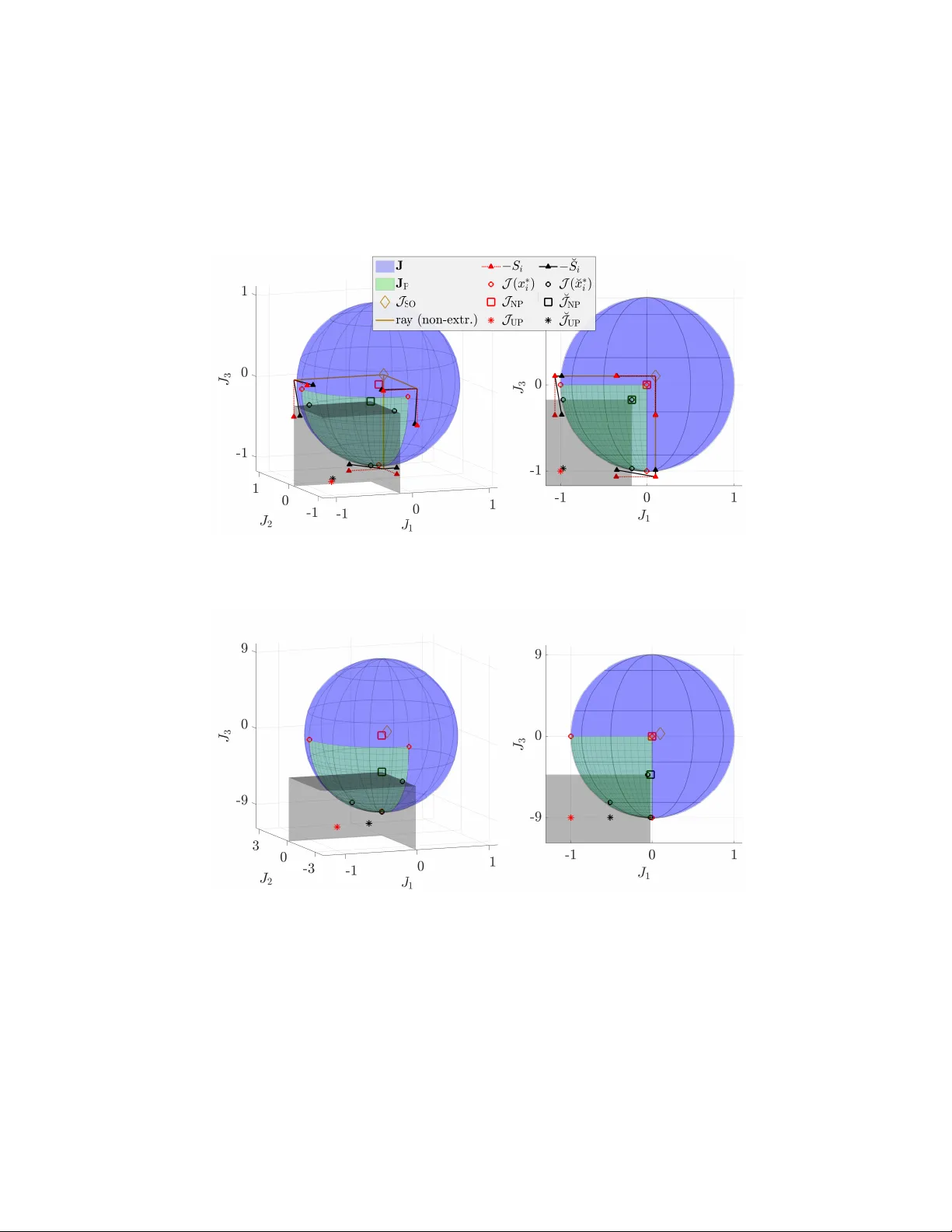
Non-Extreme Individual Minima for Impro v ed P areto F ron t Sampling Efficiency and Decision-Making Markus Herrmann-Wic klmayr Kathrin Flaßk amp Systems Mo deling and Sim ulation, Saarland Universit y , Saarbr ¨ uc ken, German y { markus.herrmannwicklmayr,kathrin.flasskamp } @uni-saarland.de Abstract In m ulti-ob jectiv e optimization, the set of optimal trade- offs—the Pareto fron t—often con tains regions that are extremely steep or flat. The P areto optimal p oints in these regions are typically of limited in terest for decision-making, as the marginal rate of substitution is ex- treme: a marginal improv emen t in one ob jectiv e necessitates a significant deterioration in at least one other ob jective. These unfa v orable trade-offs frequen tly o ccur near the individual minima, where single ob jectives attain their minim um v alues without considering the remaining criteria. T o address this, we prop ose the concept of non-extr eme individual minima that relies on the notion of L -practical prop er efficiency . These p oin ts can serve as a less sensitive replacement for standar d individual minima in subsequent related metho ds. Specifically , they allo w for a more practical restriction of the Pareto front sampling within a refined utopia- nadir hyperb ox, provide a meaningful basis for image space normalization, and can enhance decision-making techniques, such as knee-p oint metho ds, b y fo cusing on regions with acceptable trade-offs. W e pro vide a computationally efficient alg orithm to determine these non- extreme individual minima by solving at most 2 n J standard weigh ted-sum scalarizations, where n J is the num b er of ob jectives. T o ensure robustness across v arying ob jective scales, the metho d incorp orates an in tegrated image space normalization strategy . Numerical examples, sp ecifically a con vex academic case and a non-con v ex real-world application, demonstrate that the metho d successfully excludes practically irrelev ant regions in the image space. Keyw ords: Multi-ob jective optimization · Practical prop er efficiency · Individual minima 1 In tro duction In multi-ob jective optimization problems ( MOOP s), a solution is t ypically se- lected among all optimal trade-offs [ 13 ], i.e. the Pareto optimal p oin ts forming the so-called Pareto fron t ( PF ). This task must b e p erformed either by a h uman decision-mak er or by an automated decision-making sc heme. In b oth cases, it 1 is reasonable to exclude parts of the PF that are e xtremely steep or flat, i.e. parts of the PF are a voided where a minor impro vemen t in one ob jective yields a ma jor deterioration in at least one other comp onent. W e denote the regions of the PF that are extremely steep or flat as pr actic al ly irr elevant . Con ven tionally , the iden tification of r elevant solutions is performed a-posteriori: a h uman decision-mak er lo calizes preferred regions only after a fine and ideally uniform sampling of the PF has b een generated, whic h is a challenging task in itself [ 6 ]. Ho w ever, this man ual procedure is sev erely limited by human p er- ception; once the num ber of ob jectiv es exceeds three, the resulting data p oints b ecome nearly imp ossible to visualize and in terpret. F urthermore, mo dern applications with real-time requirements often preclude h uman in terven tion entirely , making this a-p osteriori approach infeasible even for lo w-dimensional problems. Such scenarios necessitate automated decision- making metho ds. If these methods are guided b y information ab out the individual minima (IMs) [ 16 , 2 , 10 ], it b ecomes particularly reasonable to utilize more robust reference p oin ts. T o address these challenges, w e prop ose an a-priori strategy based on the notion of L -practical proper efficiency . By utilizing what w e denote as non- extr eme IMs, we can delimit the searc h space b efore the full sampling process b egins. The core idea is to sp ecifically target and remov e unpromising regions in the proximit y of the “standard” IMs where the marginal rate of substitution ( MRS ) is excessively high. Since these non-extreme IMs can b e determined efficien tly by solving at most 2 n J w eighted-sum ( WS ) scalarizations, they enable a more fo cused allocation of computational resources by av oiding practically irrelev an t trade-offs from the outset. Bey ond computational efficiency , this approac h provides automated decision-making schemes (as e.g. [ 12 , 14 ]) with less sensitiv e and more represen tativ e reference p oints, whic h ultimately increases the reliability of the resulting selection. The paper is organized as follo ws: In Section 2 w e in troduce the basic notation and definitions of MOOP s. F urthermore, we define the term non-extreme IM . In Section 3 we show an intuitiv e wa y to compute non-extreme IMs. The metho d is then summarized in an algorithm. In Section 4 w e apply the metho d to an exemplary MOOP. Finally , the pap er is concluded in Section 5. Notation. W e denote the standard basis of R n b y { e 1 , . . . , e n } . F or a vector v ∈ R n , the relations v = 0 and v ≥ 0 are to b e understo o d comp onent-wise, i.e., v i = 0 and v i ≥ 0 for all i = 1 , . . . , n . W e use the op erator diag ( v ), whic h returns a diagonal matrix with v on its diagonal and the sign function sign ( x ), defined as sign ( x ) = 1 if x > 0 and sign ( x ) = − 1 otherwise. Bold symbols 0 and 1 denote vectors of zeros and ones, resp ectively , with context-dependent dimensions. 2 Preliminaries W e repeat the problem setting and the c haracterization of imp ortant quantities in MOOPs from [10] in the next tw o subsections. 2 2.1 Problem Statemen t Consider the MOOP min x ∈ X J ( x ) ( P ) with the vector J ( x ) := J 1 ( x ) , . . . , J n J ( x ) ⊺ of n J ob jectiv es J i : X → R , i = 1 , . . . , n J . The set X ⊆ R n x denotes the feasible set; a point x ∈ R n x is feasible if x ∈ X . The v ector-v alued minimization in ( P ) is clarified b y definitions and conv entions adopted from [15]. Definition 1 (Pareto optimalit y , nondominance) . A p oint x ⋆ ∈ X is an efficient or a Pareto optimal solution to the m ulti-ob jectiv e optimization problem ( P ) if there do es not exist an y feasible x ∈ X such that J i ( x ) ≤ J i x ⋆ for all i ∈ { 1 , . . . , n J } and J k ( x ) < J k x ⋆ for at least one k ∈ { 1 , . . . , n J } . The respective image v alue J x ⋆ is called nondominated. The set of all nondom- inated p oints is the nondominated set or P areto fron t J P := J ( x ) x ∈ X P , with the Pareto set X P giv en by X P := arg min x ∈ X J ( x ) = x ∈ X x is a Pareto optimal solution to ( P ) . 2.2 Characteristic Quan tities W e derive characteristic quantities of an MOOP . W e denote by x ∗ i , i = 1 , . . . , n J the individual minima (IMs), i.e. solutions to the single-ob jective optimization problem min x ∈ X J i ( x ) , i = 1 , . . . , n J . Ev aluating the full ob jectiv e vector J at all IM defines the pay-off matrix (see, e.g. [5]) Φ = [ J ( x ∗ 1 ) , . . . , J ( x ∗ n J )]. Definition 2 (Utopia and nadir p oint) . The utopia p oint ( UP ) J UP is defined as the ro w-wise minimum of Φ. W e define the nadir p oint ( NP ) J NP as the ro w-wise maximum of Φ. Note that, in literature, it is sometimes further distinguished b etw een pseudo NPs (as defined in Definition 2) and real NPs [5, Chapter 2.2]. Definition 3 (Normalized image space) . Let C NP , UP denote the p ositive def- inite, diagonal matrix C NP , UP := diag ( J NP − J UP ) − 1 . Then, the op eration ¯ J ( x ) = C NP , UP ( J − J UP ) shifts and scales the image space, such that the PF is contained in the unit b ox (or h yp erb ox) spanned b y the tw o p oints 0 and 1 . W e call this a normalized image space. The bar accen t indicates a quantit y in that normalized image space, e.g. ¯ J UP = 0 and ¯ J NP = 1 are the UP and NP in that normalized space. 3 2.3 Non-Extreme Individual Minima In order to define what we mean b y non-extr eme IMs w e first lo ok at the definition of prop er efficiency: Definition 4 (Prop er efficiency (in the sense of Geoffrion [ 7 ])) . A feasible p oin t x ′ ∈ X is a prop erly efficient solution if it is efficient and if there exists some real n umber M > 0 such that, for each i ∈ { 1 , . . . , n J } and x ∈ X satisfying J i ( x ) < J i ( x ′ ), there exists at least one j ∈ { 1 , . . . , n J } \ i suc h that J j ( x ′ ) < J j ( x ) and J i ( x ′ ) − J i ( x ) J j ( x ) − J j ( x ′ ) ≤ M . W e can illustrate Definition 4 with an exemplary bi-ob jective optimization problem in Figure 1 where we inv estigate the prop er efficiency of the solutions i = 2 ∆ J i = J i ( x ′ ) − J i ( x ) i = 1 J 1 ∆ J j = J j ( x ) − J j ( x ′ ) ∆ J j = J j ( x ) − J j ( x ′ ) ∆ J i = J i ( x ′ ) − J i ( x ) J 2 Figure 1: Ob jective v alue ev aluated at x ′ mark ed with a cross, which w as obtained using the weigh t vector w = ( w 1 , w 2 ) ⊺ , and at x mark ed with a circle. x ′ mark ed with a cross. F or this it is helpful to consider a comparativ e solution x , marked with a circle. In the following we assume that w i > 0 , i ∈ { 1 , . . . , n J } . W e first fix the case where i = 2 (and subsequently j m ust b e 1). F or a conv ex PF as in Figure 1 we know that at the solution J ( x ′ ), that was obtained by solving the WS problem min x ∈ X w ⊺ J , the PF has the slop e m = − w 1 /w 2 . W e notice that with x → x ′ the approximation − w 1 /w 2 = m ≈ − J 2 ( x ′ ) − J 2 ( x ) J 1 ( x ) − J 1 ( x ′ ) =: − ∆ J 2 ∆ J 1 b ecomes exact. W e then obtain w 1 /w 2 = lim x → x ′ ∆ J 2 / ∆ J 1 . In the same wa y , for the case i = 1 (and j = 2), we can derive w 2 /w 1 = lim x → x ′ ∆ J 1 / ∆ J 2 . This limit has a significan t in terpretation in m ulti-ob jectiv e optimization: it represen ts the marginal rate of substitution ( MRS ). The MRS quan tifies the rate at which a decision-mak er is willing to sacrifice an amoun t of ob jectiv e J j to obtain a marginal impro vemen t in ob jective J i while remaining on the PF . In this context, the constan t M in Definition 4 acts as an upp er b ound on the MRS . This means 4 that for b oth cases the solutions x ′ are properly efficient with M = w 1 /w 2 and M = w 2 /w 1 , resp ectiv ely . F or the general n J -dimensional case, it w as prov ed in [8, 11] that J i ( x ′ ) − J i ( x ) J j ( x ) − J j ( x ′ ) ≤ w j w i , i, j ∈ { 1 , . . . , n J } , i = j. Although Definition 4 requires M to b e finite, the v alue for it can still b e arbitrarily high, implying an extreme trade-off where a negligible gain in one ob jectiv e requires a massiv e loss in another. F rom an engineering or economic p ersp ective, solutions with an excessiv ely high MRS are not of practical relev ance. In order to upper b ound the v alue of M and th us the allow able MRS , w e introduce the following definition: Definition 5 ( L -practical prop er efficiency) . A feasible p oin t x ′ ∈ X is a L - practically prop erly efficien t solution if it is prop erly efficient (as defined in Definition 4) with M ≤ L . W e can now define the term non-extreme IM: Definition 6 (Non-extreme individual minim um) . Let L > 0. W e call a L - practically properly efficient solution ˘ x ∗ i a non-extreme IM of the i -th ob jectiv e if there exists no L -practically prop erly efficient solution x ∈ X \ ˘ x ∗ i suc h that J i ( x ) < J i ( ˘ x ∗ i ). Note that w e used a br eve accen t in order to differentiate betw een the standar d IM x ∗ i and the non-extr eme IM ˘ x ∗ i . W e apply this notation to those quan tities that exist in the standard and non-extreme case. An example of this notation is the non-extreme pay-off matrix ˘ Φ := J ˘ x ∗ 1 , . . . , J ˘ x ∗ n J whic h serv es as the basis for deriving further quantities, such as the NP and UP . 2.4 Distance-Based Knee-P oin t Based on the IM and the hyperplane spanned by their conv ex hull, [ 3 ] defines the knee-p oint as the p oin t in the feasible image set J ( X ) that maximizes the distance to this plane. F urthermore, in [4, 3] it was prov ed that the knee-p oint can b e determined using either the WS scalarization with suitable weigh ts. Since the knee-p oin t is a p oint that is furthest to a hyperplane, this w eight vector is the normal vector η of the considered hyperplane. Ho wev er, the normal v ector is only determined up to a non-zero constant. Since w e wan t to a void negative comp onen ts in the weigh t v ector, w e define the following scaling op erator. Definition 7 (Scaling vectors) . Let the scaling op erator scal : R n \ { 0 } 7→ R n b e defined suc h that for an y v ∈ R n \ { 0 } , the output ˜ v = scal ( v ) is the unique v ector ˜ v = cv with c ∈ R \ { 0 } c hosen to satisfy sum ( | ˜ v | ) = 1 and sign ( ˜ v i max ) = − 1, where i max = arg max i | ˜ v i | . 5 Note that if the normal v ector η has comp onen ts with the same sign then the weigh t v ector w knee = scal ( η ) has only non-negativ e comp onents. Similar to w knee based on the standard IM , w e can compute the ˘ w knee based on the non-extreme IMs. 3 Computing Non-Extreme Individual Minima 3.1 General Idea The dev elopmen t of the method starts with recapitulating one approac h to obtain a standar d i -th IM . The approach uses the Pascoletti-Serafini scalarization [ 6 , Chapter 2.1] min x ∈ X , l ∈ R − l s.t. ˆ J SO + l ˆ d − ˜ J ( x ) ∈ K (1) that is parameterized in the sho oting origin ( SO ) ˆ J SO and the sho oting direction v ector ˆ d and for which we choose K = n ν ∈ R n J − 1 − ˆ V ν o and ˜ J ( x ) = ˆ T J ( J ( x ) − ˆ J shift ) . The parameters ˆ T J and ˆ J shift can b e used to effectiv ely transform and shift the image space. By appropriately setting these parameters the image space can b e normalized. In view of the differen t roles of the v ariables in this deriv ation, we adhere to a strict notation conv en tion. While the tilde ( ˜ · ) is used flexibly for general mo difications and transformations, the follo wing three accen ts are reserved for sp ecific con texts: the hat ( ˆ · ) for parameter v ariables, the che ck ( ˇ · ) for their sp ecific realizations, and the br eve ( ˘ · ) for quantities asso ciated with the non-extreme case. Table 1 provides a summary of these conv en tions. Accent Example Reserved meaning / use case hat ˆ p parameter of an optimization problem che ck ˇ p numerical value of a parameter br eve ˘ Φ non-extreme case: quantities related to the non-extreme indi- vidual minima tilde ˜ J general mo difications of a sp ecific quantit y T able 1: Summary of mathematical notation conv en tions and reserved accents. W e solve (1) with the parameter realizations ˇ T J = I n J , ˇ J shift = 0 (3a) ˇ J SO ∈ R n J , ˇ d = − e i , ˇ V = S i := [ e k ] k ∈{ 1 ,...,n J }\ i (3b) 6 J 1 J 2 J 1 J 2 α 2 J P J SO ray J ( x ∗ 1 ) J ( ˘ x ∗ 1 ) Figure 2: First individual minimum: standard approach (left) and non-extreme approac h (righ t). The arrows represent the (elongated) vector S 2 (red) and ˘ S 2 ( α ) (blac k). to obtain the (standard) i -th IM. Equiv alently , we can use the formulation min x ∈ X , l ∈ R , ν ∈ R n J − 1 − l s.t. ˜ J ( x ) = ˆ J SO + l ˆ d + ˆ V ν. ( P PS ( p )) with p = { ˆ J SO , ˆ d, ˆ V , ˆ T J , ˆ J shift , } . The optimization problem ( P PS ( p )) with the parameter realizations (3) can b e understo o d and visualized as follo ws: A h yp erplane, spanned by the column vectors of S i (whic h we refer to as spanning v ectors), is attached at the end of the sho oting ray ˇ J SO − l e i . A feasible ob jective v ector ˜ J ( x ) must then lie on that hyperplane. W e note that ( P PS ( p )) with ˇ d = − e i and ˇ V = S i is formally equiv alent to the WS scalarization 1 min x ∈ X ˆ w ⊺ J ( x ) ( P WS ( ˆ w )) with ˇ w = e i . How ev er, the application of the Pascoletti-Serafini scalarization pro vides a more conv enien t framework for the following deriv ation. Instead of using basis vectors to span the hyperplane, we rotate each basis v ector around a sp ecific axis in a sp ecific direction, see the exemplary rotation of e 2 in Figure 2. The rotated spanning vectors read v ( i ) ( α k ) = R n,m sign( k − i ) α k e k , i ∈ { 1 , . . . , n J } , k ∈ { 1 , . . . , n J } \ i, (4) with n = min { k , i } , m = max { k , i } , α = [ α 1 , . . . , α n J ] and R n,m ( ϕ ) is a Giv ens rotation in the ( n, m )-plane [ 9 , chapter 5.1.8]. The Giv ens rotation R n,m ( ϕ ) is equal to the n J × n J iden tity matrix except that the entries ( n, n ), ( n, m ), ( m, n ) 1 This formulation also covers the case of using ˜ J instead of J : ˆ w ⊺ ˜ J = ˆ w ⊺ ˆ T J ( J − ˆ J shift ) = ˆ T ⊺ J ˆ w | {z } =: ˆ w ′ ⊺ J − ˆ w ⊺ ˆ J shift | {z } = const. 7 and ( m, m ) are ov erwritten with " cos( ϕ ) − sin( ϕ ) sin( ϕ ) cos( ϕ ) # . The spanning vectors of our new hyperplane are concatenated horizontally to form ˘ S i ( α ) = h v ( i ) ( α k ) i k ∈{ 1 ,...,n J }\ i . (5) Note that ˘ S i ( α ) = S i when α = 0. F urthermore, the hyperplane associated with ˘ S i ( α ) has a normal v ector w ( i ) whic h w e can scale such that w ( i ) ≥ 0 and P k w ( i ) k = 1. Cho osing α > 0, we can now obtain the i -th non-extreme IM with ( P PS ( p )) b y setting ˇ J SO ∈ R n J , ˇ d = − e i , ˇ V = ˘ S i ( α ) (6) and the remaining parameters as sho wn (3a) or with ( P WS ( ˆ w )) b y setting ˇ w = w ( i ) . Cho osing α > 0, whic h yields w ( i ) > 0, guaran tees a finite L and th us also a non-extreme IM. T o see the general trend of increasing α comp onen ts w e exemplarily set α = ¯ α , with ¯ α ∈ R > 0 and compute ¯ L := max i ∈{ 1 ,...,n J } max l,m ∈{ 1 ,...,n J } , l = m w ( i ) l /w ( i ) m . (7) As w e can see in Figure 3, with an increasing ¯ α the v alue of ¯ L is strictly decreasing. Figure 3: Finite v alues of ¯ L for non-negative ¯ α . F urthermore, numerical inv estigations show that ¯ L seems to b e inv ariant w.r.t. the num b er of ob jectiv es n J . 8 3.2 Handling Differen t Ob jectiv e Ranges W e apply the metho d to the exemplary three-ob jective optimization problem min x ∈ R 3 J ( x ) = diag ([ l 1 , l 2 , l 3 ]) x s.t. x 2 1 + x 2 2 + x 2 3 ≤ 1 , (8) where the set of feasible ob jectiv es is a non-rotated ellipsoid with the semi-axis lengths [ l 1 , l 2 , l 3 ]. F or our inv estigations we choose α = 10 ◦ . Our first numerical test uses the semi-axis lengths [ l 1 , l 2 , l 3 ] = [1 , 1 , 1] (cf. Fig- ure 4(a)) and we set the parameters as shown in (3a) and (6) . Then, the metho d p erforms “as exp ected” in the sense that the set ˘ J P := n J ∈ J P | J ≤ ˘ J NP o excludes regions of the PF that we regard as practically irrelev an t. How ever, in our second n umerical test with [ l 1 , l 2 , l 3 ] = [1 , 3 , 9] (cf. Figure 4(b)) and the parameter realizations as b efore the metho d fails to only exclude practically irrelev an t regions. T o counteract this effect we can incorp orate information ab out the NP and the UP whic h giv e us v aluable insight ov er the ranges of the ob jectives. By c ho osing the parameter realizations ˇ T J = C NP , UP , ˇ J shift = J UP (9) w e normalize the image space. This idea of normalizing the image space also transfers to ( P WS ( ˆ w )) . Here, we can realize the image space normalization by setting ˇ w = C ⊺ NP , UP w ( i ) = C NP , UP w ( i ) instead of ˇ w = w ( i ) . The effect of the normalization approac h is that (except for the sho oting ra ys and the attached spanning vectors) the numerical results w ould pro duce a figure that looks like Figure 4(a) only that num bers on the J 2 and J 3 axis ha ve c hanged to ± 3 and ± 9. This means that ˘ J P no w contains the desired region of the PF. 3.3 Algorithm W e can combine the previous findings to construct Algorithm 1. Notably , step 0) of this algorithm needs to b e p erformed only once for a fixed α . F urthermore, if the v alues of J NP and J UP are not a v ailable, which is generally the case, step 1) and 2) hav e to b e executed. Then, in total, 2 n J optimization problems hav e to b e solved to determine the non-extreme IMs. Applying Algorithm 1 to MOOP (8) with α = ¯ α , where ¯ α = 0 ◦ , 1 ◦ , . . . , 10 ◦ , yields Figure 5. While NP v alues of non-extreme IMs drop significan tly , the asso ciated UP v alues show only a sligh t increase. This effect yields hypercub es of reduced size whic h allow for a denser sampling of the PF with a fixed n umber of sampling p oints or, alternatively , few er samples for a targeted approximate p oin t density . By omitting practically irrelev ant regions, improv ed resolution or efficiency gains are achiev ed. 9 (a) The semi-axis lengths are [ l 1 , l 2 , l 3 ] = [1 , 1 , 1] and no image space normalization is used. Note that only the ray for the non-extreme case is displa yed. F or comparison, at the end of the rays b oth sets of spanning vectors are “attached”. Due to the symmetry the views in the other tw o planes lo ok the same as the J 1 - J 3 -plane on the right. (b) The semi-axis lengths are [ l 1 , l 2 , l 3 ] = [1 , 3 , 9] and no image space normalization is used. F or reasons of a cleaner visual presentation, we refrain from displaying the spanning v ectors and the sho oting rays. Figure 4: Results for the m ulti-ob jectiv e optimization problem (8). 10 Algorithm 1 Non-Extreme Individual Minima 0) Use α to compute ˘ S i ( α ), i ∈ { 1 , . . . , n J } . Then, compute w ( i ) as the normal v ector of the h yp erplane spanned b y the column vectors of ˘ S i ( α ) as defined in (5) and (4) (and scale it as describ ed in Definition 7). 1) Solve ( P WS ( ˆ w )) with ˇ w = e i for all i ∈ { 1 , . . . , n J } and compute Φ. 2) Derive J NP , J UP and C NP , UP from Φ. 3) Solv e ( P WS ( ˆ w )) with ˇ w = C NP , UP w ( i ) for all i ∈ { 1 , . . . , n J } and compute ˘ Φ. 4 Numerical Example As our numerical example we consider the PF of “Figure 6.” from [ 10 ]. This reference describ es in detail how the MOOP , which implemen ts a nonlinear he ating, ventilation and air c onditioning control problem and yields the PF depicted in Figure 6 (left), is constructed. W e c ho ose this sp ecific PF b ecause i) it constitutes a non-academic example and ii) it has a large region where it is either extremely flat or steep. W e set α = 3 ◦ whic h results in L = ¯ L < 20 (cf. (7) ) for the non-extreme IMs (cf. Figure 3). W e then compute the standard IMs and the non-extreme IMs as describ ed in Algorithm 1. Both resulting sets of p oints can b e seen in Figure 6. As can b e concluded from the closeness of ˘ J UP to J UP only extreme trade-off solutions are excluded. This is supp orted by the fact that Figure 6 (righ t) has no regions that are extremely flat or steep. W e note that from all 1520 PF samples shown in Figure 6 (left) only 186 are con tained in the b o x spanned by ˘ J NP and ˘ J UP . This means that, since sampling practically irrelev ant p oints on the PF pro vides no added v alue to the decision- mak er, more than 87% of the optimizations represented a superfluous expenditure of time and resources that our metho d successfully eliminates. F urthermore, for Figure 6, the knee-points based on the standard and non-extreme IMs w ere computed. This requires the normal v ector of the conv ex hull of the IMs and non-extreme IMs, which are w knee = [ − 0 . 0239 , 0 . 9673 , − 0 . 0088] ⊺ and ˘ w knee = [0 . 0306 , 0 . 9527 , 0 . 0167] ⊺ , resp ectiv ely . Note that w knee con tains negativ e comp onen ts. This leads to t wo critical issues: first, the theoretical guarantee of obtaining a Pareto optimal solution is lost; second, and more imp ortantly , the scalarization effectively rewards increases in cost for ob jectives asso ciated with negative weigh ts, contradicting the fundamen tal goal of minimization. Consequen tly , the resulting p oint J knee = 10 3 · [2 . 9783 , 0 . 0036 , 3 . 1886] ⊺ is a dominated p oin t lo cated on the b oundary of the feasible image set J ( X ) and is outside the axis interv als of Figure 6. Enforcing a lo wer b ound of zero on the w eight components as a “safet y la y er” w ould, in this example, lead to the reco very 11 Figure 5: The colored mark ers are related to the non-extreme IMs (with α = ¯ α ): dots represen t the non-extreme IMs, while diamonds and squares represent the corresp onding NPs and UPs, resp ectively . of the second IM . Ho wev er, such a solution contradicts the fundamental concept of a knee p oint, which is intended to represen t a balanced compromise rather than an extreme b oundary solution. In contrast, the solution ˘ J knee obtained b y using the weigh t ˘ w knee (constructed from the non-extreme IMs) constitutes a balanced trade-off. 5 Conclusion and Outlo ok In this pap er, we introduced the concept of non-extreme individual minima as a means to exclude practically irrelev an t regions of the Pareto front. By lev eraging the definition of L -practical prop er efficiency , w e deriv ed a metho d to exclude solution candidates that represent unreasonable trade-offs. The prop osed algorithm is straightforw ard to implement, relying solely on w eighted-sum scalarizations with mo dified weigh t vectors obtained via geometric rotations. W e demonstrated that integrating information ab out the utopia p oin t and the nadir p oint to normalize the image space is crucial for the metho d’s robustness against differing ob jective ranges. The n umerical results confirm that the computed non-extreme individual minim um effectively bound the area of in terest, excluding extremely steep or flat parts of the front. This b ounding b ox allo ws subsequent m ulti-ob jective optimization metho ds or automated decision- making schemes to fo cus their computational effort on the most promising trade-offs. F uture w ork could ev aluate the influence of this approach on algorithms that rely on automated decision-making. A prime example of this is the P areto 12 Figure 6: PF reconstruction using the PF samples and the ball-piv oting algo- rithm [ 1 ]. The right plot shows a segmen t of the PF that does not contain practically irrelev an t regions. Both figures use an equal plot b ox asp ect ratio whic h has a similar visual effect as normalizing the image space and allows for a fair comparison of b oth PF regions. fron t from [ 10 ] shown in Figure 6, whic h arises during the first iteration of an m ulti-ob jectiv e mo del predictiv e control sc heme. References [1] F. Bernardini, J. Mittleman, H. Rushmeie r, C. Silv a, and G. T aubin. The Ball-Piv oting Algorithm for Surface Reconstruction. IEEE T r ansactions on Visualization and Computer Gr aphics , 5(4):349–359, Octob er 1999. ISSN 1077-2626. URL https://doi.org/10.1109/2945.817351 . [2] W ei-Y u Chiu, Gary G. Y en, and T eng-Kuei Juan. Minimum Manhat- tan Distance Approac h to Multiple Criteria Decision Making in Multi- ob jectiv e Optimization Problems. IEEE T r ansactions on Evolutionary Computation , 20(6):972–985, Decem b er 2016. ISSN 1941-0026. URL https://doi.org/10.1109/TEVC.2016.2564158 . [3] I. Das. On characterizing the “knee” of the Pareto curve based on Normal- Boundary In tersection. Structur al optimization , 18(2):107–115, October 1999. ISSN 1615-1488. URL https://doi.org/10.1007/BF01195985 . [4] Indraneel Das and J. E. Dennis. Normal-Boundary Intersection: A New Metho d for Generating the Pareto Surface in Nonlinear Mul- ticriteria Optimization Problems. SIAM Journal on Optimization , 13 8(3):631–657, August 1998. ISSN 1052-6234, 1095-7189. URL https://doi.org/10.1137/S1052623496307510 . [5] Matthias Ehrgott. Multicriteria Optimization . Springer, Berlin, 2nd ed edition, 2005. ISBN 978-3-540-21398-7. URL https://doi.org/10.1007/3- 540- 27659- 9 . [6] Gabriele Eichfelder. A daptive Sc alarization Metho ds in Multi- obje ctive Optimization . V ector Optimization. Springer Berlin, Berlin Heidelb erg, 2008. ISBN 978-3-540-79157-7. URL https://doi.org/10.1007/978- 3- 540- 79159- 1 . [7] Arth ur M Geoffrion. Prop er Efficiency and the Theory of V ec- tor Maximization. Journal of Mathematic al Analysis and Ap- plic ations , 22(3):618–630, June 1968. ISSN 0022-247X. URL https://doi.org/10.1016/0022- 247X(68)90201- 1 . [8] J. C. Geromel and P . A. V alente F erreira. An upp er b ound on prop erly efficien t solutions in multiob jective optimization. Op er ations R ese ar ch L etters , 10(2):83–86, March 1991. ISSN 0167-6377. URL https://doi.org/10.1016/0167- 6377(91)90091- 3 . [9] Gene H. Golub and Charles F. V an Loan. Matrix Computations . Johns Hopkins studies in the mathematical sciences. Johns Hopkins Universit y Press, Baltimore, 3rd ed edition, 1996. ISBN 978-0-8018-5413-2 978-0-8018- 5414-9. URL https://doi.org/10.56021/9781421407944 . [10] Markus Herrmann-Wic klmayr and Kathrin Flaßk amp. Individual Minima- Informed Multi-Ob jective Mo del Predictive Control for Fixed P oint Stabi- lization, Octob er 2025. URL . [11] Masoud Karimi and Balal Karimi. Linear and conic scalarizations for obtain- ing prop erly efficient solutions in multiob jective optimization. Mathematic al Scienc es , 11(4):319–325, December 2017. ISSN 2008-1359, 2251-7456. URL https://doi.org/10.1007/s40096- 017- 0234- 0 . [12] W enh ua Li, Guo Zhang, T ao Zhang, and Sheng jun Huang. Knee P oin t- Guided Multiob jectiv e Optimization Algorithm for Microgrid Dynamic Energy Management. Complexity , 2020:1–11, Nov em ber 2020. ISSN 1099- 0526, 1076-2787. URL https://doi.org/10.1155/2020/8877008 . [13] Bernard Roy . Multicriteria Metho dolo gy for De cision Aiding , vol- ume 12 of Nonc onvex Optimization and Its Applic ations . Springer US, Boston, MA, 1996. ISBN 978-1-4419-4761-1 978-1-4757-2500-1. URL https://doi.org/10.1007/978- 1- 4757- 2500- 1 . [14] Thomas Schmitt, Matthias Hoffmann, T obias Ro demann, and J ¨ urgen Adam y . Incorp orating Human Preferences in Decision Making for 14 Dynamic Multi-Ob jectiv e Optimization in Model Predictiv e Con- trol. Inventions , 7(3):46, June 2022. ISSN 2411-5134. URL https://doi.org/10.3390/inventions7030046 . [15] Marleen Stieler. Performanc e Estimates for Sc alar and Multiobje ctive Mo del Pr e dictive Contr ol Schemes . PhD thesis, March 2018. URL https://nbn- resolving.org/urn:nbn:de:bvb:703- epub- 3783- 4 . [16] Victor M. Za v ala and Antonio Flores-Tlacuahuac. Stability of mul- tiob jectiv e predictiv e control: A utopia-trac king approac h. A uto- matic a , 48(10):2627–2632, Octob er 2012. ISSN 00051098. URL https://doi.org/10.1016/j.automatica.2012.06.066 . 15
Original Paper
Loading high-quality paper...
Comments & Academic Discussion
Loading comments...
Leave a Comment