The perturbation threshold of degenerate graphs
We show that for any $d\ge 2$ and $Δ>0$ there exists $η>0$ such that the following holds: Let $G$ be an $n$-vertex graph with at least $Ω(n^2)$ edges and let $H$ be an $n$-vertex $d$-degenerate graph with maximum degree at most $Δ$. Then with high pr…
Authors: Jie Han, Seonghyuk Im, Bin Wang
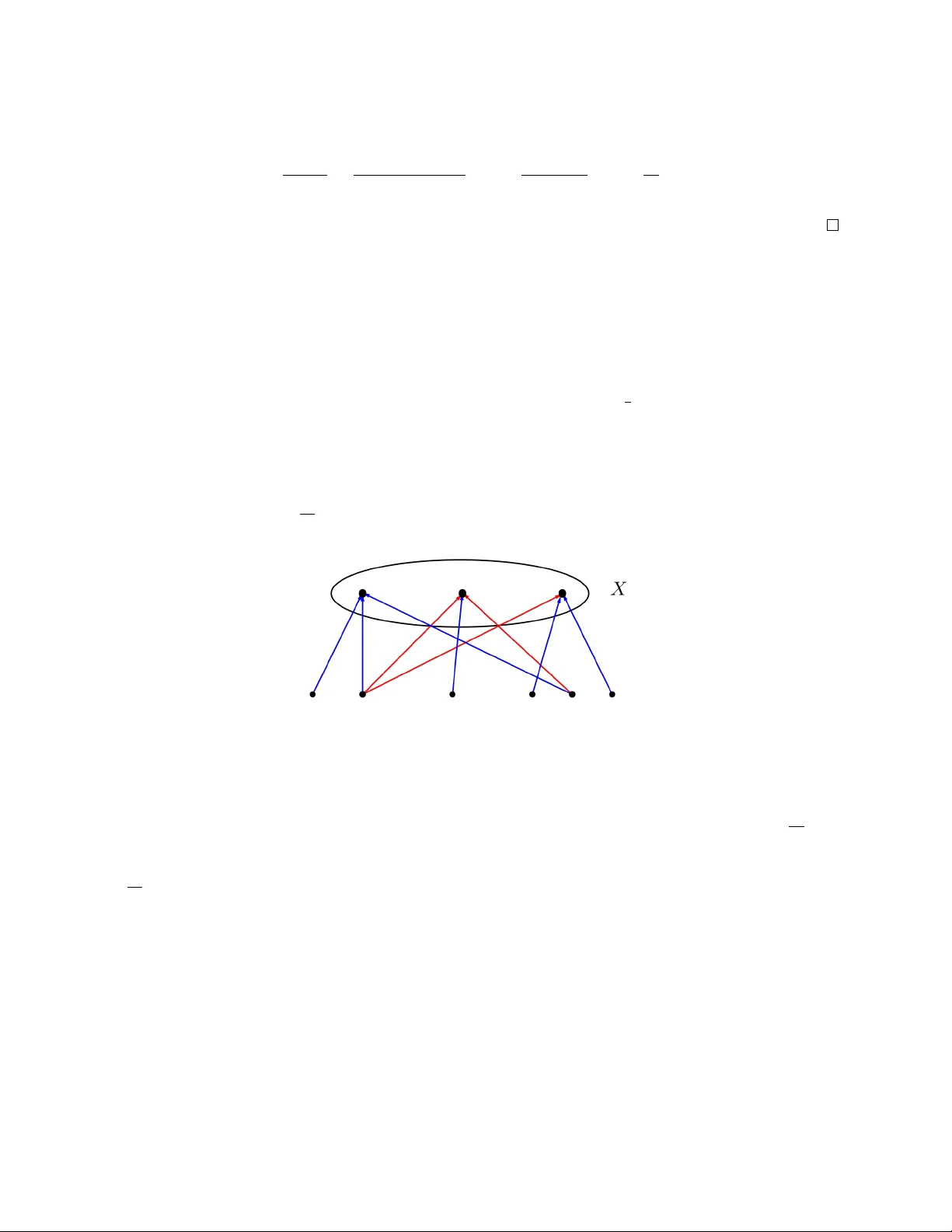
The p erturbation threshold of degenerate graphs Jie Han a , Seongh yuk Im b c , Bin W ang a , and Junxue Zhang a a Sc ho ol of Mathematics and Statistics, Beijing Institute of T ec hnology , China b Departmen t of Mathematical Science, KAIST, South Korea c Extremal Combinatorics and Probability Group (ECOPRO), Institute for Basic Science (IBS), South K orea han.jie@bit.edu.cn, seonghyuk@k aist.ac.kr, bin.wang@bit.edu.cn, jxuezhang@163.com Abstract W e sho w that for an y d ≥ 2 and ∆ > 0 there exists η > 0 such that the following holds: Let G b e an n -vertex graph with at least Ω( n 2 ) edges and let H b e an n -vertex d -degenerate graph with maximum degree at most ∆ . Then with high probability , G ∪ G ( n, n − 1 /d − η ) contains a cop y of H . W e also prov e that the same conclusion extends to d -regular graphs with d ≥ 4 satisfying a certain edge expansion prop ert y , with the threshold improv ed to n − 2 /d − η . Suc h a prop ert y is satisfied by almost all d -regular graphs and for even d , by the ( d/ 2) -th p ow er of a Hamilton cycle. 1 In tro duction A binomial random graph or Erdős–Rén yi graph G ( n, p ) is a graph on the v ertex set [ n ] := { 1 , 2 , . . . , n } where eac h pair of vertices forms an edge indep enden tly with probability p . A cen tral topic in random graph theory is the study of thresholds for graph properties, defined as criti- cal probabilities at whic h a random graph t ypically acquires a giv en prop ert y . F ormally , given a graph property P , w e sa y that G ( n, p ) has the prop ert y P with high probabilit y (w.h.p.) if lim n →∞ P [ G ( n, p ) ∈ P ] = 1 . A function ˆ p : N → [0 , 1] is called a thr eshold for the prop ert y P if w.h.p. G ( n, p ) has the prop ert y P when p = ω ( ˆ p ) and w.h.p. G ( n, p ) do es not ha v e the prop ert y P when p = o ( ˆ p ) . A classical result of Bollobás and Thomason [ 6 ] establishes that ev ery monotone prop ert y admits a threshold. In particular, the prop ert y of containing a sp ecific spanning subgraph H is monotone and therefore has a threshold. A notable example is a result of Erdős and Rén yi [ 13 ], who prov ed that the threshold for the existence of a p erfect matching in G ( n, p ) is log n n . This spurred extensiv e researc h in to determining thresholds for the con tainmen t of v arious fixed spanning structures in G ( n, p ) . 1 1.1 Randomly p erturb ed graphs Bohman, F rieze, and Martin [ 4 ] introduced the mo del of r andomly p erturb e d gr aphs G ∪ G ( n, p ) , defined as the union of a deterministic graph G and a binomial random graph G ( n, p ) on the same v ertex set V ( G ) . Let α > 0 b e a constan t and let G α b e an n -vertex graph with minimum degree at least αn . Bohman, F rieze, and Martin [ 4 ] prov ed that for every α > 0 , there exists C = C ( α ) > 0 suc h that if p = C /n , then for an y graph G α , w.h.p. G α ∪ G ( n, p ) is Hamiltonian. Note that the threshold for Hamiltonicit y in G ( n, p ) alone is log n n ; th us, the addition of the edges in G α significan tly reduces the required edge probability . This reduced probabilit y is called the p erturb ation thr eshold for the graph prop ert y . This result initiated a broad line of researc h on v arious spanning structures in randomly perturb ed graphs, such as b ounded degree spanning trees, p o w ers of Hamilton cycles and so on [ 1 , 2 , 3 , 7 , 8 , 12 , 16 , 18 , 20 ]. In 2020, Böttcher, Mon tgomery , Parczyk, and Per son [ 8 ] prov ed a result on em b edding general b ounded degree graphs in randomly p erturb ed graphs. They prov ed that for every ∆ ≥ 5 , if H is an n -v ertex graph with maximum degree at most ∆ , then for an y α > 0 , there exists a constan t C = C ( α, ∆) suc h that w.h.p. G α ∪ G ( n, C n − 2 ∆+1 ) contains a cop y of H . Again, the edge probability n − 2 ∆+1 is significan tly smaller than the threshold in G ( n, p ) alone, whic h is n − 2 ∆+1 (log n ) − 2 ∆(∆+1) , as pro v ed b y F rankston, Kahn, Nara y anan, and P ark [ 14 ]. Another commonly studied family of sparse graphs is the family of d -degenerate graphs. Note that K 1 ,n − 1 is 1 -degenerate but it is unlikely to exist in G α ∪ G ( n, p ) unless p is close to 1 . Thus, it is natural to consider d -degenerate graphs with additional maximum degree conditions. F or the case when d = 1 , i.e., b ounded degree forests, Kriv elevic h, K w an, and Sudako v [ 20 ] prov ed that for an y α > 0 and ∆ ≥ 2 , there exists C = C ( α, ∆) such that for ev ery n -vertex tree T with ∆( T ) ≤ ∆ , w.h.p. G α ∪ G ( n, C /n ) contains a copy of T . This was extended by Böttc her, Han, Koha y ak a wa, Mon tgomery , Parczyk, and Person [ 7 ], who pro v ed that w.h.p. G α ∪ G ( n, C /n ) con tains all b ounded degree n -vertex trees simultaneously . Our first main theorem shows that for an y d ≥ 2 , the threshold for b ounded degree d -degenerate graphs in randomly p erturb ed graphs is p olynomially smaller than n − 1 /d , which is the threshold in G ( n, p ) alone (shown by Riordan [ 22 ] for d ≥ 3 and b y Chen, Han, and Luo [ 10 ] for d = 2 ). Theorem 1.1. F or every inte ger d ≥ 2 and c onstants ε, ∆ > 0 , ther e exists η > 0 such that the fol lowing holds. If G is an n -vertex gr aph with at le ast εn 2 e dges and H is an n -vertex d -de gener ate gr aph with maximum de gr e e at most ∆ , then w.h.p. G ∪ G ( n, n − 1 d − η ) c ontains a c opy of H . W e note that in this theorem, w e only require that the base graph G has at least Ω( n 2 ) edges instead of a linear minim um degree condition. This aligns with the recent results by the authors [ 15 ], whic h replaces the minimum degree condition on G with a muc h weak er density condition for em- b edding K r -factors, p o wers of Hamilton cycles, and bounded degree graphs in randomly p erturbed graphs. 2 Our second main theorem considers a family of d -regular graphs with certain expansion property . Note that a K d +1 -factor is a d -regular graph and its threshold in randomly p erturb ed graphs is n − 2 / ( d +1) , as sho wn in [ 2 ]. W e impro ve this b ound when H is far from being a disjoin t union of K d +1 ’s in the sense that it has a “go o d” edge-connectivity prop ert y . F or a set X ⊆ V ( H ) , we denote b y ∂ ( X ) the set of edges with exactly one endp oin t in X . Theorem 1.2. F or every inte ger d ≥ 3 and c onstants 0 < ε, γ ≤ 1 / 2 , ther e exists a c onstant η > 0 such that the fol lowing holds for sufficiently lar ge n . L et H b e an n -vertex d -r e gular gr aph satisfying | ∂ ( X ) | ≥ d + 1 for every X ⊆ V ( H ) with 2 ≤ | X | ≤ γ n . Then for any n -vertex gr aph G with at le ast εn 2 e dges, w.h.p. G ∪ G ( n, n − 2 d − η ) c ontains a c opy of H . It is sho wn in [ 10 ] that the threshold of suc h graphs H is n − 2 /d , and in a recent pap er, Zh uk o vskii [ 23 ] determined the sharp threshold for most of such H , which is (1 + o (1))( e/n ) 2 /d . Therefore, similar to Theorem 1.1 , Theorem 1.2 sho ws a saving of a p olynomial factor on the p erturbation threshold for this family of graphs. W e note that the assumption | ∂ ( X ) | ≥ d + 1 in Theorem 1.2 is sharp. Indeed, for d ≥ 3 and n ∈ d N , consider the follo wing construction given in [ 10 ]. Let H b e a d -regular graph obtained by taking n/d disjoin t copies of K d . Partition eac h clique into sets A i , B i of sizes ⌈ d/ 2 ⌉ and ⌊ d/ 2 ⌋ . A dd a p erfect matc hing b et ween A i and A i +1 for o dd i ∈ [ n/d − 1] , and b et w een B i and B i +1 for ev en i ∈ [ n/d − 1] . If n/d is even, then add a p erfect matching betw een B n/d and B 1 ; if n/d is o dd, then add one b et ween A n/d and B 1 . (When d is o dd, n/d is ev en by the handshaking lemma.) It is readily c hec ked that | ∂ ( X ) | ≥ d for every X ⊆ V ( H ) with 2 ≤ | X | ≤ n/ 2 . Ho w ev er, the p erturbation threshold of H is at least that of a K d -factor, whic h b y Balogh, T reglown and W agner [ 2 ] is n − 2 /d , and in constrast, the threshold of H is at most n − 2 /d log n . Consequently , the saving for suc h H is at most logarithmic, not polynomial. W e also present tw o applications of Theorem 1.2 . The first result states that for almost all d -regular graphs with d ≥ 4 , the condition in Theorem 1.2 is satisfied; th us, a typical d -regular graph is m uc h easier to embed in randomly p erturb ed graphs than the K d +1 -factor. Corollary 1.3. L et d ≥ 4 b e a fixe d inte ger. Then ther e exists a c onstant η > 0 such that the fol lowing holds for sufficiently lar ge n . F or almost al l n -vertex d -r e gular gr aphs H and any n -vertex gr aph G with at le ast εn 2 e dges, w.h.p. G ∪ G ( n, n − 2 d − η ) c ontains a c opy of H . This follows from [ 5 , Theorem 7.32], whic h implies that w.h.p. a random d -regular graph has an edge-cut of size at most d only when one side of the cut is a singleton. W e prov e this formally in Section 4.2 . W e also note that when d = 3 , with probabilit y Ω(1) , a random 3 -regular graph con tains a triangle, and thus there exists a set X of three vertices with | ∂ ( X ) | = 3 . Another notable family of graphs satisfying the condition in Theorem 1.2 is the d -th p o w er of a Hamilton cycle. The d -th p ower of a Hamilton cy cle is the graph obtained from a Hamilton cycle C n b y adding an edge b etw een every pair of v ertices whose distance along C n is at most d . Böttc her, 3 Mon tgomery , P arczyk, and Person [ 8 ] pro v ed that for ev ery d ≥ 2 and α > 0 , there exists a constant η = η ( α, d ) such that w.h.p. G α ∪ G ( n, n − 1 /d − η ) contains the d -th p o wer of a Hamilton cycle. The minim um degree condition on G α w as recently relaxed to a densit y condition b y the authors [ 15 ]. Theorem 1.2 reco v ers both results. Corollary 1.4. F or every inte ger d ≥ 2 and c onstant ε > 0 , ther e exists a c onstant η > 0 such that the fol lowing holds. F or any n -vertex gr aph G with at le ast εn 2 e dges, w.h.p. G ∪ G ( n, n − 1 d − η ) c ontains the d -th p ower of a Hamilton cycle. One common feature of Theorems 1.1 and 1.2 is that both the p erturbation thresholds enjo y a saving of a polynomial factor in n , in con trast to most other results on perturbation thresholds where the sa ving is a p oly-logarithmic factor. W e no w presen t the main technical theorem that we use to deriv e both Theorems 1.1 and 1.2 . Before stating our technical theorem, we in tro duce some notation. F or a digraph D and a v ertex v ∈ V ( D ) , let N + D ( v ) = { u ∈ V ( D ) \ { v } : ( v , u ) is an arc in D } be the out-neighb orho o d of v in D . This concept extends to any v ertex set W ⊆ V ( D ) b y defining N + ( W ) = S w ∈ W N + ( w ) \ W . F or a vertex v ∈ V ( D ) , the p -out-b al l B + p D ( v ) of v is the set of v ertices reac hable from v b y a directed path of length at most p , including v itself. W e omit the subscript D when it is clear from the context. Giv en a graph F , let v F and e F denote the num b er of vertices and edges of F , resp ectively . If F has at least tw o vertices, its 1- density is defined as m 1 ( F ) := max { d ( F ′ ) : F ′ ⊆ F , v F ′ ≥ 2 } , where d ( F ′ ) := e F ′ v F ′ − 1 . W e use ≪ to denote a hierarc h y b et w een constan ts. If w e write that a statement holds whenev er 0 < a ≪ b, c ≪ d , then it means that there exist non-decreasing functions g 1 , g 2 : (0 , 1] → (0 , 1] and f : (0 , 1] 2 → (0 , 1] suc h that the statemen t holds for all a, b, c, d satisfying b ≤ g 1 ( d ) , c ≤ g 2 ( d ) , and a ≤ f ( b, c ) . W e will not explicitly comput e these functions to a void cluttering the presentation of the pro ofs. With these definitions, we can now state our main tec hnical result. Theorem 1.5. L et d > 1 b e a r e al numb er. Supp ose 1 /n ≪ η ≪ ε ′ ≪ 1 /K ≪ ε, 1 /d, 1 / ∆ . L et H b e an n -vertex gr aph with ∆( H ) ≤ ∆ and let D b e an acyclic orientation of H . L et V ′ := { v ∈ V ( H ) : | B + K D ( v ) | ≥ K / 2 } . Supp ose that every sub gr aph H ′ of H of or der m satisfies the fol lowing: (1) If m > K/ 2 , then d ( H ′ ) ≤ d − ε ′ or ther e exists v ∈ V ( H ′ ) ∩ V ′ with E ( D [ B +( K +1) ( v )]) ⊆ E ( H ′ ) . (2) If m ≤ K/ 2 , then e H ′ ≤ d ( m − 1) − 1 / 2 . If G is an n -vertex gr aph with at le ast εn 2 e dges and p = n − 1 d − η , then w.h.p. G ∪ G ( n, p ) c ontains a c opy of H . F or an n -v ertex d -degenerate graph H , we hav e m 1 ( H ) ≤ d − o n (1) , and its threshold (in G ( n, p ) ) is equal to n − 1 /d ≍ n − 1 /m 1 ( H ) . Indeed, the celebrated result of F rankston, Kahn, Nara y anan and 4 P ark [ 14 ] indeed gives that the threshold of any graph H is at most n − 1 /m 1 ( H ) log n , whic h mak es n − 1 /m 1 ( H ) a natural target for the H -containmen t prop ert y for man y graphs H . F or the randomly p erturbed mo del, given that ∆( H ) ≤ ∆ , it is clear that the deterministic graph G with density ε (or minimum degree εn ) ma y contribute at most o ( n ) edges to a copy of H in G ∪ G ( n, p ) . Therefore, one must em b ed a subgraph H ∗ of H to G ( n, p ) with e H ∗ = e ( H ) − o ( n ) . It implies that the p erturbation threshold of H is upp er b ounded by the threshold of H ∗ , which in turn is upp er b ounded b y n − 1 /m 1 ( H ∗ ) . Th us, roughly sp eaking, to ha v e a p olynomial-sa ving on the p erturbation threshold of H , w e need to ha v e m 1 ( H ∗ ) ≤ m 1 ( H ) − ε for some absolute ε > 0 . This suggests a pro of strategy: in the pro of, we would lik e to choose H ∗ (equiv alen tly , to c ho ose the edges to b e co v ered in G ) so that every induced subgraph of H ∗ has densit y at most m 1 ( H ) − ε . F or large subgraphs, this is achiev ed b y removing some edges of H from it; for small subgraphs (of constan t order), as we only remo v e o ( n ) edges from H , they must hav e densit y at most m 1 ( H ) − ε in H by themselves. The assumptions (1) and (2) in Theorem 1.5 pro vide a sufficien t condition: if i) every large subgraph of H m ust either ha v e a low er density or completely con tain an (out)- K -ball, ii) ev ery small subgraph has a strictly low er density , then the p olynomial-saving on the p erturbation threshold is guaranteed. In view of the ab o ve discussion, (2) is essentially necessary while it is not clear to us whether (1) is necessary for the p olynomial-sa ving. The rest of this pap er is structured as follo ws. Section 2 introduces our notation for digraphs and preliminary results on spreadness. Section 3 presen ts the proof of our main framew ork, Theorem 1.5 . The applications of this framework are then developed in Section 4.1 , where w e prov e Theorem 1.1 for degenerate graphs and Theorem 1.2 for regular graphs. Corollaries 1.3 and 1.4 , whic h follo w from Theorem 1.2 , are stated in Section 4.2 . 2 Notation and Preliminaries 2.1 Basic notation Giv en a graph F , let v F and e F denote the n umber of vertices and edges of F , resp ectiv ely . The e dge cut of F asso ciated with X ⊆ V ( F ) , denoted b y ∂ ( X ) , is the set of edges with one end in X and the other in V ( F ) \ X . F or t w o subsets X , Y ⊆ V ( F ) , w e define E ( X ) as the set of edges with b oth ends in X and E ( X, Y ) as the set of edges with one end in X and the other in Y . A digraph D consists of a non-empt y finite set V ( D ) of elemen ts called vertic es and a finite set A ( D ) of ordered pairs of distinct v ertices called ar cs . The or der ( size ) of D is the num b er of vertices (arcs) in D . The order of D will sometimes b e denoted by | D | . Denote the edge set 5 of the underlying graph of D by E ( D ) . F or a subset S ⊆ A ( D ) , let D \ S denote the digraph obtained from D by deleting all arcs in S . Denote by D [ S ] the ar c-induc e d sub digr aph with arc set S and vertex set consisting of all vertices incident with arcs in S . F or a vert ex v in D , N + D ( v ) = { u ∈ V ( D ) \ { v } : ( v , u ) ∈ A ( D ) } , N − D ( v ) = { w ∈ V ( D ) \ { v } : ( w , v ) ∈ A ( D ) } . The sets N + D ( v ) , N − D ( v ) are called the out-neighb orho o d , in-neighb orho o d of v , resp ectiv ely . W e call the v ertices in N + D ( v ) , N − D ( v ) the out-neighb ors , in-neighb ors of v . F or an y subset X of V ( D ) , let N + D ( v , X ) ( N − D ( v , X ) ) denote the out-neighbors (in-neighbors) of v in X . F or a set W ⊆ V ( D ) , let N + D ( W ) = S w ∈ W N + D ( w ) \ W and N − D ( W ) = S w ∈ W N − D ( w ) \ W . A walk in D is an alternating sequence W = x 1 a 1 x 2 a 2 x 3 · · · x k − 1 a k − 1 x k of vertices x i and arcs a j from D such that a i = ( x i , x i +1 ) . If the vertices and arcs are distinct, then W is a p ath . F urthermore, if x 1 = x k , then W is a cycle . The length of a walk is the num b er of its arcs. The distanc e betw een x and y , denoted by dist ( x, y ) , is the minim um length of an ( x, y ) -w alk. A digraph is called acyclic if it has no cycle. An oriente d graph is a digraph with no cycles of length t w o. A digraph D is called an orientation of graph H if it is obtained from H by replacing each edge { x, y } of H b y ( x, y ) or ( y , x ) . A set Q of v ertices in a digraph D is indep endent if A ( D [ Q ]) = ∅ . 2.2 Spreadness The follo wing notion of spreadness has pla y ed a critical role in the recent celebrated results on the fractional exp ectation thresholds by F rankston, Kahn, Nara yanan and Park [ 14 ]. A hyp er gr aph H consists of a vertex set V ( H ) and edge set E ( H ) ⊆ 2 V ( H ) . Definition 2.1 (Spread) . L et q ∈ [0 , 1] and r ∈ N . Assume that H is a hyp er gr aph on the vertex set V and µ is a pr ob ability me asur e on the e dge set of H . W e say that µ is q - spr ead if for every S ⊆ V , the fol lowing holds: µ ( { A ∈ E ( H ) : S ⊆ A } ) ≤ q | S | . F rankston, Kahn, Nara yanan and Park [ 14 ] established a connection b et ween spreadness and the threshold in random graphs. W e use V p to denote a subset of V where each x ∈ V is included indep enden tly with probability p . Prop osition 2.2. ([ 14 ], Theorem 1.6) L et H b e an r -b ounde d hyp er gr aph on vertex set V that supp orts a q -spr e ad distribution. If p ≥ K q log r , then with pr ob ability 1 − o r (1) , the r andom subset V p c ontains an e dge of H . Pham, Sah, Sawhney and Simkin [ 21 ] in tro duced a notion of vertex-spreadness, and Kelly , Müy esser and P okro vskiy [ 19 ] put it in a general setting. Definition 2.3 (V ertex-spread) . L et X and Y b e finite sets and let µ b e a pr ob ability distribution over inje ctions ψ : X → Y . F or q ∈ [0 , 1] , we say that µ is a q - v er tex - spread if for every s ≤ | X | 6 and every two se quenc es of distinct vertic es x 1 , . . . , x s ∈ X and y 1 , . . . , y s ∈ Y , µ ( { φ : φ ( x i ) = y i for all i ∈ [ s ] } ) ≤ q s . A hyp er gr aph emb e dding ψ : G → H of a hypergraph G in to a hypergraph H is an injectiv e map ψ : V ( G ) → V ( H ) that maps edges of G to edges of H , so there is an embedding of G into H if and only if H con tains a subgraph isomorphic to G . Note that when H is a complete hypergraph, and G and H hav e the same vertex set, the uniformly random embedding ψ : G → H is a p erm utation of V ( H ) , which is e/v H -v ertex-spread (by Stirling appro ximation). The follo wing result allo ws us to connect spreadness and vertex-spreadness. Prop osition 2.4. ([ 19 ], Proposition 1.17) F or every k, ∆ ∈ N and C > 0 , ther e exists a c onstant C 2 . 4 > 0 such that the fol lowing holds for sufficiently lar ge n . L et H and G b e n -vertex k -gr aphs. If ther e is a ( C /n ) -vertex-spr e ad distribution on emb e ddings G → H and ∆( G ) ≤ ∆ , then ther e is a ( C 2 . 4 /n 1 /m 1 ( G ) ) -spr e ad distribution on sub gr aphs of H which ar e isomorphic to G . F urthermore, com bined with Prop osition 2.2 , it giv es an upp er b ound n − 1 /m 1 ( G ) log n for the threshold of G . 3 Pro of of Theorem 1.5 Our pro of of Theorem 1.5 is divided in to the follo wing t w o steps. Step 1. Let D be an orien tation of H satisfing the assumption of Theorem 1.5 . Then there is an indep enden t set X of size o ( n ) suc h that the 1 -denstity of the subgraph of H obtained b y deleting a set of vertex-disjoin t in-stars with centers in X is at most d − Ω(1) (see Lemma 3.1 ). Step 2. If there exists suc h an indep enden t set X of H , then G ∪ G ( n, n − 1 /d − Ω(1) ) contains a copy of H (see Lemma 3.2 ) where G is a deterministic graph with p ositiv e densit y . Before our proofs, we introduce some additional notation. A digraph S + = ( V , A ) is called an out-star if there exists a unique v ertex v ∈ V suc h that A = { ( v , u ) : u ∈ V \ { v }} . The v ertex v is called the c enter of S + . The vertices V \ { v } are called the le aves of S + . Given a digraph D and an indep enden t set Q in D , let S ( Q ) be the subgraph with the arc set A ( V ( D ) \ Q, Q ) . Note that S ( Q ) is a collection of out-stars with cen ters in V ( D ) \ Q and leav es in Q . F or each such out-star in S ( Q ) , we c ho ose exactly one arc tow ards a leaf and let M − ( Q ) b e the set of all chosen arcs (See Figure 1 ). Similarly , a digraph S − = ( V , A ) is called an in-star if there exists a unique v ertex v ∈ V such that A = { ( u, v ) : u ∈ V \ { v }} . The v ertex v is called the c enter of S − . Lemma 3.1. L et d > 1 b e a r e al numb er. Supp ose 1 /n ≪ ε ′ ≪ 1 /K ≪ γ ≪ 1 /d, 1 / ∆ . L et H b e a gr aph with ∆( H ) ≤ ∆ and D b e an acyclic orientation of H . L et V ′ := { v ∈ V ( H ) , | B + K D ( v ) | ≥ K/ 2 } . Supp ose that every sub gr aph H ′ of H of or der m satisfies: 7 Figure 1: S ( Q ) where dotted arcs are edges of M − ( Q ) (1) If m > K/ 2 , then d ( H ′ ) ≤ d − ε ′ or ther e exists v ∈ V ( H ′ ) ∩ V ′ with E ( D [ B +( K +1) ( v )]) ⊆ E ( H ′ ) . (2) If m ≤ K/ 2 , then e H ′ ≤ d ( m − 1) − 1 / 2 . Then ther e exists an indep endent set X ⊆ V ( H ) of size at most γ n/ 2 such that m 1 ( H \ M − ( X )) ≤ d − ε ′ . Pr o of. Set K := 10 ln(20 /γ ) /γ . Let V = V ( H ) and V ′ := { v ∈ V ( H ) , | B + K D ( v ) | ≥ K / 2 } . Let V γ / 4 b e a subset of V where eac h v ertex is included indep enden tly with probability γ / 4 . Clearly E [ | V γ / 4 | ] = γ n/ 4 . By Chernoff ’s b ound (cf. [ 17 , Corollary 2.3]), we hav e P [ | V γ / 4 | ≤ 3 γ n/ 8] = 1 − o (1) . (3.1) F or an y v ∈ V ′ , it is easy to see that P h ( B + K D ( v ) \ { v } ) ∩ V γ / 4 = ∅ i = (1 − γ / 4) | B + K D ( v ) |− 1 ≤ e − γ 4 ( | B + K D ( v ) |− 1) ≤ e − γ · K 10 , Let Z b e the num b er of v ertices v in V ′ suc h that ( B + K D ( v ) \ { v } ) ∩ V γ / 4 = ∅ . Then E [ Z ] ≤ e − γ · K 10 | V ′ | . By Mark o v’s inequalit y , w e ha v e P [ Z ≥ 2 e − γ · K 10 | V ′ | ] ≤ 1 / 2 . Com bining with ( 3.1 ), there exists a set V γ / 4 satisfing the follo wing properties: ( Q 1) | V γ / 4 | ≤ 3 γ n/ 8 , ( Q 2) F or all but at most 2 e − γ · K 10 | V ′ | v ertices v of V ′ , w e ha v e ( B + K D ( v ) \ { v } ) ∩ V γ / 4 = ∅ . 8 F or each vertex v ∈ V ′ suc h that ( B + K D ( v ) \ { v } ) ∩ V γ / 4 = ∅ , we choose a vertex u ∈ ( B + K D ( v ) \ { v } ) arbitrarily and add it to a set X 0 . Note that | X 0 | ≤ 2 e − γ · K 10 | V ′ | ≤ 2 e − γ · K 10 n ≤ γ n/ 8 since K = 10 ln(20 /γ ) /γ . Let X 1 := V γ / 4 ∪ X 0 . By construction, X 1 satisfies the follo wing properties: ( Q 1 ′ ) | X 1 | ≤ γ n/ 2 , ( Q 2 ′ ) F or each vertex v of V ′ , w e ha v e ( B + K D ( v ) \ { v } ) ∩ X 1 = ∅ . Next, w e use the following pro cess. T o output an independent set : Initiate X 1 = V γ / 4 ∪ X 0 , B 1 = { v ∈ X 1 : | N + D [ X 1 ] ( v ) | = 0 } and i = 1 . Note that D [ X 1 ] is also acyclic. Step 1 . Define X i +1 = X i \ N − ( B i ) . Step 2 . Define B i +1 = { v ∈ X i +1 : | N + D [ X i +1 ] ( v ) | = 0 } . Step 3 . If X i +1 is not indep enden t in D , then up date i := i + 1 and go to Step 1; otherwise, terminate the process. W e claim that after the pro cess, we obtain an indep enden t set X satisfying the following. ( P 1) | X | ≤ γ n/ 2 . ( P 2) F or all vertices v of V ′ , w e ha v e ( B +( K +1) D ( v ) \ { v } ) ∩ X = ∅ . T o see this, we first show that the pro cess terminates. Supp ose that X i is not an indep endent set in D . Then as D [ X i ] is acyclic, there exists an edge ( u, v ) ∈ A ( D [ X i ]) suc h that v ∈ B i . Thus, u / ∈ X i +1 so | X i +1 | < | X i | . Hence, the pro cess terminates in at most | X 1 | steps. W e no w prov e ( P 1) and ( P 2) . First, we obtain ( P 1) b y ( Q 1 ′ ) and | X | ≤ | X 1 | . F or ( P 2) , by ( Q 2 ′ ) , ( B + K D ( v ) \ { v } ) ∩ X 1 = ∅ for any vertex v ∈ V ′ . If ( B + K D ( v ) \ { v } ) ∩ X = ∅ , then it is ob vious that B +( K +1) D ( v ) ∩ X = ∅ . If ( B + K D ( v ) \ { v } ) ∩ X = ∅ , then the v ertices in ( B + K D ( v ) \ { v } ) ∩ X 1 w ere deleted in the ab o ve pro cess. W e choose an arbitrary vertex u in ( B + K D ( v ) \ { v } ) ∩ X 1 . Then there exists an index i and a vertex w ∈ B i suc h that ( u, w ) is an arc in D . Since w ∈ B j for all j ≥ i , w is preserved in X . Th us, w ∈ B +( K +1) D ( v ) ∩ X . In addition, w is differen t from v since D is acyclic. Therefore, ( B +( K +1) D ( v ) \ { v } ) ∩ X = ∅ for all v ∈ V ′ , giving ( P 2) . W e now sho w that X satisfies the conclusion of the lemma. Let H ′ b e a subgraph of H \ M − ( X ) of order m . (1) If m > K / 2 , then we claim that there is no vertex v ∈ V ( H ′ ) ∩ V ′ suc h that E ( D [ B +( K +1) D ( v )]) ⊆ E ( H ′ ) . F or all vertices v of V ′ , we ha v e ( B +( K +1) D ( v ) \ { v } ) ∩ X = ∅ by (P2). W e choose u ∈ B +( K +1) D ( v ) \ { v } and u − ∈ B + K D ( v ) such that u − / ∈ X , u ∈ X and ( u − , u ) ∈ A ( D ) and thus, | N + D ( u − , X ) | > 0 . This can be done b y c hoosing u b e the closest v ertex to v in B +( K +1) D ( v ) ∩ X and u − b e the in-neighbor of u in B + K D ( v ) . By the construction of M − ( X ) , there exists an out-neigh b or u ′ ∈ X of u − (it is possible that u ′ = u ) such that u − u ′ ∈ M − ( X ) and thus u − u ′ / ∈ E ( H ′ ) . As u − ∈ B + K D ( v ) , we hav e u ′ ∈ B +( K +1) D ( v ) ∩ X . Therefore, E ( D [ B +( K +1) D ( v )]) ⊈ E ( H ′ ) . By the assumption of the lemma, we hav e d ( H ′ ) ≤ d − ε ′ . 9 (2) If m ≤ K / 2 , then we obtain that d ( H ′ ) = e H ′ m − 1 ≤ d ( m − 1) − 1 / 2 m − 1 = d − 1 2( m − 1) ≤ d − 1 K ≤ d − ε ′ , where the last inequality holds since ε ′ ≤ 1 /K . The next lemma sho ws that if there exists such an X in Lemma 3.1 , then we can obtain the desired upp er b ound on the randomly p erturb ed threshold of H . Lemma 3.2. L et d > 1 b e a r e al numb er and let 1 /n ≪ η ≪ ε ′ ≪ 1 /K ≪ γ ≪ ε, 1 /d, 1 / ∆ . L et H b e a gr aph with ∆( H ) ≤ ∆ a nd satisfying the fol lowing c ondition: Ther e exists an indep endent set X ⊆ V ( H ) of size at most γ n/ 2 and an acyclic orientation D of H such that m 1 ( H \ M − ( X )) ≤ d − ε ′ . If G is an n -vertex gr aph with at le ast εn 2 e dges and p = n − 1 d − η , then w.h.p. G ∪ G ( n, p ) c ontains a c opy of H . Pr o of. Fix the v ertex set X given in Lemma 3.1 and let E = M − ( X ) to simplify the notation. Note that X is indep enden t and th us, E is the edge set of a family of vertex-disjoin t in-stars with ro ots in X (See Figure 2 ). Let H b e the subgraph of H obtained by removing the edges of E . Figure 2: An example for E = M − ( X ) , the blue edegs. W e define G c as a 2 -edge-colored K n on V ( G ) where the blue edges are exactly the edges of E ( G ) . Let Φ b e the family of all em b eddings of H to G c suc h that all edges of E are mapp ed to blue edges. Then w e note that if there is an embedding ϕ ∈ Φ suc h that all the edges in ϕ ( H ) are presen t in G ( n, p ) , then G ∪ G ( n, p ) con tains a cop y of H . W e no w sho w that the family Φ admits a 4 εn -v ertex spread distribution. Let L = { v ∈ V ( G ) : d G ( v ) ≥ εn/ 2 } b e the set of high degree v ertices. As 2 εn 2 ≤ 2 e G ≤ | L | · n + εn/ 2 · n , w e can obtain that | L | ≥ εn . W e no w construct a random embedding φ from { x 1 , . . . , x n } to V ( K n ) . Lab el the v ertices of X as X = { x ′ 1 , . . . , x ′ | X | } and let Y i = N − D [ E ] ( x ′ i ) for eac h i ∈ [ | X | ] . F or each j ∈ [ | X | ] , assume that x ′ 1 , . . . , x ′ j − 1 and Y 1 , . . . , Y j − 1 are already embedded and let I b e the collection of the images. W e first c ho ose x ′ j uniformly at random from L \ I and there are at least | L | − (∆ + 1) γ n/ 2 ≥ εn/ 4 c hoices for the images of x ′ j . Lab el Y j = { y j 1 , . . . , y j | Y j | } . W e c ho ose the image of y j ℓ uniformly at random from N G ( x ′ j ) \ ( I ∪ φ ( { y j 1 , . . . , y j ℓ − 1 } )) for each 10 ℓ ∈ [ | Y j | ] . By the same computation, there are at least εn/ 2 − (∆ + 1) γ n/ 2 ≥ εn/ 4 choices for the images of eac h y j ℓ where ℓ ∈ [ | Y j | ] . After w e embed all the vertices in X ∪ N − D [ E ] ( X ) = V ( E ) , we em b ed the vertices in V ( H ) \ V ( E ) to the remaining v ertices of V ( G ) uniformly at random. This defines a probabilit y distribution on Φ , denoted b y µ . W e now prov e that µ is a 4 εn -v ertex spread distribution. Let C := 4 /ε . Recall that in our random pro cess of generating the embeddings of H to K n , w e first c ho ose the images of the vertices V ( E ) and then assign images to the rest of the v ertices. F or an y s ∈ [ n ] and any sequences y 1 , . . . , y s ∈ V ( H ) , z 1 , . . . , z s ∈ V ( K n ) , let t = |{ y 1 , . . . , y s } ∩ V ( E ) | . If t = s , then µ ( { ψ : ψ ( y i ) = z i , ∀ i ∈ [ s ] } ) ≤ 1 ( εn/ 4) s = C n s ; if t < s , then w e ha v e µ ( { ψ : ψ ( y i ) = z i , ∀ i ∈ [ s ] } ) ≤ 1 ( εn/ 4) t · ( n − (∆ + 1) γ n/ 2) · · · ( n − (∆ + 1) γ n/ 2 − ( s − t − 1)) = C n t ( n − (∆ + 1) γ n/ 2 − ( s − t ))! ( n − (∆ + 1) γ n/ 2)! ≤ C n t e n − (∆ + 1) γ n/ 2 s − t ≤ C n s . Therefore, Φ admits a 4 εn -v ertex spread distribution. By Prop osition 2.4 , there exists C ′ = C ′ ( ε ) and there is a ( C ′ /n 1 /m 1 ( H ) ) -spread distribution on subgraphs of K n isomorphic to H which admits a lab eling such that all edges of E are blue edges (edges of G ). By Lemma 3.1 , we obtain that m 1 ( H ) ≤ d − ε ′ and therefore p = n − 1 d − η ≥ n − 1 d − ε ′ + η ≥ n − 1 m 1 ( H ) log n by 1 /n ≪ η ≪ ε ′ ≪ 1 /d . By Prop osition 2.2 , w e obtain that w.h.p. the random graph G ( n, p ) contains a subgraph isomorphic to H such that all edges in E app ear in H . This yields a cop y of H in G ∪ G ( n, p ) . The pro of of Theorem 1.5 immediately follo ws from the com bination of Lemmas 3.1 and 3.2 . 4 Pro ofs of Theorems 1.1 and 1.2 4.1 Pro ofs of Theorems 1.1 and 1.2 T o pro v e Theorems 1.1 and 1.2 , it suffices to construct an acyclic orien tation of H satisfying the assumptions in Theorem 1.5 . W e first sho w that a d -degenerate graph with b ounded maxim um degree admits suc h an acyclic orientation. Pr o of of The or em 1.1 . Let 1 /n ≪ η ≪ ε ′ ≪ 1 /K ≪ ε, 1 /d, 1 / ∆ . Let H b e a d -degenerate graph with maxim um degree at most ∆ . Note that there is an ordering ( v 1 , . . . , v n ) of V ( H ) such that for ev ery i , v i has at most d neigh bors among { v 1 , . . . , v i − 1 } . W e define an orientation of H as follows: for each edge v i v j , i < j , orien t the edge from v j to v i . The resulting digraph D is acyclic and eac h 11 v ertex has out-degree at most d . Let V ′ = { v ∈ V ( H ) , | B + K D ( v ) | ≥ K/ 2 } and H ′ b e a subgraph of H of order m . In addition, let D ′ b e the sub digraph of D induced by V ( H ′ ) . (1) If K/ 2 < m ≤ 2 d ( K + 1)∆ K +1 + 1 then w e note that the n umber of edges in H ′ is at most dm − d ( d +1) 2 since the first d v ertices has at most d − 1 , d − 2 , . . . , 0 out-neigh b ors in H ′ while eac h other v ertex has at most d out-neighbors in H ′ . Th us, w e ha v e d ( H ′ ) ≤ dm − d ( d +1) 2 m − 1 = d − d 2 m − 1 ≤ d − d 2 2 d (( K + 1)∆ K +1 + 1) ≤ d − ε ′ , where the last inequality holds since ε ′ ≪ 1 /K ≪ 1 / ∆ , 1 /d . If m ≥ 2 d ( K + 1)∆ K +1 + 1 + 1 and ev ery v ertex v ∈ V ( H ′ ) ∩ V ′ satisfies E ( D [ B +( K +1) D ( v )]) \ E ( H ′ ) = ∅ , then w e obtain the following observ ation: F or any vertex v ∈ V ( H ′ ) , ther e exists a vertex u ∈ B +( K +1) D ( v ) ∩ V ( H ′ ) such that d + D ′ ( u ) ≤ d − 1 . Indeed, • If v ∈ V ′ and B +( K +1) D ( v ) ⊆ V ( H ′ ) , then b y the assumption, there exists an edge ( u, u + ) ∈ E ( D [ B +( K +1) D ( v )]) \ E ( H ′ ) . Then the v ertex u is as desired. • If v ∈ V ′ and B +( K +1) D ( v ) ⊈ V ( H ′ ) , then w e choose a v ertex u ∈ V ( H ′ ) suc h that there exists an out-neigh b or u + of u in B +( K +1) D ( v ) with u + / ∈ V ( H ′ ) . Th us, w e ha v e d + D ′ ( u ) ≤ d − 1 . • If v / ∈ V ′ , then | B + K D ( v ) ∩ V ( H ′ ) | ≤ K / 2 < d K . Th us, there exists a vertex u ∈ B + K D ( v ) ∩ V ( H ′ ) suc h that d + D ′ ( u ) ≤ d − 1 . W e now observ e that each v ertex u is contained in at most P K +1 i =0 ∆ i ≤ ( K + 1)∆ K +1 + 1 sets of the form B +( K +1) D ( v ) for some v ∈ V ( H ′ ) . Th us, w e ha v e e H ′ ≤ X v ∈ V ( H ′ ) d + D ′ ( v ) ≤ dm − m ( K + 1)∆ K +1 + 1 . Therefore, writing K ′ := ( K + 1)∆ K +1 + 1 , the 1 -density of H ′ can b e b ounded b y d ( H ′ ) ≤ ( d − 1 /K ′ ) m m − 1 ≤ d − 1 K ′ + d m − 1 ≤ d − 1 K ′ + d 2 dK ′ ≤ d − ε ′ , where the last inequality comes from ε ′ ≪ 1 /K ≪ 1 /d, 1 / ∆ . (2) If m ≤ d , then e H ′ ≤ m 2 ≤ d ( m − 1) − 1 / 2 . If d + 1 ≤ m ≤ K/ 2 , then we hav e e H ′ ≤ dm − d ( d + 1) 2 ≤ d ( m − 1) − 1 2 , as d ≥ 2 . Therefore, D satisfies the condition of Theorem 1.5 , whic h completes the pro of. W e no w pro v e Theorem 1.2 . 12 Pr o of of The or em 1.2 . Cho ose the parameters suc h that 1 /n ≪ η ≪ ε ′ ≪ 1 /K ≪ ε, γ , 1 /d . Let H b e as giv en in the statement of Theorem 1.2 . It suffices to verify that H satisfies the conditions of Theorem 1.5 for d/ 2 under a suitable acyclic orientation. W e first construct an acyclic orien tation D of H . Note that each nonempt y set of v ertices of size at most γ n has at least d outgoing edges, so each connected comp onen t of H has size at least γ n . Consequen tly , the n umber of comp onents c satisfies c ≤ 1 /γ . Let C 1 , . . . , C c b e the comp onen ts of H . F or each 1 ≤ i ≤ c , c ho ose an arbitrary v ertex r i in C i and let T i b e a spanning tree of C i ro oted at r i . Let T b e the union of all T i . Then T is a spanning forest of H with c trees. W e define the lev els L 0 , . . . , L ℓ of the spanning forest T as follo ws. Let L 0 = { r 1 , . . . , r c } b e the set of ro ots. F or i ≥ 1 , the lev el L i is the set of all vertices at distance i from their resp ective ro ots within their o wn comp onen t tree of T . F or the edges of H b et ween t w o different la yers L i and L j , orient eac h edge from the higher level to the low er level. i.e., if i < j , then orient the edge from L j to L i . F or the edges within the same la yer L i , we choose an arbitrary acyclic orientation in eac h L i . This yields an acyclic orien tation D of H . Let V ′ := { v ∈ V ( H ) : | B + K D ( v ) | ≥ K/ 2 } and let H ′ b e an m -v ertex subgraph of H . W e now v erify that H ′ satisfies conditions (1) and (2) of Theorem 1.5 . V erify Theorem 1.5 (1). Supp ose m > K / 2 and for every vertex v ∈ V ( H ′ ) ∩ V ′ , we hav e E ( D [ B +( K +1) ( v )]) ⊈ E ( H ′ ) . W e show that d ( H ′ ) ≤ d/ 2 − ε ′ . If K / 2 < m < 6( K +2) d K +2 γ , then | ∂ ( V ( H ′ )) | ≥ d + 1 as 6( K +2) d K +2 γ ≤ γ n . As H is d -regular, it follo ws that e H ′ ≤ dm − ( d +1) 2 = d ( m − 1) / 2 − 1 / 2 . Thus, we obtain d ( H ′ ) = e H ′ m − 1 ≤ d/ 2 − γ 12( K + 2) d K +2 ≤ d/ 2 − ε ′ , since ε ′ ≪ 1 /K ≪ γ , 1 /d . W e now assume m ≥ 6( K +2) d K +2 γ . Note that by assumption for an y vertex w ∈ V ( H ′ ) ∩ V ′ , we ha v e E ( D [ B +( K +1) ( w )]) ⊈ E ( H ′ ) . Therefore, there exists a v ertex u ∈ B +( K +1) D ( w ) ∩ V ( H ′ ) such that u has degree at most d − 1 in H ′ . Since H is d -regular, for a fixed v ertex u , the n umber of v ertices w suc h that u ∈ B +( K +1) D ( w ) is at most P 0 ≤ i ≤ K +1 d i ≤ ( K + 2) d K +1 =: K ′ . W e now count the n um b er of suc h v ertices u . Define V 0 = { u ∈ V ( H ′ ) : | N ( u ) ∩ V ( H ′ ) | ≤ d − 1 } . Then, a double coun ting argumen t yields | V 0 | ≥ | V ( H ′ ) ∩ V ′ | K ′ . (4.1) Let V ′ = { v ∈ V ( H ) : | B + K D ( v ) | < K / 2 } b e the complemen t of V ′ . By the construction of the acyclic orien tation D , w e kno w that for any v ∈ L i , | B + K D ( v ) | ≥ i . This implies V ′ ⊆ S 0 ≤ i | Z | = 1 . Since n is sufficiently large, 14 | Y | = n − | X | − | Z | ≥ n/ 2 − 1 ≥ d + 1 . Now assume a ≥ 2 and recall that d ≥ 4 . By Theorem 4.1 with ( d, { X , Z } , Y ) playing the role of ( r, { A, B } , S ) , we obtain that for almost ev ery d -regular graph H , | Y | ≥ d + 1 , if a = 2 , d + 2 , if a ≥ 3 . Since every vertex in Y is adjacen t to at least one vertex in X , we hav e | ∂ ( X ) | ≥ | Y | . Hence | ∂ ( X ) | ≥ d + 1 whenev er 2 ≤ | X | ≤ n/ 2 . This completes the pro of. Remark. F or | X | = 2 , degree counting gives | ∂ ( X ) | ≥ 2 d − 2 ≥ d + 2 , using d ≥ 4 . Consequently , for d ≥ 4 , the nontrivial edge cut in almost ev ery d -regular graph has size at least d + 2 . How ever, the b ound | ∂ ( X ) | ≥ d + 1 already suffices for our purpose. W e now prov e Corollary 1.4 . The corollary follo ws from Theorem 1.2 once w e show that the d -th p ow er of a Hamiltonian cycle satisfies the 2 d -regular graph family condition stated in Theorem 1.2 . Pr o of of Cor ol lary 1.4 . Cho ose 1 /n < γ ≪ 1 /d . Let H b e the d -th pow er of a Hamilton cycle. By Theorem 1.2 , it suffices to show that there exists a constan t γ > 0 suc h that H satisfies | ∂ ( X ) | ≥ 2 d + 1 for ev ery X ⊆ V ( H ) with 2 ≤ | X | ≤ γ n . The conditions | X | ≤ γ n and γ ≪ 1 /d imply that H [ X ] is contained in the d -th p ow er of a path P . Let us label V ( P ) ∩ X = { v 1 , . . . , v | X | } in the natural order. If | X | = 2 , then | ∂ ( X ) | ≥ 4 d − 2 > 2 d + 1 for d ≥ 2 , as desired. Now supp ose | X | ≥ 3 . In the d -th p o wer of a path P , the ends v 1 and v | X | ha v e degree at most d in H [ X ] , and the vertex v 2 has degree at most d + 1 in H [ X ] . Thus, | ∂ ( X ) | ≥ P i ∈{ 1 , 2 , | X |} (2 d − | N ( v i ) ∩ X | ) ≥ 3 d − 1 ≥ 2 d + 1 for d ≥ 2 . Therefore, the d -th p o wer of a Hamilton cycle H satisfies the condition of Theorem 1.2 , which completes the pro of. 5 Concluding Remarks W e study p erturbation thresholds for spanning subgraph containmen t in the randomly p erturbed mo del, where an arbitrary deterministic graph with at least εn 2 edges is augmen ted b y the addition of a binomial random graph. Throughout, all considered graphs are assumed to ha v e b ounded maxim um degree. Our main result, Theorem 1.1 , sho ws that for every fixed ε > 0 , there exists η > 0 suc h that for all d -degenerate graphs, the p erturbation threshold in the randomly p erturb ed mo del is at most n − 1 /d − η . This giv es a p olynomial impro vemen t ov er the corresp onding threshold p ≤ n − 1 /d in the binomial random graph mo del (sho wn by Riordan [ 22 ] for d ≥ 3 and b y Chen, Han, and Luo [ 10 ] for d = 2 ). F or some natural subclasses, the exp onen ts in the tw o models already align. F or example, every K 4 -minor-free graph (in particular, ev ery outerplanar graph) is 2 -degenerate, b y a classical result 15 of Dirac [ 11 ]. Hence, our b ound yields a p erturbation threshold of at most n − 1 / 2 − η , whereas in the binomial random graph the threshold is at most n − 1 / 2 . Ho w ev er, the situation is differen t for planar graphs. Planar graphs are 5 -degenerate, so applying Theorem 1.1 with d = 5 w ould only giv e a p erturbed threshold at most n − 1 / 5 − η . Y et the kno wn threshold in G ( n, p ) for containing a planar graph of b ounded maximum degree is at most n − 1 / 3 (due to Riordan [ 22 ] and Chen, Han and Luo [ 10 ]). Thus, the existence of a p olynomial saving in the p erturbed setting for planar graphs remains open. Problem 5.1. F or c onstants ε, ∆ > 0 , do es ther e exist η > 0 such that for al l sufficiently lar ge n , if G is an n -vertex gr aph with at le ast εn 2 e dges and H is an n -vertex planar gr aph with maximum de gr e e at most ∆ , then G ∪ G ( n, n − 1 / 3 − η ) w.h.p. c ontains a c opy of H ? Another natural but chal lenging problem is to inv estigate how large the η in this type of results can be, e.g., in Theorem 1.1 . This has been studied for square of Hamilton cycles under the minim um degree condition b y Böttcher, Parczyk, Sgueglia and Sk ok an [ 9 ], that is, giv en graph G with minimum degree αn , they determined the b est p ossible η = η ( α ) for p = n − 1 / 2 − η in the p erturbation threshold. A ckno wledgemen ts JH was partially supported b y the Natural Science F oundation of China (12371341). SI was sup- p orted by the National Researc h F oundation of Korea (NRF) grant funded b y the Korea gov ern- men t(MSIT) No. RS-2023-00210430, and supp orted by the Institute for Basic Science (IBS-R029- C4). JZ w as supp orted by the China Postdoctoral Science F oundation (No. 2024M764113). References [1] S. An toniuk, A. Dudek, C. Reiher, A. Ruciński, and M. Sc hac h t. High p o w ers of Hamiltonian cycles in randomly augmented graphs. J. Gr aph The ory , 98(2):255–284, 2021. [2] J. Balogh, A. T reglown, and A. Z. W agner. Tilings in randomly p erturb ed dense graphs. Combin. Pr ob ab. Comput. , 28(2):159–176, 2019. [3] P . Bennett, A. Dudek, and A. F rieze. Adding random edges to create the square of a Hamilton cycle. , 2017. [4] T. Bohman, A. F rieze, and R. Martin. How man y random edges make a dense graph Hamilto- nian? R andom Structur es & Algorithms , 22(1):33–42, 2003. [5] B. Bollobás. R andom gr aphs , volume 73 of Cambridge Studies in A dvanc e d Mathematics . Cam- bridge Univ ersit y Press, Cam bridge, second edition, 2001. 16 [6] B. Bollobás and A. Thomason. Threshold functions. Combinatoric a , 7(1):35–38, 1987. [7] J. Böttcher, J. Han, Y. Koha yak aw a, R. Montgomery , O. Parczyk, and Y. P erson. Universal- it y for bounded degree spanning trees in randomly perturb ed graphs. R andom Structur es & A lgorithms , 55(4):854–864, 2019. [8] J. Böttcher, R. Mon tgomery , O. P arczyk, and Y. P erson. Embedding spanning bounded degree graphs in randomly p erturb ed graphs. Mathematika , 66(2):422–447, 2020. [9] J. Böttc her, O. Parczyk, A. Sgueglia, and J. Sk ok an. The square of a Hamilton cycle in randomly p erturbed graphs. R andom Structur es & Algorithms , 65(2):342–386, 2024. [10] Y. Chen, J. Han, and H. Luo. On the thresholds of degenerate h yp ergraphs. arXiv pr eprint arXiv:2411.18596 , 2024. [11] G. A. Dirac. In abstrakten graphen v orhandene v ollstandige 4-graphen und ihre un terteilungen. Math. Nachr. , 22:61–85, 1960. [12] A. Dudek, C. Reiher, A. Ruciński, and M. Sc hac h t. Po wers of Hamiltonian cycles in randomly augmen ted graphs. R andom Structur es & Algorithms , 56(1):122–141, 2020. [13] P . Erdős and A. Rén yi. On the existence of a factor of degree one of a connected random graph. A cta Math. A c ad. Sci. Hungar , 17(359-368):192, 1966. [14] K. F rankston, J. Kahn, B. Naray anan, and J. P ark. Thresholds v ersus fractional exp ectation- thresholds. A nn. of Math. (2) , 194(2):475–495, 2021. [15] J. Han, S. Im, B. W ang, and J. Zhang. P erturbation of dense graphs. arXiv pr eprint arXiv:2508.18042 , 2025. [16] J. Han, P . Morris, and A. T reglo wn. Tilings in randomly p erturb ed graphs: Bridging the gap betw een Ha jnal-Szemerédi and Johansson-Kahn-Vu. R andom Structur es & Algorithms , 58(3):480–516. [17] S. Janson, T. Łuczak, and A. Ruciński. Random graphs. John Wiley and Sons , New Y ork, 2000. [18] F. Jo os and J. Kim. Spanning trees in randomly p erturbed graphs. R andom Structur es & A lgorithms , 56(1):169–219, 2020. [19] T. Kelly , A. Müyesser, and A. Pokro vskiy . Optimal spread for spanning subgraphs of dirac h yp ergraphs. J. Combin. The ory, Ser. B , 169:507–541, 2024. [20] M. Krivelevic h, M. K wan, and B. Sudako v. Bounded-degree spanning trees in randomly p er- turb ed graphs. SIAM J. Discr ete Math. , 31(1):155–171, 2017. 17 [21] H. T. Pham, A. Sah, M. Sawhney , and M. Simkin. A to olkit for robust thresholds. arXiv pr eprint arXiv:2210.03064 , 2023. [22] O. Riordan. Spanning subgraphs of random graphs. Combin. Pr ob ab. Comput. , 9(2):125–148, 2000. [23] M. Zh uk o vskii. Sharp thresholds for spanning regular subgraphs. arXiv pr eprint arXiv:2502.14794 , 2025. 18
Original Paper
Loading high-quality paper...
Comments & Academic Discussion
Loading comments...
Leave a Comment