On large deviations for the range of a two-dimensional random walk
In this note, we compute the probability that a two-dimensional symmetric random walk visits more vertices than expected, for deviations on scales between the mean behavior and linear growth.
Authors: Serguei Popov, Quirin Vogel
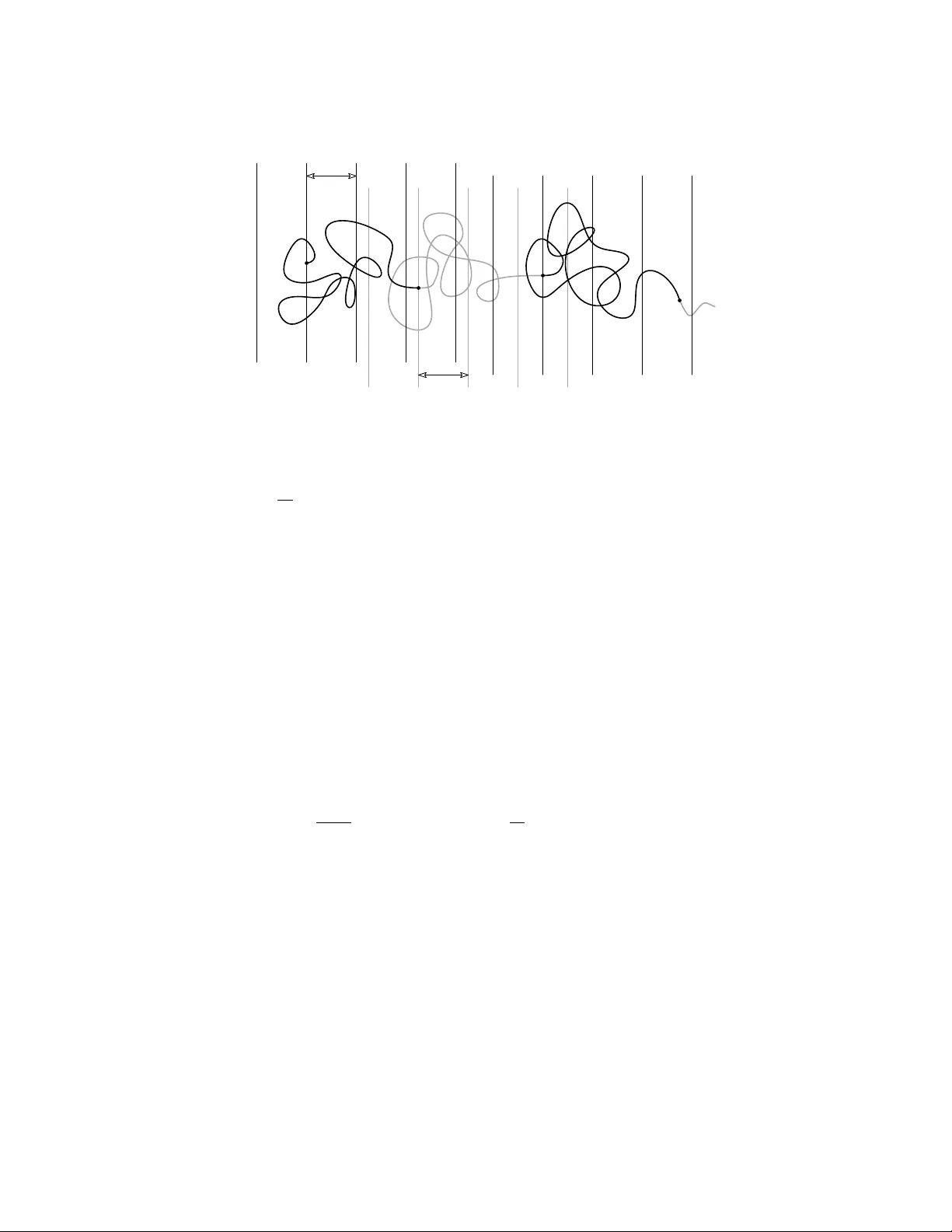
ON LAR GE DEVIA TIONS F OR THE RANGE OF A TW O-DIMENSIONAL RANDOM W ALK SER GUEI POPO V 1 , QUIRIN V OGEL 2 Abstract. In this note, we compute the probabilit y that a t wo-dimensional symmetric random w alk visits more vertices than exp ected, for deviations on scales b et ween the mean b ehavior and linear gro wth. 1 Centr o de Matem´ atic a, University of Porto, Porto, Portugal serguei.popo v@f c.up.pt 2 University of Klagenfurt, Dep artment of Statistics, Klagenfurt, A ustria quirin.vogel@aa u.a t MSC 2020: 60G50, 60G17, 60F10 Keywor ds and phr ases: range, large deviations, planar random w alk, upp er tail deviations 1. Introduction and resul ts Let ( X i ) i ≥ 1 b e i.i.d. symmetric random v ectors in Z 2 with mean zero and finite second moment; w e also assume that they are not supp orted on a one-dimensional subspace. Let us define the random walk ( S n ) n ≥ 1 as S n = P n i =1 X i for n ≥ 1. F or this t w o-dimensional random w alk, denote the range and its deviation by R n = X x ∈ Z 2 1 { H x ≤ n } and R n = R n − E [ R n ] , (1.1) where H x = inf { n ≥ 0 : S n = x } is the en trance time to x . Denote the co v ariance matrix of X 1 b y Γ. Then we hav e, as n → ∞ , E [ R n ] = 2 π n √ det Γ log n + 2 π n √ det Γ log 2 n (1 + o (1)) , (1.2) see [LGR91, Theorem 6.9] (w e write log α n for (log( n )) α , for better legibilit y). This result goes bac k to [DE51], where the first order was obtained for the simple random walk, where 2 π √ det Γ = π . F or conv enience, we henceforth denote e 1 = 2 π √ det Γ and r n = E [ R n ]. A nonstandard central limit theorem was prov ed in [LG86] for the random walk range in tw o dimensions, see also [Che10, Theorem 5.4.3], showing that log 2 n n R n (d) − − − → n →∞ − (2 π ) 2 √ det Γ γ 1 , (1.3) where γ 1 is the renormalized self-intersection local time for the Brownian motion in t w o dimensions up to time 1. W e now formulate our main result: Date : F ebruary 26, 2026. 1 2 Theorem 1. Ther e exist C up , C low > 0 such that for al l θ n ≥ 1 with θ n r n ≤ n , we obtain that for al l n exp − C low n 1 − θ − 1 n ≤ P ( R n ≥ θ n r n ) ≤ exp − C up n 1 − θ − 1 n . (1.4) Note that in the sp ecial case where θ n = (1 + δ ) for δ > 0, w e obtain large deviation estimates on the scale of the mean, with the factor n 1 − θ − 1 n = n δ δ +1 in the exp onent. Large deviations at the linear scale (i.e., θ n = δ log n ) w ere first studied in [HK01] for d ≥ 2, with asymptotic b ounds. In [BCR09], the authors studied the deviations of R n on scales muc h smaller than r n for d = 2, also without matching constan ts. W e remark that large deviations in the down w ards direction (i.e., the probability that the range is less than its expectation) were in v estigated in [L V21] for d = 2 on the scale of the mean and in [DV79] for smaller scales. In the remaining part of the pap er, w e prov e Theorem 1: first the upp er b ound in (1.4) (Section 2), then the low er b ound (Section 3). 2. Upper bound Let us prov e the following (slightly more general) result: Lemma 2.1. Ther e exists C up > 0 such that for al l n and al l θ n ≥ 1 with r n θ n ≤ n , we have that P ( R n ≥ θ n r n ) ≤ exp − C up n 1 − θ − 1 n , (2.1) If θ n = o (log n ) , then we c an cho ose C up = e Λ(1 + o (1)) with e Λ = e − (Λ ′ ( b 0 ) − 1) b 0 , (2.2) wher e Λ is the lo garithmic moment gener ating function of − γ 1 , with γ 1 the r enormalize d self- interse ction lo c al time in the unit interval of the Br ownian motion and b 0 solves Λ( b ) = b (Λ ′ ( b ) − 1) . In p articular, for every δ > 0 lim sup n →∞ 1 n δ δ +1 log P ( R n ≥ (1 + δ ) r n ) ≤ − e Λ . (2.3) Pr o of. Without loss of generality , we can assume that θ n < ε 0 log n for ε 0 ∈ (0 , 1) arbitrarily small but fixed, since for some ψ : (0 , 1] → (0 , ∞ ) P ( R n ≥ ε 0 r n log n ) ≤ P ( R n ≥ ε 0 e 1 n/ 2) = e − ψ ( ε 0 / 2) n (1+ o (1)) , (2.4) b y [HK01, Theorem 1]. Define now α n = 1 θ n ≤ 1 as well as m = j e β +1 n α n k and M = ⌈ n/m ⌉ . (2.5) Note that if θ n = o (log n ), then m diverges to infinit y . Also, we define R a,b = card { S a , . . . , S b − 1 } (2.6) to b e the num b er of sites visited b et w een time a up to time b − 1 and, similarly , let R a,b = R a,b − E [ R a,b ] = R a,b − r b − a . Naturally , we ha ve R n ≤ M X i =1 R ( i − 1) m,im , (2.7) 3 and hence P ( R n ≥ θ n r n ) ≤ P M X i =1 R ( i − 1) m,im ≥ θ n r n − M r m ! . (2.8) By (1.2), there exists δ m → 0 (as m → ∞ ), such that r m ≤ e 1 m log m + e 1 m log 2 m (1 + δ m / 2) ≤ e 1 e β +1 n α n α n log n − e 1 β e β +1 n α n α 2 n log 2 n (1 + δ m ) , (2.9) using the expansion 1 log m = 1 α n log n + ( β + 1) (1 + o (1)) = 1 α n log n − β + 1 α 2 n log 2 n (1 + o (1)) . (2.10) Therefore, we obtain M r m ≤ θ n r n − β θ 2 n r n log n (1 + 2 δ m ) . (2.11) This implies by (2.8) that P ( R n ≥ θ n r n ) ≤ P M X i =1 R ( i − 1) m,im ≥ β θ 2 n r n log n (1 + 2 δ m ) ! . (2.12) One can similarly verify that β log 2 m m θ 2 n r n log n (1 + 2 δ m ) ≥ β M (1 + δ m ) . (2.13) Then, the exp onential Chebyshev’s inequality implies that P ( R n ≥ θ n r n ) ≤ P M X i =1 log 2 m m R ( i − 1) m,im ≥ β M (1 + δ m ) ! (2.14) ≤ exp − λβ M (1 + δ m ) + M log E h e λ e R m i , (2.15) where e R m has the law of e R m (d) = log 2 m m R ( i − 1) m,im . (2.16) Note that we can furthermore choose δ m suc h that for fixed λ > 0 log E h e λ e R m i ≤ Λ( λ )(1 + δ m ) , (2.17) where Λ is the logarithmic momen t generating function of − γ 1 , the renormalized self-in tersection lo cal time of the Brownian motion, see [BCR09] shortly b efore (3.3). Cho ose now λ = λ 0 maxi- mizing [ β λ − Λ( λ )], i.e., such that [ β λ − Λ( λ )] b ecomes the large-deviation rate of − γ 1 at p oin t β . W rite Λ ∗ ( β ) = λ 0 − Λ( λ 0 ). W e then get that P ( R n ≥ θ n r n ) ≤ exp ( − Λ ∗ ( β ) M (1 + 3 δ m )) . (2.18) Define now e Λ = inf β > 0 n e − ( β +1) Λ ∗ ( β ) o , (2.19) and note that this infim um is achiev ed at the p oin t β 0 where d d β Λ ∗ ( β ) = Λ ∗ ( β ) . (2.20) 4 m 1 / 2 m 1 / 2 Figure 1. Definition of the ev ents B k and the strategy for the low er b ound. Let us denote b 0 = d d β Λ ∗ ( β 0 ). By the definition on conv ex conjugate, w e hav e Λ ′ ( b 0 ) = β 0 and Λ ∗ ( β 0 ) = b 0 β 0 − Λ ′ ( b 0 ). This then yields that b 0 solv es the equation Λ( b ) = b (Λ ′ ( b ) − 1). This concludes the pro of. □ 3. Lower bound W e w an t to pro v e that there is C > 0 suc h that for all n and all θ n ≥ 1 suc h that θ n r n ≤ n w e ha v e P ( R n ≥ θ n r n ) ≥ exp( − C n 1 − θ − 1 n ) . (3.1) First, assume that θ n < ε 0 log n for some small ε 0 (otherwise, (3.1) trivially holds b ecause of the ob vious strategy “force the random walk to increase the 1st co ordinate on every step”, whic h leads to P ( R n = n ) ≥ c n 1 for some c 1 > 0). F or a large constant β > 0 (to b e chosen later) define m = exp log n θ n − β and M = n m = exp β + (1 − θ − 1 n ) log n . In the follo wing, for simplicit y , w e do the calculations as if m and M were in tegers; it is straigh t- forw ard to chec k that the calculations in the general case are essen tially the same (see the previous section for details). Note that, to pro ve (3.1), it suffices to show that P ( R n ≥ θ n r n ) ≥ c M 2 for some p ositiv e c 2 . F or ℓ ∈ N , write S (1) ℓ for the first co ordinate of the random walk er (at time ℓ ). F or k = 1 , . . . , M define the (indep endent and same-probability) even ts B k = S (1) ( k − 1) m + j − S (1) ( k − 1) m ∈ ( − m 1 / 2 , 3 m 1 / 2 ) for j = 0 , . . . , m − 1 , and S (1) km − 1 − S (1) ( k − 1) m ∈ (2 m 1 / 2 , 3 m 1 / 2 ) . See on Figure 1 an illustration of ev ents B 1 , B 2 , B 3 ; in particular, note that, when these even ts o ccur, the t wo bold pieces of the tra jectory (i.e., those corresponding to B 1 and B 3 ) cannot intersect. Note that, b y the Donsker’s in v ariance principle (see e.g. [LL10, Theorem 3.4.2]), there exists h 0 > 0 suc h that, for all m ≥ 8 P ( B k ) ≥ h 0 . (3.2) 5 Next, for k = 1 , . . . , M let us abbreviate R ( k ) := R ( k − 1) m,k m − 1 and define the (again, indep enden t and same-probability) even ts E k = n R ( k ) ≥ r m 1 − β / 2 log m o . Note that (1.3) implies that, with some f ( β ) → 0 as β → ∞ P ( E k ) ≥ 1 − f ( β ) . (3.3) Then, define I ( k,k +1) = card { S ( k − 1) m , . . . , S km − 1 } ∩ { S km , . . . , S ( k +1) m − 1 } to b e the sizes of the intersections of “neighbouring” ranges, and let I k,k +1 = n I ( k,k +1) ≤ r m β / 6 log m o . W e note that I ( k,k +1) = R ( k ) + R ( k +1) − R ( k − 1) m, ( k +1) m − 1 , so E h I ( k,k +1) i = 2 r m − r 2 m = r m 2 log 2 log m (1 + o (1)) . Therefore, Chebyshev’s inequality implies that P ( I k,k +1 ) ≥ 1 − 2 log 2 β / 6 (1 + o (1)) . (3.4) No w, on the ev en t B := B 1 ∩ . . . ∩ B M only neighbouring ranges can in tersect (again, see Figure 1), so, on B we hav e R n = R (1) + · · · + R ( M ) − ( I 1 , 2 + · · · + I M − 1 ,M ) . (3.5) Then, it holds that (note that log n = θ n ( β + log m )) r n r m = M log m θ n ( β + log m ) 1 − 1 log n + 1 log m (1 + o (1)) , so θ n r n ≤ M r m 1 − β log m (1 + o (1)) . (3.6) Denote E := E 1 ∩ . . . ∩ E M and I := I 1 , 2 ∩ . . . ∩ I M − 1 ,M . Then, on B ∩ E ∩ I w e ha ve, due to (3.5) R n ≥ M r m 1 − β / 2 log m − β / 6 log m = M r m 1 − 2 β / 3 log m , and so, due to (3.6), on B ∩ E ∩ I the even t {R n ≥ θ n r n } o ccurs (at least if m is large enough). W e are th us left with the task of finding a lo w er b ound for P ( B ∩ E ∩ I ) = P ( B ) P ( E ∩ I | B ). Denote η k = 1 { E k ∩ E k +1 ∩ I k,k +1 } , and let P ∗ ( · ) = P ( · | B ). Note that { η k = 1 } is indep endent of ( B ℓ , ℓ = k , k + 1), and so (3.2), (3.3) and (3.4) imply that P ∗ ( η k = 1) = P ( E k ∩ E k +1 ∩ I k,k +1 | B k ∩ B k +1 ) ≥ 1 − 2 f ( β ) + 2 log 2 β / 6 (1 + o (1)) h 2 0 > 3 4 (3.7) if β is large enough. No w, ( η 1 , . . . , η M ) is a 1-dep enden t random sequence under P ∗ (that is, ( η k , k ∈ A 1 ) and ( η k , k ∈ A 2 ) are P ∗ -indep enden t when no elemen t of A 1 is a neigh b our of an elemen t of A 2 ), and so Theorem 0.0 (i) of [LSS97] implies that P ( E ∩ I | B ) = P ∗ [ η 1 = . . . = η M = 1] ≥ (1 / 4) M . Since we also ha ve P ( B ) ≥ h M 0 , this implies (3.1) and thus concludes the pro of of Theorem 1. 6 A cknowledgments The authors would like to thank the organizers of the CIRM researc h sc ho ol 3451 Mar ches al ´ eatoir es: applic ations et inter actions during whic h they had the opp ortunity to discuss this prob- lem. SP was partially supp orted by CMUP , member of LASI, whic h is financed b y national funds through F CT (F unda¸ c˜ ao para a Ciˆ encia e a T ecnologia, I.P .) under the pro ject with reference UID/00144/2025. References [BCR09] R. Bass, X. Chen, and J. Rosen. Mo der ate deviations for the r ange of planar r andom walks . American Mathematical So c., 2009. [Che10] X. Chen. R andom walk interse ctions: lar ge deviations and r elate d topics . Number 157. American Mathe- matical So c., 2010. [DE51] A. Dv oretzky and P . Erd˝ os. Some problems on random walk in space. In Pr o c. Se cond Berkeley Symp. Math. Statist. Pr ob ab , pages 353–367, 1951. [D V79] M. Donsk er and S. V aradhan. On the n umber of distinct sites visited by a random walk. Communic ations on Pur e and Applie d Mathematics , 32(6):721–747, 1979. [HK01] Y. Hamana and H. Kesten. A large-deviation result for the range of random walk and for the wiener sausage. Pr ob ability theory and r elate d fields , 120(2):183–208, 2001. [LG86] J-F. Le Gall. Propri´ et ´ es d’intersection des marc hes al´ eatoires: I. Conv ergence vers le temps lo cal d’in tersection. Communic ations in mathematic al physics , 104(3):471–507, 1986. [LGR91] J-F. Le Gall and J. Rosen. The range of stable random walks. The Annals of Pr ob ability , pages 650–705, 1991. [LL10] G. Lawler and V. Limic. R andom walk: a mo dern intro duction , volume 123. Cambridge Univ ersity Press, 2010. [LSS97] T.M. Liggett, R.H. Schonmann, and A.M. Stacey . Domination b y pro duct measures. The Annals of Pr ob a- bility , 25(1):71–95, 1997. [L V21] J. Liu and Q. V ogel. Large deviations of the range of the planar random walk on the scale of the mean. Journal of The or etic al Pr ob ability , 34(4):2315–2345, 2021.
Original Paper
Loading high-quality paper...
Comments & Academic Discussion
Loading comments...
Leave a Comment