Reuse-Aware Compilation for Zoned Quantum Architectures Based on Neutral Atoms
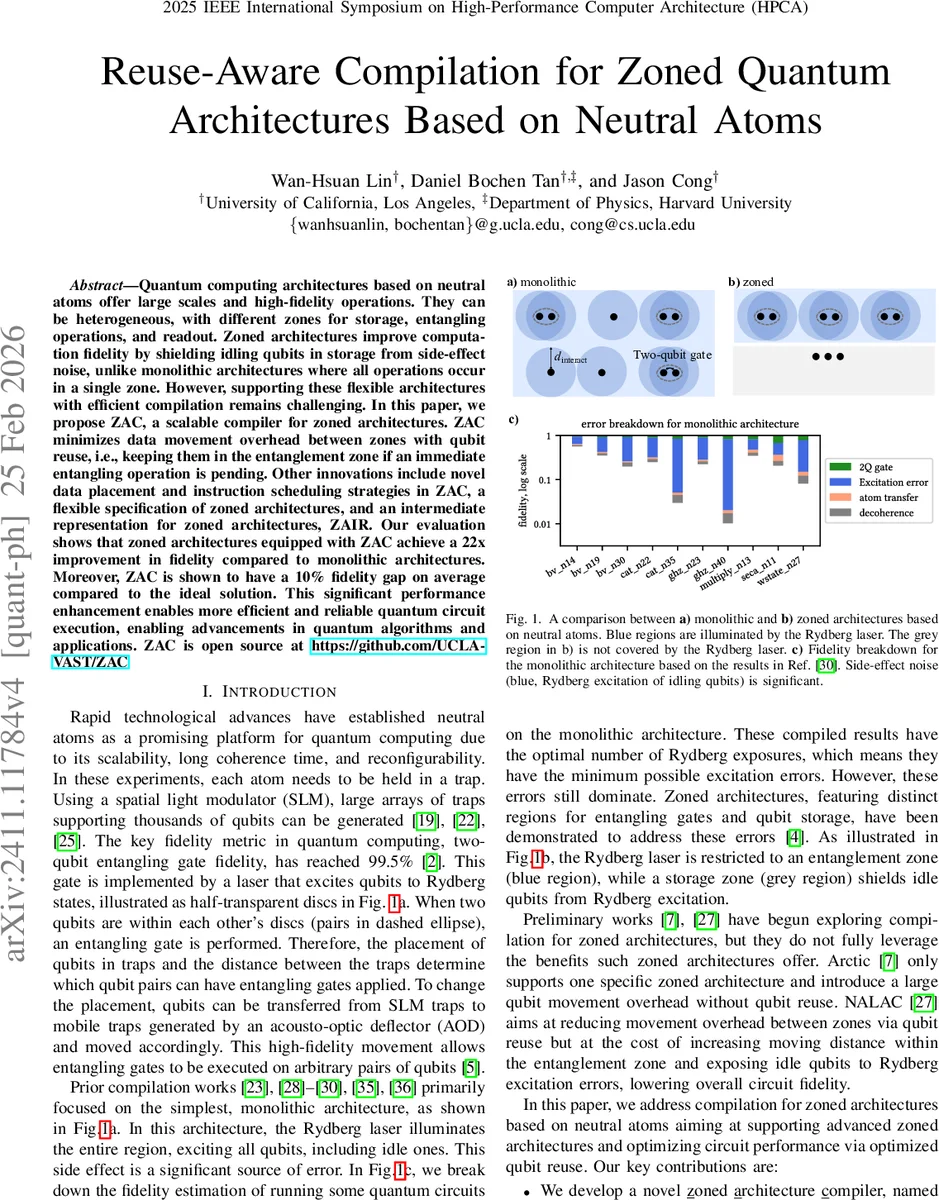
Quantum computing architectures based on neutral atoms offer large scales and high-fidelity operations. They can be heterogeneous, with different zones for storage, entangling operations, and readout. Zoned architectures improve computation fidelity by shielding idling qubits in storage from side-effect noise, unlike monolithic architectures where all operations occur in a single zone. However, supporting these flexible architectures with efficient compilation remains challenging. In this paper, we propose ZAC, a scalable compiler for zoned architectures. ZAC minimizes data movement overhead between zones with qubit reuse, i.e., keeping them in the entanglement zone if an immediate entangling operation is pending. Other innovations include novel data placement and instruction scheduling strategies in ZAC, a flexible specification of zoned architectures, and an intermediate representation for zoned architectures, ZAIR. Our evaluation shows that zoned architectures equipped with ZAC achieve a 22x improvement in fidelity compared to monolithic architectures. Moreover, ZAC is shown to have a 10% fidelity gap on average compared to the ideal solution. This significant performance enhancement enables more efficient and reliable quantum circuit execution, enabling advancements in quantum algorithms and applications. ZAC is open source at https://github.com/UCLA-VAST/ZAC
💡 Research Summary
The paper presents ZAC, a scalable compiler specifically designed for “zoned” neutral‑atom quantum architectures that separate qubits into storage, entanglement, and readout regions. In monolithic designs the global Rydberg laser excites all atoms, causing side‑effect noise on idle qubits and limiting fidelity. Zoned architectures mitigate this by confining the Rydberg beam to a dedicated entanglement zone while shielding idle qubits in a storage zone, but they introduce new challenges: qubits must be moved between zones, and the compiler must decide when to keep a qubit in the entanglement zone for subsequent gates.
ZAC’s contributions are threefold. First, it introduces a reuse‑aware placement strategy. By analyzing the circuit’s sequence of two‑qubit (Rydberg) stages, ZAC marks a qubit as “reusable” if it participates in the next stage. Reusable qubits remain in the entanglement zone, avoiding costly atom‑pickup/drop‑off operations and the associated decoherence. The placement algorithm uses a novel cost function that estimates the movement duration rather than simple Euclidean distance, and it incorporates a look‑ahead term to reduce future movement overhead.
Second, ZAC provides a load‑balanced scheduling mechanism for the rearrangement jobs that move qubits between zones. Modern neutral‑atom platforms often employ multiple AOD (acousto‑optic deflector) arrays; ZAC distributes the movement jobs across these arrays to maximize parallelism and hardware utilization. Dependencies among rearrangement jobs, Rydberg gates, and single‑qubit gates are captured in a directed acyclic graph, and an ASAP (as‑soon‑as‑possible) scheduler orders them while respecting the parallelism constraints of the AODs.
Third, the authors define a flexible architecture specification and an intermediate representation called ZAIR. The specification, expressed in a JSON‑like schema, describes AOD arrays, SLM trap arrays, and each zone’s offset, dimensions, and contained traps. This enables rapid exploration of heterogeneous layouts (multiple entanglement zones, varied trap densities, etc.). ZAIR captures the circuit as a sequence of Rydberg stages, single‑qubit stages, and explicit rearrangement jobs, providing a clean interface between placement and scheduling modules.
The compilation flow consists of: (1) preprocessing – gate set resynthesis to {CZ, U3} and single‑qubit optimization (e.g., via Qiskit); (2) placement – initial mapping of logical qubits to storage traps, followed by reuse‑aware assignment of two‑qubit gates to specific Rydberg sites; (3) scheduling – generation of rearrangement jobs, load‑balanced assignment to AODs, and final instruction ordering.
Experimental evaluation uses realistic neutral‑atom parameters (99.5 % two‑qubit gate fidelity, measured atom‑transport errors, decoherence times). Compared to state‑of‑the‑art monolithic compilers such as Enola and Arctic, ZAC‑compiled zoned architectures achieve a 22× improvement in overall circuit fidelity. When benchmarked against an ideal optimal placement (computed via exhaustive search for small instances), ZAC’s fidelity is within 10 % on average, indicating near‑optimal performance while remaining scalable to large qubit counts. The framework also supports transversal gates, a prerequisite for fault‑tolerant quantum computing (FTQC), demonstrating its applicability to error‑corrected workloads.
All source code, including the architecture specification parser, ZAIR generator, and the ZAC compiler itself, is released open‑source (https://github.com/UCLA‑VAST/ZAC), encouraging community adoption and further research. The authors outline future directions such as dynamic zone reconfiguration, real‑time feedback‑driven compilation, and adaptation of the methodology to other physical platforms (e.g., trapped ions).
In summary, ZAC bridges the gap between the physical advantages of zoned neutral‑atom systems and the algorithmic requirements of large‑scale quantum programs. By intelligently reusing qubits, balancing movement workloads across multiple AODs, and providing a modular specification/IR stack, ZAC delivers a practical, high‑fidelity compilation pipeline that paves the way for scalable, fault‑tolerant quantum computation on neutral‑atom hardware.
Comments & Academic Discussion
Loading comments...
Leave a Comment