Learning Partial Graph Matching via Optimal Partial Transport
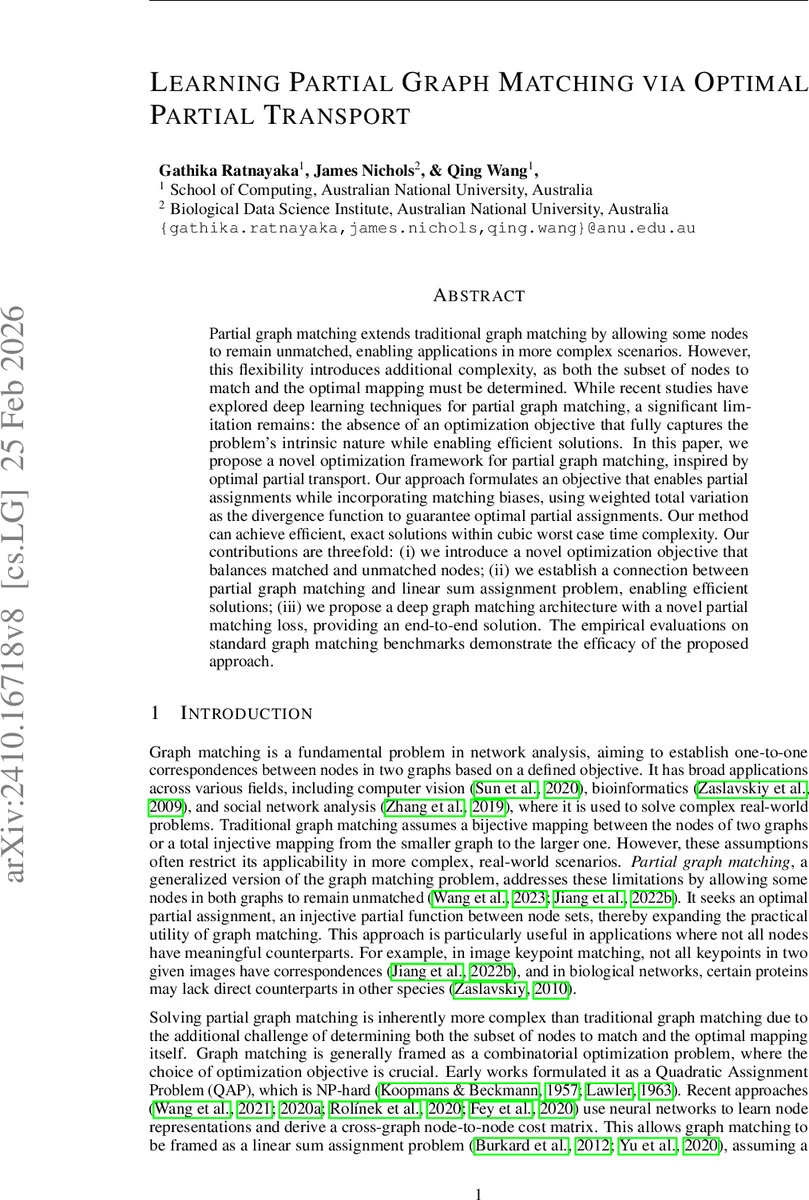
Partial graph matching extends traditional graph matching by allowing some nodes to remain unmatched, enabling applications in more complex scenarios. However, this flexibility introduces additional complexity, as both the subset of nodes to match and the optimal mapping must be determined. While recent studies have explored deep learning techniques for partial graph matching, a significant limitation remains: the absence of an optimization objective that fully captures the problem’s intrinsic nature while enabling efficient solutions. In this paper, we propose a novel optimization framework for partial graph matching, inspired by optimal partial transport. Our approach formulates an objective that enables partial assignments while incorporating matching biases, using weighted total variation as the divergence function to guarantee optimal partial assignments. Our method can achieve efficient, exact solutions within cubic worst case time complexity. Our contributions are threefold: (i) we introduce a novel optimization objective that balances matched and unmatched nodes; (ii) we establish a connection between partial graph matching and linear sum assignment problem, enabling efficient solutions; (iii) we propose a deep graph matching architecture with a novel partial matching loss, providing an end-to-end solution. The empirical evaluations on standard graph matching benchmarks demonstrate the efficacy of the proposed approach.
💡 Research Summary
The paper tackles the challenging problem of partial graph matching, where only a subset of nodes from two graphs should be matched while the rest may remain unmatched. Existing deep learning approaches either rely on integer linear programming with dummy nodes—incurring exponential worst‑case complexity—or treat the problem as a k‑assignment that requires a separate neural module to estimate the unknown number of matches k. Both strategies suffer from inefficiency, error propagation, and difficulty incorporating node‑specific matching biases.
Inspired by the theory of optimal partial transport (OPT), the authors propose a novel optimization objective that directly models partial graph matching as a transport problem with a controllable amount of “mass” (nodes) left unmapped. They introduce a weighted total variation (TV) divergence term that penalizes unmapped mass in proportion to learned bias vectors α (for source nodes) and β (for target nodes). The full objective is
TC(π; C, α, β) = ⟨π, C⟩₍F₎ + ρ
Comments & Academic Discussion
Loading comments...
Leave a Comment