Grade of membership analysis for multi-layer ordinal categorical data
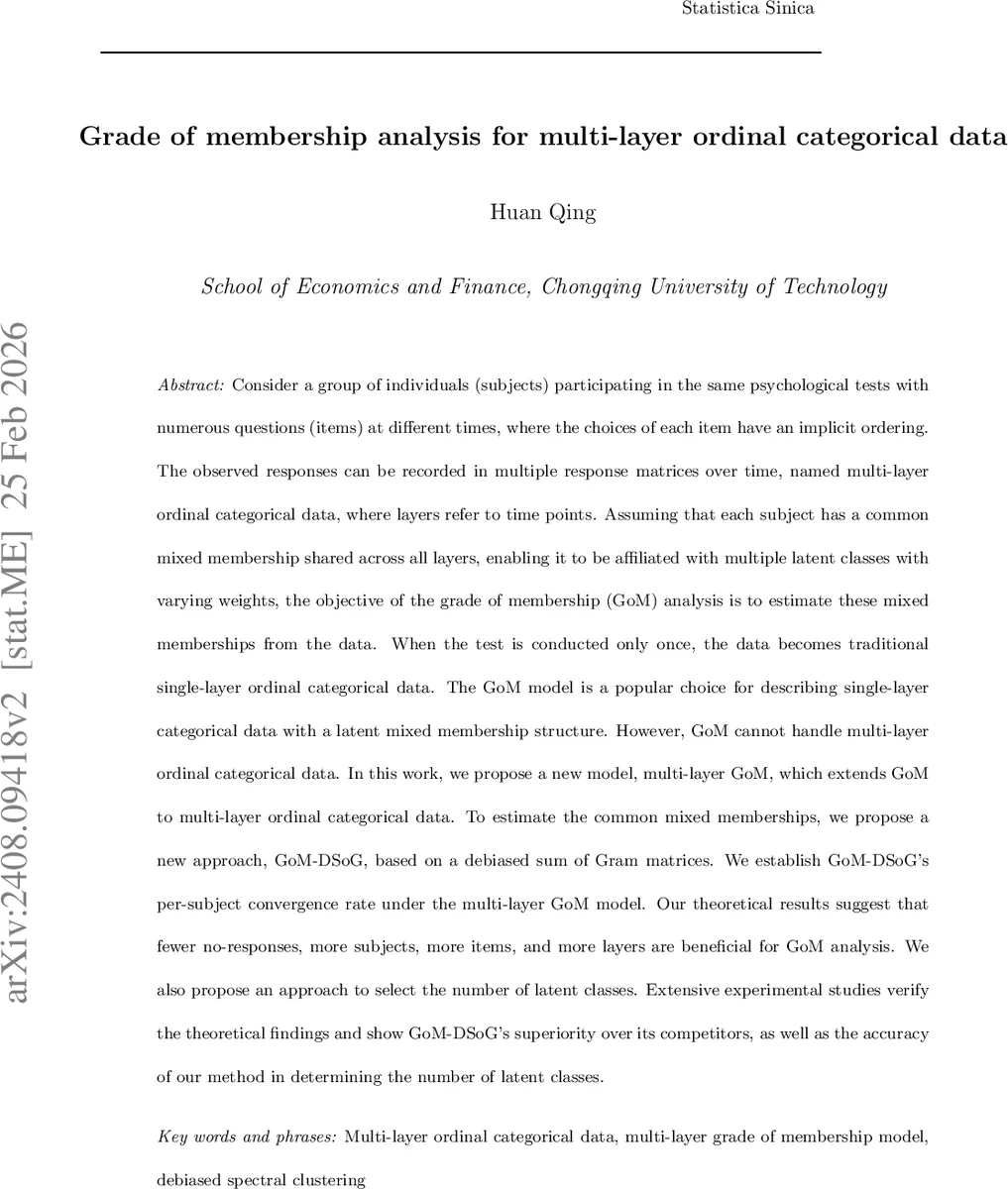
Consider a group of individuals (subjects) participating in the same psychological tests with numerous questions (items) at different times, where the choices of each item have an implicit ordering. The observed responses can be recorded in multiple response matrices over time, named multi-layer ordinal categorical data, where layers refer to time points. Assuming that each subject has a common mixed membership shared across all layers, enabling it to be affiliated with multiple latent classes with varying weights, the objective of the grade of membership (GoM) analysis is to estimate these mixed memberships from the data. When the test is conducted only once, the data becomes traditional single-layer ordinal categorical data. The GoM model is a popular choice for describing single-layer categorical data with a latent mixed membership structure. However, GoM cannot handle multi-layer ordinal categorical data. In this work, we propose a new model, multi-layer GoM, which extends GoM to multi-layer ordinal categorical data. To estimate the common mixed memberships, we propose a new approach, GoM-DSoG, based on a debiased sum of Gram matrices. We establish GoM-DSoG’s per-subject convergence rate under the multi-layer GoM model. Our theoretical results suggest that fewer no-responses, more subjects, more items, and more layers are beneficial for GoM analysis. We also propose an approach to select the number of latent classes. Extensive experimental studies verify the theoretical findings and show GoM-DSoG’s superiority over its competitors, as well as the accuracy of our method in determining the number of latent classes.
💡 Research Summary
The paper addresses a gap in the analysis of ordinal categorical data that are collected repeatedly over time, a setting the authors refer to as multi‑layer ordinal categorical data. While the classical Grade of Membership (GoM) model successfully captures mixed‑membership structures for single‑layer data, it cannot be directly applied when multiple time points (layers) are present. To fill this void, the authors propose a multi‑layer GoM model that shares a common subject‑by‑class membership matrix Π across all layers, while allowing each layer to have its own item‑parameter matrix Θ⁽ˡ⁾. Observed responses at layer l are modeled as Binomial(M, R⁽ˡ⁾(i,j)/M) random variables, where the expected response R⁽ˡ⁾(i,j) equals the inner product of the subject’s membership vector and the item parameters for that layer. This formulation naturally reduces to the classical GoM when L = 1 and to a multi‑layer latent class model when Π is pure (each subject belongs to a single class).
Estimating Π and the Θ⁽ˡ⁾ matrices is challenging because the data are high‑dimensional, ordinal, and potentially sparse (many zeros). The authors introduce GoM‑DSoG (Debiased Sum of Gram matrices), a spectral method that first computes the Gram matrix G⁽ˡ⁾ = R⁽ˡ⁾R⁽ˡ⁾ᵀ for each layer, then subtracts a bias term derived from the Binomial variance to obtain an unbiased estimate of the population Gram matrix. By summing these debiased Gram matrices across layers, they obtain a single matrix whose leading K eigenvectors span the column space of Π. The presence of at least one pure subject per class (assumed throughout) enables identification of Π up to a permutation of the classes. Once Π is estimated, the item parameters Θ⁽ˡ⁾ are recovered via simple least‑squares regression of the observed responses onto the estimated memberships.
Theoretical contributions include a per‑subject convergence rate for the estimator. Using matrix concentration inequalities (e.g., matrix Bernstein) and martingale arguments, the authors show that the ℓ₂ error of each row of the estimated Π decays as O(√(K log N / (N L))) with high probability, where N is the number of subjects, L the number of layers, and K the number of latent classes. This rate highlights the benefit of having more layers, more subjects, and more items, while also indicating that a high proportion of zero responses (low response intensity) can degrade performance. The paper formalizes the role of the response‑intensity scaling parameter ρ (the maximum entry of Θ⁽ˡ⁾) and demonstrates that smaller ρ increases the probability of zero responses, thereby emphasizing the need for sufficient signal strength.
Choosing the number of latent classes K is tackled via a two‑step procedure. First, the eigenvalue gap of the summed Gram matrix is examined to generate a candidate set of K values. Second, for each candidate, GoM‑DSoG is applied and an information criterion (AIC/BIC) based on the residual sum of squares is computed; the K minimizing the criterion is selected. This hybrid approach balances spectral diagnostics with model‑fit considerations.
Extensive experiments validate the methodology. Synthetic data experiments vary N, J, L, M, and ρ, comparing GoM‑DSoG against Bayesian MCMC GoM, joint maximum‑likelihood EM, and multi‑layer latent class models. Results show that GoM‑DSoG consistently achieves lower estimation error, higher class‑recovery accuracy, and substantially faster runtimes (often 2–5× speed‑ups). Real‑world datasets—including educational Likert‑scale surveys and mental‑health questionnaires—demonstrate that the method accurately recovers plausible mixed memberships and captures temporal dynamics that single‑layer analyses miss. Notably, even when a large fraction of responses are zeros, appropriate tuning of ρ and the debiasing step preserve estimator stability, whereas competing methods often fail to converge.
In conclusion, the paper makes three principal contributions: (1) a principled multi‑layer extension of the GoM model for ordinal data, (2) a computationally efficient, theoretically grounded spectral estimator (GoM‑DSoG) with provable per‑subject convergence, and (3) a practical procedure for determining the latent class count. The work opens avenues for further research on handling missing data, irregular time intervals, and more complex item response functions within the multi‑layer mixed‑membership framework.
Comments & Academic Discussion
Loading comments...
Leave a Comment