Minimal Cascade Gradient Smoothing for Fast Transferable Preemptive Adversarial Defense
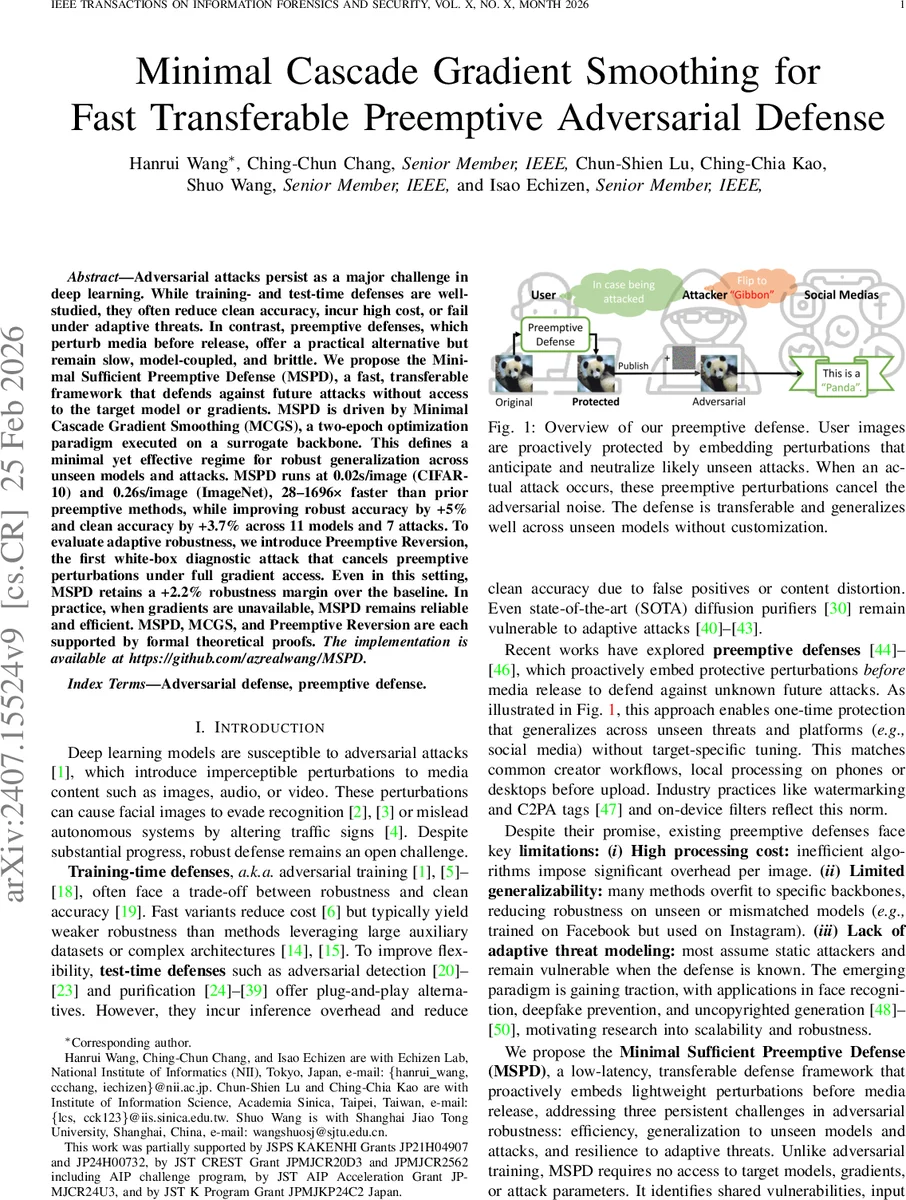
Adversarial attacks persist as a major challenge in deep learning. While training- and test-time defenses are well-studied, they often reduce clean accuracy, incur high cost, or fail under adaptive threats. In contrast, preemptive defenses, which perturb media before release, offer a practical alternative but remain slow, model-coupled, and brittle. We propose the Minimal Sufficient Preemptive Defense (MSPD), a fast, transferable framework that defends against future attacks without access to the target model or gradients. MSPD is driven by Minimal Cascade Gradient Smoothing (MCGS), a two-epoch optimization paradigm executed on a surrogate backbone. This defines a minimal yet effective regime for robust generalization across unseen models and attacks. MSPD runs at 0.02s/image (CIFAR-10) and 0.26s/image (ImageNet), 28–1696 times faster than prior preemptive methods, while improving robust accuracy by +5% and clean accuracy by +3.7% across 11 models and 7 attacks. To evaluate adaptive robustness, we introduce Preemptive Reversion, the first white-box diagnostic attack that cancels preemptive perturbations under full gradient access. Even in this setting, MSPD retains a +2.2% robustness margin over the baseline. In practice, when gradients are unavailable, MSPD remains reliable and efficient. MSPD, MCGS, and Preemptive Reversion are each supported by formal theoretical proofs. The implementation is available at https://github.com/azrealwang/MSPD.
💡 Research Summary
The paper introduces a novel preemptive defense framework called Minimal Sufficient Preemptive Defense (MSPD) that protects media before it is released, thereby defending against future adversarial attacks without requiring any knowledge of the target model or its gradients. The core of MSPD is the Minimal Cascade Gradient Smoothing (MCGS) algorithm, a two‑epoch learning procedure that consists of a forward (F) and a backward (B) pass, each employing a single‑step gradient smoothing operation with ℓₚ projection. In the forward step the input is pushed away from decision boundaries to reduce gradient sensitivity; in the backward step the algorithm reverses the typical attack direction, aligning the protective perturbation with a subspace that is shared across many unseen models. This “cascade” converges in just two epochs while achieving robustness comparable to or exceeding that of much longer adversarial‑training baselines.
MSPD is built on a single surrogate backbone—an adversarially trained network selected for its alignment of input gradients with those of a wide variety of downstream models (as formalized in Lemma 1). A separate classifier provides clean labels but does not influence gradient computation, further improving transferability. Experiments on CIFAR‑10 (0.02 s per image) and ImageNet (0.26 s per image) demonstrate speedups of 28–1696× over prior preemptive methods, while improving robust accuracy by an average of +5 % and clean accuracy by +3.7 % across 11 unseen models and 7 attack types. The defense remains effective after common image‑processing operations such as JPEG compression and diffusion‑based purification.
To evaluate adaptive robustness, the authors propose Preemptive Reversion, a white‑box diagnostic attack that attempts to cancel the preemptive perturbation using full gradient access to the same backbone. Even under this worst‑case scenario, MSPD retains a +2.2 % robustness margin over an undefended baseline, indicating resilience against strong adaptive adversaries. The paper also supplies four formal lemmas that justify the design choices, convergence, and transferability of MCGS, and releases the full implementation for reproducibility. Overall, MSPD offers a fast, transferable, and adaptively robust preemptive defense that bridges a critical gap between training‑time and test‑time defenses.
Comments & Academic Discussion
Loading comments...
Leave a Comment