Quantum Cosmology, Decoherence, and the Emergence of Classical Spacetime
We analyze the emergence of classical cosmological spacetimes in quantum cosmology by computing the reduced density matrix for long-wavelength curvature perturbations. Starting from standard Hartle--H
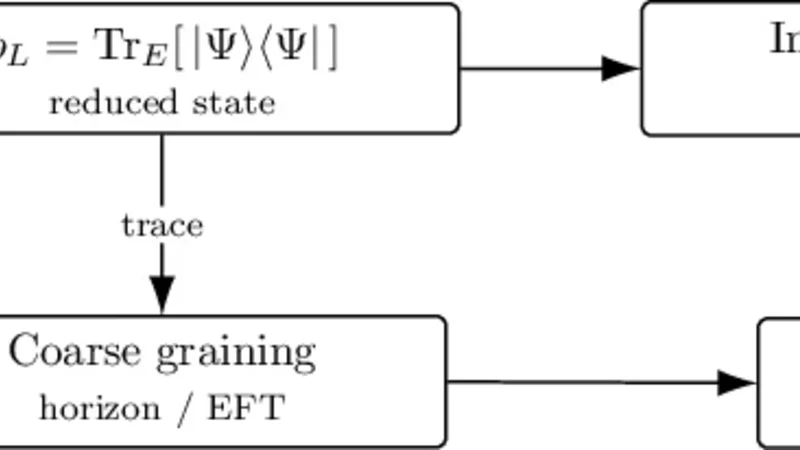
We analyze the emergence of classical cosmological spacetimes in quantum cosmology by computing the reduced density matrix for long-wavelength curvature perturbations. Starting from standard Hartle–Hawking and tunneling boundary conditions, we emphasize that semiclassical WKB structure and inflationary squeezing do not by themselves yield classicality. Tracing over unobserved degrees of freedom and using the influence functional formalism, we derive the decoherence functional for superhorizon curvature modes during inflation. For a light massive environmental scalar field in the Bunch–Davies vacuum, we obtain an explicit noise kernel and show how a nonzero mass regulates the infrared behavior. We then evaluate decoherence under horizon-based and EFT-motivated coarse grainings, finding efficient suppression of interference between macroscopically distinct perturbation histories in both cases. The analysis clarifies the distinct roles of boundary conditions (branch amplitudes) and decoherence (classical branch selection) and yields an emergent cosmological arrow of time through environment-induced entanglement.
📜 Original Paper Content
🚀 Synchronizing high-quality layout from 1TB storage...