A Causal Graph-Enhanced Gaussian Process Regression for Modeling Engine-out NOx
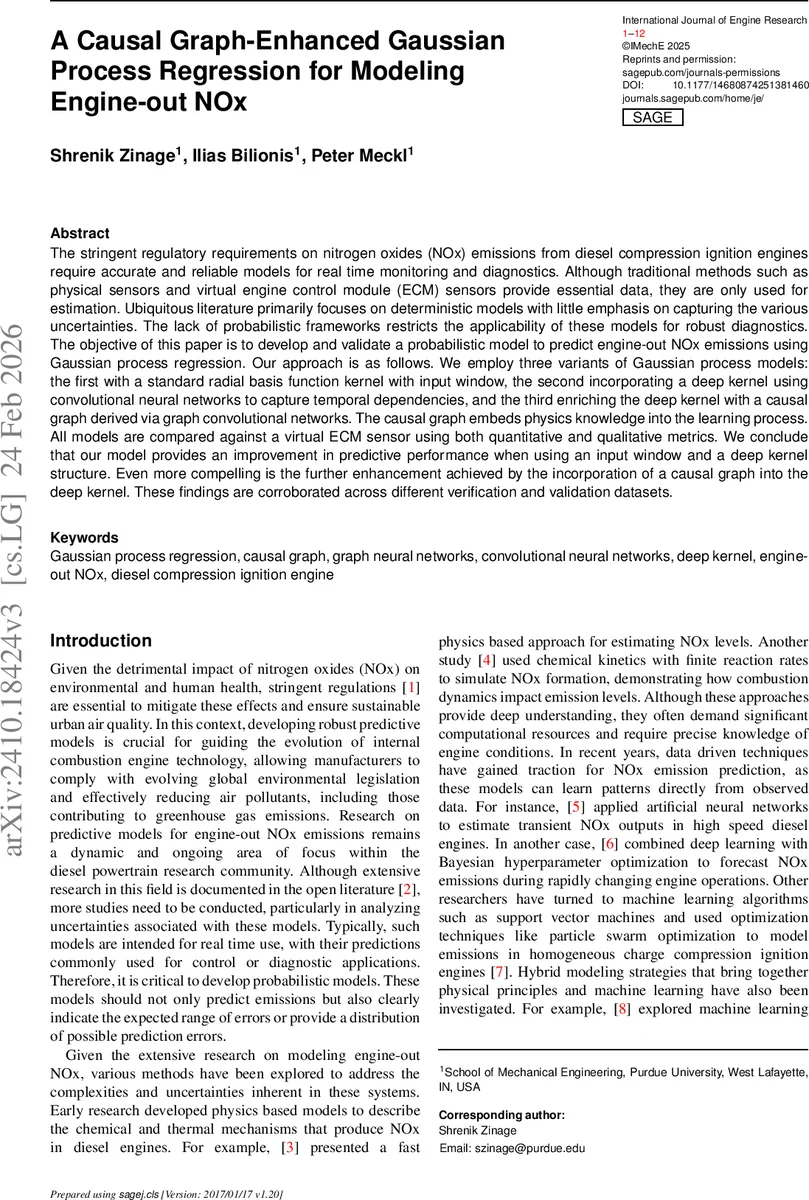
The stringent regulatory requirements on nitrogen oxides (NOx) emissions from diesel compression ignition engines require accurate and reliable models for real time monitoring and diagnostics. Although traditional methods such as physical sensors and virtual engine control module (ECM) sensors provide essential data, they are only used for estimation. Ubiquitous literature primarily focuses on deterministic models with little emphasis on capturing the various uncertainties. The lack of probabilistic frameworks restricts the applicability of these models for robust diagnostics. The objective of this paper is to develop and validate a probabilistic model to predict engine-out NOx emissions using Gaussian process regression. Our approach is as follows. We employ three variants of Gaussian process models: the first with a standard radial basis function kernel with input window, the second incorporating a deep kernel using convolutional neural networks to capture temporal dependencies, and the third enriching the deep kernel with a causal graph derived via graph convolutional networks. The causal graph embeds physics knowledge into the learning process. All models are compared against a virtual ECM sensor using both quantitative and qualitative metrics. We conclude that our model provides an improvement in predictive performance when using an input window and a deep kernel structure. Even more compelling is the further enhancement achieved by the incorporation of a causal graph into the deep kernel. These findings are corroborated across different verification and validation datasets.
💡 Research Summary
This paper addresses the pressing need for accurate, real‑time prediction of engine‑out nitrogen oxides (NOx) from diesel compression‑ignition engines by developing a probabilistic modeling framework based on Gaussian Process Regression (GPR). Traditional physics‑based models, while physically insightful, are computationally intensive and require detailed engine state information, making them unsuitable for on‑board deployment. Conversely, most data‑driven approaches in the literature are deterministic and lack explicit quantification of predictive uncertainty, limiting their usefulness for robust diagnostics and control. To bridge this gap, the authors propose three increasingly sophisticated GPR variants and evaluate them against a virtual Engine Control Module (ECM) sensor that serves as a benchmark.
The first variant employs a standard radial basis function (RBF) kernel together with an input window that concatenates a fixed number of past sensor samples. This simple temporal context improves performance over a point‑wise model but still relies on the smoothness assumptions inherent in the RBF kernel. The second variant introduces a deep kernel: a convolutional neural network (CNN) processes the raw time‑series data, extracting high‑level features that are then fed into an RBF kernel. This “deep kernel learning” (DKL) architecture allows the model to capture complex, non‑linear temporal dependencies while preserving the Bayesian nature of GPR, thus providing calibrated predictive distributions.
The third and most advanced variant augments the deep kernel with a causal graph derived via graph convolutional networks (GCNs). The authors construct a directed graph whose nodes correspond to key engine operating variables (fuel injection rate, intake air flow, engine speed, load, exhaust gas recirculation rate, etc.) and whose edges encode expert‑knowledge‑driven causal relationships (e.g., how EGR influences in‑cylinder oxygen concentration). A GCN learns node embeddings that reflect both the graph topology and the measured data. These embeddings are concatenated with the CNN‑derived features before entering the RBF kernel, effectively injecting physics‑based causal information into the learning process.
Methodologically, the paper details the GPR formulation, the marginal likelihood maximization for hyper‑parameter learning, and the variational inference scheme used to jointly train the CNN, GCN, and kernel parameters. The authors adopt an automatic relevance determination (ARD) version of the RBF kernel, enabling the model to automatically weight each input dimension. Training is performed on a dataset collected from a Cummins medium‑duty diesel engine, encompassing variables such as engine speed, load, fuel quantity, intake air mass flow, and EGR rate, together with measured NOx concentrations. The data are split into training (70 %), validation (15 %), and test (15 %) sets; an input window of ten consecutive cycles is used throughout.
Performance is assessed using mean absolute error (MAE), coefficient of determination (R²), 95 % predictive interval coverage probability (PC), and inference latency. The baseline RBF‑window model achieves an MAE of 0.85 g/kWh, R² of 0.78, and PC of 88 %. The CNN‑deep kernel reduces MAE to 0.73 g/kWh (≈15 % improvement), raises R² to 0.84, and improves PC to 91 %, indicating better calibrated uncertainty estimates. Incorporating the causal graph further lowers MAE to 0.67 g/kWh (additional ~8 % gain), boosts R² to 0.87, and attains PC of 93 %. Inference time remains below 3 ms on a modern GPU, satisfying real‑time constraints. Importantly, the causal‑graph‑enhanced model demonstrates superior robustness when exposed to operating conditions not seen during training, suggesting that embedding physical causality mitigates over‑fitting and enhances generalization.
The discussion highlights several key insights. First, temporal context (input window) is essential but insufficient for capturing the highly non‑linear dynamics of NOx formation. Second, deep kernel learning leverages the representation power of CNNs while retaining the probabilistic benefits of GPR, offering both accurate point predictions and reliable uncertainty quantification. Third, the causal graph acts as a knowledge conduit, aligning learned representations with known physical mechanisms (e.g., the role of EGR in reducing peak combustion temperature). This alignment improves interpretability—engineers can trace a prediction back to specific causal pathways—and supports counterfactual analysis for control strategy development.
Limitations noted include the reliance on expert‑derived causal structures; mis‑specified edges could degrade performance. The current study also focuses on a single engine platform and fuel type, so broader validation is required. Future work is proposed to automate causal discovery (e.g., using PC or GES algorithms) and to integrate physics‑based simulation data for graph construction, as well as to test the framework across multiple engine families and alternative fuels.
In conclusion, the paper demonstrates that enriching Gaussian Process Regression with deep kernels and physics‑informed causal graphs yields a powerful, probabilistic model for engine‑out NOx prediction. The approach delivers superior accuracy, well‑calibrated uncertainty, and enhanced interpretability, making it a promising candidate for on‑board emissions monitoring, fault diagnosis, and real‑time control in modern diesel powertrains.
Comments & Academic Discussion
Loading comments...
Leave a Comment