Local projections identify the same policy counterfactuals as empirical and structural models
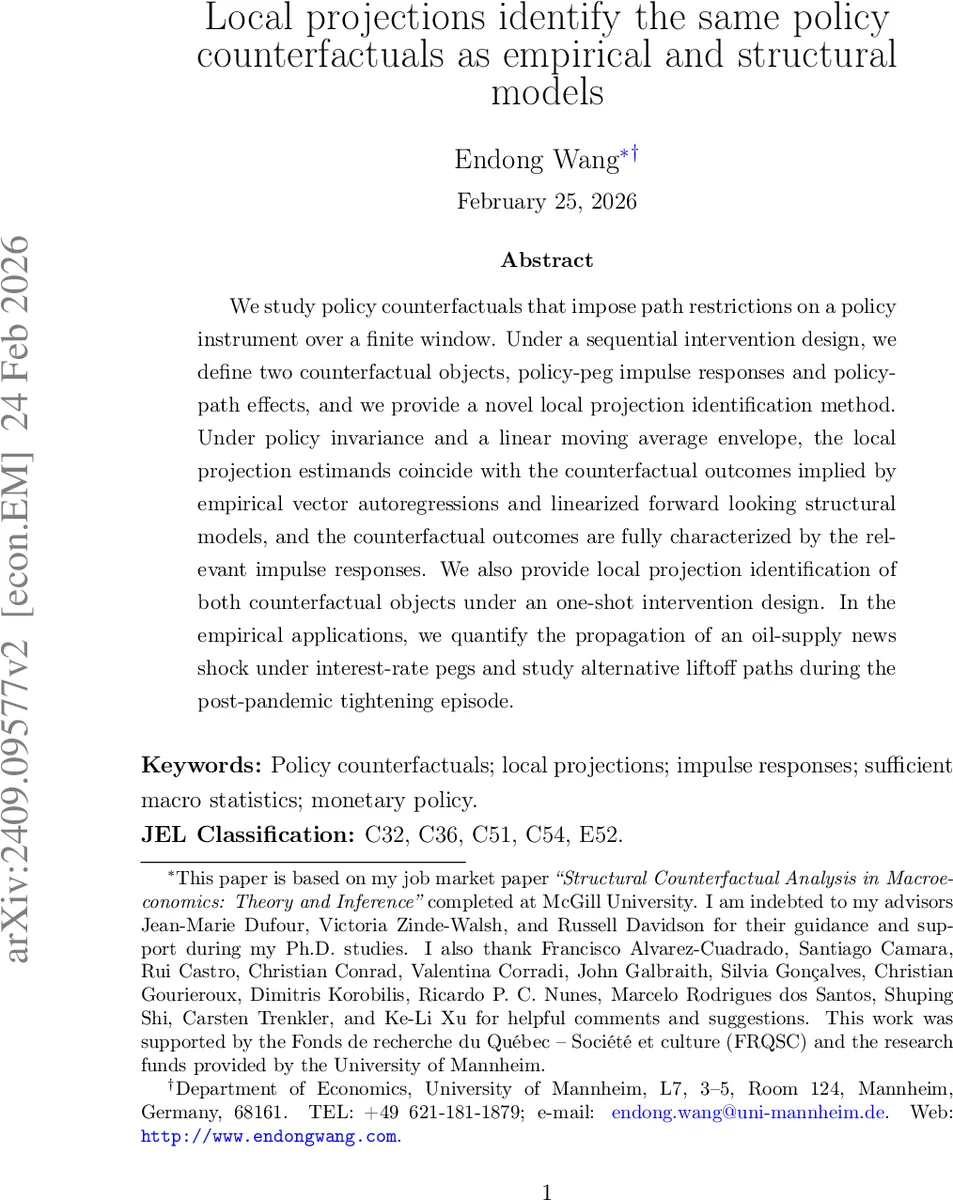
We study policy counterfactuals that impose path restrictions on a policy instrument over a finite window. Under a sequential intervention design, we define two counterfactual objects, policy-peg impulse responses and policy-path effects, and we provide a novel local projection identification method. Under policy invariance and a linear moving average envelope, the local projection estimands coincide with the counterfactual outcomes implied by empirical vector autoregressions and linearized forward looking structural models, and the counterfactual outcomes are fully characterized by the relevant impulse responses. We also provide local projection identification of both counterfactual objects under an one-shot intervention design. In the empirical applications, we quantify the propagation of an oil-supply news shock under interest-rate pegs and study alternative liftoff paths during the post-pandemic tightening episode.
💡 Research Summary
The paper develops a rigorous framework for evaluating macro‑policy counterfactuals that impose path restrictions on a policy instrument over a finite horizon. The authors introduce two objects of interest: (i) “policy‑peg impulse responses,” which measure the dynamic effect of a shock when the policy instrument is temporarily fixed (or pegged) for a set of periods, and (ii) “policy‑path effects,” which compare the realized outcome path to a counterfactual path in which the policy instrument is replaced by a prescribed sequence while all other shocks remain unchanged.
The theoretical contribution rests on two key assumptions. First, policy invariance: the private‑sector block of the economy is assumed to be invariant to policy, meaning that policy interventions affect private behavior only through the expected path of the policy instrument. This condition can be justified in micro‑founded models where the private sector’s optimal decisions depend on the anticipated policy trajectory rather than on the raw policy shock. Second, a linear moving‑average envelope: the structural mapping from shocks to observables is assumed to be a linear SVMA (Structural Vector Moving Average) process. Under these assumptions, the authors show that a local‑projection (LP) regression with appropriate instrumental variables (the identified structural shocks) yields coefficients that exactly equal the policy‑peg impulse responses and can be combined to recover policy‑path effects.
Two intervention designs are considered. The sequential design implements the peg by inserting period‑by‑period, unanticipated policy shocks that keep agents’ expectations unchanged across periods; this design is most credible for short windows and moderate interventions. The one‑shot design imposes the entire path restriction at the initial date, allowing expectations to internalize the future path from the outset, but requiring a richer set of identified policy shocks to implement. The authors prove that, under the linear SVMA envelope, the LP estimands from either design coincide with the counterfactual outcomes generated by any empirical VAR or forward‑looking structural model that reproduces the same impulse responses. Consequently, the counterfactual analysis is fully pinned down by the identified impulse responses, not by the particular full‑system representation.
The empirical section illustrates the methodology with two applications. First, the authors examine U.S. oil‑supply news shocks (using Känzig 2021’s news surprise) under three alternative short‑rate peg lengths (3, 12, and 24 months). High‑frequency monetary‑policy shocks identified by Bauer‑Swanson (2023) serve as instruments. The LP estimates reveal that pegging the policy rate substantially damps the transmission of the oil shock to inflation and output, and the magnitude of the damping grows with the length of the peg, highlighting the trade‑off between price stability and output during periods of commodity volatility.
Second, they study a “liftoff” counterfactual during the post‑pandemic tightening episode. By shifting the start of the rate‑hiking cycle from February 2022 to November 2021 and varying the duration of the hike, they construct alternative policy paths. The same high‑frequency monetary‑policy instrument identifies the relevant shock. The results show that an earlier and longer liftoff generates a larger disinflationary impact but also a deeper and more persistent contraction in real activity, quantifying the costs of aggressive tightening.
Overall, the paper establishes an equivalence between LP‑based identification and the traditional VAR/structural‑model approach for a broad class of policy‑path counterfactuals. By showing that the LP estimands are sufficient to recover the full counterfactual dynamics under modest and economically interpretable conditions, the authors provide a practical tool for policymakers and researchers to evaluate a wide range of policy scenarios without having to estimate fully specified structural models. This contribution bridges the gap between reduced‑form impulse‑response analysis and full‑scale structural policy simulation, expanding the toolbox for macro‑economic policy evaluation.
Comments & Academic Discussion
Loading comments...
Leave a Comment