On Landau-Type Theorems for Poly-Analytic Functions
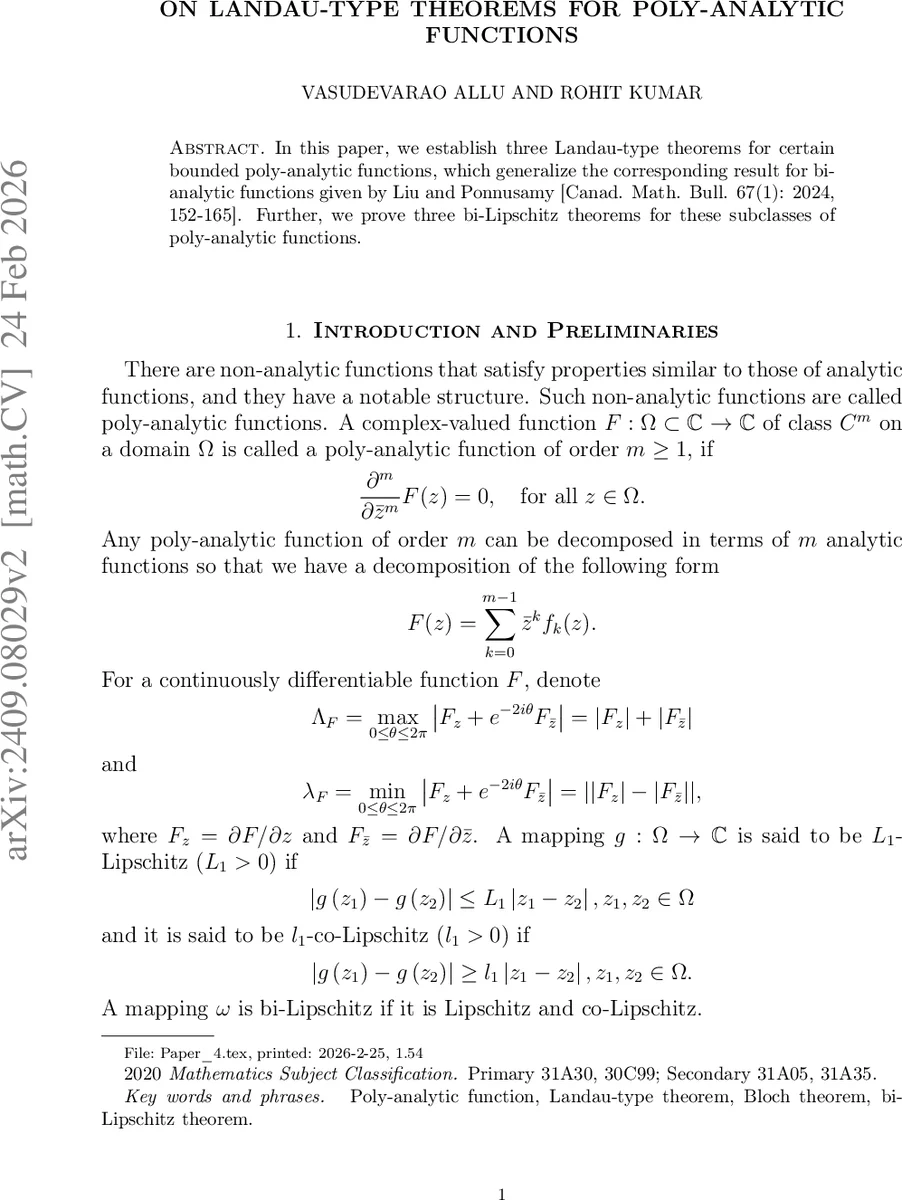
In this paper, we establish three Landau-type theorems for certain bounded poly-analytic functions, which generalize the corresponding result for bi-analytic functions given by Liu and Ponnusamy [Canad. Math. Bull. 67(1): 2024, 152-165]. Further, we prove three bi-Lipschitz theorems for these subclasses of poly-analytic functions.
💡 Research Summary
The paper investigates Landau‑type theorems for poly‑analytic functions of order m ≥ 2, extending recent results on bounded bi‑analytic functions. A poly‑analytic function on the unit disc is written as
F(z)=∑_{k=0}^{m‑1}\bar z^{k}f_k(z)
with each f_k holomorphic. The authors introduce three subclasses:
* F₁ consists of functions with |f′₀(z)| < Λ (Λ > 1) and |f_k(z)| ≤ M_k for k ≥ 1;
* F₂ consists of functions with |f₀(z)| < M (M ≥ 1) and |f′_k(z)| ≤ Λ_k for k ≥ 1;
* F₃ consists of functions with |f′₀(z)| < Λ₀ (Λ₀ > 1) and |f′_k(z)| ≤ Λ_k for k ≥ 1.
For each class the authors prove that F is univalent in a disc D_{r_i} where r_i is the unique root in (0,1) of a strictly decreasing auxiliary function. For F₁ the auxiliary function is
ϕ(r)=Λ(1‑Λr)/(Λ‑r)‑∑_{k=1}^{m‑1} r^{k}\bigl(M_k/(1‑r²)+kM_k\bigr).
Because ϕ(0)=1 and ϕ(1⁻)=‑∞, a unique r₁∈(0,1) satisfies ϕ(r₁)=0. The image disc radius is
R₁=Λ²r₁+(Λ³‑Λ) ln(1‑Λr₁)‑∑_{k=1}^{m‑1} r₁^{k+1}M_k.
Analogous decreasing functions ψ₁(r) and ψ₂(r) are constructed for F₂ and F₃, yielding unique radii r₂, r₃ and corresponding image radii R₂, R₃ expressed in terms of M, Λ_k, Λ₀, etc. The proofs rely on three main tools:
- Lemma 2.1, a lower bound for the distance between values of a holomorphic map with bounded derivative;
- Lemma 2.2, coefficient estimates for bounded holomorphic functions;
- Lemma 2.3, monotonicity of the auxiliary functions guaranteeing a unique zero.
The authors combine these lemmas with the Schwarz lemma and elementary integral estimates along line segments to bound |F(z₁)‑F(z₂)| from below, which yields univalence. They also obtain lower bounds for |F(z)| on the boundary of D_{r_i}, guaranteeing that the image contains a schlicht disc of radius R_i. Sharpness is demonstrated in the limiting case when the auxiliary bounds M_k or Λ_k vanish, reducing the results to the classical Landau theorem for analytic functions.
Beyond the Landau‑type results, the paper establishes bi‑Lipschitz properties for the three subclasses. By estimating both the maximal stretch Λ_F and the minimal stretch λ_F, explicit constants L_i and ℓ_i are derived such that
ℓ_i |z₁‑z₂| ≤ |F(z₁)‑F(z₂)| ≤ L_i |z₁‑z₂|
for all z₁, z₂ in D_{r_i}. This shows that the mappings are simultaneously Lipschitz and co‑Lipschitz on the univalence disks, providing quantitative control of distortion.
Overall, the work generalizes Liu and Ponnusamy’s 2024 bi‑analytic Landau theorems to arbitrary poly‑analytic order, introduces a systematic monotonicity method for locating the optimal univalence radius, and supplies explicit bi‑Lipschitz constants. The results fill a gap in the literature on higher‑order poly‑analytic functions and suggest further research directions, such as refining the constants, extending to weighted poly‑analytic spaces, or investigating analogous Bloch‑type theorems.
Comments & Academic Discussion
Loading comments...
Leave a Comment