Abelian groups without 3-chromatic Cayley graphs
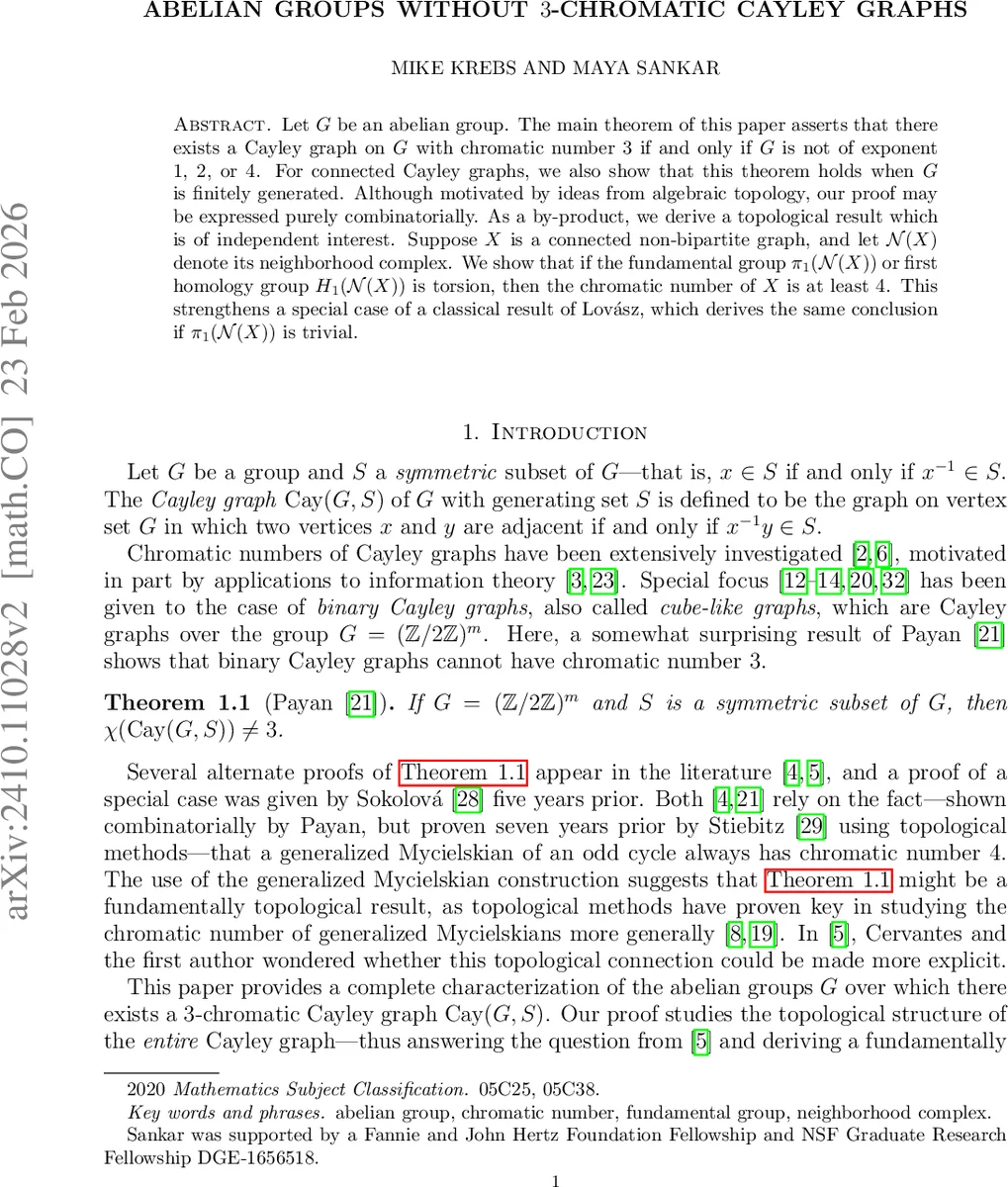
Let $G$ be an abelian group. The main theorem of this paper asserts that there exists a Cayley graph on $G$ with chromatic number $3$ if and only if $G$ is not of exponent $1$, $2$, or $4$. For connected Cayley graphs, we also show that this theorem holds when $G$ is finitely generated. Although motivated by ideas from algebraic topology, our proof may be expressed purely combinatorially. As a by-product, we derive a topological result which is of independent interest. Suppose $X$ is a connected non-bipartite graph, and let $\N(X)$ denote its neighborhood complex. We show that if the fundamental group $π_1(\N(X))$ or first homology group $H_1(\N(X))$ is torsion, then the chromatic number of $X$ is at least $4$. This strengthens a special case of a classical result of Lovász, which derives the same conclusion if $π_1(\N(X))$ is trivial.
💡 Research Summary
The paper gives a complete characterization of when an abelian group admits a 3‑chromatic Cayley graph. The authors show that a Cayley graph on an abelian group G can be 3‑colored if and only if the exponent of G is not 1, 2, or 4. The “if” direction is constructive: if G contains an element of infinite order, one takes S={±x,±2x} and obtains a disjoint union of copies of Cay(ℤ,{±1,±2}), which is non‑bipartite and 3‑colorable. If G is torsion but has an element whose order m does not divide 4, one extracts a cyclic subgroup of order 8 or an odd order and chooses S accordingly (e.g., S={±x,4x} for order‑8 elements, or S={±x} for odd cycles). In all cases the resulting Cayley graph is a disjoint union of 3‑chromatic components; when G is finitely generated the generating set can be chosen to make the graph connected. Conversely, if exp(G)∈{1,2,4} then any symmetric generating set yields either a bipartite graph or a graph requiring at least four colors, so no 3‑chromatic Cayley graph exists.
Beyond this combinatorial classification, the authors strengthen a classic result of Lovász concerning the neighborhood complex N(X) of a graph X. Lovász proved that if N(X) is k‑connected then χ(X)≥k+3; in particular, trivial π₁(N(X)) forces χ≥3. The present work shows that the weaker condition “π₁(N(X)) is torsion” or even “H₁(N(X)) is torsion” already forces χ(X)≥4 for any connected non‑bipartite graph X. The proof proceeds by introducing a discrete fundamental group for graphs, defined via homotopy equivalence of walks (substitution, insertion, deletion). For a Cayley graph Cay(G,S) over an abelian group, the authors compute π₁(Cay(G,S)) as the quotient R
Comments & Academic Discussion
Loading comments...
Leave a Comment