Determination of the stably free cancellation property for orders
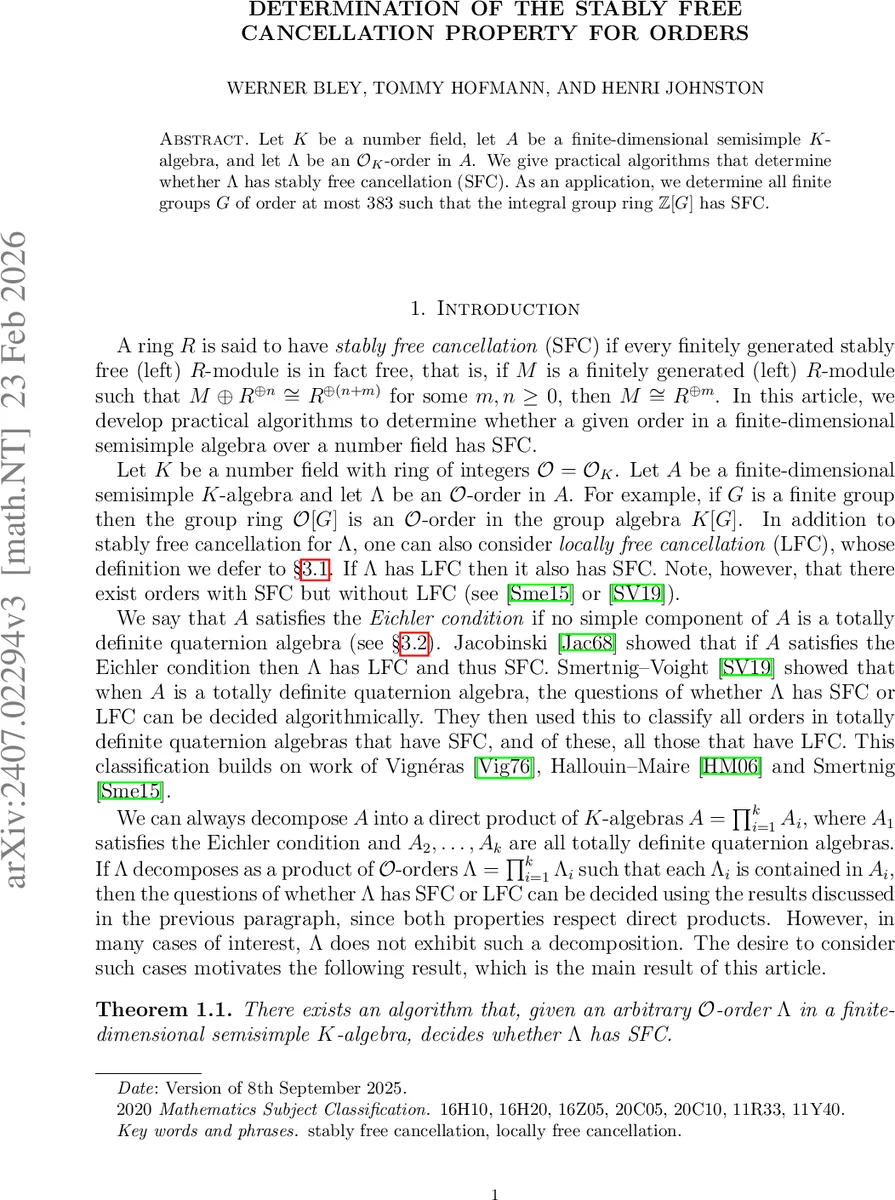
Let $K$ be a number field, let $A$ be a finite-dimensional semisimple $K$-algebra, and let $Λ$ be an $\mathcal{O}_{K}$-order in $A$. We give practical algorithms that determine whether $Λ$ has stably free cancellation (SFC). As an application, we determine all finite groups $G$ of order at most $383$ such that the integral group ring $\mathbb{Z}[G]$ has SFC.
💡 Research Summary
The paper addresses the problem of deciding whether a given order Λ in a finite‑dimensional semisimple algebra A over a number field K enjoys the stably free cancellation (SFC) property, i.e. every finitely generated stably free left Λ‑module is actually free. After recalling the definitions of SFC and the stronger locally free cancellation (LFC), the authors review classical results: Jacobinski’s theorem guarantees LFC (hence SFC) for any order when A satisfies the Eichler condition (no simple component is a totally definite quaternion algebra), while Smertnig–Vogt showed that for orders in totally definite quaternion algebras the SFC/LFC question can be settled algorithmically.
The main contribution is Theorem 1.1, which asserts the existence of a practical algorithm that decides SFC for an arbitrary O_K‑order Λ. Three concrete algorithms are presented:
-
Algorithm 8.9 – suited for algebras of modest dimension. It computes a maximal order M containing Λ, selects a two‑sided ideal f⊂Λ, and analyses the image of (Λ/f)× in a suitable ray class group. Using this data the algorithm tests a finite list of explicit “test lattices” for freeness. The method builds on earlier work of Bley–Böckle and the authors’ own previous results.
-
Algorithm 9.1 – a probabilistic approach that cannot prove SFC but can efficiently exhibit a counterexample. By generating random test lattices and checking that none are free, it quickly demonstrates failure of SFC in many cases.
-
Algorithm 10.3 – the most sophisticated. It reduces the problem for Λ to a problem for an order in a smaller‑dimensional algebra via fiber‑product constructions and requires the computation of a subgroup of the unit group of a finite ring. The reduction relies on deep results of Reiner–Ullom and Swan concerning locally free class groups and cancellation.
To support these algorithms the authors develop auxiliary procedures: algorithms for primary decomposition and unit‑group computation of finite rings (§11), and new freeness tests for modules over orders (§12). All these are implemented in GAP and Magma, with timing data provided in Appendix A.
The paper then applies the algorithms to integral group rings ℤ
Comments & Academic Discussion
Loading comments...
Leave a Comment