Galois module structure of algebraic integers of cyclic cubic fields
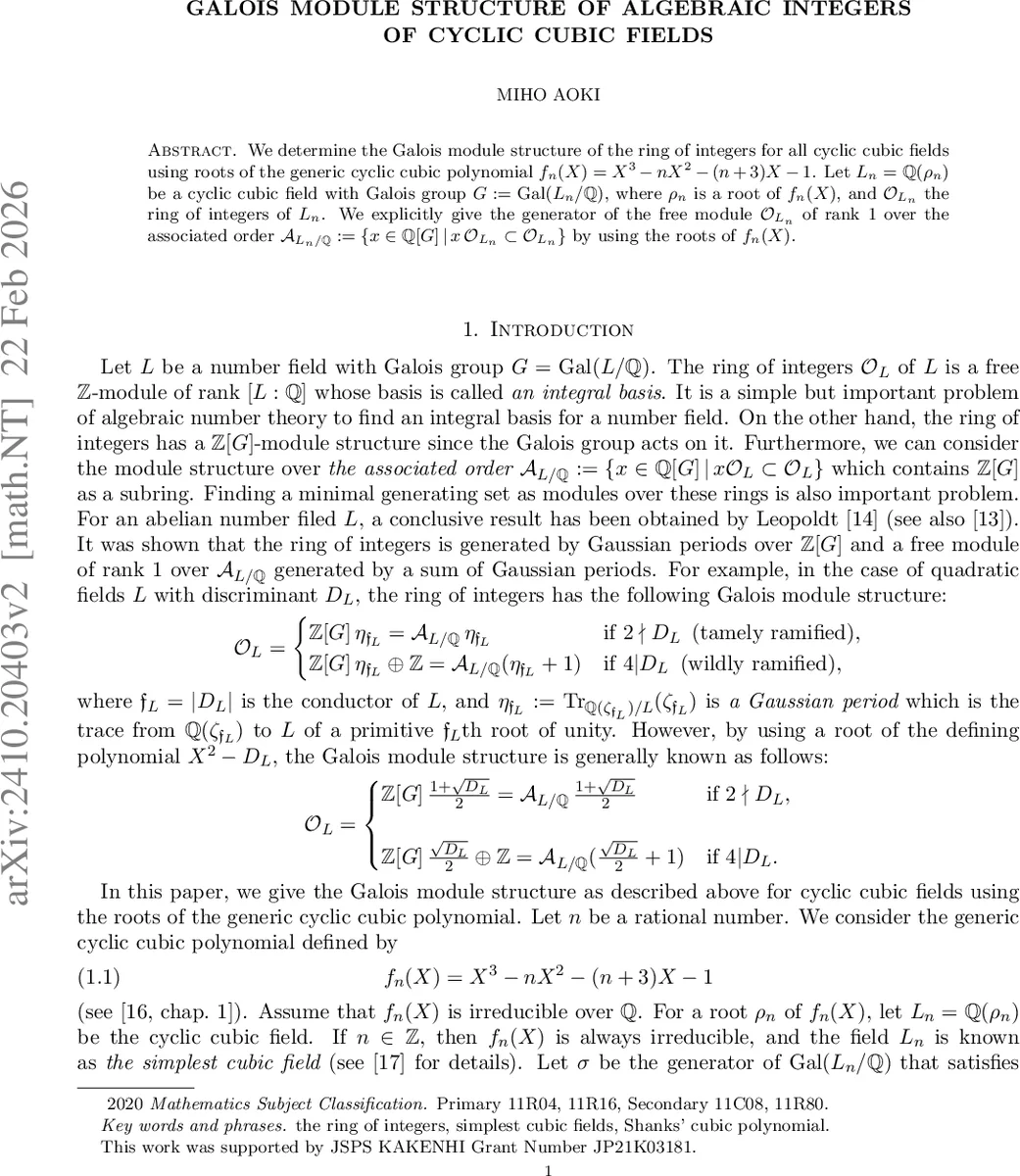
We determine the Galois module structure of the ring of integers for all cubic fields using roots of the generic cyclic cubic polynomial $f_n(X)=X^3-nX^2-(n+3)X-1$. Let $L_n=\mathbb Q(ρ_n)$ be a cyclic cubic field with Galois group $G:={\rm Gal}(L_n/\mathbb Q)$, where $ρ_n$ is a root of $f_n (X)$, and ${\mathcal O}{L_n}$ the ring of integers of $L_n$. We explicitly give the generator of the free module ${\mathcal O}{L_n}$ of rank $1$ over the associated order ${\mathcal A}{L_n/\mathbb Q}:= { x\in \mathbb Q [G] , |, x, {\mathcal O}{L_n} \subset {\mathcal O}_{L_n} }$ by using the roots of $f_n(X)$.
💡 Research Summary
The paper determines the Galois‑module structure of the ring of integers for every cyclic cubic field by exploiting the roots of the generic cyclic cubic polynomial
(f_n(X)=X^3-nX^2-(n+3)X-1).
For a rational parameter (n=n_1/n_2) (with coprime integers (n_1,n_2)), let (\rho_n) be a root of (f_n) and set (L_n=\mathbb{Q}(\rho_n)). The Galois group (G=\operatorname{Gal}(L_n/\mathbb{Q})) is cyclic of order three, generated by the automorphism (\sigma) defined by (\sigma(\rho_n)=-1/(1+\rho_n)). The authors first transform (f_n) into a monic cubic with integer coefficients,
(h_n(X)=X^3+aX+b), where
(a=-3\Delta_n/m^2) and (b=-(2n_1+3n_2)\Delta_n/m^3).
Here (\Delta_n=n_1^2+3n_1n_2+9n_2^2) is factored as (\Delta_n=d,e^2,c^3) with (d,e) square‑free and ((d,e)=1); the integer (m) is chosen as the largest divisor of both (3\Delta_n) and ((2n_1+3n_2)\Delta_n) that respects the square‑free decomposition. This reduction allows the use of Albert’s explicit integral‑basis theorem for cubic fields defined by a polynomial (X^3+aX+b). Consequently an explicit integral basis of (L_n) is obtained in terms of (\theta:=\frac{3n_2\rho_n-n^3}{m}), a root of (h_n), together with a correction term (r) that depends on the (p)-adic valuations of (a,b) and the discriminant (\Delta=4a^3+27b^2).
Having an explicit integral basis, the authors invoke Leopoldt’s theorem on the structure of (\mathcal{O}_L) as a (\mathbb{Z}
Comments & Academic Discussion
Loading comments...
Leave a Comment