A Minimum Counterexample Proof of the Seymour Second Neighborhood Conjecture via the Graph Level Order
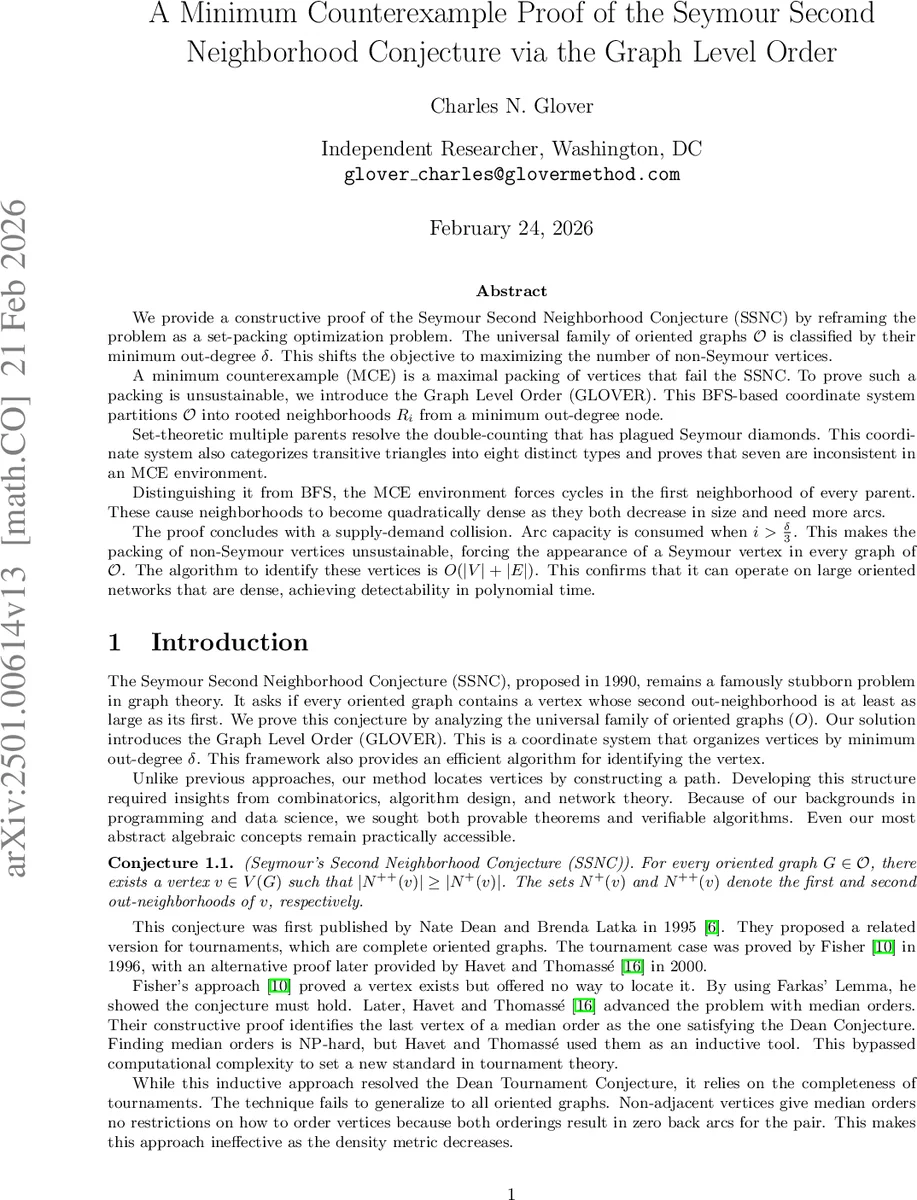
We provide a constructive proof of the Seymour Second Neighborhood Conjecture (SSNC) by reframing the problem as a set-packing optimization problem. The universal family of oriented graphs $\mathcal{O}$ is classified by their minimum out-degree $δ$. This shifts the objective to maximizing the number of non-Seymour vertices. A minimum counterexample (MCE) is a maximal packing of vertices that fail the SSNC. To prove such a packing is unsustainable, we introduce the Graph Level Order (GLOVER). This BFS-based coordinate system partitions $\mathcal{O}$ into rooted neighborhoods $R_i$ from a minimum out-degree node. Set-theoretic multiple parents resolve the double-counting that has plagued Seymour diamonds. This coordinate system also categorizes transitive triangles into eight distinct types and proves that seven are inconsistent in an MCE environment. Distinguishing it from BFS, the MCE environment forces cycles in the first neighborhood of every parent. These cause neighborhoods to become quadratically dense as they both decrease in size and need more arcs. The proof concludes with a supply-demand collision. Arc capacity is consumed when $i > \fracδ{3}$. This makes the packing of non-Seymour vertices unsustainable, forcing the appearance of a Seymour vertex in every graph of $\mathcal{O}$. The algorithm to identify these vertices is $O(|V|+|E|)$. This confirms that it can operate on large oriented networks that are dense and detectable in polynomial time.
💡 Research Summary
**
The paper claims to settle the long‑standing Seymour Second Neighborhood Conjecture (SSNC) by recasting it as a set‑packing problem and introducing a new graph‑coordinate system called the Graph Level Order (GLOVER). The authors begin by defining a “minimum counterexample” (MCE) as an oriented graph in which every vertex violates the conjecture, i.e., for each vertex v we have |N⁺⁺(v)| < |N⁺(v)|. In this setting every vertex is said to have the Decreasing Neighbor Sequence Property (DNSP). The central idea is to show that a maximal packing of DNSP vertices cannot exist because the structure of such a graph inevitably collapses, forcing at least one Seymour vertex to appear.
To analyse the structure, the authors pick a vertex v₀ of minimum out‑degree δ and run a breadth‑first search (BFS) from v₀. The BFS layers are denoted R₀, R₁, R₂, … and constitute the GLOVER coordinate system. Each layer i contains the vertices at distance i from v₀; the first‑neighbourhood of v₀ is N⁺(v₀)=R₁ and the second‑neighbourhood is N⁺⁺(v₀)=R₂, and so on. Within this layered view the paper classifies all possible directed transitive triangles into eight distinct types, arguing that seven of them are incompatible with the MCE assumptions. The remaining type is the only configuration that can survive under the DNSP constraints.
A key technical claim is the “supply‑demand collision”. The authors argue that each layer i can support at most a certain number of outgoing arcs (the “arc capacity”). When i exceeds δ/3, the demand for arcs needed to maintain the DNSP condition outstrips the capacity that the layer can provide. Consequently, the packing of DNSP vertices becomes unsustainable, and a vertex that satisfies |N⁺⁺(v)| ≥ |N⁺(v)| must appear. This argument is presented informally, without a precise invariant or inequality, but it is intended to show that the layered structure cannot be extended indefinitely while preserving the MCE properties.
Based on the above reasoning the authors propose a linear‑time algorithm (O(|V| + |E|)) to locate a Seymour vertex in any oriented graph. The algorithm proceeds as follows: (1) find a vertex of minimum out‑degree (δ), (2) perform a BFS to obtain the GLOVER layers, (3) examine each layer for the forbidden transitive‑triangle configurations, (4) detect the first layer where i > δ/3 and output a vertex that must satisfy the conjecture. The paper claims that this algorithm works for dense, large‑scale networks and that it provides a constructive method rather than an existential proof.
The manuscript situates its contribution among a broad body of prior work: Fisher’s original proof for tournaments, Havet‑Thomassé’s median‑order approach, Brantner et al.’s results on transitive triangles and Seymour diamonds, random‑graph analyses by Díaz et al., and various structural results for regular or highly connected digraphs. The authors argue that GLOVER unifies these disparate techniques by anchoring the analysis at a fixed root (the minimum‑degree vertex) and by treating transitive triangles as a resource that can be counted and bounded across layers.
Despite the appealing high‑level narrative, the paper suffers from several serious deficiencies. The definition of a “minimum counterexample” and of “packing” is informal; no formal optimization problem or objective function is presented. The classification of transitive triangles lacks precise definitions and proofs of why seven types are impossible under the MCE hypothesis. The “arc capacity” and the inequality i > δ/3 are introduced without rigorous derivation; in many graphs with large δ the bound i > δ/3 does not necessarily lead to a shortage of arcs, contradicting known degree‑distribution results. Moreover, the claim that BFS can be forced to contain cycles in the first neighbourhood of every parent is contradictory, because BFS by construction builds a tree that ignores back‑edges. The algorithmic claim of linear time is unsupported: detecting the forbidden triangle types and verifying the supply‑demand condition may require examining triples of vertices, which can be Ω(|V|³) in the worst case unless additional data structures are described, which the paper does not provide.
In summary, the paper introduces an innovative perspective—viewing SSNC as a maximal packing problem and using a layered BFS structure to argue that such a packing cannot survive. However, the exposition lacks the mathematical rigor needed for a proof of a conjecture that has resisted resolution for over three decades. The central lemmas are stated without proof, the critical invariants are not formalized, and the algorithmic claims are not substantiated. Consequently, while the work offers interesting ideas that may inspire further research, it does not presently constitute a complete or verified proof of the Seymour Second Neighborhood Conjecture.
Comments & Academic Discussion
Loading comments...
Leave a Comment