Polytopes of alternating sign matrices with dihedral-subgroup symmetry
We investigate the convex hulls of the eight dihedral symmetry classes of $n \times n$ alternating sign matrices, i.e., ASMs invariant under a subgroup of the symmetry group of the square. Extending the prefix-sum description of the ASM polytope, we …
Authors: Péter Madarasi
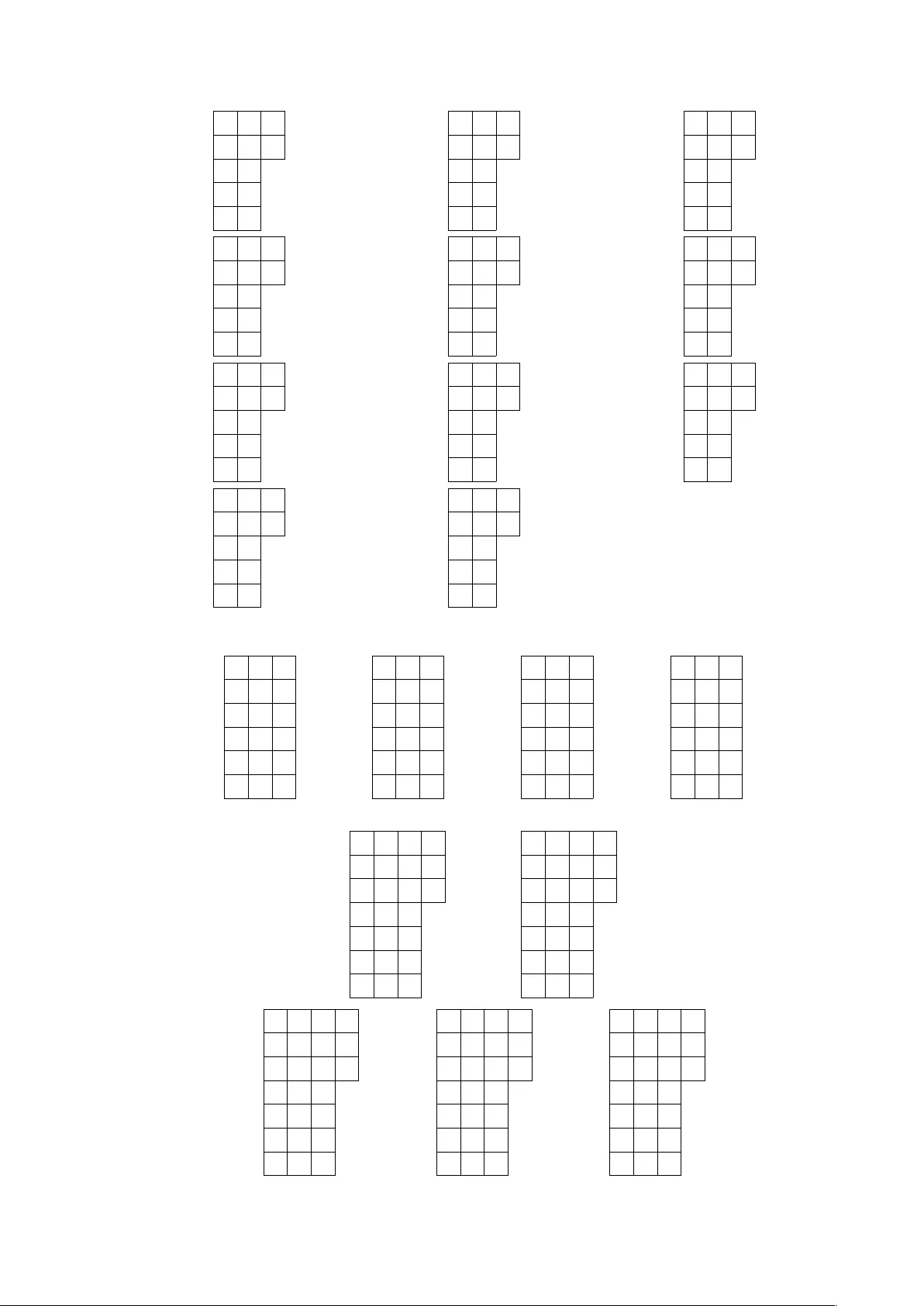
P olytop es of alternating sign matrices with dihedral-subgroup symmetry P ´ eter Madarasi ∗ Abstract W e in vestigate the con v ex hulls of the eigh t dihedral symmetry classes of n × n alternating sign matrices, i.e., ASMs in v ariant under a subgroup of the symmetry group of the square. Extending the prefix-sum description of the ASM p olytope, we dev elop a uniform core–assem bly framework: eac h symmetry class is enco ded b y a set of core p ositions and an affine assem bly map that reconstructs the full matrix from its core. This reduction transfers p olyhedral questions to low er-dimensional core polytop es, which are b etter suited to the to ol set of p olyhedral combinatorics, while retaining complete information ab out the original symmetry class. F or the vertical, vertical–horizon tal, half- turn, diagonal, diagonal–an tidiagonal, and total symmetry classes, w e give explicit p olynomial-size linear inequality descriptions of the associated polytop es. In these cases, w e also determine the dimension and provide facet descriptions. The quarter-turn symmetry class b eha ves differently: the natural relaxation admits fractional v ertices, and we need to extend the system with a structured family of parit y-type Chv´ atal–Gomory inequalities to obtain the quarter-turn symmetric ASM p olytope. Our framework leads to efficient algorithms for computing minim um-cost ASMs in each symmetry class and pro vides a direct link b et w een the combinatorics of symmetric ASMs and to ols from p olyhedral com binatorics and combinatorial optimization. Keyw ords: alternating sign matrices; dihedral symmetry classes; conv ex p olytopes; dimension; facet description; p olyhedral combinatorics. 1 In tro duction An alternating sign matrix (ASM) is an n × n matrix with en tries in { 0 , ± 1 } suc h that, in each ro w and each column, the non-zero entries alternate in sign and the first and last non-zero entries are 1. The symmetry group of the square is the dihedral group D 4 = {I , V , H , D , A , R π / 2 , R π , R − π / 2 } , which acts naturally on n × n matrices by reflections and rotations, where I denotes the iden tity , V , H , D , and A denote reflections in the v ertical, horizontal, diagonal, and an tidiagonal axes, resp ectively , and R θ denotes counterclockwise rotation b y angle θ . W e consider the subset of n × n ASMs that are inv ariant under a given subgroup G ⊆ D 4 . Any tw o subgroups that are conjugate in D 4 yield essentially the same symmetry class, and one finds that there are exactly eight distinct symmetry classes of ASMs up to conjugacy . Next, we list these classes, state the corresp onding in v ariance condition, and describ e the subgroup inv olved. 1. Unrestricted ASMs (ASMs) : No additional symmetry is imp osed b eyond the standard alternating-sign-matrix conditions. The symmetry subgroup is G = {I } . 2. V ertically symmetric ASMs (VSASMs) : The ASMs that are inv arian t under reflection across the vertical cen tral axis. The symmetry subgroup is G = {I , V } . 3. V ertically and horizon tally symmetric ASMs (VHSASMs) : The ASMs that are inv ariant under b oth v ertical and horizon tal reflections — and hence also under rotation by π induced b y comp osing them. The symmetry subgroup is G = {I , V , H , R π } . 4. Half-turn symmetric ASMs (HTSASMs) : The ASMs that are inv ariant under rotation b y π . The symmetry subgroup is G = {I , R π } . 5. Quarter-turn symmetric ASMs (QTSASMs) : The ASMs that are inv ariant under rotation b y π / 2 — and hence also under rotations by π and − π / 2. The symmetry subgroup is G = {I , R π / 2 , R π , R − π / 2 } . 6. Diagonally symmetric ASMs (DSASMs) : The ASMs that are in v ariant under reflection across the main diagonal. The symmetry subgroup is G = {I , D } . 7. Diagonally and antidiagonally symmetri c ASMs (DASASMs) : The ASMs that are inv ariant under re- flection across both the main diagonal and the antidiagonal, and hence also under rotation by π . The symmetry subgroup is G = {I , D , A , R π } . 8. T otally symmetric ASMs (TSASMs) : The ASMs that are in v arian t under the full dihedral symmetry group of the square, that is, under all reflections and rotations. The symmetry subgroup is G = D 4 . ∗ HUN-REN Alfr´ ed R´ enyi Institute of Mathematics, and Department of Op erations Research, E¨ otv¨ os Lor´ and Universit y Budap est, P´ azm´ an y P . s. 1/c, Budap est H-1117. E-mail: madarasi@renyi.hu 1 When w e say that a matrix is v ertically , horizontally , (anti)diagonally , half-turn, or quarter-turn symmetric, w e mean that it is in v ariant under the corresp onding reflection or rotation in D 4 , acting on matrix p ositions. The goal of this paper is to give explicit linear inequalit y descriptions for the con vex hulls of dihedrally symmetric alternating sign matrices. F or eac h size and for each of the seven non-trivial symmetry classes listed ab ov e, w e provide an explicit linear inequalit y system whose feasible region is exactly this conv ex hull, and w e study basic p olyhedral prop erties such as the dimension and the num b er of facets. Previous work. Alternating sign matrices rose to prominence through the conjectural pro duct formula of Mills, Robbins, and Rumsey for the num b er of ASMs [9], first pro ved b y Zeilberger [14] and later reprov ed by Kup erberg [7] via an alternativ e approach. A substan tial parallel literature is devoted to symmetric ASMs, where b oth existence and en umeration dep end delicately on the imp osed symmetry and on the parit y of n . These counts are closely connected to in tegrable lattice mo dels, most notably the six–v ertex model with symmetry-adapted b oundary conditions. In particular, Kup erberg’s framework expresses sev eral symmetry-class partition functions as determinants or Pfaffians, leading to pro duct formulas for a n umber of symmetry classes [8]. More recently , Behrend, Fisc her, and Koutsc han derived a Pfaffian formula for the enumeration of diagonally symmetric ASMs, pro viding an explicit expression for a symmetry class b ey ond the classical pro duct-form ula cases [1]. The p olyhedral approach to alternating sign matrices starts with a linear description of the ASM p olytope: Behrend and Knight [2], and indep enden tly , Strik er [12, 13] sho wed in 2007 that the conv ex hull P ASM of n × n ASMs admits a compact system of linear inequalities expressed in terms of prefix sums; we recall this fundamen tal characterization in Section 2. Building on this viewp oin t, Knight carried out a systematic p olyhedral study of dihedrally symmetric v ariants in his PhD thesis [6]. F or each subgroup G ⊆ D 4 , he considered the polytop e obtained as the intersection of the ASM p olytope with the G -inv ariance subspace, and inv estigated its vertices and Ehrhart (quasi-)p olynomial. A key outcome is that, for several symmetry classes, this naive relaxation has fractional vertices. Equiv alently , the conv ex h ull of G -inv ariant ASMs is in general a prop er subset of the intersection of P ASM and the G -inv ariance subspace; thus, the resulting symmetric ASM polytop es can exhibit gen uinely new and in tricate geometry . Finally , we note that Theorem 6.7 in [3] implies that, for each dihedral symmetry class, the matrices in the class are all vertices of their conv ex hull. Our con tribution. F or eac h dihedral symmetry class XASM, we in tro duce a uniform c or e–assembly reduction: we sp ecify a set of core p ositions C and an affine assembly map φ : R C → R n × n suc h that every XASM is uniquely determined by its core, and φ reconstructs the full matrix from its core. Consequently , the conv ex hull P XASM of XASMs is affinely isomorphic to a low er-dimensional c or e p olytop e P core XASM , and p olyhedral questions ab out P XASM can b e studied on P core XASM . W e then translate the ASM prefix-sum constraints to the cores and deriv e explicit linear descriptions of the core p olytop es and hence of the symmetric ASM polytop es. F or the vertical, v ertical–horizontal, half-turn, diagonal, diagonal–an tidiagonal, and total symmetry classes, these descriptions hav e polynomial size; moreov er, we determine the dimension and identify the facet-defining inequalities, yielding closed-form expressions for the n umber of facets. The quarter-turn class b eha ves differen tly from the other symmetry classes: b esides the usual ASM constraints and the quarter-turn symmetry equations, it seems that an exp onen tial num b er of additional inequalities is needed to cut off fractional solutions. In particular, we derive a structured family of parity-t yp e Chv´ atal–Gomory inequalities that remo ves these fractional solutions and yields a complete description of the con vex h ull of QTSASMs, but w e do not deriv e the dimension and determine the facets in this case. Our approach also pro vides efficien t algorithms for computing minim um-cost ASMs in each symmetry class. T able 1 summarizes the dimensions and the facet counts for different symmetry classes. Symmetry class Dimension Num b er of facets ASM ( n − 1) 2 [2, 12, 13] 4 ( n − 2) 2 + 1 if n ≥ 3 [12, 13] VSASM (2 ∤ n ) ( n − 3) 2 2 if n ≥ 3 2 n 2 − 19 n + 49 if n ≥ 7 VHSASM (2 ∤ n ) ( n − 5) 2 4 if n ≥ 5 n 2 − 15 n + 60 if n ≥ 9 HTSASM l ( n − 1) 2 2 m 2 ( n − 2) 2 + χ 2 | n if n ≥ 4 DSASM n ( n − 1) 2 2( n − 2) 2 + 3 if n ≥ 3 D ASASM j n 2 4 k ( n − 2) 2 + 2 if n ≥ 2 TSASM (2 ∤ n ) ( n − 5)( n − 3) 8 if n ≥ 3 n 2 − 15 n +62 2 if n ≥ 9 T able 1: Summary of the dimensions and facet counts. 2 Organization of the pap er. W e conclude this section by introducing notation and by presenting the core–assembly framew ork used throughout. Section 2 recalls the prefix-sum description of the ASM p olytop e. Sections 3–9 treat the remaining symmetry classes in turn, following the uniform core–assembly approach. 1.1 Preliminaries W e start by in troducing our notation. F or a symmetry class XASM, w e denote the set of n × n XASMs b y XASM( n ), and the con v ex h ull of XASMs in R n × n b y P XASM( n ) . W e often write P XASM if n is clear from the context. F or in tegers n ≤ m , w e write [ n, m ] = { n, . . . , m } , and w e set [ n, m ] = ∅ whenever n > m . F or an in teger n , we use the shorthand [ n ] = [1 , n ]. F or X ∈ R m × n and I ⊆ [ m ], J ⊆ [ n ], let X I ,J ∈ R | I |×| J | b e the submatrix formed by the ro ws with indices in I and columns with indices in J . F or singleton index sets, we use the shorthand X i,J = X { i } ,J , X I ,j = X I , { j } , X i,j = X { i } , { j } . W e often write x i,j for the en try X i,j . F or a finite set S and a subset T ⊆ S , w e write χ T ∈ { 0 , 1 } S for the c haracteristic v ector of T ; for a singleton, we abbreviate χ s = χ { s } ; and for S = [ n ] × [ n ] w e write χ i,j for the unit v ector supp orted on ( i, j ). When the subscript is a predicate P (e.g., χ 2 | n ), we interpret χ P as the scalar indicator of P , i.e., χ P = 1 if P holds and 0 otherwise. F or a finite set S and a function f : S → R , we extend f to subsets T ⊆ S b y f ( T ) = P t ∈ T f ( t ). W e do not distinguish b etw een row and column vectors; expressions are interpreted so that all pro ducts are conformable, with inner pro ducts preferred. No w w e summarize some basic results that w e will rely on throughout the man uscript. The following basic observ ation w as form ulated in [4] as Theorem (39); see also Theorem 41.11 in [11]. Theorem 1.1 (Edmonds [4]) . L et L b e the union of two laminar families on a gr ound set S . Then the incidenc e matrix of L is total ly unimo dular. T ogether with the well-kno wn fact that a system with a totally unimo dular constraint matrix and integer right-hand side has an in tegral feasible region, this yields the following consequence. Theorem 1.2. L et L 1 , L 2 ⊆ 2 S b e two laminar families on a gr ound set S , and let f i , g i : L i → Z b e inte ger-value d b ounding functions for i = 1 , 2 . Then the line ar ine quality system x s ∈ R ∀ s ∈ S, (1.1) f 1 ( Z ) ≤ X s ∈ Z x s ≤ g 1 ( Z ) ∀ Z ∈ L 1 , (1.2) f 2 ( Z ) ≤ X s ∈ Z x s ≤ g 2 ( Z ) ∀ Z ∈ L 2 (1.3) defines an inte gr al p olyhe dr on. Another standard source of in tegrality in our argumen ts relies on the fact that the incidence matrices of directed graphs are totally unimo dular, which implies the following. Theorem 1.3. L et M ∈ {− 1 , 0 , 1 } m × n b e the no de–ar c incidenc e matrix of a digr aph or its tr ansp ose. Then, for any inte ger ve ctors a, b ∈ Z m and c, d ∈ Z n , the line ar ine quality system { x ∈ R n : c ≤ x ≤ d, a ≤ M x ≤ b } defines an inte gr al p olyhe dr on. In the quarter-turn case, we rely on an explicit p olyhedral description of the conv ex hull of the in teger points defined by a linear inequality system with a bidirected constraint matrix, i.e., an integer matrix M ∈ Z m × n suc h that P m i =1 | M ij | = 2 for ev ery j ∈ [ n ]. The following theorem was first prop osed in [5]; see also [11, Chapter 36]. Theorem 1.4 (Edmonds and Johnson [5]) . F or a bidir e cte d matrix M ∈ Z m × n and for arbitr ary ve ctors a, b ∈ Z m and c, d ∈ Z n , the c onvex hul l of the inte ger solutions to { x ∈ Z n : c ≤ x ≤ d, a ≤ M x ≤ b } is describ e d by the system x ∈ R n , (1.4a) c ≤ x ≤ d, (1.4b) a ≤ M x ≤ b, (1.4c) ( χ U − χ V ) M + χ F − χ H x 2 ≤ b ( U ) − a ( V ) + d ( F ) − c ( H ) 2 for every disjoint U, V ⊆ [ m ] and p artition F , H of δ ( U ∪ V ) , (1.4d) wher e δ ( U ∪ V ) = { j ∈ [ n ] : P i ∈ U ∪ V | M ij | = 1 } . W e will rep eatedly use the following elementary rank statement when determining the dimensions of our p olytopes. Since it follows from a routine linear-algebra argument, we omit its pro of. 3 Lemma 1.5. L et m, n ≥ 1 b e inte gers, r ∈ R m , and c ∈ R n . Consider the system x i,j ∈ R ∀ i ∈ [ m ] , j ∈ [ n ] , (1.5) n X j =1 x i,j = r i ∀ i ∈ [ m ] , (1.6) m X i =1 x i,j = c j ∀ j ∈ [ n ] . (1.7) Then the c o efficient matrix of the e quations in (1.6) and (1.7) has r ank m + n − 1 , and any subsystem obtaine d by deleting one e quation is line arly indep endent. A recurring step in our facet pro ofs is to show that a prop osed inequality description is minimal. F or this, we inv oke the following classical result: after splitting off the implicit equations of a non-empty p olyhedron, the facets are exactly the supp orting h yp erplanes given b y the non-redundant remaining inequalities, and each suc h inequality defines a unique facet; see, for example, Theorem 8.1 in [10]. F ormally , we state the following theorem. Theorem 1.6. L et P = { x : Ax ≤ b } b e non-empty. Partition the ine qualities of Ax ≤ b into those that ar e tight for al l x ∈ P (implicit e quations) and the r emaining ones; denote these subsystems by A = x = b = and A + x ≤ b + , r esp e ctively. Assume no ine quality in A + x ≤ b + is r e dundant in the ful l system Ax ≤ b . Then e ach fac et of P has the form F = { x ∈ P : a i x = b i } for a unique ine quality a i x ≤ b i fr om A + x ≤ b + , yielding a bije ction b etwe en fac ets of P and ine qualities in A + x ≤ b + . 1.2 General core and assem bly setup W e no w formalize a reduction used throughout the paper. Fix a symmetry class XASM of ASMs of size n ≥ 1. Let C ⊆ [ n ] × [ n ] b e a set of p ositions of an n × n matrix, called the core p ositions for XASMs, and let π C : R n × n → R C denote the co ordinate-wise pro jection onto C . F or an n × n matrix X , its pro jection π C ( X ) is referred to as the core of X . W e call an affine map φ : R C → R n × n an assem bly map if π C ( φ ( Y )) = Y for ev ery Y ∈ R C , and φ ( π C ( X )) = X for ev ery X ∈ XASM( n ). Note that φ is injective by the first condition: for ev ery Y , Y ′ ∈ R C , if φ ( Y ) = φ ( Y ′ ), then Y = π C ( φ ( Y )) = π C ( φ ( Y ′ )) = Y ′ . W e often denote an n × n matrix — typically an XASM or an elemen t of the conv ex h ull of XASMs — by X , and its core b y Y . Define the core p olytope for XASMs as P core XASM = con v { π C ( X ) : X ∈ XASM( n ) } ⊆ R C , and also in tro duce the lifting of the core p olytop e b P core XASM = { X ∈ R n × n : π C ( X ) ∈ P core XASM } . Theorem 1.7. With the setup ab ove, P XASM = φ ( P core XASM ) = b P core XASM ∩ φ ( R C ) . Pr o of. First, w e pro ve that φ ( P core XASM ) ⊆ P XASM . Let Y ∈ P core XASM and write Y = P t λ t ( π C ( X t )) as a conv ex com bination of the matrices X t ∈ XASM( n ) pro jected to the core. By affinit y and the second prop ert y of φ , φ ( Y ) = X t λ t φ ( π C ( X t )) = X t λ t X t ∈ conv(XASM) = P XASM . F or the reverse inclusion, let X = P t λ t X t b e a conv ex combination with X t ∈ XASM( n ). Again by affinity and the second prop ert y of φ , X = X t λ t φ ( π C ( X t )) = φ X t λ t π C ( X t ) ∈ φ ( P core XASM ) . W e conclude that P XASM = φ ( P core XASM ). It remains to pro ve that φ ( P core XASM ) = b P core XASM ∩ φ ( R C ). First, let X = φ ( Y ) with Y ∈ P core XASM . Then π C ( X ) = π C ( φ ( Y )) = Y ∈ P core XASM b y the first prop ert y of φ , so X ∈ b P core XASM . Conv ersely , let X ∈ b P core XASM ∩ φ ( R C ) and write X = φ ( Y ) for some Y ∈ R C . Since X ∈ b P core XASM , w e hav e Y = π C ( X ) ∈ P core XASM b y the first prop ert y of φ ; hence X = φ ( Y ) ∈ φ ( P core XASM ). 2 Unrestricted alternating sign matrices (ASMs) In this section, we study the conv ex h ull of n × n alternating sign matrices, without imp osing an y additional sym- metry constrain ts. W e recall a fundamental description of this polytop e via linear inequality constraints, established indep enden tly by Behrend and Knight, and b y Striker in 2007. 4 Theorem 2.1 (Behrend and Knight [2], and Strik er [12, 13]) . The c onvex hul l P ASM of ASMs is the set of r e al n × n matric es satisfying the system x i,j ∈ R ∀ i, j ∈ [ n ] , (2.1) 0 ≤ j X j ′ =1 x i,j ′ ≤ 1 ∀ i ∈ [ n ] , j ∈ [ n − 1] , (2.2) 0 ≤ i X i ′ =1 x i ′ ,j ≤ 1 ∀ i ∈ [ n − 1] , j ∈ [ n ] , (2.3) n X j =1 x i,j = 1 ∀ i ∈ [ n ] , (2.4) n X i =1 x i,j = 1 ∀ j ∈ [ n ] . (2.5) Constrain ts (2.2) and (2.3) require that, for eac h fixed row, the row-prefix sums other than the full row sum lie b et w een 0 and 1; similarly , the column-prefix sums other than the full column sum lie b etw een 0 and 1. Meanwhile, constrain ts (2.4) and (2.5) enforce that each ro w and each column of the matrix sums to 1. The dimension of P ASM and the num b er of its facets are already known in the literature: Theorem 2.2 (Behrend and Knight [2], and Striker [12, 13]) . The dimension of P ASM is ( n − 1) 2 for n ≥ 3 . Theorem 2.3 (Striker [12, 13]) . The numb er of fac ets of P ASM is 4(( n − 2) 2 + 1) for n ≥ 3 . 3 V ertically symmetric ASMs (VSASMs) W e consider those n × n alternating sign matrices that remain unchanged under reflection across the vertical axis. The corresp onding symmetry subgroup is G = {I , V } . Let P VS denote the p olyhedron of vertically symmetric real matrices, i.e., P VS = X ∈ R n × n : x i,j = x i,n +1 − j ∀ i, j ∈ [ n ] . Clearly , any VSASM satisfies the ASM constrain ts (2.1)–(2.5) and also the symmetry constrain ts defining P VS ; thus P VSASM ⊆ P ASM ∩ P VS . W e note, ho w ever, that P ASM ∩ P VS do es not equal P VSASM . In fact, we sho w that P VSASM ⊂ P ASM ∩ P VS for ev ery n ≥ 2. Let I n and I ′ n denote the n × n iden tit y matrix and its reflection across the vertical axis. It is easy to see that the fractional matrix 1 2 ( I n + I ′ n ) is a v ertex of P ASM ∩ P VS ; e.g., for n = 3, we ha ve I 3 + I ′ 3 2 = 1 / 2 0 1 / 2 0 1 0 1 / 2 0 1 / 2 . Lemma 3.1. Ther e is no n × n VSASM if n is even. Pr o of. Let n b e even and set k = n/ 2. In any vertically symmetric integer matrix X ∈ Z n × n , each row i is palindromic, i.e., X i, [ n ] = ( x i, 1 , . . . , x i,k , x i,k , . . . , x i, 1 ) for i ∈ [ n ]. Therefore, the sum of the entries in row i is P n j =1 x i,j = 2 P k j =1 x i,j , whic h is an even integer for every i ∈ [ n ]. On the other hand, in any ASM, every row sums to 1. Hence no n × n VSASM exists for even n . Th us, P VSASM = ∅ for even n ; hence, we assume that n is o dd in the rest of the section. W e need the following tw o lemmas b efore in tro ducing the core and assembly map for VSASMs. Lemma 3.2. L et x ∈ Z n b e a ve ctor of o dd length n = 2 k + 1 such that 1) it is symmetric, i.e., x j = x n +1 − j for every j ∈ [ k ] , 2) the first k pr efix sums lie in { 0 , 1 } , and 3) the total sum of entries is 1 . Then x k +1 = 1 − 2 P k j =1 x j ∈ {± 1 } and al l pr efix sums lie in { 0 , 1 } . Pr o of. By symmetry , P n j =1 x j = 2 P k j =1 x j + x k +1 . Since the total sum equals 1, we hav e x k +1 = 1 − 2 P k j =1 x j ∈ {± 1 } . F or any r ∈ [ k + 1], w e ha ve P k + r j =1 x j = 1 − P n j = k +1+ r x j = 1 − P k +1 − r j =1 x j , where the last equality follo ws from symmetry . F or r ∈ [ k + 1], the sum P k +1 − r j =1 x j lies in { 0 , 1 } by assumption, thus so do es the sum P k + r j =1 x j . Hence every prefix sum of x lies in { 0 , 1 } . 5 Lemma 3.3. L et n ≥ 1 b e o dd and set k = ⌊ n/ 2 ⌋ . F or every VSASM X ∈ { 0 , ± 1 } n × n , we have x i,k +1 = ( − 1) i +1 for every i ∈ [ n ] . Pr o of. Applying Lemma 3.2 to each ro w of X , we obtain that the middle column has no zeros, i.e., x i,k +1 ∈ {± 1 } for ev ery i ∈ [ n ]. In an y column of an ASM, the non-zero entries alternate in sign and the first non-zero entry is +1; therefore, the entry in the central column in row i must b e x i,k +1 = ( − 1) i +1 for every i ∈ [ n ]. Core and assembly map. Assume n is o dd and let k = ⌊ n/ 2 ⌋ . Let the core of a VSASM b e its left n × k block, i.e., C = [ n ] × [ k ] is the set of core p ositions , and let π C b e the co ordinate-wise pro jection onto C . Define the affine map φ : R C → R n × n b y φ ( Y ) i,j = y i,j if j ∈ [ k ] , ( − 1) i +1 if j = k + 1 , y i,n +1 − j if j ∈ [ k + 2 , n ] for Y ∈ R C and i, j ∈ [ n ]. Thus φ places the core Y on the left, fixes the middle column to the alternating v ector from Lemma 3.3, and fills the right n × k blo c k by v ertical reflection. Clearly , the map φ is an assem bly map: it is affine, satisfies π C ( φ ( Y )) = Y for every Y ∈ R C , and φ ( π C ( X )) = X for every X ∈ VSASM( n ), because X is determined b y its core together with the prescrib ed middle column and vertical symmetry . W e now describ e the core p olytop e of VSASMs. Theorem 3.4. L et n ≥ 1 b e o dd, and set k = ⌊ n/ 2 ⌋ . Then the c or e p olytop e P core VSASM ⊆ R C of n × n VSASMs is describ e d by the fol lowing system. y i,j ∈ R ∀ i ∈ [ n ] , j ∈ [ k ] , (3.1) 0 ≤ j X j ′ =1 y i,j ′ ≤ 1 ∀ i ∈ [ n ] , j ∈ [ k − 1] , (3.2) 0 ≤ i X i ′ =1 y i ′ ,j ≤ 1 ∀ i ∈ [ n − 1] , j ∈ [ k ] , (3.3) k X j =1 y i,j = χ 2 | i ∀ i ∈ [ n ] , (3.4) n X i =1 y i,j = 1 ∀ j ∈ [ k ] . (3.5) Pr o of. W e show that the integer solutions to the system (3.1)–(3.5) are exactly the cores of VSASMs, and then we argue that the system defines an integral p olytope. First, let X b e an n × n VSASM, and let Y be its core, that is, y i,j = x i,j for ev ery i ∈ [ n ] and j ∈ [ k ]. Since ev ery VSASM is in particular an ASM, the ASM constraints (2.1), (2.2), (2.3), and (2.5) in Theorem 2.1 directly imply (3.1), (3.2), (3.3), and (3.5) for Y . F or the row-sum constraints (3.4), Lemma 3.3 gives x i,k +1 = ( − 1) i +1 for every i ∈ [ n ]; hence, for every i ∈ [ n ], k X j =1 y i,j = k X j =1 x i,j = 1 − x i,k +1 2 = χ 2 | i as required. Thus the cores of VSASMs satisfy (3.1)–(3.5). Second, we show that every integer solution to (3.1)–(3.5) is the core of a VSASM. Let Y ∈ Z C satisfy (3.1)–(3.5), and set X = φ ( Y ). By construction, X is vertically symmetric n × n in teger matrix, its middle column is given by x i,k +1 = ( − 1) i +1 for i ∈ [ n ], and its core is Y . W e verify that X satisfies the ASM constraints given in Theorem 2.1. F or i ∈ [ n ], w e obtain n X j =1 x i,j = k X j =1 y i,j + x i,k +1 + k X j =1 y i,j = 2 χ 2 | i + ( − 1) i +1 = 1 for the sum of ro w i , by (3.4). F urthermore, the prefix sums within each row of X are in { 0 , 1 } by (3.2), (3.4), and Lemma 3.2; thus the row-prefix constraints hold for X . F or j ∈ [ k ], column j sums to 1 b y (3.5). F or j = k + 1, the 6 middle column en tries alternate b et w een +1 and − 1, with the first entry equal to +1; and since n is o dd, this column also sums to 1. The prefix b ounds for column j coincide with (3.3) for j ∈ [ k ], and in the middle column j = k + 1, the en tries alternate b et w een +1 and − 1, with the first entry equal to +1; so ev ery prefix sum is either 0 or 1. F or the last k columns, the constrain ts follo w by vertical symmetry . Thus X ∈ Z n × n satisfies all ASM constraints in Theorem 2.1, hence X is an ASM. W e conclude that the integer solutions to the system (3.1)–(3.5) are exactly the cores of VSASMs. It remains to prov e that (3.1)–(3.5) define an integral polytop e. Observe that (3.1)–(3.5) imp ose low er and upp er b ounds on the sums of the entries within prefixes of each row and column. Therefore, the cores of VSASMs are so- called prefix-b ounded matrices , and the p olytope of prefix-b ounded matrices is known to b e describ ed by the system ab o v e [3]. Alternativ ely , the result also directly follows from Theorem 1.2 applied to the laminar families of row and column prefixes. F rom Theorems 1.7 and 3.4, we obtain the following description of the p olytop e P VSASM of VSASMs. Theorem 3.5. L et n ≥ 1 b e o dd, and let k = ⌊ n/ 2 ⌋ and b P core VSASM = { X ∈ R n × n : π C ( X ) ∈ P core VSASM } . Then P VSASM = b P core VSASM ∩ P VS ∩ { X ∈ R n × n : x i,k +1 = ( − 1) i +1 ∀ i ∈ [ n ] } . Pr o of. By Theorems 1.7 and 3.4, it suffices to prov e that φ ( R C ) = P VS ∩ { X ∈ R n × n : x i,k +1 = ( − 1) i +1 ∀ i ∈ [ n ] } . Let P denote the right-hand side. By definition, φ inserts its argument as the left half, fixes the i th en try of the middle column to ( − 1) i +1 for every i , and fills the right half by v ertical reflection. Thus, φ ( Y ) ∈ P for every Y ∈ R C . Conv ersely , take an y X ∈ P , and notice that φ ( π C ( X )) = X ; hence X ∈ φ ( R C ). Theorem 3.6. L et n ≥ 1 b e arbitr ary, and set k = ⌊ n/ 2 ⌋ . Then P VSASM = P ASM ∩ P VS ∩ { X ∈ R n × n : x i,k +1 = ( − 1) i +1 ∀ i ∈ [ n ] } . Pr o of. F or o dd n , we obtain the statement b y straightforw ard transformations of the system giv en in Theorem 3.4. F or ev en n , the p olytope P VSASM is empty; th us w e need to show that the right-hand side is empt y as w ell. Notice that { X ∈ R n × n : x i,k +1 = ( − 1) i +1 ∀ i ∈ [ n ] } forces the en tries in column k + 1 to alternate b et ween +1 and − 1, with the first entry equal to +1; and thus P n i =1 x i,k +1 = 0. On the other hand, (2.5) gives P n i =1 x i,k +1 = 1; th us the right-hand side is empty . Next, we discuss the dimension of P VSASM for o dd n . Theorem 3.7. F or every o dd n ≥ 3 , the dimension of P VSASM is ( n − 3) 2 2 . Pr o of. It suffices to prov e that the dimension of P core VSASM is ( n − 3) 2 2 , b ecause the assembly map φ restricts to an affine isomorphism b et ween P core VSASM and P VSASM , whic h preserves dimension. First, we give an upper b ound. Observe that (3.3) together with (3.4) and (3.5) forces all row-prefix sums in rows 1 and n to b e 0; hence y 1 ,j = 0 ∀ j ∈ [ k ] , (3.6) y n,j = 0 ∀ j ∈ [ k ] . (3.7) Using the equations in (3.6) and (3.7), we eliminate the v ariables y 1 ,j and y n,j from the column-sum equations (3.5) as follo ws: for eac h j ∈ [ k ], we replace the j th equation of (3.5) b y the difference of that equation and the tw o equations y 1 ,j = 0 and y n,j = 0. This elementary row op eration do es not change the solution set, so it do es not c hange the rank of the equation system. After this replacemen t, none of the mo dified equations in (3.5) in volv es a v ariable of the form y 1 ,j or y n,j . Moreo ver, the equations in (3.4) for i ∈ { 1 , n } b ecome redundant. By Lemma 1.5, n + k − 3 independent equations remain in (3.4) and (3.5), which — after the elimination — inv olv e only v ariables y i,j with i ∈ [2 , n − 1], and th us hav e disjoint support from (3.6) and (3.7). W e obtain ( n + k − 3) + 2 k = 5 k − 2 indep enden t equations. These define an affine subspace of dimension | C | − (5 k − 2) = nk − (5 k − 2) = 2 k 2 − 4 k + 2 = ( n − 3) 2 2 , which contains P core VSASM and hence gives the b ound dim( P core VSASM ) ≤ ( n − 3) 2 2 . Second, we construct ( n − 3) 2 2 + 1 affinely indep enden t cores in P core VSASM and hence obtain a matching low er b ound. Let Y denote the av erage of the cores of VSASMs. W e claim that Y reaches neither the low er nor the upp er b ound in (3.2) for any i ∈ [2 , n − 1] , j ∈ [ k − 1]. It suffices to show that, for each such pair i and j , there exists a VSASM for which the sum of the first j entries in ro w i is 1, and there exists a VSASM for whic h this sum is 0. T o see this, place a k × k p erm utation matrix into the submatrix formed b y the first k entries of the k ro ws with even index in such a wa y that y i, 1 = 1 for some fixed even i ∈ [2 , n − 1]; and fill the rest of the core entries with 0. F or each ev en i ∈ [2 , n − 1], we obtain the core of a VSASM in which, for the fixed index i , the sum of the first j entries in ro w i equals 1 for ev ery j ∈ [ k ], and equals 0 for ev ery ro w with o dd index and every j ∈ [ k ]. 7 Next, set y i,k = ( − 1) i for every i ∈ [2 , n − 1]. Place a ( k − 1) × ( k − 1) p erm utation matrix in to the submatrix formed b y the first k − 1 entries of the k − 1 rows with o dd index in such a w ay that y i, 1 = 1 for some fixed o dd i ∈ [3 , n − 2]; and fill the rest of the core en tries with 0. This yields the core of a VSASM in which, for the fixed index i , the sum of the first j entries in row i equals 1 for every j ∈ [ k − 1], and equals 0 for every even i ∈ [2 , n − 1] and every j ∈ [ k − 1]. Th us, Y do es not reach equality in (3.2) for an y i ∈ [2 , n − 1] , j ∈ [ k − 1]. An analogous argument shows that Y do es not reac h equalit y in (3.3) for an y i ∈ [2 , n − 2] , j ∈ [ k ]. F or each i ∈ [2 , n − 2] , j ∈ [ k − 1], define Y i,j = Y + εχ i,j − εχ i,k − εχ n − 1 ,j + εχ n − 1 ,k , where ε is a small positive constan t. By the argument ab o ve, Y i,j do es not violate (3.2) and (3.3) when ε > 0 is small enough, and it fulfills (3.4) and (3.5) by the definition of Y i,j ; thus Y i,j ∈ P core VSASM . The cores Y and Y i,j for i ∈ [2 , n − 2] , j ∈ [ k − 1] are affinely indep enden t: only the difference Y i,j − Y has a non-zero en try at ( i, j ), so the cores { Y i,j − Y : i ∈ [2 , n − 2] , j ∈ [ k − 1] } are linearly indep enden t. Therefore, the dimension of P core VSASM is at least ( n − 3)( k − 1) = ( n − 3) 2 2 . Com bining the low er and upp er b ounds yields dim( P core VSASM ) = dim( P VSASM ) = ( n − 3) 2 2 . Theorem 3.8. L et n ≥ 7 b e o dd, and set k = ⌊ n/ 2 ⌋ . The fac ets of P core VSASM ar e given by tightening the lower b ound in (3.2) to e quality for ( i, j ) ∈ { ( i, j ) : i ∈ [3 , n − 2] , j ∈ [ k − 1 − χ 2 | i ] } and the upp er b ound for ( i, j ) ∈ { ( i, j ) : i ∈ [4 , n − 3] , j ∈ [2 , k − 1 − χ 2 ∤ i ] } ; and by tightening the lower b ound in (3.3) to e quality for ( i, j ) ∈ { (2 , 1) } ∪ { ( i, j ) : i ∈ [2 , n − 4] , j ∈ [2 , k − χ 2 | i ] } , and the upp er b ound for ( i, j ) ∈ { ( n − 2 , 1) } ∪ { ( i, j ) : i ∈ [4 , n − 2] , j ∈ [2 , k − χ 2 ∤ i ] } . In p articular, the numb er of fac ets of P core VSASM is 2 n 2 − 19 n + 49 . Pr o of. The facets are obtained b y tightening a single inequality in (3.2) or (3.3) to equality for the index pairs listed in the statement of the theorem. W e call the instances of the lo wer b ounds in (3.2) that are tigh tened to equality the horizontal fac et lower b ounds , and w e define the horizontal fac et upp er b ounds analogously . Likewise, w e call the instances of the low er b ounds in (3.3) that are tightened to equality the vertic al fac et lower b ounds , and we define the vertic al fac et upp er b ounds analogously . W e refer to the union of these four families as the fac et ine qualities . W e pro ceed in tw o steps. First, we show that the facet inequalities together w ith (3.4)–(3.7) imply every inequality in (3.2) and (3.3). Then, for every facet inequality , we establish a core of an n × n matrix violating that facet inequalit y and no other, thereb y pro ving that no facet inequality is redundant. The core Y constructed in the second step of the pro of of Theorem 3.7 shows that none of the facet inequalities are implicit equations; thus the tw o steps together imply that the facet inequalities form a minimal system that, extended with (3.4)–(3.7), describ es the conv ex h ull of the cores of VSASMs, which pro ves the theorem. Next, we prov e that the facet inequalities together with (3.4)–(3.7) imply every inequality in (3.2) and (3.3). Clearly , w e need to treat only those inequalities in (3.2) and (3.3) that are non-fac et inequalities, namely , the low er bounds in (3.2) for ( i, j ) ∈ { 1 , 2 , n − 1 , n } × [ k − 1] ∪ { i ∈ [4 , n − 3] : 2 | i } × { k − 1 } and the upp er b ounds for ( i, j ) ∈ { 1 , 2 , 3 , n − 2 , n − 1 , n } × [ k − 1] ∪ [4 , n − 3] × { 1 } ∪ { i ∈ [5 , n − 4] : 2 ∤ i } × { k − 1 } ; and the low er b ounds in (3.3) for ( i, j ) ∈ { 1 } × [ k ] ∪ [3 , n − 1] × { 1 } ∪ { n − 3 , n − 2 , n − 1 } × [2 , k ] ∪ { i ∈ [2 , n − 5] : 2 | i } × { k } and the upp er b ounds for ( i, j ) ∈ { 1 , 2 , 3 , n − 1 } × [ k ] ∪ [4 , n − 3] × { 1 } ∪ { i ∈ [5 , n − 2] : 2 ∤ i } × { k } . W e start with the non-facet inequalities in (3.2). By (3.6) and (3.7), we hav e y 1 ,j = y n,j = 0 for j ∈ [ k ]; hence the b ounds in (3.2) hold for i ∈ { 1 , n } , j ∈ [ k − 1]. The v ertical facet low er b ound at (2 , 1) gives y 2 , 1 ≥ 0, and the horizontal facet low er b ounds at ( i, 1) give y i, 1 ≥ 0 for all i ∈ [3 , n − 2]. Moreov er, the vertical facet upp er b ound at ( n − 2 , 1) yields P n − 2 i ′ =1 y i ′ , 1 ≤ 1, hence y n − 1 , 1 = 1 − P n − 2 i ′ =1 y i ′ , 1 ≥ 0 by (3.5) and (3.7). Consequently y i, 1 ≥ 0 for all i ∈ [ n ], which also implies y i, 1 ≤ 1 for all i ∈ [ n ] by (3.5) for j = 1, thus the non-facet row-prefix upp er b ounds at ( i, 1) for i ∈ [ n ] hold. F or i = 2 , j ∈ [ k − 1], the v ertical facet low e r b ound giv es y 2 ,j ≥ 0. Moreo ver, w e ha ve y 3 ,k ≤ 0 by the horizontal facet low er b ound at (3 , k − 1) and (3.4) for i = 3, whic h together with the vertical facet lo wer b ound for i = 3 , j = k , i.e., 0 ≤ y 1 ,k + y 2 ,k + y 3 ,k = y 2 ,k + y 3 ,k , imply y 2 ,k ≥ 0. Th us y 2 ,j ≥ 0 for every j ∈ [ k ], and therefore both the lo wer and the upp er b ound in (3.2) hold for i = 2 , j ∈ [ k − 1]. F or i = n − 1 , j ∈ [ k − 1], the vertical facet upp er b ound gives P n − 2 i ′ =1 y i ′ ,j ≤ 1, hence y n − 1 ,j = P n i ′ =1 y i ′ ,j − P n − 2 i ′ =1 y i ′ ,j = 1 − P n − 2 i ′ =1 y i ′ ,j ≥ 0 by (3.5) and (3.7). F urthermore, using the horizon tal facet lo w er b ound at ( n − 2 , k − 1) and (3.4) for i = n − 2, we obtain y n − 2 ,k ≤ 0, which together with the vertical facet upp er b ound for i = n − 3 , j = k imply P n − 3 i ′ =1 y i ′ ,k ≤ 1, hence P n − 2 i ′ =1 y i ′ ,k ≤ 1 and thus y n − 1 ,k = 1 − P n − 2 i ′ =1 y i ′ ,k ≥ 0. Therefore, y n − 1 ,j ≥ 0 for all j ∈ [ k ]. By (3.4), 0 ≤ P j j ′ =1 y n − 1 ,j ′ ≤ P k j ′ =1 y n − 1 ,j ′ = 1 for all j ∈ [ k − 1], and thus (3.2) holds for i = n − 1 , j ∈ [ k − 1]. 8 Next, let i = 3 , j ∈ [ k − 1]. F or every j ′ ∈ [ j + 1 , k ], the vertical facet low er b ound at (3 , j ′ ) giv es 0 ≤ y 2 ,j ′ + y 3 ,j ′ , hence − y 3 ,j ′ ≤ y 2 ,j ′ . Using (3.4) for i = 2 , 3, w e obtain P j j ′ =1 y 3 ,j ′ = − P k j ′ = j +1 y 3 ,j ′ ≤ P k j ′ = j +1 y 2 ,j ′ = 1 − P j j ′ =1 y 2 ,j ′ ≤ 1 , pro ving the upp er b ound in (3.2) for i = 3 , j ∈ [ k − 1]. No w let i = n − 2. W e hav e already v erified the upper b ound in (3.2) for j = 1. Fix j ∈ [2 , k − 1]. Summing the first j vertical facet upp er b ounds for i = n − 2 yields P j j ′ =1 y n − 2 ,j ′ ≤ j − P j j ′ =1 P n − 3 i ′ =1 y i ′ ,j ′ after simple rearrangement. Summing (3.4) ov er [2 , n − 3] gives P n − 3 i ′ =2 P k j ′ =1 y i ′ ,j ′ = k − 1. Moreo ver, for every j ′ ∈ [ j + 1 , k ] ⊆ [2 , k ], we hav e P n − 3 i ′ =2 y i ′ ,j ′ ≤ 1 by the vertical facet upper bound at ( n − 3 , j ′ ). Hence P n − 3 i =2 P j j ′ =1 y i,j ′ ≥ j − 1, and since the first ro w is zero we obtain P j j ′ =1 P n − 3 i ′ =1 y i ′ ,j ′ ≥ j − 1. Plugging this into the previous display gives P j j ′ =1 y n − 2 ,j ′ ≤ 1 for all j ∈ [2 , k − 1], which is exactly the upp er b ound in (3.2) for i = n − 2. If i ∈ [4 , n − 3] is even, then the vertical facet low er b ound at ( i − 1 , k ) and the vertical facet upp er b ound at ( i, k ) together imply y i,k ≤ 1, hence P k − 1 j ′ =1 y i,j ′ = 1 − y i,k ≥ 0 by (3.4), which is the non-facet low er b ound in (3.2) at ( i, k − 1). If i ∈ [5 , n − 4] is o dd, then the vertical facet upper b ound at ( i − 1 , k ) and the v ertical facet low er b ound at ( i, k ) together imply y i,k ≥ − 1, hence P k − 1 j ′ =1 y i,j ′ = − y i,k ≤ 1 b y (3.4), which is the non-facet upp er b ound in (3.2) at ( i, k − 1). This completes the deriv ation of all b ounds in (3.2). W e no w turn to the non-facet inequalities in (3.3). F or i = 1 , j ∈ [ k ], the inequalities follo w b ecause the first row is uniformly zero b y (3.6). W e ha ve already sho wn abov e that y i ′ , 1 ≥ 0 for all i ′ ∈ [ n ] and P n i ′ =1 y i ′ , 1 = 1 b y (3.5), th us the low er and upp er b ounds in (3.3) for i ∈ [ n ] , j = 1 follow. Let i = 2 , j ∈ [2 , k ]. As shown abov e, we ha ve y 2 ,j ′ ≥ 0 for all j ′ ∈ [ k ], and (3.4) for i = 2 gives P k j ′ =1 y 2 ,j ′ = 1. Hence y 2 ,j ≤ 1, and since y 1 ,j = 0 by (3.6), we obtain y 1 ,j + y 2 ,j = y 2 ,j ≤ 1, proving the non-facet upp er b ound in (3.3) at (2 , j ). Next, w e deriv e the non-facet upp er bound in (3.3) for i = 3 , j ∈ [ k ]. W e ha ve y 2 , 1 ≥ 0 b y the vertical facet lo wer b ound at (2 , 1), and y 3 , 1 ≥ 0 by the horizontal facet lo wer b ound at (3 , 1), hence y 2 , 1 + y 3 , 1 ≥ 0. F or every j ′ ∈ [2 , k − 1], the vertical facet lo wer b ound at (3 , j ′ ) yields 0 ≤ y 1 ,j ′ + y 2 ,j ′ + y 3 ,j ′ = y 2 ,j ′ + y 3 ,j ′ , b ecause y 1 ,j ′ = 0 by (3.6). Moreov er, w e ha ve P k j ′ =1 ( y 2 ,j ′ + y 3 ,j ′ ) = P k j ′ =1 y 2 ,j ′ + P k j ′ =1 y 3 ,j ′ = 1 + 0 = 1 by (3.4). Since y 2 ,j ′ + y 3 ,j ′ ≥ 0 for all j ′ ∈ [ k ], it follo ws that y 2 ,j + y 3 ,j ≤ 1, and hence y 1 ,j + y 2 ,j + y 3 ,j = y 2 ,j + y 3 ,j ≤ 1 , proving the non-facet upp er b ound in (3.3) for i = 3 , j ∈ [ k ]. F or i = n − 1, we hav e P n − 1 i ′ =1 y i ′ ,j = P n i ′ =1 y i ′ ,j = 1 b y (3.5) and (3.7), proving the non-facet low er and upp er b ound in (3.3) for i = n − 1 , j ∈ [ k ]. Fix j ∈ [2 , k ]. Summing (3.4) ov er [2 , n − 3] gives P n − 3 i =2 P k j ′ =1 y i,j ′ = k − 1 . F or every j ′ ∈ [2 , k ], the vertical facet upp er b ound at ( n − 3 , j ′ ) yields P n − 3 i =2 y i,j ′ ≤ 1 , and we also hav e P n − 3 i =2 y i, 1 ≤ P n i =1 y i, 1 = 1 by (3.5). Therefore, P n − 3 i =2 y i,j = ( k − 1) − P t ∈ [ k ] \{ j } P n − 3 i =2 y i,t ≥ ( k − 1) − ( k − 1) = 0 , and, since the first ro w is zero, w e obtain 0 ≤ P n − 3 i ′ =1 y i ′ ,j , whic h is the non-facet low er b ound in (3.3) at ( n − 3 , j ). Using P n i =1 y i,k = 1, y n,k = 0, and the v ertical facet upp er b ound in (3.3) for ( n − 3 , k ), w e obtain y n − 1 ,k = P n i =1 y i,k − P n − 3 i =1 y i,k − y n − 2 ,k − y n,k ≥ − y n − 2 ,k . Hence y n − 1 ,k ≥ 0, since y n − 2 ,k ≤ 0 follows from P k j =1 y n − 2 ,j = 0 together with the horizon tal facet lo wer bound for ( n − 2 , k − 1). Moreov er, as y n − 1 ,j ≥ 0 was already established for all j ∈ [ k − 1], every summand in P k j =1 y n − 1 ,j = 1 is nonnegative, and therefore y n − 1 ,j ≤ 1 for all j ∈ [ k ]. Combining this with P n i ′ =1 y i ′ ,j = 1 and y n,j = 0 from (3.7), w e get, for each j ∈ [ k ], P n − 2 i ′ =1 y i ′ ,j = P n i ′ =1 y i ′ ,j − y n − 1 ,j = 1 − y n − 1 ,j ≤ 1. This prov es the non-facet upp er b ound in (3.3) for ( n − 2 , j ). No w we deriv e the non-facet b ounds in (3.3) for j = k . F or every o dd i ∈ [3 , n − 2], (3.4) gives P k j ′ =1 y i,j ′ = 0 and the horizon tal facet low er b ound at ( i, k − 1) gives P k − 1 j ′ =1 y i,j ′ ≥ 0, hence y i,k = − P k − 1 j ′ =1 y i,j ′ ≤ 0. No w let i ∈ [2 , n − 5] b e ev en. Then i + 1 is o dd and lies in [3 , n − 4], so P i +1 i ′ =1 y i ′ ,k ≥ 0 is a vertical facet low er b ound. T ogether with y i +1 ,k ≤ 0 this implies P i i ′ =1 y i ′ ,k = P i +1 i ′ =1 y i ′ ,k − y i +1 ,k ≥ 0 , which prov es the non-facet low er b ounds in (3.3) for even i ∈ [2 , n − 5] and j = k . Similarly , let i ∈ [5 , n − 2] b e o dd. Then i − 1 is ev en and lies in [4 , n − 3], so P i − 1 i ′ =1 y i ′ ,k ≤ 1 is a v ertical facet upp er b ound. T ogether with y i,k ≤ 0 this implies P i i ′ =1 y i ′ ,k = P i − 1 i ′ =1 y i ′ ,k + y i,k ≤ 1 , which prov es the non-facet upp er b ounds in (3.3) for o dd i ∈ [5 , n − 2] and j = k . It remains to show that no facet inequality is redundant. F or ev ery horizontal facet low er b ound, we construct a core L n,H i,j ∈ R C that violates the facet low er b ound in (3.2) for the giv en i, j and satisfies every other facet inequality as w ell as the equations in (3.4)–(3.7). Similarly , we construct the cores L n,V i,j , U n,H i,j , U n,V i,j ∈ R C defined analogously for the v ertical facet low er b ounds, the horizontal and v ertical facet upp er b ounds for the resp ectiv e indices i and j . 9 No w w e are ready to construct L n,H i,j , L n,V i,j , U n,H i,j , and U n,V i,j via an inductive approac h. F or n = 7, we set L 7 , H 3 , 1 = 0 0 0 1 0 0 − 1 1 0 1 0 0 0 0 0 0 0 1 0 0 0 , L 7 , H 3 , 2 = 0 0 0 0 1 0 0 − 1 1 0 1 0 0 0 0 1 0 0 0 0 0 , L 7 , H 4 , 1 = 0 0 0 0 0 1 1 0 − 1 − 1 1 1 1 0 − 1 0 0 1 0 0 0 , L 7 , H 5 , 1 = 0 0 0 0 0 1 0 0 0 1 0 0 − 1 1 0 1 0 0 0 0 0 , L 7 , H 5 , 2 = 0 0 0 1 0 0 0 0 0 0 1 0 0 − 1 1 0 1 0 0 0 0 , L 7 , V 2 , 1 = 0 0 0 − 1 1 1 1 − 1 0 1 0 0 0 0 0 0 1 0 0 0 0 , L 7 , V 2 , 2 = 0 0 0 1 − 1 1 0 1 − 1 0 1 0 0 0 0 0 0 1 0 0 0 , L 7 , V 3 , 2 = 0 0 0 0 0 1 1 − 1 0 0 1 0 0 0 0 0 1 0 0 0 0 , L 7 , V 3 , 3 = 0 0 0 1 0 0 0 1 − 1 0 0 1 0 0 0 0 0 1 0 0 0 , U 7 , V 5 , 1 = 0 0 0 1 0 0 0 0 0 0 1 0 1 − 1 0 − 1 1 1 0 0 0 , U 7 , V 4 , 2 = 0 0 0 0 1 0 0 0 0 0 1 0 1 − 1 0 0 0 1 0 0 0 , U 7 , V 5 , 2 = 0 0 0 0 1 0 0 0 0 0 0 1 0 1 − 1 1 − 1 1 0 0 0 , U 7 , V 4 , 3 = 0 0 0 0 0 1 0 0 0 0 0 1 0 1 − 1 1 0 0 0 0 0 , U 7 , H 4 , 2 = 0 0 0 0 0 1 0 0 0 1 1 − 1 0 0 0 0 0 1 0 0 0 . F or the case n ≥ 9, assume that all certificates of size ( n − 2) × ( k − 1) are already defined. That is, for every facet inequalit y of P core VSASM for size n − 2, we already ha ve the core L n − 2 , H i,j , L n − 2 , V i,j , U n − 2 , H i,j , or U n − 2 , V i,j that violates that particular facet inequality and satisfies every other facet inequality as well as the equations in (3.4)–(3.7). In order to build the certifying cores of n × n VSASMs from the certifying cores at ( n − 2) × ( n − 2), we define the four extension op erators ext UL ( Z ) = , 0 0 0 · · · 1 0 · · · 0 0 · · · Z 0 ext UR ( Z ) = , 0 0 0 · · · 0 0 · · · 1 Z 0 · · · 0 ext BL ( Z ) = , 0 Z · · · 0 1 0 · · · 0 0 0 · · · 0 ext BR ( Z ) = . 0 Z 0 · · · 0 0 · · · 1 0 0 · · · 0 10 More precisely , each op erator tak es a core of an ( n − 2) × ( n − 2) matrix and yields the core of an n × n matrix. In particular, ext UL and ext UR adjoin tw o new top rows, whereas ext BL and ext BR adjoin tw o new b ottom rows; ext BL and ext UL adjoin a new first column, whereas ext BR and ext UR adjoin a new last column. In each case, the unique new entry at the corner cell adjacent to the old core is set to 1, and the other new entries are set to 0. By the definition of the four extension op erators, ev ery prefix sum in (3.2) and (3.3) either coincides with the corresp onding prefix sum on Z (after p ossibly a simple index shift), b ecause all new entries in those prefixes are 0; or lies in { 0 , 1 } b ecause it inv olves only newly inserted entries. Moreo ver, the index ( i, j ) of the unique violated facet inequality is transp orted as follows. Under ext BR the endp oin t remains ( i, j ), under ext BL it b ecomes ( i, j + 1), under ext UR it b ecomes ( i + 2 , j ), and under ext UL it b ecomes ( i + 2 , j + 1). Accordingly , the recursive definitions will inv oke the smaller certificate with indices ( i, j ), ( i, j − 1), ( i − 2 , j ), or ( i − 2 , j − 1), resp ectiv ely . Finally , it is straightforw ard to see that the equations in (3.4)–(3.7) are preserved under these extensions. W e now giv e the recursive definitions of the certifying cores for n ≥ 9. F or i ∈ [3 , n − 2] and j ∈ [ k − 1 − χ 2 | i ], define L n, H i,j = ext BR L n − 2 , H i,j if i ∈ [3 , n − 4] and j ∈ [ k − 2 − χ 2 | i ] , ext BL L n − 2 , H i,j − 1 if i ∈ [3 , n − 4] and j = k − 1 − χ 2 | i , ext UR L n − 2 , H i − 2 ,j if i ∈ { n − 3 , n − 2 } and j ∈ [ k − 2 − χ 2 | i ] , ext UL L n − 2 , H i − 2 ,j − 1 if i ∈ { n − 3 , n − 2 } and j = k − 1 − χ 2 | i . F or i ∈ [4 , n − 3] and j ∈ [2 , k − 1 − χ 2 ∤ i ], define U n, H i,j = 0 0 0 0 0 0 0 1 0 0 0 0 0 0 1 0 1 1 − 1 − 1 0 0 1 0 0 0 0 0 0 0 0 1 0 0 0 0 if n = 9 , i = 5 , and j = 2 , ext BR U n − 2 , H i,j if i ∈ [4 , n − 5] and j ∈ [2 , k − 2 − χ 2 ∤ i ] , ext BL U n − 2 , H i,j − 1 if i ∈ [4 , n − 5] and j = k − 1 − χ 2 ∤ i , ext UR U n − 2 , H i − 2 ,j if i ∈ { n − 4 , n − 3 } and j ∈ [2 , k − 2 − χ 2 ∤ i ] , ext UL U n − 2 , H i − 2 ,j − 1 if i ∈ { n − 4 , n − 3 } and j = k − 1 − χ 2 ∤ i . Note that we include U 9 ,H 5 , 2 as an additional “base case” b ecause it has no predecessor under the index shifts induced by the extension op erators. F or every ( i, j ) ∈ { (2 , 1) } ∪ { ( i, j ) : i ∈ [2 , n − 4] , j ∈ [2 , k − χ 2 | i ] } , define L n, V i,j = ext BR L n − 2 , V i,j if ( i, j ) = (2 , 1) or ( i ∈ [2 , n − 6] and j ∈ [2 , k − 1 − χ 2 | i ]) , ext BL L n − 2 , V i,j − 1 if i ∈ [2 , n − 6] and j = k − χ 2 | i , ext UR L n − 2 , V i − 2 ,j if i ∈ { n − 5 , n − 4 } and j ∈ [2 , k − 1 − χ 2 | i ] , ext UL L n − 2 , V i − 2 ,j − 1 if i ∈ { n − 5 , n − 4 } and j = k − χ 2 | i . F or every ( i, j ) ∈ { ( n − 2 , 1) } ∪ { ( i, j ) : i ∈ [4 , n − 2] , j ∈ [2 , k − χ 2 ∤ i ] } , define U n, V i,j = ext BR U n − 2 , V i,j if i ∈ [4 , n − 4] and j ∈ [2 , k − 1 − χ 2 ∤ i ] , ext BL U n − 2 , V i,j − 1 if i ∈ [4 , n − 4] and j = k − χ 2 ∤ i , ext UR U n − 2 , V i − 2 ,j if ( i, j ) = ( n − 2 , 1) or ( i ∈ { n − 3 , n − 2 } and j ∈ [2 , k − 1 − χ 2 ∤ i ]) , ext UL U n − 2 , V i − 2 ,j − 1 if i ∈ { n − 3 , n − 2 } and j = k − χ 2 ∤ i . W e prov e by induction on n that these definitions provide the desired certificates. The cores given explicitly for n = 7 and U 9 , H 5 , 2 satisfy the claim b y direct insp ection. No w let n ≥ 9, and assume that the claim holds for size n − 2. By construction, ev ery certifying core for size n is obtained from a certifying core for size n − 2 by one of the four extension op erators. The applied extension embeds the corresp onding ( n − 2) × ( k − 1) certificate as a submatrix and assigns the v alue 0 to every other entry , except for a single new entry equal to 1 at the corner cell adjacen t to the em b edded copy . In particular, every facet inequality for size n is 11 a row- or column-prefix inequality whose defining prefix lies either inside the embedded submatrix apart from new zero en tries, or entirely in the newly inserted rows or columns. If the defining prefix lies inside the em b edded copy , then its prefix sum coincides with the corresp onding prefix sum of the smaller certificate after the eviden t index shift. Hence it is satisfied b y the induction h yp othesis, except for the single facet inequalit y violated by the smaller certificate. The extension op erator w as chosen so that this unique violated facet inequality is transp orted to the intended facet inequalit y for size n , via the endp oin t shifts describ ed ab o ve. If the defining prefix lies in one of the newly inserted rows or in the newly inserted column, then its prefix sum b elongs to { 0 , 1 } , b ecause all new entries are 0 except for the single new entry equal to 1. Therefore, all such facet inequalities are satisfied. Finally , the equations in (3.4)–(3.7) are preserv ed under the extension op erators. Note that L 7 , V 2 , 1 violates not only the facet low er b ound in (3.3) at (2 , 1), but also the non-facet low er b ound in (3.2) at (2 , 1); similarly , U 7 , V 5 , 1 also violates the non-facet inequalit y (3.2) at (6 , 1). It is straightforw ard to verify that the extra violations remain non-facet under the index transp orts throughout the recursion. Therefore, for every facet inequalit y for size n , w e ha ve constructed a core that violates that facet inequalit y and satisfies every other facet inequality as w ell as (3.4)–(3.7). This sho ws that no facet inequalit y is redundant. T ogether with the first part of the pro of and the fact that no facet inequality is an implicit equation, the facet inequalities form a minimal description of P core VSASM . 4 V ertically and horizon tally symmetric ASMs (VHSASMs) In this class, w e impose in v ariance under b oth v ertical and horizontal reflection; hence the matrix is symmetric both left-to-righ t and top-to-b ottom. As a consequence, the matrix is also inv ariant under rotation by π . The corresp onding symmetry subgroup is G = {I , V , H , R π } . Let P HS denote the p olyhedron of horizontally symmetric real matrices, i.e., P HS = X ∈ R n × n : x i,j = x n +1 − i,j ∀ i, j ∈ [ n ] . Clearly , any VHSASM satisfies the VSASM constraints and also the symmetry constraints defining P HS ; thus P VHSASM ⊆ P VSASM ∩ P HS . W e note, how ever, that P VSASM ∩ P HS do es not equal P VHSASM . In fact, w e show that P VHSASM ⊂ P VSASM ∩ P HS for every o dd n ≥ 5. It is straightforw ard to verify that the fractional matrix defined b elo w is a vertex of P VSASM ∩ P HS . In this matrix, the first tw o and last tw o columns hav e entries 1 / 2 in rows ( n + 1) / 2 ± 1, and 0 in every other row. All remaining columns follo w the diamond pattern: for each j ∈ [3 , n − 2], the first and last | ( n + 1) / 2 − j | en tries are 0, and the entries alternate b etw een +1 and − 1, with the first entry equal to +1. F or example, we obtain the follo wing matrix for n = 7 0 0 0 1 0 0 0 0 0 1 − 1 1 0 0 1 / 2 1 / 2 − 1 1 − 1 1 / 2 1 / 2 0 0 1 − 1 1 0 0 1 / 2 1 / 2 − 1 1 − 1 1 / 2 1 / 2 0 0 1 − 1 1 0 0 0 0 0 1 0 0 0 . Lemma 3.1 immediately implies the following. Lemma 4.1. Ther e is no n × n VHSASM if n is even. Th us, P VHSASM = ∅ for even n ; hence, we assume that n is o dd in the rest of the section. Applying Lemma 3.3 to a VHSASM and its transp ose, we obtain the following. Lemma 4.2. L et n ≥ 1 b e o dd and set k = ⌊ n/ 2 ⌋ . F or every VHSASM X ∈ { 0 , ± 1 } n × n , we have x i,k +1 = ( − 1) i +1 for every i ∈ [ n ] and x k +1 ,j = ( − 1) j +1 for every j ∈ [ n ] . Core and assembly map. Assume n is o dd and let k = ⌊ n/ 2 ⌋ . Let the core of a VHSASM b e its upper-left k × k blo c k, i.e., C = [ k ] × [ k ] is the set of core p ositions . Define the affine map φ : R C → R n × n b y φ ( Y ) i,j = y i,j if i ∈ [ k ] , j ∈ [ k ] , ( − 1) i +1 if j = k + 1 , ( − 1) j +1 if i = k + 1 , y i,n +1 − j if i ∈ [ k ] , j ∈ [ k + 2 , n ] , y n +1 − i,j if i ∈ [ k + 2 , n ] , j ∈ [ k ] , y n +1 − i,n +1 − j if i ∈ [ k + 2 , n ] , j ∈ [ k + 2 , n ] 12 for Y ∈ R C and i, j ∈ [ n ]. Note that the second and third cases b oth apply for ( i, j ) = ( k + 1 , k + 1); how ever, they giv e the same v alue ( − 1) k +2 , so φ ( Y ) is w ell defined. By definition, φ places the core Y in the upp er-left k × k block, fixes the middle column and the middle row to the alternating pattern from Lemma 4.2, and completes the matrix b y reflecting Y across the middle column and across the middle row, thereb y filling all four quadran ts b y v ertical and horizon tal reflections. Clearly , the map φ is an assembly map: it is affine, satisfies π C ( φ ( Y )) = Y for every Y ∈ R C , and φ ( π C ( X )) = X for every X ∈ VHSASM( n ), b ecause X is determined by its core together with the prescrib ed middle column and row and the imp osed vertical and horizontal symmetries, where π C is the co ordinate-wise pro jection onto C . W e now describ e the core p olytop e of VHSASMs. Theorem 4.3. L et n ≥ 1 b e o dd, and set k = ⌊ n/ 2 ⌋ . Then the c or e p olytop e P core VHSASM ⊆ R C of n × n VHSASMs is describ e d by the fol lowing system. y i,j ∈ R ∀ i, j ∈ [ k ] , (4.1) 0 ≤ j X j ′ =1 y i,j ′ ≤ 1 ∀ i ∈ [ k ] , j ∈ [ k − 1] , (4.2) 0 ≤ i X i ′ =1 y i ′ ,j ≤ 1 ∀ i ∈ [ k − 1] , j ∈ [ k ] , (4.3) k X j =1 y i,j = χ 2 | i ∀ i ∈ [ k ] , (4.4) k X i =1 y i,j = χ 2 | j ∀ j ∈ [ k ] . (4.5) Pr o of. W e sho w that the integer solutions to the system (4.1)–(4.5) are exactly the cores of VHSASMs, and then we argue that the system defines an in tegral p olytope. First, let X b e an n × n VHSASM, and let Y b e its core, that is, y i,j = x i,j for every i, j ∈ [ k ]. Since every VHSASM is in particular a VSASM, we obtain that Y is the first k rows of the core of a VSASM; th us constraints (3.1), (3.2), (3.3), and (3.4) in Theorem 3.4 directly imply (4.1), (4.2), (4.3), and (4.4) for Y . Since the transp ose of ev ery VHSASM is again a VSASM, w e obtain that Y ⊤ is the first k rows of the core of a VSASM, th us constraint (3.4) directly implies (4.5) for Y . Thus the cores of VHSASMs satisfy (4.1)–(4.5). Second, we sho w that ev ery in teger solution to (4.1)–(4.5) is the core of a VHSASM. Let Y ∈ Z C satisfy (4.1)– (4.5), and set X = φ ( Y ). By construction, X is vertically and horizon tally symmetric, its middle column is giv en by x i,k +1 = ( − 1) i +1 for i ∈ [ n ], its middle row is given by x k +1 ,j = ( − 1) j +1 for j ∈ [ n ], and its core is Y . W e verify that X satisfies the ASM constrain ts giv en in Theorem 2.1. F or i ∈ [ k ], we obtain n X j =1 x i,j = k X j =1 y i,j + x i,k +1 + k X j =1 y i,j = 2 χ 2 | i + ( − 1) i +1 = 1 for the sum of row i , by (4.4). By horizontal symmetry , the same holds for ro w n + 1 − i . In the middle row i = k + 1, the entries alternate b et w een +1 and − 1, with the first en try equal to +1; and since n is o dd, this ro w also sums to 1. F urthermore, all row-prefix sums within the first k rows are in { 0 , 1 } by (4.2), (4.4), and Lemma 3.2, and the same holds for ev ery ro w b y horizon tal symmetry . Rep eating the argumen t for columns, inv oking (4.3), (4.5), together with Lemma 3.2, shows that X satisfies the ASM constraints on column-prefix sums and column sums. Th us X ∈ Z n × n satisfies all ASM constraints in Theorem 2.1, hence X is an ASM. T ogether with the construction, this shows that X is a VHSASM. W e conclude that the integer solutions to the system (4.1)–(4.5) are exactly the cores of VHSASMs. It remains to pro ve that (4.1)–(4.5) define an integral p olytope. Observ e that (4.2) and (4.3) imp ose low er and upp er b ounds on the sums of the entries within prefixes of eac h row and column of the k × k core, while (4.4) and (4.5) fix the ro w and column sums to 0 or 1. Therefore, the cores of VHSASMs are prefix-b ounded matrices with prescrib ed (in teger) row and column sums, and the p olytop e of suc h prefix-b ounded matrices is known to b e describ ed by the system ab o ve [3]. Alternativ ely , the result also directly follo ws from Theorem 1.2 applied to the laminar families of row and column prefixes. F rom Theorems 1.7 and 4.3, we obtain the following description of the p olytop e P VHSASM of VHSASMs. Theorem 4.4. L et n ≥ 1 b e o dd, and let k = ⌊ n/ 2 ⌋ and b P core VHSASM = { X ∈ R n × n : π C ( X ) ∈ P core VHSASM } . Then P VHSASM = b P core VHSASM ∩ P VS ∩ P HS ∩ X ∈ R n × n : x i,k +1 = x k +1 ,i = ( − 1) i +1 ∀ i ∈ [ n ] . 13 Pr o of. By Theorems 1.7 and 4.3, it suffices to pro ve that φ ( R C ) = P VS ∩ P HS ∩ { X ∈ R n × n : x i,k +1 = x k +1 ,i = ( − 1) i +1 ∀ i ∈ [ n ] } . Let P denote the right-hand side. By definition, φ inserts its argument as the upp er-left k × k block, fixes the i th en try of the middle column and the middle row to ( − 1) i +1 for ev ery i , and fills the remaining en tries by v ertical and horizontal reflection. Th us, φ ( Y ) ∈ P for every Y ∈ R C . Con versely , tak e an y X ∈ P . The inequalities defining P VS ∩ P HS together with the prescrib ed middle row and column imply that X is completely determined by its upp er-left k × k blo ck, that is, by its core π C ( X ). Therefore, φ ( π C ( X )) = X , and hence X ∈ φ ( R C ). This shows φ ( R C ) = P , and the statement follows. Theorem 4.5. L et n ≥ 1 b e arbitr ary, and set k = ⌊ n/ 2 ⌋ . Then P VHSASM = P ASM ∩ P VS ∩ P HS ∩ X ∈ R n × n : x i,k +1 = x k +1 ,i = ( − 1) i +1 ∀ i ∈ [ n ] . Pr o of. F or o dd n , we obtain the statemen t b y straigh tforward transformations of the system giv en in Theorem 4.4, in complete analogy with the passage from Theorem 3.5 to Theorem 3.6. F or ev en n , the p olytop e P VHSASM is empty; thus we need to show that the right-hand side is empty as well. Notice that { X ∈ R n × n : x i,k +1 = x k +1 ,i = ( − 1) i +1 ∀ i ∈ [ n ] } forces the entries of column k + 1 to alternate b et ween +1 and − 1, with the first entry equal to +1; and hence P n i =1 x i,k +1 = 0 b ecause n is even. On the other hand, if X ∈ P ASM , then by (2.5) we hav e P n i =1 x i,k +1 = 1, a contradiction. Thus the right-hand side is empty for even n . Theorem 4.6. F or every o dd n ≥ 5 , the dimension of P VHSASM is ( n − 5) 2 4 . Pr o of. Let n ≥ 5 b e o dd and set k = ⌊ n/ 2 ⌋ . It suffices to pro ve that dim( P core VHSASM ) = ( n − 5) 2 4 , b ecause the assem bly map φ restricts to an affine isomorphism b et ween P core VHSASM and P VHSASM , which preserves dimension. First, we give an upp er b ound. By Theorem 4.3, the core polytop e P core VHSASM ⊆ R C is describ ed by (4.1)–(4.5). Observe that (4.3) with i = 1 implies 0 ≤ y 1 ,j ≤ 1 for ev ery j ∈ [ k ]. Since (4.4) for i = 1 gives P k j =1 y 1 ,j = 0, it follows that y 1 ,j = 0 ∀ j ∈ [ k ] . (4.6) Lik ewise, (4.2) with j = 1 implies 0 ≤ y i, 1 ≤ 1 for ev ery i ∈ [ k ], and (4.5) for j = 1 gives P k i =1 y i, 1 = 0, hence y i, 1 = 0 ∀ i ∈ [ k ] . (4.7) Using the equations in (4.6) and (4.7), we eliminate the v ariables in the first ro w and first column as follows: for eac h i ∈ [2 , k ], we replace the i th equation of (4.4) b y the difference of that equation and the equation y i, 1 = 0; for eac h j ∈ [2 , k ], w e replace the j th equation of (4.5) by the difference of that equation and the equation y 1 ,j = 0. These elemen tary row op erations do not change the solution set, and th us do not change the rank of the equation system. After this replacement, the equation (4.4) for i = 1 and the equation (4.5) for j = 1 b ecome redundant, and none of the remaining mo dified equations inv olv es a v ariable from the first row or the first column. The remaining row- and column-sum equations are those for i, j ∈ [2 , k ]. By Lemma 1.5 applied for m = n = k − 1, they con tain 2( k − 1) − 1 = 2 k − 3 indep enden t equations. Moreov er, these 2 k − 3 equations inv olve only v ariables y i,j with i, j ∈ [2 , k ] after the elimination, and hence hav e disjoint supp ort from (4.6) and (4.7). Therefore, the tw o families of equations are linearly indep endent, and so we obtain (2 k − 3) + (2 k − 1) = 4 k − 4 indep enden t equations in total. Since | C | = k 2 , these define an affine subspace of dimension k 2 − (4 k − 4) = ( n − 5) 2 4 , which contains P core VHSASM and hence giv es the b ound dim( P core VHSASM ) ≤ ( n − 5) 2 4 . Second, we construct ( n − 5) 2 4 + 1 = ( k − 2) 2 + 1 affinely indep enden t cores in P core VHSASM . Let Y denote the av erage of the cores of all VHSASMs. W e claim that Y reac hes neither the low er nor the upp er b ound in (4.2) for any i ∈ [2 , k ] and j ∈ [2 , k − 1]. It suffices to show that, for each such i, j , there exists a core for which the sum of the first j en tries in row i is 1, and there exists a core for which this sum is 0. T o see this, place a p erm utation matrix in to the submatrix formed b y the ro ws and columns with ev en index of the k × k core in such a w ay that y i, 2 = 1 for some fixed even i ∈ [2 , k ]; fill the remaining core en tries with 0. This yields an in teger solution to (4.1)–(4.5), and hence the core of a VHSASM. F or the fixed index i , the sum of the first j entries in ro w i equals 1 for ev ery j ∈ [2 , k − 1], while for every o dd row index the same sum equals 0 for every j ∈ [2 , k − 1]. Next, set y r,k = ( − 1) r for ev ery r ∈ [2 , k ], and place a p ermutation matrix in to the submatrix formed by the ro ws with o dd index in [2 , k ] and the columns with even index in [2 , k − 1] in suc h a w ay that y i, 2 = 1 for some fixed o dd i ∈ [3 , k ]; fill the remaining core entries with 0. Again we obtain an integer solution to (4.1)–(4.5). F or the fixed index i , the sum of the first j en tries in row i equals 1 for every j ∈ [2 , k − 1], while for every even row index the same sum equals 0 for every j ∈ [2 , k − 1]. Thus, for every i ∈ [2 , k ] and j ∈ [2 , k − 1], the ro w-prefix sum in (4.2) attains b oth v alues 0 and 1 on VHSASM cores, and therefore Y do es not reac h equality in (4.2) for any such i, j . An analogous argumen t applied to transposed cores shows that Y reaches neither b ound in (4.3) for an y i ∈ [2 , k − 1] and j ∈ [2 , k ]. 14 F or each i, j ∈ [2 , k − 1], define Y i,j = Y + εχ i,j − εχ i,k − εχ k,j + εχ k,k , where ε is a small positive constan t. By definition, Y i,j satisfies (4.4) and (4.5). By the claim ab o ve, choosing ε > 0 small enough ensures that Y i,j violates no inequalit y in (4.2) and (4.3), hence Y i,j ∈ P core VHSASM . The cores Y and Y i,j for i, j ∈ [2 , k − 1] are affinely indep endent: only the difference Y i,j − Y has a non-zero en try at ( i, j ), so the cores { Y i,j − Y : i, j ∈ [2 , k − 1] } are linearly independent. Therefore, the dimension of P core VHSASM is at least ( k − 2) 2 = ( n − 5) 2 4 . Com bining the low er and upp er b ounds yields dim( P core VHSASM ) = dim( P VHSASM ) = ( n − 5) 2 4 . Theorem 4.7. L et n ≥ 9 b e o dd, and set k = ⌊ n/ 2 ⌋ . The fac ets of P core VHSASM ar e given by tightening the lower b ound in (4.2) to e quality for ( i, j ) ∈ { (2 , 2) } ∪ { ( i, j ) : i ∈ [3 , k − 1] , j ∈ [2 , k − 1 − χ 2 | i ] } ∪ { k } × { j ∈ [3 , k − 1] : 2 ∤ j } , and the upp er b ound for ( i, j ) ∈ { ( i, j ) : i ∈ [4 , k − 1] , j ∈ [4 , k − 1 − χ 2 ∤ i ] } ∪ { k } × { j ∈ [4 , k − 1] : 2 | j } ; and by tightening the lower b ound in (4.3) to e quality for ( i, j ) ∈ { ( i, j ) : j ∈ [3 , k − 1] , i ∈ [2 , k − 1 − χ 2 | j ] } ∪ { i ∈ [3 , k − 2] : 2 ∤ i } × { k } , and the upp er b ound for ( i, j ) ∈ { ( i, j ) : j ∈ [4 , k − 1] , i ∈ [4 , k − 1 − χ 2 ∤ j ] } ∪ { i ∈ [4 , k − 2] : 2 | i } × { k } . In p articular, the numb er of fac ets of P core VHSASM is n 2 − 15 n + 60 . Pr o of. The facets are obtained b y tightening a single inequality in (4.2) or (4.3) to equality for the index pairs listed in the statement of the theorem. W e call the instances of the lo wer b ounds in (4.2) that are tigh tened to equality the horizontal fac et lower b ounds , and w e define the horizontal fac et upp er b ounds analogously . Likewise, w e call the instances of the low er b ounds in (4.3) that are tightened to equality the vertic al fac et lower b ounds , and we define the vertic al fac et upp er b ounds analogously . W e refer to the union of these four families as the fac et ine qualities . W e pro ceed in tw o steps. First, w e show that the facet inequalities together with the equations in (4.4)–(4.7) imply ev ery inequality in (4.2) and (4.3). Then, for every facet inequality , w e construct a core of an n × n matrix violating that facet inequality and no other, thereby pro ving that no facet inequalit y is redundan t. The core Y constructed in the second step of the pro of of Theorem 4.6 sho ws that none of the facet inequalities are implicit equations; thus the t wo steps together imply that the facet inequalities form a minimal system that, extended with (4.4)–(4.7), describ es the con vex hull of the cores of VHSASMs, whic h pro ves the theorem. No w we pro ve that the facet inequalities together with the equations in (4.4)–(4.7) imply every inequalit y in (4.2) and (4.3). Clearly , we need to treat only those inequalities in (4.2) and (4.3) that are non-fac et inequalities, namely , the lo wer b ounds in (4.2) for ( i, j ) ∈ ( { 1 } × [ k − 1]) ∪ ( { 2 } × ( { 1 } ∪ [3 , k − 1])) ∪ ([3 , k ] × { 1 } ) ∪ ( { i ∈ [4 , k − 1] : 2 | i } × { k − 1 } ) ∪ ( { k } × { j ∈ [2 , k − 1] : 2 | j } ) , and the upp er b ounds for ( i, j ) ∈ ([ k ] × [3]) ∪ ([3] × [4 , k − 1]) ∪ ( { i ∈ [5 , k − 1] : 2 ∤ i } × { k − 1 } ) ∪ ( { k } × { j ∈ [5 , k − 1] : 2 ∤ j } ); and the low er b ounds in (4.3) for ( i, j ) ∈ ([ k − 1] × [2]) ∪ ( { 1 } × [3 , k ]) ∪ ( { k − 1 } × { j ∈ [4 , k − 1] : 2 | j } ) ∪ { i ∈ [2 , k − 2] : 2 | i } ∪ { k − 1 } × { k } , and the upp er b ounds for ( i, j ) ∈ ([ k − 1] × [3]) ∪ ([3] × [4 , k ]) ∪ ( { k − 1 } × { j ∈ [5 , k − 1] : 2 ∤ j } ) ∪ { i ∈ [5 , k − 2] : 2 ∤ i } ∪ { k − 1 } × { k } . W e start with the non-facet inequalities in (4.2). By (4.6) and (4.7), we hav e y 1 ,j = 0 for all j ∈ [ k ] and y i, 1 = 0 for all i ∈ [ k ]; hence (4.2) holds whenever i = 1 or j = 1. Next, consider i = 2. The horizon tal facet lo wer bound at (2 , 2) giv es 0 ≤ y 2 , 1 + y 2 , 2 = y 2 , 2 . Moreov er, for ev ery j ∈ [3 , k − 1], the vertical facet low er b ound at (2 , j ) yields 0 ≤ y 1 ,j + y 2 ,j = y 2 ,j . Hence y 2 ,j ≥ 0 for all j ∈ [2 , k − 1], and therefore the non-facet lo wer b ounds in (4.2) at (2 , j ) with j ∈ { 1 } ∪ [3 , k − 1] follo w. T o obtain the corresponding non-facet upp er b ounds for i = 2, we first note that P k j ′ =1 y 2 ,j ′ = χ 2 | 2 = 1 b y (4.4). F urthermore, using the horizontal facet low er b ound at (3 , k − 1) and (4.4) for i = 3, we obtain y 3 ,k = − P k − 1 j ′ =1 y 3 ,j ′ ≤ 0 . If k ≥ 5, then the vertical facet lo wer b ound at (3 , k ) gives 0 ≤ y 1 ,k + y 2 ,k + y 3 ,k = y 2 ,k + y 3 ,k , hence y 2 ,k ≥ 0. F or n = 9, the remaining non-facet b ounds can b e chec ked directly . Th us y 2 ,j ≥ 0 for all j ∈ [ k ] and P k j ′ =1 y 2 ,j ′ = 1, which implies 0 ≤ P j j ′ =1 y 2 ,j ′ ≤ 1 for ev ery j ∈ [ k − 1], and hence all non-facet upp er b ounds in (4.2) at (2 , j ) follow. 15 Next, w e deriv e the non-facet upp er b ounds in (4.2) for i = 3. Fix j ∈ [2 , k − 1]. F or ev ery j ′ ∈ [ j + 1 , k − 1], the v ertical facet lo wer b ound at (3 , j ′ ) yields 0 ≤ y 1 ,j ′ + y 2 ,j ′ + y 3 ,j ′ = y 2 ,j ′ + y 3 ,j ′ , hence − y 3 ,j ′ ≤ y 2 ,j ′ . If k ≥ 5, the same inequalit y also holds for j ′ = k by the vertical facet lo wer b ound at (3 , k ). Using (4.4) for i = 2 , 3, we obtain P j j ′ =1 y 3 ,j ′ = − P k j ′ = j +1 y 3 ,j ′ ≤ P k j ′ = j +1 y 2 ,j ′ = 1 − P j j ′ =1 y 2 ,j ′ ≤ 1, pro ving the required non-facet row-prefix upp er b ounds for i = 3. Next let i ∈ [5 , k − 1] b e odd. By (4.4) we ha ve P k j ′ =1 y i,j ′ = 0, so P k − 1 j ′ =1 y i,j ′ = − y i,k . Hence it suffices to sho w y i,k ≥ − 1. If i ≤ k − 2, then the vertical facet upp er b ound at ( i − 1 , k ) and the vertical facet lo wer b ound at ( i, k ) giv e P i − 1 r =1 y r,k ≤ 1 and P i r =1 y r,k ≥ 0, and subtracting yields y i,k ≥ − 1. If k is ev en and i = k − 1, then the horizontal facet lo wer b ound at ( k , k − 1) implies y k,k = 1 − P k − 1 j ′ =1 y k,j ′ ≤ 1 by (4.4), hence P k − 1 r =1 y r,k = 1 − y k,k ≥ 0 by (4.5). T ogether with the vertical facet upp er b ound at ( k − 2 , k ) this g iv es y k − 1 ,k ≥ − 1. Therefore in all cases P k − 1 j ′ =1 y i,j ′ = − y i,k ≤ 1. No w let i ∈ [4 , k − 1] b e even. W e sho w the non-facet low er b ound in (4.2) at ( i, k − 1). If i ≤ k − 2, then the vertical facet low e r bound at ( i − 1 , k ) and the vertical facet upper b ound at ( i, k ) imply y i,k ≤ 1, hence P k − 1 j ′ =1 y i,j ′ = χ 2 | i − y i,k = 1 − y i,k ≥ 0 by (4.4). If k is o dd and i = k − 1, we use P k j ′ =1 y k,j ′ = 0 from (4.4) and the horizontal facet upp er b ound at ( k , k − 1) to get y k,k ≥ − 1, hence P k − 1 i ′ =1 y i ′ ,k = − y k,k ≤ 1; together with the vertical facet low er b ound at ( k − 2 , k ) this gives y k − 1 ,k ≤ 1 and th us P k − 1 j ′ =1 y i,j ′ ≥ 0. F or the remaining non-facet upper b ounds in (4.2) with j ∈ { 2 , 3 } , note that y i, 1 = 0 for all i b y (4.6). Th us the horizon tal facet low er b ound at ( i, 2) yields y i, 2 ≥ 0 for all i ∈ [3 , k ], and together with the already established y 2 , 2 ≥ 0 w e obtain y i, 2 ≥ 0 for all i ∈ [ k ]. Using the column-sum equation (4.5) for j = 2, we hav e P k i =1 y i, 2 = 1, hence y i, 2 ≤ 1 for all i , pro ving the upp er b ound at ( i, 2). Similarly , the horizontal facet low er b ound at ( i, 3) gives y i, 2 + y i, 3 ≥ 0 for all i ∈ [3 , k ], and with the already established y 2 , 2 + y 2 , 3 ≥ 0 we get y i, 2 + y i, 3 ≥ 0 for all i ∈ [ k ]. Summing o v er i and using (4.5) for j = 2 , 3 yields P k i =1 ( y i, 2 + y i, 3 ) = P k i =1 y i, 2 + P k i =1 y i, 3 = 1, so eac h summand satisfies y i, 2 + y i, 3 ≤ 1, whic h pro ves the upp er b ound at ( i, 3). Finally , w e treat the case i = k . F or every o dd j ′ ∈ [3 , k − 1], the vertical facet lo wer b ound at ( k − 1 , j ′ ) giv es P k − 1 i ′ =1 y i ′ ,j ′ ≥ 0, and since P k i ′ =1 y i ′ ,j ′ = χ 2 | j ′ = 0 by (4.5), we obtain y k,j ′ = − P k − 1 i ′ =1 y i ′ ,j ′ ≤ 0. Lik ewise, for every ev en j ′ ∈ [4 , k − 1], the vertical facet upp er b ound at ( k − 1 , j ′ ) gives P k − 1 i ′ =1 y i ′ ,j ′ ≤ 1, and P k i ′ =1 y i ′ ,j ′ = 1, hence y k,j ′ = 1 − P k − 1 i ′ =1 y i ′ ,j ′ ≥ 0. No w let j ∈ [2 , k − 1] b e even. If j ≤ k − 2, then j + 1 is o dd and the horizontal facet lo wer b ound at ( k , j + 1) giv es P j +1 j ′ =1 y k,j ′ ≥ 0, so P j j ′ =1 y k,j ′ = P j +1 j ′ =1 y k,j ′ − y k,j +1 ≥ 0, b ecause y k,j +1 ≤ 0 as shown ab o ve. If k is o dd and j = k − 1, then j is even and the vertical facet upp er b ound at ( k − 1 , k − 1) together with P k i ′ =1 y i ′ ,k − 1 = 1 giv es y k,k − 1 ≥ 0, hence P k − 1 j ′ =1 y k,j ′ ≥ P k − 2 j ′ =1 y k,j ′ ≥ 0. This prov es the non-facet low er b ounds in (4.2) at ( k, j ) with j ev en. F or the non-facet upp er b ounds in (4.2) in row k at o dd j ∈ [5 , k − 1], we use that j + 1 is even. If j ≤ k − 2, then the horizontal facet upp er b ound at ( k , j + 1) giv es P j +1 j ′ =1 y k,j ′ ≤ 1. and since y k,j +1 ≥ 0 as ab o ve, w e obtain P j j ′ =1 y k,j ′ = P j +1 j ′ =1 y k,j ′ − y k,j +1 ≤ 1. If k is even and j = k − 1, then by (4.5), we hav e P k i ′ =1 y i ′ ,k = 1, and the vertical facet upp er b ound at ( k − 1 , k ) yields P k − 1 i ′ =1 y i ′ ,k ≤ 1, hence y k,k = 1 − P k − 1 i ′ =1 y i ′ ,k ≥ 0. T ogether with P k j ′ =1 y k,j ′ = 1 from (4.4), this implies P k − 1 j ′ =1 y k,j ′ = 1 − y k,k ≤ 1, which completes the deriv ation of all b ounds in (4.2). The non-facet inequalities in (4.3) follow analogously by applying the argument ab o ve with ro ws and columns inter- c hanged. It remains to sho w that no facet inequalit y is redundan t. F or every horizon tal facet lo wer b ound, w e construct a core L n, H i,j ∈ R C that violates that facet inequalit y and satisfies every other facet inequalit y as well as the equations defining P core VHSASM . Similarly , w e construct certifying cores U n, H i,j for the horizontal facet upp er b ounds. Since the vertical certificates L n, V i,j and U n, V i,j can b e obtained by transp osition, i.e., L n, V i,j = L n, H j,i ⊤ and U n, V i,j = U n, H j,i ⊤ , we fo cus on the horizon tal certificates. In order to build the certifying cores of n × n VHSASMs from the certifying cores for smaller sizes, we define the four extension op erators ext UL ( Z ) = , 0 0 · · · 0 0 0 1 · · · 0 0 0 · · · 0 0 · · · 0 Z ext UR ( Z ) = , 0 · · · 0 0 1 − 1 1 · · · Z 16 ext BL ( Z ) = , 0 0 Z · · · 0 1 − 1 1 · · · ext BR ( Z ) = . Z 0 · · · 0 0 · · · 0 χ 2 | k More precisely , the op erator ext UL tak es a ( k − 2) × ( k − 2) core Z and yields a k × k core by placing Z in the low er-right blo c k, adjoining tw o new top rows and tw o new left columns, all-zero except for a single 1 at the corner cell adjacent to the embedded copy . The other three op erators take a ( k − 1) × ( k − 1) core Z and yield a k × k core. In particular, ext UR extends a ( k − 1) × ( k − 1) core Z by inserting a new top row of zeros and app ending a new last column whose entries alternate b et ween +1 and − 1, with the first entry equal to +1; ext BL extends Z by inserting a new first column of zeros and app ending a new b ottom ro w whose entries alternate b et ween +1 and − 1, with the first en try equal to +1; and ext BR extends Z b y app ending a new last column and a new b ottom ro w, all-zero except p ossibly for the b ottom-righ t corner entry , which is set to χ 2 | k . By the definition of our four extension op erators, ev ery prefix sum in (4.2) and (4.3) either coincides with the corresp onding prefix sum on the em b edded core (after a simple index shift), b ecause all newly inserted en tries contributing to that prefix are 0; or b elongs to { 0 , 1 } b ecause the defining prefix lies entirely in the newly inserted b oundary rows or columns, and the alternating patterns yield prefix sums alternating b et ween 0 and 1. Moreo ver, the endp oint ( i, j ) of the unique violated facet inequality is transp orted as follows. Under ext UL it b ecomes ( i + 2 , j + 2), under ext UR it b ecomes ( i + 1 , j ), under ext BL it b ecomes ( i, j + 1), and under ext BR the endp oint remains ( i, j ). Accordingly , the recursive definitions in vok e the smaller certificate with indices ( i − 2 , j − 2), ( i − 1 , j ), ( i, j − 1), or ( i, j ), resp ectiv ely . Finally , it is straightforw ard to see that the equations (4.4)–(4.7) are preserved under ext UL , ext UR , ext BL , and ext BR . No w w e are ready to construct L n,H i,j , L n,V i,j , U n,H i,j , and U n,V i,j via an inductive approac h. F or n = 9, we set L 9 , H 2 , 2 = 0 0 0 0 0 − 1 1 1 0 1 − 1 0 0 1 0 0 , L 9 , H 3 , 2 = 0 0 0 0 0 1 0 0 0 − 1 1 0 0 1 − 1 1 , L 9 , H 3 , 3 = 0 0 0 0 0 0 1 0 0 0 − 1 1 0 1 0 0 , L 9 , H 4 , 3 = 0 0 0 0 0 1 0 0 0 0 1 − 1 0 0 − 1 2 . W e define L 9 , V i,j = ( L 9 , H j,i ) ⊤ for ( i, j ) ∈ { (2 , 3) , (3 , 3) } . F or n = 11, w e define L 11 , H i,j as follows. F or ( i, j ) ∈ { (2 , 2) , (3 , 2) , (3 , 3) } , set L 11 , H i,j = ext BR L 9 , H i,j ; for ( i, j ) ∈ { (4 , 2) , (4 , 3) , (5 , 3) } , set L 11 , H i,j = ext UR L 9 , H i − 1 ,j ; for ( i, j ) = (3 , 4), set L 11 , H 3 , 4 = ext BL L 9 , H 3 , 3 . W e define U 11 , H 4 , 4 = 0 0 0 0 0 0 0 0 0 1 0 0 0 0 0 0 1 0 1 − 1 0 0 0 0 0 , U 11 , H 5 , 4 = 0 0 0 0 0 0 0 0 0 1 0 0 0 0 0 0 0 0 0 1 0 1 0 1 − 2 . W e define L 11 , V i,j = ( L 11 , H j,i ) ⊤ for ( i, j ) ∈ { (2 , 3) , (2 , 4) , (3 , 3) , (3 , 4) , (3 , 5) , (4 , 3) } and U 11 , V 4 , 4 = ( U 11 , H 4 , 4 ) ⊤ . W e now give the recursive definitions of the certifying cores for o dd n ≥ 13. Assume that the certificates are already defined for sizes n − 2 and n − 4. F or horizontal facet low er b ounds, define L n, H i,j for ev ery index ( i, j ) app earing in the horizon tal facet low er family as follo ws: L n, H i,j = ext BR L n − 2 , H 2 , 2 if ( i, j ) = (2 , 2) , ext BR L n − 2 , H i,j if i ∈ [3 , k − 2] and j ∈ [2 , k − 2 − χ 2 | i ] , ext BL L n − 2 , H i,j − 1 if i ∈ [3 , k − 2] and j = k − 1 − χ 2 | i , ext UR L n − 2 , H k − 2 ,j if i = k − 1 and j ∈ [2 , k − 3 − χ 2 ∤ k ] , ext UL L n − 4 , H k − 3 ,j − 2 if i = k − 1 and k − 2 − χ 2 ∤ k ≤ j, ext UR L n − 2 , H k − 1 ,j if i = k and j ∈ [3 , k − 2 − χ 2 ∤ k ] , ext UL L n − 4 , H k − 2 ,j − 2 if i = k and j = k − 1 − χ 2 ∤ k . 17 F or horizontal facet upper b ounds, define U n, H i,j for every index ( i, j ) appearing in the horizontal facet upper family as follo ws: U n, H i,j = 0 0 0 0 0 0 0 0 0 0 0 1 0 0 0 0 0 0 0 0 0 0 1 0 0 0 0 0 0 0 0 1 0 1 − 1 0 if n = 13 , ( i, j ) = ( k , k − 2) , ext UL U n − 4 , H i − 2 ,j − 2 if n ≥ 17 , 2 | k and ( i, j ) = ( k , k − 2) , ext BR U n − 2 , H i,j if i ∈ [4 , k − 2] and j ∈ [4 , k − 2 − χ 2 ∤ i ] , ext BL U n − 2 , H i,j − 1 if i ∈ [4 , k − 2] and j = k − 1 − χ 2 ∤ i , ext UR U n − 2 , H k − 2 ,j if i = k − 1 and j ∈ [4 , k − 2 − χ 2 ∤ k ] , ext BL U n − 2 , H k − 1 ,k − 3 if 2 ∤ k and ( i, j ) = ( k − 1 , k − 2) , ext UL U n − 4 , H k − 3 ,k − 3 if 2 ∤ k and ( i, j ) = ( k − 1 , k − 1) , ext UR U n − 2 , H k − 1 ,j if i = k and j ∈ [4 , k − 2 − χ 2 | k ] , ext UL U n − 4 , H k − 2 ,k − 3 if 2 ∤ k and ( i, j ) = ( k , k − 1) . Finally , we define the vertical certificates by transp osition: for every vertical facet low er (resp ectively , upp er) index ( i, j ) set L n, V i,j = L n, H j,i ⊤ , U n, V i,j = U n, H j,i ⊤ . W e claim that these definitions provide the desired certificates. W e prov e this by induction on n . The explicitly listed cores for n = 9 (horizon tal low er), for n = 11 (horizontal upp er), and the additional base case U 13 , H k,k − 2 satisfy the claim b y direct insp ection. Now let n ≥ 13 and assume that the claim holds for sizes n − 2 and n − 4. By construction, every certifying core for size n is obtained from a smaller certifying core (of size n − 2 or n − 4) by applying one of the four extension op erators. Eac h extension em b eds the smaller k ′ × k ′ core as a submatrix and fills the remaining new rows and columns with entries of the fixed b oundary patterns used in the definition of ext UL , ext UR , ext BL , ext BR (zeros, or alternatingly 1 and − 1, or a single corner entry), so that every ro w- or column- prefix sum whose endpoint lies entirely in the newly inserted part takes a v alue in { 0 , 1 } . Consequen tly , every facet inequalit y whose defining prefix lies in the newly inserted rows or columns is satisfied. If the endp oin t ( i, j ) of a facet inequality lies in the embedded copy of the smaller certificate, then its defining prefix is contained in that cop y (after the evident index shift), and its prefix sum coincides with the corresp onding prefix sum of the smaller certificate. Hence it is satisfied by the induction hypothesis, except for the unique facet inequality violated b y the smaller certificate. The extension op erator in the recursive definition is chosen so that this uniquely violated facet inequality is transp orted to the intended facet inequalit y for size n : under ext BR the endp oin t remains ( i, j ), under ext BL it b ecomes ( i, j + 1), under ext UR it b ecomes ( i + 1 , j ), and under ext UL it b ecomes ( i + 2 , j + 2). Accordingly , the recursiv e definitions inv ok e the predecessor certificate with indices ( i, j ), ( i, j − 1), ( i − 1 , j ), or ( i − 2 , j − 2), resp ectively (and size n − 2 or n − 4 as indicated). Finally , it is straightforw ard to v erify from the definitions of the extension op erators that all equations defining P core VHSASM (ro w and column sum equations, and the implicit equations in the middle ro w and column inherited by the core) are preserv ed under ext UL , ext UR , ext BL , ext BR . Therefore, for every facet inequality for size n we hav e constructed a core that violates that facet inequality and satisfies every other facet inequality as well as all defining equations. This sho ws that no facet inequalit y is redundant. 5 Half-turn symmetric ASMs (HTSASMs) In this class, we imp ose inv ariance under rotation b y π . The symmetry subgroup is G = { I , R π } , where R π denotes the rotation by π . Let P HTS denote the p olyhedron of half-turn symmetric real matrices, i.e., P HTS = X ∈ R n × n : x i,j = x n +1 − i,n +1 − j ∀ i, j ∈ [ n ] . Clearly , any HTSASM satisfies the ASM constraints (2.1)–(2.5) and also the symmetry constraints defining P HTS ; thus P HTSASM ⊆ P ASM ∩ P HTS . W e will pro ve that these constraints are in fact sufficien t, i.e., P HTSASM = P ASM ∩ P HTS . 18 Core and assembly map. Let the core of an HTSASM b e given b y the first k = ⌊ n/ 2 ⌋ columns, together with the en tries strictly ab o ve the cen tral row in the middle column when n is o dd, i.e., C = ( [ n ] × [ k ] if 2 | n, ([ n ] × [ k ]) ∪ ([ k ] × { k + 1 } ) if 2 ∤ n is the set of core p ositions , and let π C b e the co ordinate-wise pro jection onto C . Define the affine map φ : R C → R n × n b y φ ( Y ) i,j = y i,j if ( i, j ) ∈ C , 1 − 2 P k j ′ =1 y k +1 ,j ′ if n = 2 k + 1 and i = j = k + 1 , y n +1 − i,n +1 − j otherwise for Y ∈ R C and i, j ∈ [ n ]. Thus φ places the core Y to the left half of the matrix, assigns the central en try according to the second case when n is o dd, and fills the remaining en tries by a rotation by π , yielding a half-turn symmetric matrix. Clearly , the map φ is an assembly map: it is affine, satisfies π C ( φ ( Y )) = Y for every Y ∈ R C , and φ ( π C ( X )) = X for every X ∈ HTSASM( n ), because X is completely determined by its entries in C together with the imp osed half- turn symmetry , including the middle entry for odd n , which is uniquely determined in an HTSASM by the rest of the palindromic middle row. W e now describ e the core p olytop e of HTSASMs. Theorem 5.1. L et n ≥ 1 , k = ⌊ n/ 2 ⌋ , and ℓ = ⌈ n/ 2 ⌉ . Then the c or e p olytop e P core HTSASM ⊆ R C of n × n HTSASMs is describ e d by the fol lowing system. y i,j ∈ R ∀ ( i, j ) ∈ C, (5.1) 0 ≤ min { ℓ,j } X j ′ =1 y i,j ′ + j X j ′ = ℓ +1 y n +1 − i,n +1 − j ′ ≤ 1 ∀ i ∈ [ k ] , j ∈ [ n − 1] , (5.2) 0 ≤ i X i ′ =1 y i ′ ,j ≤ 1 ∀ i ∈ [ n − 1] , j ∈ [ k ] , (5.3) ℓ X j ′ =1 y i,j ′ + n X j ′ = ℓ +1 y n +1 − i,n +1 − j ′ = 1 ∀ i ∈ [ k ] , (5.4) n X i =1 y i,j = 1 ∀ j ∈ [ k ]; (5.5) if n is o dd, then we also add the c onstr aints 0 ≤ j X j ′ =1 y ℓ,j ′ ≤ 1 ∀ j ∈ [ k ] , (5.6) 0 ≤ i X i ′ =1 y i ′ ,ℓ ≤ 1 ∀ i ∈ [ k ] . (5.7) Pr o of. W e prov e that, when n is even, the integer solutions to (5.1)–(5.5) are exactly the cores of HTSASMs, while for o dd n the cores arise precisely as the integer solutions to the extended s ystem (5.1)–(5.7). W e then show that the system defines an integral p olytope in b oth cases. First, let X b e an n × n HTSASM, and let Y = π C ( X ) be its core. Since X is half-turn symmetric, w e ha v e X = φ ( Y ). By the definition of φ , for ev ery i ∈ [ k ] and j ∈ [ n ], j X j ′ =1 x i,j ′ = min { ℓ,j } X j ′ =1 y i,j ′ + j X j ′ = ℓ +1 y n +1 − i,n +1 − j ′ . (5.8) F or the first k columns, we similarly hav e, for ev ery j ∈ [ k ] and i ∈ [ n ], i X i ′ =1 x i ′ ,j = i X i ′ =1 y i ′ ,j . (5.9) 19 If n is o dd, then ( i, ℓ ) ∈ C for every i ∈ [ k ], and ( ℓ, j ) ∈ C for ev ery j ∈ [ k ], so for the middle column and ro w we also obtain, for every i, j ∈ [ k ], i X i ′ =1 x i ′ ,ℓ = i X i ′ =1 y i ′ ,ℓ and j X j ′ =1 x ℓ,j ′ = j X j ′ =1 y ℓ,j ′ . (5.10) Moreo ver, in the o dd case, b oth the middle row and column of X are palindromic; thus P n j =1 x ℓ,j = 2 P k j =1 x ℓ,j + x ℓ,ℓ and P n i =1 x i,ℓ = 2 P k i =1 x i,ℓ + x ℓ,ℓ . Since every HTSASM is in particular an ASM, the ASM row-prefix b ounds (2.2) applied to (5.8) for j ∈ [ n − 1] yield the constrain ts (5.2), and taking j = n in (5.8) together with the ASM row-sum constraint (2.4) gives (5.4). In the o dd case, com bining the ASM row-prefix b ounds (2.2) with (5.10) yields the middle row-prefix b ounds (5.6). Likewise, the ASM column-prefix b ounds (2.3) applied to (5.9) for i ∈ [ n − 1] yield (5.3), and taking i = n in (5.9) together with the ASM column-sum constraint (2.5) gives (5.5); in the o dd case, combining the ASM column-prefix b ounds (2.3) with (5.10) yields the middle column-prefix b ounds (5.7). Thus the cores of HTSASMs satisfy (5.1)–(5.7). Second, let Y ∈ Z C satisfy (5.1)–(5.7), and set X = φ ( Y ). By construction, X is an n × n integer matrix, it is inv ariant under rotation by π , and its core is Y . F or ev ery i ∈ [ k ] and j ∈ [ n ], the equation (5.8) translates the constrain ts (5.2) and (5.4) exactly in to the ASM ro w-prefix bounds (2.2) and row-sum constrain ts (2.4) for the first k rows of X . F or the last k rows, the half-turn symmetry of X implies that each ro w is the rev erse of some row in the top half; using the row-sum constraints just established, this shows that all ro w-prefix sums lie b et ween 0 and 1, and ev ery ro w sums to 1. Similarly , for eac h j ∈ [ k ] and i ∈ [ n ], the equation (5.9) translates (5.3) and (5.5) into the ASM column-prefix b ounds (2.3) and column sums (2.5) for the first k columns of X . F or the last k columns, the constrain ts follow by half-turn symmetry . When n is o dd, subtracting the sum of the equations (5.4) from the sum of the equations (5.5), w e obtain that the sums of the first half of the middle row and that of the middle column are equal, and th us, using the definition of φ , the ASM row- and column-sum constraints are satisfied; furthermore, the additional constraints (5.6) and (5.7) together with half-turn symmetry ensure that the middle row and middle column also satisfy the ASM prefix b ounds. Altogether, X satisfies all ASM constraints from Theorem 2.1. Since X is also half-turn symmetric, we conclude that X is an HTSASM. Hence the integer solutions to (5.1)–(5.7) are precisely the cores of HTSASMs. It remains to pro v e that the systems (5.1)–(5.5) and (5.1)–(5.7) define integral polytop es when n is even and odd, resp ectiv ely . W e first w ork out the details for the case when n is even. Consider the index sets A ⊆ C that app ear on the left-hand sides of the ro w constraints (5.2) and (5.4), so that eac h of these constraints can b e written in the form α A ≤ P ( i,j ) ∈ A y i,j ≤ β A with α A ∈ { 0 , 1 } and β A = 1. F or fixed i , the sets corresp onding to (5.2) form a chain as j increases that ends with the index set of the v ariables in the left-hand side of (5.4); for different i , these c hains are supp orted on disjoint pairs of rows, so they form a laminar family L row ⊆ 2 C . Likewise, the index sets o ccurring in the column constrain ts (5.3) and (5.5) form a second laminar family L col ⊆ 2 C . Thus the system (5.1)–(5.5) is exactly of the form treated in Theorem 1.2, with v ariables ( y i,j ) ( i,j ) ∈ C and laminar families L row and L col , and therefore defines an in tegral p olytope. When n is o dd, the additional constraints (5.6) and (5.7) fit in to the same framework as follows. The index sets in (5.6) form a chain supp orted on the middle row, which is disjoint from every set in L row ; thus adjoining them yields a laminar family L ′ row . Lik ewise, the index sets in (5.7) form a chain supp orted on the middle column, which is disjoint from ev ery set in L col ; adjoining them yields a laminar family L ′ col . Therefore, the system (5.1)–(5.7) is of the form treated in Theorem 1.2 with laminar families L ′ row and L ′ col , and hence defines an integral p olytope. By Theorems 1.7 and 5.1, we obtain the following description of P HTSASM . Theorem 5.2. L et n ≥ 1 , k = ⌊ n/ 2 ⌋ , and b P core HTSASM = { X ∈ R n × n : π C ( X ) ∈ P core HTSASM } . Then P HTSASM = b P core HTSASM ∩ P HTS ∩ n X ∈ R n × n : n X j =1 x k +1 ,j = 1 o . Using the assembly map φ and the equations (5.8)–(5.10) to translate the HTSASM core constrain ts in Theorem 5.2 to and from the ASM constraints in Theorem 2.1, w e obtain the following. Theorem 5.3. F or every n ≥ 1 , P HTSASM = P ASM ∩ P HTS . Theorem 5.4. F or every n ≥ 1 , the dimension of P HTSASM is l ( n − 1) 2 2 m . 20 Pr o of. It suffices to prov e that the dimension of P core HTSASM is l ( n − 1) 2 2 m , b ecause the assembly map φ restricts to an affine isomorphism b et ween P core HTSASM and P HTSASM , which preserv es dimension. First, we giv e an upp er b ound. Let k = ⌊ n/ 2 ⌋ and ℓ = ⌈ n/ 2 ⌉ . Assume n is even, and recall that C = [ n ] × [ k ]. Consider the co efficien t matrix of the 2 k equations in (5.4) and (5.5). Deleting all columns corresp onding to v ariables y i,j with i ∈ [ k + 1 , 2 k ] yields the coefficient matrix of the ro w- and column- sum system for a k × k matrix in the v ariables y i,j with i, j ∈ [ k ]. By Lemma 1.5, this subsystem has rank 2 k − 1. Hence the original system has rank at least 2 k − 1, and therefore dim( P core HTSASM ) ≤ | C | − (2 k − 1) = 2 k 2 − (2 k − 1) = l ( n − 1) 2 2 m . Assume n is o dd, and recall that C = ([ n ] × [ k ]) ∪ ([ k ] × { ℓ } ). Consider the co efficien t matrix A of the 2 k equations in (5.4) and (5.5). Deleting all columns of A except those corresp onding to v ariables y i,j with i, j ∈ [ k ] yields the coefficient matrix of the row- and column-sum system for a k × k matrix, and hence has rank 2 k − 1 b y Lemma 1.5. Moreov er, k eeping in addition the column corresp onding to y 1 ,ℓ increases the rank b y 1: for ev ery v ariable y i,j with i, j ∈ [ k ], its column has one non-zero entry among the equations (5.4) and one non-zero entry among the equations (5.5), and hence every linear combination of these columns has the same total sum in the ro ws corresp onding to (5.4) as in those corresp onding to (5.5). In contrast, the column of y 1 ,ℓ has total sum 1 in the former and 0 in the latter rows; th us it is not contained in the span of the first k columns. Therefore, the system giv en by (5.4) and (5.5) has rank at least 2 k . Consequently , dim( P core HTSASM ) ≤ | C | − 2 k = (2 k 2 + 2 k ) − 2 k = 2 k 2 = l ( n − 1) 2 2 m . Thus we obtain the b ound dim( P core HTSASM ) ≤ l ( n − 1) 2 2 m for every n ≥ 1. Second, we construct l ( n − 1) 2 2 m + 1 affinely independent cores in P core HTSASM . Let Y ∈ R C b e the core with all en tries equal to 1 /n . It is easy to see that Y satisfies all inequalities in Theorem 5.1 strictly , and it satisfies (5.4) and (5.5). Assume n is even. F or i, j ∈ [ k − 1], define Y i,j = Y + εχ i,j − εχ i,k − εχ k,j + εχ k,k , and for i ∈ [ k + 1 , 2 k ] and j ∈ [ k ], define Z i,j = Y + εχ n +1 − i,j − εχ i,j , where ε > 0 is a small constant. By construction, in each equation (5.4) and (5.5) the increment(s) are cancelled by the decrement(s), hence every Y i,j with i, j ∈ [ k − 1] and every Z i,j with i ∈ [ k + 1 , 2 k ], j ∈ [ k ] satisfies (5.4) and (5.5). Since Y satisfies all inequalities strictly , choosing ε > 0 small enough guaran tees that Y i,j ∈ P core HTSASM for all i, j ∈ [ k − 1] and Z i,j ∈ P core HTSASM for all i ∈ [ k + 1 , 2 k ], j ∈ [ k ]. W e claim that the cores Y and Y i,j for i, j ∈ [ k − 1] are affinely indep enden t: only the difference Y i,j − Y has a non-zero entry among the positions [ k − 1] × [ k − 1], namely at ( i, j ). Hence the cores { Y i,j − Y : i, j ∈ [ k − 1] } are linearly indep endent. Lik ewise, the cores Y and Z i,j for i ∈ [ k + 1 , 2 k ] and j ∈ [ k ] are affinely indep enden t: only the difference Z i,j − Y has a non-zero en try among the p ositions [ k + 1 , 2 k ] × [ k ], namely at ( i, j ). Hence the cores { Z i,j − Y : i ∈ [ k + 1 , 2 k ] , j ∈ [ k ] } are linearly indep enden t. Moreov er, these t wo sets of differences are linearly indep enden t together: every core Y i,j − Y has all its non-zero entries in rows [ k ], while every core Z i,j − Y has a non-zero en try in a row from [ k + 1 , 2 k ], namely at ( i, j ). W e obtain ( k − 1) 2 + k 2 + 1 = 2 k 2 − 2 k + 2 = l ( n − 1) 2 2 m + 1 affinely indep enden t cores, therefore, dim( P core HTSASM ) ≥ l ( n − 1) 2 2 m . Assume n is o dd. F or i, j ∈ [ k ], define Y i,j = Y + εχ i,j − εχ i,ℓ − εχ ℓ,j , and for i ∈ [ ℓ + 1 , n ] and j ∈ [ k ], define Z i,j = Y + εχ n +1 − i,j − εχ i,j . Again, by construction every Y i,j with i, j ∈ [ k ] and ev ery Z i,j with i ∈ [ ℓ + 1 , n ], j ∈ [ k ] satisfies (5.4) and (5.5), and since Y satisfies all inequalities strictly , choosing ε > 0 small enough ensures that Y i,j ∈ P core HTSASM for all i, j ∈ [ k ] and Z i,j ∈ P core HTSASM for all i ∈ [ ℓ + 1 , n ], j ∈ [ k ]. The cores Y and Y i,j for i, j ∈ [ k ] are affinely independent: the difference Y i,j − Y has a unique non-zero en try among the p ositions [ k ] × [ k ], namely at ( i, j ), so the cores { Y i,j − Y : i, j ∈ [ k ] } are linearly indep enden t. Lik ewise, the cores Y and Z i,j for i ∈ [ ℓ + 1 , n ] and j ∈ [ k ] are affinely indep enden t: only the difference Z i,j − Y has a non-zero en try at ( i, j ), so the cores { Z i,j − Y : i ∈ [ ℓ + 1 , n ] , j ∈ [ k ] } are linearly indep enden t. Moreo ver, these tw o sets of differences are linearly indep enden t together: every difference Y i,j − Y with i, j ∈ [ k ] has all its non-zero en tries outside [ ℓ + 1 , n ] × [ k ], while ev ery difference Z i,j − Y with i ∈ [ ℓ + 1 , n ] has a non-zero en try among the positions [ ℓ + 1 , n ] × [ k ], namely at ( i, j ). Hence dim( P core HTSASM ) ≥ k 2 + k 2 = 2 k 2 = l ( n − 1) 2 2 m . Com bining the low er and upp er b ounds yields dim( P core HTSASM ) = dim( P HTSASM ) = l ( n − 1) 2 2 m . Theorem 5.5. L et n ≥ 4 , and set k = ⌊ n/ 2 ⌋ . The fac ets of P core HTSASM ar e given by tightening the lower b ound in (5.2) to e quality for ( i, j ) ∈ { (1 , 1) } ∪ [2 , k ] × [ n − 2] , and the upp er b ound for ( i, j ) ∈ { (1 , n − 1) } ∪ [2 , k ] × [2 , n − 1] ; and by tightening the lower b ound in (5.3) to e quality for ( i, j ) ∈ [ n − 2] × [2 , k ] , and the upp er b ound for ( i, j ) ∈ [2 , n − 1] × [2 , k ] . If n is o dd, then in addition the fac ets include those obtaine d by tightening the lower b ound in (5.6) to e quality for j ∈ [ k ] , and the upp er b ound for j ∈ [2 , k ] ; and by tightening the lower b ound in (5.7) to e quality for i ∈ [ k − 1] , and the upp er b ound for i ∈ [2 , k − 1] . In p articular, the numb er of fac ets is 2 ( n − 2) 2 + χ 2 | n . Pr o of. The facets are obtained by tightening a single inequality in (5.2) or (5.3) to equality for the index pairs listed in the statemen t of the theorem; furthermore, if n is odd, then w e additionally obtain facets b y tigh tening a single inequalit y 21 in (5.6) or (5.7) to equalit y . W e call the instances of the low er bounds in (5.2) that are tigh tened to equalit y the horizontal fac et lower b ounds , and we define the horizontal fac et upp er b ounds analogously . Likewise, we call the instances of the lo wer b ounds in (5.3) that are tightened to equality the vertic al fac et lower b ounds , and we define the vertic al fac et upp er b ounds analogously . When n is o dd, we also call the instances of the low er b ounds in (5.6) that are tightened to equality the midd le-r ow fac et lower b ounds , and we define the midd le-r ow fac et upp er b ounds analogously . Lik ewise, tightening the b ounds in (5.7) yields the midd le-c olumn fac et lower b ounds and midd le-c olumn fac et upp er b ounds . W e refer to the union of these families as the fac et ine qualities . W e pro ceed in t wo steps. First, we sho w that the facet inequalities together with (5.4) and (5.5) imply (5.2) and (5.3), and when n is o dd, also (5.6) and (5.7). Then, for every facet inequality , we construct a core of an n × n matrix violating that facet inequality and no other, thereby proving that no facet inequality is redundant. The core Y constructed in the second step of the pro of of Theorem 5.4 satisfies all inequalities in the core description strictly , hence none of the facet inequalities is an implicit equation. Thus, the tw o steps together imply that the facet inequalities form a minimal system that, extended with the defining equations, describ es P core HTSASM , which prov es the theorem. No w we prov e that the facet inequalities together with (5.4) and (5.5) imply every inequality in (5.2) and (5.3), and, when n is o dd, also every inequalit y in (5.6) and (5.7). Clearly , we need to treat only those inequalities that are non-fac et inequalities, namely , the low er b ounds in (5.2) for ( i, j ) ∈ { 1 } × [2 , n − 1] ∪ [2 , k ] × { n − 1 } and the upp er b ounds for ( i, j ) ∈ { 1 } × [ n − 2] ∪ [2 , k ] × { 1 } ; and the low er b ounds in (5.3) for ( i, j ) ∈ [ n − 1] × { 1 } ∪ { n − 1 } × [2 , k ] and the upp er b ounds for ( i, j ) ∈ [ n − 1] × { 1 } ∪ { 1 } × [2 , k ] . If n is o dd, then in addition the only non-facet inequalities in (5.6) and (5.7) are the upp er b ound in (5.6) for j = 1, the lo wer b ound in (5.7) for i = k , and the upp er b ounds in (5.7) for i ∈ { 1 , k } . W e start with the non-facet inequalities in (5.2). F or i ∈ [ k ] and j ∈ [ n − 1], let z i,j denote the left-hand side of (5.2), and extend the notation by z i,n = 1 using (5.4). W e first record that every entry in the first core column is non-negative. Indeed, the horizon tal facet low er b ound at (1 , 1) gives y 1 , 1 ≥ 0, and for each i ∈ [2 , k ] the horizontal facet low er b ound at ( i, 1) giv es y i, 1 ≥ 0. Moreov er, for i ∈ [2 , k ] the horizontal facet upp er b ound at ( i, n − 1) yields z i,n − 1 ≤ 1, hence y n +1 − i, 1 = z i,n − z i,n − 1 = 1 − z i,n − 1 ≥ 0 . Lik ewise, the horizon tal facet upper b ound at (1 , n − 1) gives y n, 1 = 1 − z 1 ,n − 1 ≥ 0. If n is odd, then the middle-ro w facet low er b ound in (5.6) for j = 1 gives y ℓ, 1 ≥ 0, where ℓ = ⌈ n/ 2 ⌉ . Consequently y i ′ , 1 ≥ 0 for all i ′ ∈ [ n ]; and by (5.5) for j = 1, we also hav e y i ′ , 1 ≤ 1 for all i ′ ∈ [ n ]. In particular, the non-facet upp er b ounds in (5.2) at ( i, 1) for i ∈ [2 , k ] hold. Next, let i ∈ [2 , k ]. Using again z i,n = 1, we obtain z i,n − 1 = 1 − y n +1 − i, 1 ≥ 0 , b ecause y n +1 − i, 1 ≤ 1. This prov es the non-facet low er b ounds in (5.2) at ( i, n − 1) for i ∈ [2 , k ]. No w we treat the non-facet b ounds in (5.2) for i = 1. F or j ∈ [ k ], w e hav e y 1 ,j ≥ 0: for j = 1 this is the horizontal facet lo wer b ound at (1 , 1), and for j ∈ [2 , k ] it is the v ertical facet lo wer b ound in (5.3) at (1 , j ). If n is o dd, then additionally y 1 ,ℓ ≥ 0 b y the middle-column facet lo wer b ound in (5.7) for i = 1. F urthermore, for eac h j ′ ∈ [2 , k ], the v ertical facet upper bound in (5.3) at ( n − 1 , j ′ ) gives P n − 1 i ′ =1 y i ′ ,j ′ ≤ 1, hence y n,j ′ = 1 − P n − 1 i ′ =1 y i ′ ,j ′ ≥ 0 b y (5.5). The expression for z 1 ,j is obtained from that of z 1 ,j − 1 b y adding y 1 ,j if j ≤ ℓ and y n,n +1 − j if j > ℓ . In the former case, this new term is non-negative b y the previous paragraph; in the latter case, we hav e j ≥ ℓ + 1 and j ≤ n − 1, hence 2 ≤ n + 1 − j ≤ n − ℓ = k , so the added term is among the entries y n,j ′ with j ′ ∈ [2 , k ], which are non-negativ e. Therefore, z 1 ,j ≥ z 1 ,j − 1 for every j ∈ [2 , n − 1], and since the horizontal facet lo wer b ound in (5.2) at (1 , 1) giv es z 1 , 1 ≥ 0, we obtain z 1 ,j ≥ 0 for ev ery j ∈ [2 , n − 1]. Finally , for j ∈ [ n − 2], the expression for z 1 ,j is obtained from that of z 1 ,j +1 b y removing a single term, namely y 1 ,j +1 if j + 1 ≤ ℓ and y n,n − j if j + 1 > ℓ . In b oth cases this remov ed term is non-negative by the previous paragraph. Hence z 1 ,j ≤ z 1 ,n − 1 for all j ∈ [ n − 2], and since the horizontal facet upp er b ound at (1 , n − 1) gives z 1 ,n − 1 ≤ 1, we conclude z 1 ,j ≤ 1 for all j ∈ [ n − 2]. This pro ves the non-facet upp er b ounds in (5.2) at (1 , j ) for j ∈ [ n − 2]. Altogether, we ha ve deriv ed all inequalities in (5.2). 22 W e now turn to the non-facet inequalities in (5.3). F or j = 1 and i ∈ [ n − 1], we ha v e 0 ≤ P i i ′ =1 y i ′ , 1 ≤ P n i ′ =1 y i ′ , 1 = 1 b y y i ′ , 1 ≥ 0 for all i ′ ∈ [ n ] and b y (5.5) for j = 1. This prov es all non-facet lo wer and upp er b ounds in (5.3) with j = 1. Next, let j ∈ [2 , k ]. F or the non-facet upper bound in (5.3) at (1 , j ), observ e that y 1 ,j is one of the summands of z 1 ,n = 1, and all summands of z 1 ,n are non-negative; hence y 1 ,j ≤ 1. F or the non-facet lo wer b ound in (5.3) at ( n − 1 , j ), w e write P n − 1 i ′ =1 y i ′ ,j = 1 − y n,j using (5.5). It remains to sho w that y n,j ≤ 1. F or j ∈ [2 , k ], the en try y n,j app ears as a summand of z 1 ,n − 1 (tak e j ′ = n + 1 − j ∈ [ ℓ + 1 , n − 1] in the second sum), and ev ery other summand of z 1 ,n − 1 is non-negativ e. Th us y n,j ≤ z 1 ,n − 1 ≤ 1 b y the horizontal facet upper b ound at (1 , n − 1), and therefore 1 − y n,j ≥ 0 as desired. This completes the deriv ation of (5.3). Assume now that n is o dd. The only non-facet inequality in (5.6) is the upp er b ound for j = 1, i.e., y ℓ, 1 ≤ 1, whic h follo ws from P n i ′ =1 y i ′ , 1 = 1, since every summand is non-negativ e. F or (5.7), the non-facet upper b ound for i = 1 is y 1 ,ℓ ≤ 1, which follows since ev ery summand in the definition of z 1 ,n is non-negative and this sum is prescrib ed to b e 1. Finally , for the remaining non-facet b ounds in (5.7) at i = k , w e use the identit y P k j ′ =1 y ℓ,j ′ = P k i ′ =1 y i ′ ,ℓ , whic h is obtained by subtracting the sum of the equations (5.4) o ver i ∈ [ k ] from the sum of the equations (5.5) ov er j ∈ [ k ]. Since the middle-row facet inequalities (5.6) for j = k give 0 ≤ P k j ′ =1 y ℓ,j ′ ≤ 1, the displa yed identit y implies 0 ≤ P k i ′ =1 y i ′ ,ℓ ≤ 1, which is exactly the missing low er and upp er b ound in (5.7) for i = k . This completes the deriv ation of all non-facet inequalities. It remains to show that no facet inequalit y is redundant. F or every facet inequalit y in Theorem 5.5, we construct a certifying core in R C that violates exactly this facet inequality and satisfies every other facet inequality as well as all defining equations of P core HTSASM . F or the horizontal facet low er b ounds, w e construct certificates L n, H i,j ∈ R C , and for the horizon tal facet upp er bounds, we construct certificates U n, H i,j ∈ R C . When n is o dd, we also construct horizontal certificates L n, H ℓ,j and U n, H ℓ,j . T o obtain vertical certificates from horizontal ones, w e use a core flipping op erator fl : R C → R C defined as follo ws. If n is even, then a core is an n × k matrix, and fl acts b y transposing the upp er k × k blo c k and reflecting the lo wer k × k blo c k across its anti-diagonal. If n is o dd, then a core consists of the upp er ( k + 1) × ( k + 1) blo c k with the corner ( k + 1 , k + 1) missing, together with the low er k × k block; in this case fl transp oses the upp er block and reflects the lo wer blo ck across its anti-diagonal. Using fl, we define the vertical certificates b y L n, V i,j = fl L n, H j,i , U n, V i,j = fl U n, H j,i . Since fl turns horizontal certificates into vertical ones and ev ery vertical facet has a horizontal counterpart, it suffices to construct and verify the horizontal certificates. In order to build a certifying core of size n from a certifying core Z of size ˜ n = n − 2, w e set ˜ k = ⌊ ˜ n/ 2 ⌋ and define four extension op erators, for o dd n , as ext UL ( Z ) = , 1 0 · · · 0 0 0 · · · 0 z 1 , 1 · · · z 1 , ˜ k z 1 , ˜ k +1 · · · · · · · · · z ˜ k, 1 · · · z ˜ k, ˜ k z ˜ k, ˜ k +1 0 0 0 · · · 0 z ˜ k +1 , 1 · · · z ˜ k +1 , ˜ k 0 · · · 0 z ˜ n − ˜ k, 1 · · · z ˜ n − ˜ k, ˜ k · · · · · · z ˜ n, 1 · · · z ˜ n, ˜ k ext UR ( Z ) = , 1 0 0 0 · · · 0 · · · 0 z 1 , 1 · · · z 1 , ˜ k z 1 , ˜ k +1 · · · · · · · · · z ˜ k, 1 · · · z ˜ k, ˜ k z ˜ k, ˜ k +1 0 · · · 0 0 0 z ˜ k +1 , 1 · · · z ˜ k +1 , ˜ k 0 · · · 0 z ˜ n − ˜ k, 1 · · · z ˜ n − ˜ k, ˜ k · · · · · · z ˜ n, 1 · · · z ˜ n, ˜ k 23 ext BL ( Z ) = , 0 · · · 0 z 1 , 1 · · · z 1 , ˜ k z 1 , ˜ k +1 · · · · · · · · · z ˜ k, 1 · · · z ˜ k, ˜ k z ˜ k, ˜ k +1 1 0 0 0 · · · 0 0 0 · · · 0 z ˜ k +1 , 1 · · · z ˜ k +1 , ˜ k 0 · · · 0 z ˜ n − ˜ k, 1 · · · z ˜ n − ˜ k, ˜ k · · · · · · z ˜ n, 1 · · · z ˜ n, ˜ k ext BR ( Z ) = . 0 · · · 0 z 1 , 1 · · · z 1 , ˜ k z 1 , ˜ k +1 · · · · · · · · · z ˜ k, 1 · · · z ˜ k, ˜ k z ˜ k, ˜ k +1 1 0 0 0 · · · 0 · · · 0 0 z ˜ k +1 , 1 0 · · · z ˜ k +1 , ˜ k 0 · · · 0 z ˜ n − ˜ k, 1 · · · z ˜ n − ˜ k, ˜ k · · · · · · z ˜ n, 1 · · · z ˜ n, ˜ k T o obtain the corresp onding definition for even n , remov e the middle row and the half-column on the righ t. More precisely , for a core of an ( n − 2) × ( n − 2) matrix, the op erators ext UL and ext UR adjoin a new first row and a new last ro w to the core, furthermore, ext UL adjoins a new first column, whereas ext UR adjoins a new last column of height n (b efore the half column if n is o dd). All newly created entries are set to 0, except for a single new en try equal to 1 in p osition (1 , 1) for ext UL and in p osition (1 , k ) for ext UR . Hence b oth ext UL and ext UR yield the core of an n × n matrix. The op erators ext BL and ext BR adjoin t wo new middle rows to the core of an ( n − 2) × ( n − 2) matrix: if n is o dd, then the new rows are inserted to the p ositions k and k + 2; if n is even, then they are inserted to the p ositions k and k + 1. Moreov er, ext BL adjoins a new first column, whereas ext BR adjoins a new last column. Again, all newly created en tries are set to 0, except for a single new en try equal to 1 in p osition ( k , 1) for ext BL and in p osition ( k , k ) for ext BR . Therefore, ext BL and ext BR again yield the core of an n × n matrix. No w w e are ready to construct L n,H i,j , L n,V i,j , U n,H i,j , and U n,V i,j via an inductive approac h. F or n = 4, set L 4 , H 1 , 1 = − 1 1 1 0 0 0 1 0 , L 4 , H 2 , 1 = 1 0 − 1 1 1 0 0 0 , L 4 , H 2 , 2 = 0 1 0 − 1 1 1 0 0 , U 4 , H 1 , 3 = 0 1 1 − 1 1 0 − 1 1 , U 4 , H 2 , 2 = 0 0 1 1 0 − 1 0 1 , U 4 , H 2 , 3 = 0 0 1 0 − 1 1 1 0 . 24 F or n = 5, set L 5 , H 1 , 1 = − 1 1 0 1 0 0 0 0 0 0 1 0 , L 5 , H 2 , 1 = 1 0 0 − 1 1 0 0 0 1 0 0 0 , L 5 , H 2 , 2 = 0 1 0 0 − 1 1 0 1 1 0 0 0 , L 5 , H 2 , 3 = 0 0 1 0 0 − 1 0 0 1 1 0 0 , L 5 , H 3 , 1 = 0 0 0 1 0 0 − 1 1 0 0 1 0 , L 5 , H 3 , 2 = 0 0 0 0 1 − 1 0 − 1 1 0 0 1 , U 5 , H 1 , 4 = 1 0 0 0 0 0 0 0 1 0 − 1 1 , U 5 , H 2 , 2 = 0 0 1 1 1 − 1 0 0 0 0 0 0 , U 5 , H 2 , 3 = 0 0 0 0 1 1 1 0 0 − 1 0 1 , U 5 , H 2 , 4 = 0 0 0 1 0 0 0 0 − 1 1 1 0 , U 5 , H 3 , 2 = 0 0 1 0 0 1 1 1 0 0 0 0 . F urthermore, for n = 6, we include the further explicit certificates L 6 , H 2 , 4 = 0 0 0 0 0 0 0 0 0 0 0 1 1 1 − 1 0 0 1 , L 6 , H 3 , 4 = 0 0 1 0 0 0 0 0 0 1 1 − 1 0 0 1 0 0 0 , U 6 , H 2 , 2 = 0 0 1 1 1 − 1 0 0 1 0 0 0 0 0 0 0 0 0 , U 6 , H 3 , 2 = 0 0 0 0 0 1 1 1 − 1 0 0 0 0 0 0 0 0 1 , and, for n = 7, we define L 7 , H 2 , 5 = 0 0 0 0 0 0 0 0 0 0 0 0 0 0 0 0 0 1 1 1 − 1 0 0 1 , L 7 , H 3 , 5 = 0 0 0 1 0 0 0 0 0 0 0 0 0 0 1 1 1 − 1 0 0 1 0 0 0 , U 7 , H 2 , 2 = 0 0 1 0 1 1 − 1 0 0 0 1 0 0 0 0 0 0 0 0 0 0 0 0 0 , U 7 , H 3 , 2 = 0 0 0 0 0 0 1 0 1 1 − 1 0 0 0 0 0 0 0 0 0 0 0 0 1 , U 7 , H 4 , 2 = 0 0 0 1 0 0 0 0 0 0 1 0 1 1 − 1 0 0 0 0 0 1 0 0 0 . 25 Let n ≥ 6, and assume that all certificates of size n − 2 are already defined. F or n ∈ { 6 , 7 } , some certificates are giv en explicitly ab o ve. All remaining certificates for n ≥ 6 are obtained b y the recursive rules b elo w. F or ( i, j ) ∈ { (1 , 1) } ∪ ([2 , k ] × [ n − 2]), and for o dd n also for ( i, j ) = ( k + 1 , j ) with j ∈ [ k ], define L n, H i,j recursiv ely b y L n, H i,j = ext BR L n − 2 , H i, 1 if j = 1 and i ∈ [1 , k − 1] , ext UR L n − 2 , H i − 1 , 1 if j = 1 and i ∈ { k , k + 1 } , ext BL L n − 2 , H i,j − 1 if i ∈ [2 , k − 1] and j ∈ [2 , n − 3] , ext BR L n − 2 , H i,n − 4 if i ∈ [2 , k − 1] and j = n − 2 , ext UR L n − 2 , H k − 1 ,j − 2 if i = k and j ∈ [ k + 2 + χ 2 ∤ n , n − 2] , ext UL L n − 2 , H k − 1 ,j − 1 if i = k and j ∈ [2 , k + 1 + χ 2 ∤ n ] , ext UL L n − 2 , H k,j − 1 if 2 ∤ n, i = k + 1 , and j ∈ [2 , k ] . F or ( i, j ) ∈ { (1 , n − 1) } ∪ ([2 , k ] × [2 , n − 1]), and for o dd n also for ( i, j ) = ( k + 1 , j ) with j ∈ [2 , k ], define U n, H i,j recursiv ely b y U n, H i,j = ext BR U n − 2 , H i, 2 if j = 2 and i ∈ [1 , k − 1] , ext UR U n − 2 , H i − 1 , 2 if j = 2 and i ∈ { k , k + 1 } , ext BR U n − 2 , H i,j − 2 if ( i ∈ [2 , k − 1] and j ∈ [ k + 2 + χ 2 ∤ n , n − 1]) or ( i, j ) = (1 , n − 1) , ext BL U n − 2 , H i,j − 1 if i ∈ [2 , k − 1] and j ∈ [3 , k + 1 + χ 2 ∤ n ] , ext UR U n − 2 , H k − 1 ,j − 2 if i = k and j ∈ [ k + 2 + χ 2 ∤ n , n − 1] , ext UL U n − 2 , H k − 1 ,j − 1 if i = k and j ∈ [3 , k + 1 + χ 2 ∤ n ] , ext UL U n − 2 , H k,j − 1 if 2 ∤ n, i = k + 1 , and j ∈ [3 , k ] . W e claim that these definitions provide the desired certificates and we verify this claim by induction on n . The claim holds by direct inspection for the explicitly listed cores for n ∈ [4 , 7]. This completes the proof for n ∈ { 4 , 5 } . No w let n ≥ 6 and assume that the claim holds for size n − 2. Let Y b e a certifying core of size n that is defined recursively , and let Z b e its predecessor of size n − 2 so that Y = ext( Z ), where ext is one of ext UL , ext UR , ext BL , ext BR . By the definition of the extension op erators, Y agrees with Z on an embedded copy of the core p ositions for size n − 2, and every newly created entry of Y is 0 except for a single new entry equal to 1 at the corner cell adjacent to the embedded copy . W e now chec k the facet inequalities for size n . Ev ery facet inequality is a row- or column-prefix inequality from (5.2) or (5.3), and when n is o dd, p ossibly also a middle-row- or middle-column-prefix inequalit y from (5.6) or (5.7). Fix such a facet inequality and consider its left-hand side. If the endpoint of the defining prefix lies in the em b edded copy , then any newly created en tries in that prefix are equal to 0, since the unique new 1 lies outside the embedded copy by construction. Hence the prefix sum on Y coincides with the corresp onding prefix sum on Z after the evident index shift determined b y the extension op erator. Therefore, the inequality holds for Y b y the induction hypothesis, except p ossibly for the unique facet inequalit y violated b y Z . Moreo ver, the case distinctions in the recursiv e definitions of the certificates were chosen precisely so that this uniquely violated facet inequality of Z is transp orted by the extension op erator to the intended facet inequality for Y . If the endpoint of the defining prefix lies in a newly created ro w or column, then either the defining prefix in volv es only newly created entries, or any newly created entries in that prefix are equal to 0. In the former case, all suc h entries are 0 except for the single inserted 1, the corresp onding prefix sum b elongs to { 0 , 1 } , and thus satisfies the facet lo wer and upp er b ounds. In the latter case, the prefix sum on Y coincides with the corresp onding prefix sum on Z after the eviden t index shift determined by the extension op erator, and the construction ensures that this prefix sum on Z is non-violating. Finally , it is straightforw ard to verify from the definitions of ext UL , ext UR , ext BL , ext BR that all defining equations of P core HTSASM are preserved under these extensions: the equations corresp onding to the embedded part are inherited from Z , and the newly created rows and columns clearly satisfy the required equations. Th us, for ev ery facet inequalit y of size n , we hav e constructed a core that violates that facet inequality and satisfies ev ery other facet inequality as well as all defining equations. This shows that no facet inequality is redundan t, hence the facet inequalities in Theorem 5.5 form a minimal description of P core HTSASM . 6 Quarter-turn symmetric ASMs (QTSASMs) In this class, we imp ose inv ariance under rotation by π / 2. The symmetry subgroup is G = { I , R π / 2 , R π , R − π / 2 } , where R π / 2 denotes the rotation b y π / 2. Let P QTS denote the p olyhedron of quarter-turn symmetric real matrices, i.e., P QTS = X ∈ R n × n : x i,j = x j,n +1 − i ∀ i, j ∈ [ n ] . 26 Clearly , any QTSASM satisfies the ASM constraints (2.1)–(2.5) and also the symmetry constraints defining P QTS ; th us P QTSASM ⊆ P ASM ∩ P QTS . In contrast to the half-turn symmetric case in Section 5, these constraints are not sufficient in general: the p olytope P ASM ∩ P QTS can hav e fractional v ertices and strictly con tain P QTSASM . F or example, it is easy to see that the fractional matrix 1 2 ( I n + I ′ n ) is a fractional vertex of P ASM ∩ P QTS when n ≥ 2; e.g., for n = 4, we ha ve I 4 + I ′ 4 2 = 1 / 2 0 0 1 / 2 0 1 / 2 1 / 2 0 0 1 / 2 1 / 2 0 1 / 2 0 0 1 / 2 . W e will therefore again w ork with a suitable core and assembly map and later in tro duce additional inequalities to obtain an exact description of P QTSASM . Before in tro ducing the core, w e record tw o simple structural facts. Although w e do not need the follo wing lemma, we state it for completeness. Lemma 6.1. Ther e is no n × n QTSASM if n ≡ 2 (mo d 4) . Pr o of. Let X b e a QTSASM of even order n = 2 k . The lines b et ween rows k and k + 1 and betw een columns k and k + 1 divide the square into four disjoint k × k blo c ks: the upp er-left, upp er-righ t, lo wer-righ t, and low er-left blo c ks. By rotational symmetry , the total sum of entries is four times the sum of the entries in the upp er-left k × k block and is therefore a multiple of 4. On the other hand, in an y ASM, each row sums to 1, so the total sum of all entries of X is n = 2 k . Thus 2 k m ust b e divisible by 4, which means that n is a multiple of 4. Lemma 6.2. L et n ≥ 1 b e o dd, and set k = ⌊ n/ 2 ⌋ . F or every QTSASM X ∈ { 0 , ± 1 } n × n , the c entr al entry is x k +1 ,k +1 = ( − 1) k . Pr o of. Let X be a QTSASM. By quarter-turn symmetry , every entry other than the center app ears in four copies at four p ositions. Hence the total sum of en tries is 4 t + x k +1 ,k +1 for a non-negative integer t . W e also know that the total sum of entries is n b y the ASM constraints, thus 4 t + x k +1 ,k +1 = n . If n ≡ 1 (mo d 4), then we must hav e x k +1 ,k +1 = 1; if n ≡ 3 (mo d 4), then x k +1 ,k +1 = − 1. In the former case, k is even; in the latter, k is o dd. Therefore, we can equiv alently write x k +1 ,k +1 = ( − 1) k . Core and assem bly map. Let n ≥ 1, k = ⌊ n/ 2 ⌋ , and ℓ = ⌈ n/ 2 ⌉ . Let the core of a QTSASM b e its upp er-left ℓ × k blo c k, i.e., C = [ ℓ ] × [ k ] is the set of core p ositions , and let π C : R n × n → R C b e the co ordinate-wise pro jection on to C . W e now define the affine map φ : R C → R n × n b y φ ( Y ) i,j = y i,j if i ∈ [ ℓ ] , j ∈ [ k ] , ( − 1) k if 2 ∤ n, i = j = ℓ, y j,n +1 − i if i ∈ [ ℓ + 1 , n ] , j ∈ [ ℓ ] , y n +1 − i,n +1 − j if i ∈ [ k + 1 , n ] , j ∈ [ ℓ + 1 , n ] , y n +1 − j,i if i ∈ [ k ] , j ∈ [ k + 1 , n ] for Y ∈ R C and i, j ∈ [ n ]. By construction, φ ( Y ) is quarter-turn symmetric, and for o dd n its central entry agrees with Lemma 6.2. Th us φ places the core Y into the upp er-left rectangle C , fixes the cen tral en try when n is o dd, and fills the remaining en tries b y successiv e quarter-turn rotations. It is immediate from the definition that π C ( φ ( Y )) = Y for ev ery Y ∈ R C . Con versely , if X ∈ QTSASM( n ), then X is completely determined by its entries in C together with the imp osed quarter-turn symmetry and, for o dd n , the central entry , which is uniquely determined b y Lemma 6.2. Hence φ ( π C ( X )) = X for every X ∈ QTSASM( n ), so φ is an assembly map. No w we provide a feasible inequality that cuts the fractional vertex I 4 + I ′ 4 2 of P ASM ∩ P QTS . Let n = 4, and consider the core y ∈ R C of a (fractional) QTSASM. W e ha ve the following feasible inequalities for the con vex h ull of integer QTSASMs by rotational symmetry and the ASM constraints: 2 y 1 , 1 + y 1 , 2 + y 2 , 1 ≤ 1 , y 2 , 1 + 2 y 2 , 2 + y 1 , 2 ≥ 1 , y 2 , 1 ≥ 0 , y 2 , 1 + 2 y 2 , 2 ≤ 1 . 27 By turning all inequalities into upp er b ounds and adding them up, we obtain 2 y 1 , 1 ≤ 1 . Since the left-hand side is an ev en in teger, w e can strengthen this b ound to y 1 , 1 ≤ ⌊ 1 / 2 ⌋ = 0 and still obtain a feasible cut for the conv ex hull of integer cores of 4 × 4 QTSASMs. How ev er, the core of I 4 + I ′ 4 2 violates this inequality . W e prov e that a family of feasible cuts derived in a similar manner do es cut every fractional vertex of P ASM ∩ P QTS , and thus yields a description of the core p olytop e of QTSASMs. W e start with the description of the core p olytope. Theorem 6.3. L et n ≥ 1 and set k = ⌊ n/ 2 ⌋ . Define D = ( [ k ] × [ n ] if 2 | n, [ k ] × [ n ] ∪ { ( k + 1 , j ) : j ∈ [ k ] } if 2 ∤ n, and S = n S ∈ { 0 , ± 1 } D : 2 | n i X j ′ = j s i,j ′ + n X i ′ = n +1 − i s j,i ′ ∀ ( i, j ) ∈ C o , wher e n i = n for al l i ∈ [ k ] , and, when n is o dd, n k +1 = k . Then the c or e p olytop e P core QTSASM ⊆ R C of n × n QTSASMs is describ e d by the fol lowing system. y i,j ∈ R ∀ ( i, j ) ∈ C, (6.1) 0 ≤ min { j,k } X j ′ =1 y i,j ′ + j X j ′ = k +1 y n +1 − j ′ ,i ≤ 1 ∀ ( i, j ) ∈ D \ ([ k ] × { n } ) , (6.2) k X j ′ =1 y i,j ′ + n X j ′ = k +1 y n +1 − j ′ ,i = 1 ∀ i ∈ [ k ] , (6.3) X ( i,j ) ∈ D s i,j min { j,k } X j ′ =1 y i,j ′ + j X j ′ = k +1 y n +1 − j ′ ,i 2 ≤ |{ ( i, j ) : s i,j = 1 }| − |{ ( i, n ) : s i,n = − 1 }| 2 ∀ S ∈ S . (6.4) Pr o of. W e pro ve that the in teger solutions to (6.1)–(6.3) are exactly the cores of QTSASMs. W e then show that (6.4) do es not cut any integer solution, and the system (6.1)–(6.4) defines an integral p olytop e. First, let X be an n × n QTSASM, and let Y = π C ( X ) b e its core. Since X is quarter-turn symmetric, w e hav e X = φ ( Y ) for the assembly map φ defined ab ov e. By the definition of φ , for every ( i, j ) ∈ D , the row-prefix sum within ro w i up to column j can b e written in terms of the core entries as j X j ′ =1 x i,j ′ = min { j,k } X j ′ =1 y i,j ′ + j X j ′ = k +1 y n +1 − j ′ ,i . (6.5) Since ev ery QTSASM is in particular an ASM, the ASM row-prefix bounds (2.2) applied to (6.5) for ( i, j ) ∈ D \ ([ k ] × { n } ) yield the inequalities (6.2), and taking ( i, j ) ∈ [ k ] × { n } in (6.5) together with the ASM ro w-sum constraint (2.4) gives the equations in (6.3). Thus the cores of QTSASMs satisfy (6.1)–(6.3). Con versely , let Y b e an integer solution to (6.1)–(6.3), and put X = φ ( Y ). By construction, X is an n × n integer matrix and its core is Y . Equation (6.5) sho ws that (6.2) giv es the ASM ro w-prefix b ounds for the first k rows of X , while taking j = n in (6.5) and using (6.3) gives the ASM ro w-sum constrain ts for those ro ws. When n is odd, the first k prefixes in ro w k + 1 lie in { 0 , 1 } by (6.2). Although the sum of row k + 1 is not prescrib ed to b e one in (6.3) when n is o dd, we now show that it is implied by the other constraints. Summing all equations in (6.3), every y -v ariable app ears with co efficient 2, except the v ariables y k +1 ,j for j ∈ [ k ], which app ear with co efficient 1; hence P k j =1 y k +1 ,j ≡ k (mo d 2). Moreo ver, we hav e P k j =1 y k +1 ,j ∈ { 0 , 1 } by (6.2). In particular, P k j =1 y k +1 ,j is uniquely determined, and using 28 the definition of φ , the sum of row k + 1 b ecomes 2 P k j =1 y k +1 ,j + ( − 1) k = 1. Thus the ro w-sum constraint for row k + 1 is automatically enforced when n is o dd. F urthermore, by Lemma 3.2, every prefix of row k + 1 lies in { 0 , 1 } . The row constrain ts for the last k rows and all column constraints follow by quarter-turn symmetry of X . Hence X satisfies all ASM constraints from Theorem 2.1, thus X is a QTSASM and Y = π C ( X ) is its core. This prov es that the integer solutions to (6.1)–(6.3) are exactly the cores of QTSASMs. It remains to prov e that the cores of QTSASMs satisfy (6.4) and the system (6.1)–(6.4) defines an in tegral p olytope. F or ( i, j ) ∈ D , define z i,j = min { j,k } X j ′ =1 y i,j ′ + j X j ′ = k +1 y n +1 − j ′ ,i , (6.6) that is, z i,j denotes the left-hand side of (6.2) for ( i, j ) ∈ D \ ([ k ] × { n } ), and of (6.3) when ( i, j ) ∈ [ k ] × { n } . W e record ho w z i,j c hanges with j . F or ( i, j ) ∈ D , we hav e z i,j = y i, 1 if j = 1 , z i,j − 1 + y i,j if j ∈ [2 , k ] , z i,j − 1 + y n +1 − j,i if j ∈ [ k + 1 , n ] . (6.7) Indeed, increasing j by 1 adds exactly one new term to the defining sum for z i,j : when j ≤ k , this term is y i,j in the first sum; when j > k , it is y n +1 − j,i in the second sum. By definition, the prefix constraints (6.2) b ecome 0 ≤ z i,j ≤ 1 ∀ ( i, j ) ∈ D \ ([ k ] × { n } ) , (6.8) lik ewise, (6.3) turns into z i,n = 1 ∀ i ∈ [ k ] . (6.9) F urthermore, we rearrange (6.7) to the equiv alent form z i, 1 − y i, 1 = 0 ∀ i ∈ [ ℓ ] , (6.10) z i,j − z i,j − 1 − y i,j = 0 ∀ i ∈ [ ℓ ] , j ∈ [2 , k ] , (6.11) z i,j − z i,j − 1 − y n +1 − j,i = 0 ∀ i ∈ [ k ] , j ∈ [ k + 1 , n ] , (6.12) where ℓ = ⌈ n/ 2 ⌉ . Finally , we add the redundant constraint −∞ ≤ z i,n ≤ ∞ ∀ i ∈ [ k ]; (6.13) if n is o dd, then w e also add −∞ ≤ z ℓ,k ≤ ∞ , (6.14) where the symbols −∞ and ∞ stand for sufficiently small and sufficiently large finite integers, resp ectiv ely . Clearly , (6.2) and (6.3) in the y -v ariables are equiv alent to (6.8)–(6.14) in the y - and z -v ariables. W e consider (6.8) and (6.9) as entry b ounds, and (6.10)–(6.14) as our linear constraints. There are no entry b ounds for the y -v ariables, which we ma y express as −∞ ≤ y i,j ≤ ∞ for ev ery ( i, j ) ∈ C . W e claim that the co efficien t matrix of (6.10)–(6.14) is bidirected. T o see this, observ e that each v ariable y i,j for ( i, j ) ∈ C app ears exactly t wice with co efficien t − 1, namely in the equations defining z i,j and z j,n +1 − i . F or i ∈ [ k ] , j ∈ [ n − 1] and, when n is o dd, also i = ℓ, j ∈ [ k − 1], the v ariable z i,j app ears once with co efficien t 1 and once with co efficien t − 1, in the equations defining z i,j and z i,j +1 , respectively . F or i ∈ [ k ], the v ariable z i,n app ears once with co efficien t 1 in (6.12) when defining z i,n itself and once with coefficient 1 in (6.13). When n is o dd, z ℓ,k app ears with co efficien t 1 in (6.11) and with co efficien t 1 in (6.14). Thus ev ery column of the co efficien t matrix has t w o ± 1 en tries, so, by definition, the matrix is bidirected. Applying Theorem 1.4, we obtain that the conv ex hull of the integer solutions to (6.8)–(6.14) is describ ed if w e add the feasible cut ( χ U − χ V ) M + χ F − χ H ( y , z ) 2 ≤ b ( U ) − a ( V ) + d ( F ) − c ( H ) 2 for every disjoint subsets U and V of the rows, and every partition F , H of δ ( U ∪ V ), (6.15) 29 where δ ( U ∪ V ) is the set of those y - and z -v ariables that app ear in exactly one row in U ∪ V . W e may assume that U ∪ V do es not contain any of the rows given by (6.13) and (6.14), otherwise the right-hand side is unbounded. F or every other ro w, the low er and upp er b ounds a and b are b oth zero. Thus, ( χ U − χ V ) M ( y , z ) = 0, and our cuts simplify to ( χ F − χ H )( y , z ) 2 ≤ d ( F ) − c ( H ) 2 for every subset W of the ro ws, and partition F , H of δ ( W ). (6.16) Notice that if a y -v ariable lies in δ ( W ), then the right-hand side is unbounded and the corresp onding cut is redundant. Therefore, we ma y and shall assume that W con tains either b oth or none of the rows in whic h a given y -v ariable app ears. Then, δ ( W ) consists of those z -v ariables that o ccur in exactly one row contained in W . No w we prov e that every cut in (6.16) app ears in (6.4). Each partition F , H of δ ( W ) determines a sign s i,j ∈ { 0 , ± 1 } for the v ariable z i,j , namely , s i,j = +1 if z i,j ∈ F , − 1 if z i,j ∈ H , 0 if z i,j / ∈ δ ( W ) , (6.17) for ( i, j ) ∈ D . As observ ed ab o ve, w e may assume that δ ( W ) contains only z -v ariables, so for the numerator of the left-hand side of (6.16), we hav e ( χ F − χ H )( y , z ) = X ( i,j ) ∈ D s i,j z i,j . (6.18) No w we express ev ery z -v ariable in a given cut from (6.16) in terms of y -v ariables b y (6.6), and we claim that the co efficien ts of all y -v ariables in the numerator are even integers. T o see this, add up all equations in (6.10)–(6.12) whose ro ws lie in W . Eac h y -v ariable app ears in exactly tw o such equations, and W contains either b oth of these rows or none. Since its co efficien t is − 1 in each such equation, the co efficien t of any y -v ariable in this sum is therefore 0 or − 2, in particular an even in teger. Moreo ver, each z -v ariable appears in at most t wo recursion equations, with opp osite signs, so in the sum it has co efficien t ± 1 if and only if it lies in δ ( W ), and co efficien t 0 otherwise. Rearranging this equation, we can express P ( i,j ) ∈ D s i,j z i,j , i.e., the n umerator of left-hand side of (6.16), in terms of y -v ariables by p ossibly flipping the sign of the co efficien t of z i,j for some z i,j ∈ δ ( W ). Changing the sign of the co efficien t of a given z i,j can b e achiev ed by adding or subtracting the equation (6.6) multiplied by tw o. This op eration adjusts the co efficien t of z i,j b y ± 2 and changes the co efficien ts of the y -v ariables by ± 2, so all y -coefficients remain even. Hence, the n umerator of the left-hand side of (6.16) can b e expressed as a linear com bination of the y -v ariables with even integer co efficien ts. F urthermore, direct insp ection of (6.6) yields that the co efficien t of y i,j in the numerator of (6.16) is exactly n i X j ′ = j s i,j ′ + n X i ′ = n +1 − i s j,i ′ , where we set n i = n for all i ∈ [ k ], and, when n is o dd, n k +1 = k . By the parity argument ab o ve, this integer is even for ev ery ( i, j ) ∈ C , which is exactly the defining condition for S = ( s i,j ) to b elong to the set S defined in the statement of the theorem. The b ounds (6.8) and (6.9) on the z -v ariables give c i,j = 0 and d i,j = 1 for all ( i, j ) ∈ D \ ([ k ] × { n } ), w hile c i,n = d i,n = 1 for all i ∈ [ k ]. Hence d ( F ) − c ( H ) = |{ ( i, j ) : s i,j = 1 }| − |{ ( i, n ) : s i,n = − 1 }| . Th us each choice of W , F , and H determines a sign matrix S = ( s i,j ) ∈ S via (6.17), and the corresp onding cut from Theorem 1.4 is precisely the inequality (6.16) asso ciated with this S . In particular, every cut pro duced by Theorem 1.4 for the system (6.8)–(6.12) app ears among the family of inequalities in (6.4). Con versely , for every S ∈ S , the parity condition ensures that the co efficien ts of the y -v ariables in the numerator of the left-hand side of (6.4) are even, hence, dividing the whole inequality by 2 and taking the flo or of the right-hand side giv es a feasible cut for the conv ex hull of the integer solutions to (6.1)–(6.3), i.e., the conv ex hull of QTSASMs. In conclusion, w e obtain that (6.16) is equiv alen t to (6.4). By Theorem 1.4, adding all inequalities (6.16) (equiv alen tly , all inequalities (6.4)) to the system (6.8)–(6.12) yields the con v ex hull of its in teger solutions. T ranslating bac k from ( y , z ) to y using (6.6), we conclude that the system (6.1)–(6.4) defines an integral p olytop e, which completes the pro of. By Theorems 1.7 and 6.3, we obtain the following description of P QTSASM . 30 Theorem 6.4. L et n ≥ 1 , k = ⌊ n/ 2 ⌋ , and b P core QTSASM = { X ∈ R n × n : π C ( X ) ∈ P core QTSASM } . Then P QTSASM = ( b P core QTSASM ∩ P QTS if 2 | n , b P core QTSASM ∩ P QTS ∩ { X ∈ R n × n : x k +1 ,k +1 = ( − 1) k } if 2 ∤ n . Using the assembly map φ and the identit y (6.5) to translate the QTSASM core constraints in Theorem 6.3 to and from the ASM constrain ts in Theorem 2.1, w e obtain the following. Theorem 6.5. F or every n ≥ 1 , P QTSASM ⊆ R n × n is describ e d by the system X ∈ P ASM ∩ P QTS , (6.19) X ( i,j ) ∈ D s i,j j X j ′ =1 x i,j ′ 2 ≤ |{ ( i, j ) : s i,j = 1 }| − |{ ( i, n ) : s i,n = − 1 }| 2 ∀ S ∈ S , (6.20) wher e D and S ar e as define d in The or em 6.3. Conjecture 6.6. L et n ≥ 5 b e such that n ≡ 2 (mo d 4) , and set k = ⌊ n/ 2 ⌋ . Then the dimension of P QTSASM is j ( n − 1) 2 4 k − 2 . 7 Diagonally symmetric ASMs (DSASMs) In this class, we imp ose inv ariance under reflection across the main (north west–southeast) diagonal; in other words, the matrix equals its transp ose. The symmetry subgroup is G = {I , D } , where D denotes the reflection across the main diagonal. Let P DS denote the p olyhedron of diagonally symmetric real matrices, i.e., P DS = X ∈ R n × n : x i,j = x j,i ∀ i, j ∈ [ n ] . Clearly , any DSASM satisfies the ASM constrain ts (2.1)–(2.5) and also the symmetry constraints defining P DS ; thus P DSASM ⊆ P ASM ∩ P DS . W e will pro ve that these constraints are in fact sufficien t, i.e., P DSASM = P ASM ∩ P DS . Core and assembly map. Let the core of a DSASM b e its upp er-triangular part including the main diagonal, i.e., C = { ( i, j ) ∈ [ n ] × [ n ] : i ≤ j } is the set of core p ositions , and let π C b e the co ordinate-wise pro jection onto C . Define the affine map φ : R C → R n × n b y φ ( Y ) i,j = ( y i,j if i ∈ [ j ] , y j,i if i ∈ [ j + 1 , n ] for Y ∈ R C and i, j ∈ [ n ]. Thus φ places the core Y on and ab o ve the main diagonal and fills the lo wer-triangular part b y reflection across the main diagonal, yielding a diagonally symmetric matrix. Clearly , the map φ is an assembly map: it is affine, satisfies π C ( φ ( Y )) = Y for every Y ∈ R C , and one has φ ( π C ( X )) = X for every X ∈ DSASM( n ), b ecause X is completely determined b y its entries in C together with the imp osed diagonal symmetry . W e now describ e the core p olytop e of DSASMs. Theorem 7.1. L et n ≥ 1 . Then the c or e p olytop e P core DSASM ⊆ R C of n × n DSASMs is describ e d by the fol lowing system. y i,j ∈ R ∀ i ∈ [ n ] , j ∈ [ i, n ] , (7.1) 0 ≤ min { i,j } X i ′ =1 y i ′ ,i + j X j ′ = i +1 y i,j ′ ≤ 1 ∀ i ∈ [ n ] , j ∈ [ n − 1] , (7.2) i X i ′ =1 y i ′ ,i + n X j ′ = i +1 y i,j ′ = 1 ∀ i ∈ [ n ] . (7.3) 31 Pr o of. W e show that the integer solutions to the system (7.1)–(7.3) are exactly the cores of DSASMs, and then we argue that the system defines an integral p olytope. First, let X b e an n × n DSASM, and let Y = π C ( X ) be its core. Since X is diagonally symmetric, w e hav e X = φ ( Y ). By the definition of φ , for ev ery i ∈ [ n ] and j ∈ [ n − 1], j X j ′ =1 x i,j ′ = min { i,j } X i ′ =1 y i ′ ,i + j X j ′ = i +1 y i,j ′ , (7.4) and, taking j = n , n X j ′ =1 x i,j ′ = i X i ′ =1 y i ′ ,i + n X j ′ = i +1 y i,j ′ . (7.5) Since every DSASM is in particular an ASM, the ASM row-prefix b ounds (2.2) applied to (7.4) yield (7.2); the ASM ro w-sum constraint (2.4) and (7.5) give (7.3); and (7.1) follows from (2.1). Thus the cores of DSASMs satisfy (7.1)–(7.3). Second, let Y ∈ Z C satisfy (7.1)–(7.3), and set X = φ ( Y ). By construction, X is an n × n in teger matrix with X = X ⊤ and core Y . Using (7.4) and (7.5), constrain ts (7.2) and (7.3) translate exactly into the ASM row-prefix and ro w-sum constraints for X . By symmetry , the ASM column-prefix b ounds and column sums follo w as well. Hence X satisfies all ASM constrain ts from Theorem 2.1 and, b eing diagonally symmetric, X is a DSASM. W e conclude that the in teger solutions to (7.1)–(7.3) are precisely the cores of DSASMs. It remains to pro ve that (7.1)–(7.3) define an integral p olytop e. F or i ∈ [0 , n ] , j ∈ [ i, n + 1], let z i,j = i X i ′ =1 n X j ′ = j y i ′ ,j ′ . Note that z 0 ,j = z i,n +1 = 0 by empty sums. This defines an injective linear map Y 7→ Z with inv erse y i,j = z i,j − z i,j +1 − z i − 1 ,j + z i − 1 ,j +1 for i ∈ [ n ] , j ∈ [ i, n ]. F or i ∈ [ n ] and j ∈ [ i ], we hav e the identit y j X i ′ =1 y i ′ ,i = z j,i − z j,i +1 , (7.6) and, for i ∈ [ n ] and j ∈ [ i, n ], n X j ′ = j +1 y i,j ′ = z i,j +1 − z i − 1 ,j +1 . (7.7) No w w e pro ve that (7.2) and (7.3) are equiv alent to 0 ≤ z j,i − z j,i +1 ≤ 1 ∀ i ∈ [ n ] , j ∈ [ i − 1] , (7.8) 0 ≤ z i,j +1 − z i − 1 ,j +1 ≤ 1 ∀ i ∈ [ n ] , j ∈ [ i, n − 1] , (7.9) z i,i − z i − 1 ,i +1 = 1 ∀ i ∈ [ n ] . (7.10) Indeed, for j ∈ [ i − 1], substituting (7.6) into (7.2) yields (7.8). F or j ∈ [ i, n − 1], rewrite (7.2) as 0 ≤ P n j ′ = j +1 y i,j ′ ≤ 1 using (7.3), and then apply (7.7) to obtain (7.9). Finally , substituting (7.6) with j = i and (7.7) with j = i in to (7.3) giv es (7.10) for i ∈ [ n ]. Observ e that each constraint in (7.8)–(7.10) inv olv es the difference of tw o v ariables. Therefore, the co efficient matrix is the transp ose of the no de–arc incidence matrix of a digraph, and hence it is totally unimo dular. Since the right-hand sides are integers, the system (7.8)–(7.10) together with z 0 ,j = z i,n +1 = 0 defines an integral p olytop e; see Theorem 1.3. The map Y 7→ Z is a linear bijection that preserv es integralit y , thus every vertex Y of the p olytop e defined by (7.1)– (7.3) is the pre-image of a vertex Z of the p olytope defined by (7.8)–(7.10). Therefore (7.1)–(7.3) define an in tegral p olytope. By Theorems 1.7 and 7.1, we obtain the following description of P DSASM . Theorem 7.2. L et n ≥ 1 , and b P core DSASM = { X ∈ R n × n : π C ( X ) ∈ P core DSASM } . Then P DSASM = b P core DSASM ∩ P DS . 32 Using the assembly map φ and the equations (7.4) and (7.5) to translate the DSASM core constraints in Theorem 7.2 to and from the ASM constraints in Theorem 2.1, w e obtain the following. Theorem 7.3. F or every n ≥ 1 , P DSASM = P ASM ∩ P DS . Theorem 7.4. F or every n ≥ 1 , the dimension of P DSASM is n ( n − 1) 2 . Pr o of. It suffices to pro ve that the dimension of P core DSASM is n ( n − 1) 2 , b ecause the assem bly map φ restricts to an affine isomorphism b et ween P core DSASM and P DSASM , whic h preserves dimension. First, we give an upper b ound. The polytop e P core DSASM ⊆ R C is describ ed b y the system (7.1)–(7.3). The system of linear equations given in (7.3) consists of n equations, whic h are linearly indep enden t since the v ariable y i,i app ears only in the i th equation of (7.3). Thus, the affine subspace defined by (7.3) has dimension | C | − n = n ( n +1) 2 − n = n ( n − 1) 2 , which gives the b ound dim( P core DSASM ) ≤ n ( n − 1) 2 . Second, we construct n ( n − 1) 2 + 1 affinely indep enden t cores in P core DSASM and hence obtain a matching low er b ound. Let Y ∈ R C b e the core with all en tries equal to 1 /n . It is easy to see that Y satisfies all inequalities in (7.2) strictly and also satisfies every equation in (7.3). F or eac h i, j ∈ [ n ] with i < j , define Y i,j = Y + εχ i,j − εχ i,i − εχ j,j , where ε is a small p ositiv e constant. By the definition of (7.3), the v ariable y i,j app ears in exactly the i th and j th equations, and the incremen t of y i,j in these equations is canceled by the decremen t of y i,i and y j,j , respectively . Hence Y i,j fulfills (7.3). Since Y satisfies (7.2) strictly , choosing ε > 0 small enough guaran tees that Y i,j do es not violate an y inequality in (7.2), and therefore Y i,j ∈ P core DSASM for i, j ∈ [ n ] with i < j . The cores Y and Y i,j for i, j ∈ [ n ] with i < j are affinely independent: only the difference Y i,j − Y has a non-zero off-diagonal entry at ( i, j ), so the cores { Y i,j − Y : i, j ∈ [ n ] , i < j } are linearly independent. Therefore, the dimension of P core DSASM is at least n ( n − 1) 2 . Com bining the low er and upp er b ounds yields dim( P core DSASM ) = dim( P DSASM ) = n ( n − 1) 2 . W e contin ue with identifying the facets of P core DSASM and P DSASM . Theorem 7.5. L et n ≥ 3 . The fac ets of P core DSASM ar e given by tightening the lower b ound in (7.2) to e quality for ( i, j ) ∈ ([2 , n − 1] × [2 , n − 2]) ∪ ([ n ] × { 1 } ) , and the upp er b ound for ( i, j ) ∈ ([2 , n − 1] × [2 , n − 2]) ∪ ([2 , n ] × { n − 1 } ) . In p articular, the numb er of fac ets of P core DSASM is 2( n − 2) 2 + 3 . Pr o of. The facets are obtained by tightening a single inequality (7.2) to equalit y for the index pairs listed in the statemen t of the theorem. W e call the instances of the low er b ounds in (7.2) that are tightened to equality the fac et lower b ounds , and we define the fac et upp er b ounds analogously . W e refer to the union of these t wo families as the fac et ine qualities . W e pro ceed in tw o steps. First, we show that the facet inequalities together with (7.3) imply ev ery inequality in (7.2). Then, for every facet inequalit y , we establish a core of an n × n matrix violating that facet inequalit y and no other, thereby proving that no facet inequality is redundan t. The core Y constructed in the second step of the pro of of Theorem 7.4 shows that none of the facet inequalities are implicit equations; thus the tw o steps together imply that the facet inequalities form a minimal system that, extended with (7.3), describes the conv ex hull of the cores of DSASMs, whic h pro ves the theorem. No w we pro ve that the facet inequalities together with (7.3) imply ev ery inequality in (7.2). W e first deriv e a few b ounds that will b e used later. The facet lo wer bounds in (7.2) for i ∈ [ n ] and j = 1 give y 1 ,i ≥ 0 for every i ∈ [ n ]. Moreo ver, for eac h i ∈ [2 , n ], subtracting the facet upp er bound in (7.2) for i and j = n − 1 from (7.3) for i yields y i,n ≥ 0. T ogether with (7.3) for n , this also implies y i,n ≤ 1 for all i ∈ [ n ]. T o derive the non-facet low er b ounds in (7.2), we distinguish three cases. F or i = 1 and j ∈ [2 , n − 1], the left-hand side of (7.2) equals P j t =1 y 1 ,t , which is non-negative since y 1 ,t ≥ 0 for all t ∈ [ n ]. F or i = n and j ∈ [2 , n − 1], the left-hand side equals P j t =1 y t,n , whic h is non-negative since y t,n ≥ 0 for all t ∈ [ n ]. F or i ∈ [2 , n − 1] and j = n − 1, the left-hand side equals 1 − y i,n b y (7.3) for i , and this is non-negative b ecause y i,n ≤ 1. T o deriv e the non-facet upp er b ounds in (7.2), we again distinguish three cases. F or i = 1 and j ∈ [ n − 1], we hav e P j t =1 y 1 ,t ≤ P n t =1 y 1 ,t = 1 by (7.3) for i = 1 and y 1 ,t ≥ 0. F or i = n and j ∈ [ n − 2], we hav e P j t =1 y t,n ≤ P n t =1 y t,n = 1 b y (7.3) for i = n and y t,n ≥ 0. F or i ∈ [2 , n − 1] and j = 1, the left-hand side equals y 1 ,i , and y 1 ,i ≤ P n t =1 y 1 ,t = 1 b y (7.3) for i = 1 together with y 1 ,t ≥ 0. The rest of the inequalities in (7.2) are exactly the facet inequalities, thus, we conclude that the facet inequalities together with (7.3) imply (7.2). It remains to show that no facet inequality is redundant. F or each i ∈ [2 , n − 1] , j ∈ [2 , n − 2] and i ∈ [ n ] , j = 1, w e construct a core L n i,j ∈ R C that violates the facet lo wer b ound in (7.2) for the giv en i, j and satisfies ev ery other facet inequalit y as well as the equations in (7.3). Similarly , for each i ∈ [2 , n − 1] , j ∈ [2 , n − 2] and i ∈ [2 , n ] , j = n − 1, we 33 construct a core U n i,j ∈ R C that violates the facet upper bound in (7.2) for the given i, j and satisfies every other facet inequalit y as well as the equations in (7.3). Let r ∈ [ n ] denote an in teger, set ˜ r = r − 1 and ˜ n = n − 1. F or the core Z of an ( n − 1) × ( n − 1) matrix X ′ , we define the extension op erator · · · · · · 1 0 0 0 0 · · · · · · z 1 , 1 z 1 , ˜ r z ˜ r , ˜ r · · · · · · z 1 ,r z 1 , ˜ n z ˜ r ,r z ˜ r , ˜ n · · · · · · · · · · · · z r,r z r, ˜ n z ˜ n, ˜ n · · · · · · ext r ( Z ) = . More precisely , ext r tak es the core of an ( n − 1) × ( n − 1) matrix and yields the core of an n × n matrix by adding a new r th ro w and a new r th column with the new entries b eing uniformly 0 except for the entry at the intersection of the new ro w and column, which is set to 1. Note that if r = 1, then a new first row and column are inserted; if r = n , then a new last row and column are inserted. No w w e are ready to construct L n i,j and U n i,j via an inductive approac h. F or the base case n = 3, we set L 3 1 , 1 = − 1 1 1 0 0 0 , L 3 2 , 1 = 1 − 1 1 2 0 0 , L 3 3 , 1 = 1 1 − 1 − 1 1 1 , U 3 2 , 2 = 0 0 1 2 − 1 1 , U 3 3 , 2 = 0 0 1 0 1 − 1 . F or n ≥ 4, we set L n 2 ,n − 2 = 1 0 0 0 − 1 1 1 0 0 0 if n = 4, 0 0 1 0 0 0 − 1 1 1 1 0 0 0 0 0 if n = 5, ext 3 ( L n − 1 2 ,n − 3 ) if n ≥ 6, U n n − 1 , 2 = 0 0 1 0 0 1 0 − 1 0 1 if n = 4, 0 0 0 1 0 0 0 1 0 1 − 1 1 0 0 0 if n = 5, ext 4 ( U n − 1 n − 2 , 2 ) if n ≥ 6, 34 L n n − 1 , 1 = 1 0 − 1 1 0 1 0 1 0 0 if n = 4 , ext 3 ( L n − 1 n − 2 , 1 ) if n ≥ 5 , U n 2 ,n − 1 = 0 0 0 1 1 1 − 1 0 0 1 if n = 4, ext 3 ( U n − 1 2 ,n − 2 ) if n ≥ 5, L n n, 1 = 1 0 1 − 1 0 0 1 0 0 1 if n = 4, ext 3 ( L n − 1 n − 1 , 1 ) if n ≥ 5. F or the remaining indices, we define L n i,j and U n i,j recursiv ely . In particular, for i = j = 1 and for i ∈ [2 , n − 2] , j ∈ [ n − 3], w e set L n i,j = ext n ( L n − 1 i,j ) . F or i ∈ [3 , n − 2] , j = n − 2 and i = n − 1 , j ∈ [2 , n − 2], we set L n i,j = ext 1 ( L n − 1 i − 1 ,j − 1 ) . F or i ∈ [2 , n − 2] , j ∈ [2 , n − 2] and i = n − 1 , j = n − 2, w e set U n i,j = ext n ( U n − 1 i,j ) . F or i ∈ [3 , n ] , j = n − 1 and i = n − 1 , j ∈ [3 , n − 3], we set U n i,j = ext 1 ( U n − 1 i − 1 ,j − 1 ) . It is straightforw ard to v erify that the cores L n i,j and U n i,j as defined ab o ve violate the corresp onding facet inequalit y for the giv en parameters i and j ; moreo ver, the construction ensures that they satisfy (7.3) and all remaining facet inequalities. Indeed, for n = 3 and for the explicitly listed cores for n = 4 and n = 5, this can b e chec k ed directly . By definition, ext r ( Z ) is obtained from Z by inserting a new r th ro w and column whose only non-zero entry is y r,r = 1. Consequen tly , the left-hand side of an y inequalit y in (7.2) either coincides with the corresponding left-hand side for Z (p ossibly after an index shift), or differs only by adding terms that are 0; in particular, every facet inequality that holds for Z contin ues to hold for ext r ( Z ). F urthermore, since the new row and column contribute only the entry y r,r = 1, the equations in (7.3) remain v alid under ext r . The recursive constructions of L n i,j and U n i,j ensure that, whenever Z violates exactly one facet lo w er or upp er bound, the core ext r ( Z ) violates exactly the corresp onding shifted inequalit y , namely the one for i, j , among the facet inequalities for the enlarged dimension. It follo ws b y induction on n that, for ev ery admissible index pair i, j , the core L n i,j satisfies (7.3) and all facet inequalities except the low er facet inequality for i, j , and analogously U n i,j satisfies (7.3) and all facet inequalities except the upper facet inequalit y for i, j . Hence no facet inequalit y is redundant. The n umber of facets obtained by tightening lo wer and upp er b ounds to equality is ( n − 2)( n − 3) + n and ( n − 2)( n − 3) + n − 1, resp ectiv ely . Since every facet inequality is violated by exactly one of the cores constructed ab o ve, the argumen t implies that these facets are pairwise distinct; th us their total n umber is 2( n − 2)( n − 3) + 2 n − 1 = 2( n − 2) 2 + 3, as stated in the theorem. 8 Diagonally and an tidiagonally symmetric ASMs (D ASASMs) In this class, w e impose in v ariance under reflection across both the main (north west–southeast) diagonal and the an- tidiagonal (northeast–southw est), and hence also under rotation by π induced by comp osing these tw o reflections. The symmetry subgroup is G = {I , D , A , R π } , where D and A denote the reflections across the main diagonal and the an tidiagonal, respectively . Let P DAS denote the p olyhedron of diagonally and an tidiagonally symmetric real matrices, i.e., P DAS = X ∈ R n × n : x i,j = x j,i = x n +1 − j,n +1 − i ∀ i, j ∈ [ n ] . Clearly , any DASASM satisfies the ASM constraints (2.1)–(2.5) and also the symmetry constraints defining P DAS ; thus P DASASM ⊆ P ASM ∩ P DAS . W e will pro ve that these constraints are in fact sufficien t, i.e., P DASASM = P ASM ∩ P DAS . 35 Core and assembly map. Let n ≥ 1 and set k = ⌊ n/ 2 ⌋ . Let the core of a DASASM b e the part of the matrix lying on and ab o ve b oth the main diagonal and the antidiagonal, except the middle entry ( k + 1 , k + 1) when n is o dd, i.e., C = { ( i, j ) ∈ [ k ] × [ n ] : i ≤ j ≤ n + 1 − i } is the set of core p ositions , and let π C b e the coordinate-wise pro jection onto C . Equiv alently , C consists of the full first row, the second row without its first and last entries, the third row without its first and last tw o entries, and so on, do wn to row k . Define the affine map φ : R C → R n × n b y φ ( Y ) i,j = y i,j if ( i, j ) ∈ C , 1 − 2 P k i ′ =1 y i ′ ,k +1 if 2 ∤ n, i = j = k + 1 , y j,i if j ∈ [min { i − 1 , n + 1 − i } ] , y n +1 − j,n +1 − i if j ∈ [max { i, n + 2 − i } , n ] , y n +1 − i,n +1 − j if j ∈ [ n + 2 − i, i − 1] for Y ∈ R C and i, j ∈ [ n ]. Th us φ places the core Y in the trap ezoid-shap ed region ab o ve both diagonals, assigns the cen tral entry according to the second case when n is odd, and completes the matrix b y reflecting across the main diagonal, the an tidiagonal, and their composition, yielding a diagonally and an tidiagonally symmetric matrix. Clearly , the map φ is an assem bly map: it is affine, satisfies π C ( φ ( Y )) = Y for every Y ∈ R C , and one has φ ( π C ( X )) = X for ev ery X ∈ DASASM( n ), b ecause X is completely determined by its entries in C together with the imp osed diagonal and an tidiagonal symmetries and the ASM constraints. Theorem 8.1. L et n ≥ 1 and k = ⌊ n/ 2 ⌋ . Then the c or e p olytop e P core DASASM ⊆ R C of n × n D ASASMs is describ e d by the fol lowing system. y i,j ∈ R ∀ ( i, j ) ∈ C, (8.1) 0 ≤ min { i − 1 ,j } X i ′ =1 y i ′ ,i + min { n +1 − i,j } X j ′ = i y i,j ′ + j X i ′ = n − i +2 y n +1 − i ′ ,n +1 − i ≤ 1 ∀ i ∈ [ k ] , j ∈ [ n − 1] , (8.2) i − 1 X i ′ =1 y i ′ ,i + n +1 − i X j ′ = i y i,j ′ + n X i ′ = n − i +2 y n +1 − i ′ ,n +1 − i = 1 ∀ i ∈ [ k ]; (8.3) if n is o dd, then we also add the c onstr aint 0 ≤ i X i ′ =1 y i ′ ,k +1 ≤ 1 ∀ i ∈ [ k ] . (8.4) Pr o of. W e prov e that, when n is even, the integer solutions to (8.1)–(8.3) are exactly the cores of DASASMs, while for o dd n the cores arise precisely as the integer solutions to the extended s ystem (8.1)–(8.4). W e then show that the system defines an integral p olytope in b oth cases. First, let X b e an n × n DASASM, and let Y = π C ( X ) b e its core. Since X is both diagonally and an tidiagonally symmetric, we hav e X = φ ( Y ). By the definition of φ , for every i ∈ [ k ] and j ∈ [ n ], the row-prefix sum within row i up to column j can b e written in terms of the core entries as j X j ′ =1 x i,j ′ = min { i − 1 ,j } X i ′ =1 y i ′ ,i + min { n +1 − i,j } X j ′ = i y i,j ′ + j X i ′ = n − i +2 y n +1 − i ′ ,n +1 − i . (8.5) If n is o dd, then ( i, k + 1) ∈ C for every i ∈ [ k ], so along the middle column we also obtain that, for ev ery i ∈ [ k ], i X i ′ =1 x i ′ ,k +1 = i X i ′ =1 y i ′ ,k +1 . (8.6) Since ev ery D ASASM is in particular an ASM, the ASM ro w-prefix bounds (2.2) applied to (8.5) for j ∈ [ n − 1] yield (8.2), and taking j = n in (8.5) together with the ASM row-sum constraint (2.4) giv es (8.3). In the o dd case, com bining the ASM column-prefix b ounds (2.3) with (8.6) yields the middle column-prefix b ounds (8.4). Thus the cores of DASASMs satisfy (8.1)–(8.4). Con versely , let Y b e an in teger solution to the system and put X = φ ( Y ). Equation (8.5) shows that (8.2) and (8.3) are exactly the ASM row-prefix b ounds and row-sum constraints for the top half of the matrix, while (8.6) giv es the middle- column prefixes for o dd n . The remaining ASM constraints follow by symmetry . Hence X satisfies all ASM constraints, 36 and by construction, it is diagonally and antidiagonally symmetric. Therefore, X is a DASASM and Y = π C ( X ) is its core. This prov es that the integer solutions to the system are exactly the cores of D ASASMs. It remains to pro v e that the systems (8.1)–(8.3) and (8.1)–(8.4) define integral polytop es when n is even and odd, resp ectiv ely . F or i ∈ [ k ] and j ∈ [0 , n ], define z i,j = min { i − 1 ,j } X i ′ =1 y i ′ ,i + min { n +1 − i,j } X j ′ = i y i,j ′ + j X i ′ = n − i +2 y n +1 − i ′ ,n +1 − i , that is, z i,j is the left-hand side of (8.2). If n is o dd, then, for j ∈ [0 , k ], we let z k +1 ,j = j X i ′ =1 y i ′ ,k +1 . Note that z i, 0 = 0 for every i by empty sums. By definition, the constraints (8.2) and (8.3) b ecome 0 ≤ z i,j ≤ 1 ∀ i ∈ [ k ] , j ∈ [ n − 1] , (8.7) z i,n = 1 ∀ i ∈ [ k ] , (8.8) and, for o dd n , (8.4) turns into 0 ≤ z k +1 ,j ≤ 1 ∀ j ∈ [ k ] . (8.9) Next we express the differences of consecutive z -v ariables in terms of the core entries. Fix i ∈ [ k ]. F rom the definition of z i,j w e see that, as j increases by 1, at most one of the three upp er limits changes, so z i,j − z i,j − 1 is alwa ys a single core entry . Direct insp ection of the three sums giv es z i,j − z i,j − 1 = y j,i ∀ j ∈ [ i − 1] , (8.10) z i,j − z i,j − 1 = y i,j ∀ j ∈ [ i, n + 1 − i ] , (8.11) z i,j − z i,j − 1 = y n +1 − j,n +1 − i ∀ j ∈ [ n + 2 − i, n ] , (8.12) furthermore, if n is o dd, then we hav e z k +1 ,j − z k +1 ,j − 1 = y j,k +1 ∀ j ∈ [ k ] . (8.13) F or every core p osition ( i, j ) ∈ C , equation (8.11) gives y i,j = z i,j − z i,j − 1 ∀ ( i, j ) ∈ C, (8.14) in addition, for core p ositions that are off b oth diagonals, (8.10) and (8.13) give the alternative expression y i,j = z j,i − z j,i − 1 ∀ ( i, j ) ∈ C with j ∈ [ k ] , i ∈ [ j − 1] , (8.15) y i,j = z n +1 − j,n +1 − i − z n +1 − j,n − i ∀ ( i, j ) ∈ C with j ∈ [ n + 1 − k , n ] , i ∈ [ n − j ] , (8.16) and, if n is o dd, then we hav e y i,k +1 = z k +1 ,i − z k +1 ,i − 1 ∀ i ∈ [ k ] . (8.17) W e now eliminate the core v ariables y to obtain a system in the z -v ariables — and later define y in terms of z b y (8.14). F or every ( i, j ) ∈ C that is off b oth the main diagonal and the an ti-diagonal, there is exactly one alternative form ula for y i,j , given b y one of (8.15), (8.16), or (8.17). Subtracting this alternative expression from (8.14) for the same ( i, j ) cancels y i,j and pro duces a linear relation among the z -v ariables. Explicitly , for such a pair of indices i, j , we obtain an equation of the form z i,j − z i,j − 1 − z r,s + z r,s − 1 = 0 , (8.18) where ( r, s ) is the index pair app earing in the alternativ e expression for y i,j in (8.15), (8.16), or (8.17). Let Az = 0 denote the system of all identities of the form (8.18). Each row of A has four non-zero en tries in { 0 , ± 1 } , corresp onding to the co efficien ts of z i,j , z i,j − 1 , z r,s , and z r,s − 1 . W e claim that each column of A con tains at most one 1 and at most one − 1. Fix a v ariable z u,v . It can only appear in the tw o consecutive differences z u,v − z u,v − 1 and z u,v +1 − z u,v , as right and left endp oin t, resp ectively . By construction, ev ery difference z r,t − z r,t − 1 corresp onds to a unique core en try y i,j (either via (8.14) or via one of (8.15)–(8.17)), and for each off-diagonal y i,j w e introduce at most one consistency equation. Thus each difference z r,t − z r,t − 1 app ears in at 37 most one row of A . Consequen tly , z u,v can o ccur with co efficien t 1 in at most one row (coming from z u,v − z u,v − 1 ) and with co efficien t − 1 in at most one row (coming from z u,v +1 − z u,v ), proving the claim. Hence A is a { 0 , ± 1 } -matrix with at most one 1 and at most one − 1 in each column, and therefore it is a submatrix of the no de–arc incidence matrix of a digraph, and hence it is totally unimo dular. The system in the z -v ariables is given b y (8.7), (8.8), the equation Az = 0 coming from (8.18), and, when n is o dd, (8.9). The equations ha ve a totally unimo dular co efficient matrix and integer right-hand sides, while the remaining constrain ts are simple lo wer and upp er b ounds on individual v ariables. By the standard integralit y theorem for systems with a totally unimo dular co efficien t matrix, in teger right-hand side, and integral v ariable b ounds, the feasible region in the z –space is an integral p olytop e; see Theorem 1.3. The map z 7→ y defined b y y i,j = z i,j − z i,j − 1 for ( i, j ) ∈ C is a linear bijection and it preserv es in tegrality . Con versely , from any feasible y , the equation system (8.10)–(8.13) recov ers a unique feasible z , and (8.7)–(8.9) are precisely the images of (8.2)–(8.4) under this correspondence. In particular, these constructions define in teger-linear bijections b et w een the feasible z - and y -regions. Thus the p olytop es of the feasible y and z vectors are affinely isomorphic. Since the z –polytop e is in tegral, the core p olytope P core DASASM is the image of an integral p olytope under an in teger- linear bijection, and hence is itself in tegral. Therefore, the systems (8.1)–(8.3) and (8.1)–(8.4) define in tegral p olytop es for even n and o dd n , resp ectiv ely . By Theorems 1.7 and 8.1, we obtain the following description of P DASASM . Theorem 8.2. L et n ≥ 1 , k = ⌊ n/ 2 ⌋ , and b P core DASASM = { X ∈ R n × n : π C ( X ) ∈ P core DASASM } . Then P DASASM = b P core DASASM ∩ P DAS ∩ n X ∈ R n × n : n X i =1 x i,k +1 = 1 o . Using the assembly map φ and the equations (8.5) and (8.6) to translate the D ASASM core constraints in Theorem 8.2 to and from the ASM constraints in Theorem 2.1, w e obtain the following. Theorem 8.3. F or every n ≥ 1 , P DASASM = P ASM ∩ P DAS . Theorem 8.4. F or every n ≥ 1 , the dimension of P DASASM is j n 2 4 k . Pr o of. It suffices to prov e that the dimension of P core DASASM is j n 2 4 k , b ecause the assembly map φ restricts to an affine isomorphism b et w een P core DASASM and P DASASM , which preserv es dimension. First, we giv e an upp er bound. Let k = ⌊ n/ 2 ⌋ and let C be the set of core p ositions. Then | C | = k X i =1 ( n + 1 − i ) − i + 1 = k X i =1 ( n + 2 − 2 i ) = k ( n + 1 − k ) . By Theorem 8.1, the p olytope P core DASASM ⊆ R C is describ ed by (8.1)–(8.3) if n is even, and by (8.1)–(8.4) if n is o dd. In either case, the system of linear equations giv en in (8.3) consists of k equations, which are linearly indep enden t, since the v ariable y i,i app ears only in the i th equation of (8.3). Thus, the affine subspace defined b y (8.3) has dimension | C | − k = k ( n + 1 − k ) − k = k ( n − k ) = j n 2 4 k , which gives the b ound dim( P core DASASM ) ≤ j n 2 4 k . Second, w e construct j n 2 4 k + 1 affinely independent cores in P core DASASM and hence obtain a matc hing lo wer bound. Let Y ∈ R C b e the core with all en tries equal to 1 /n . It is easy to see that Y satisfies (8.3), and the inequalities in (8.2) strictly; moreo ver, when n is o dd, Y also satisfies the inequalities in (8.4) strictly . Th us Y ∈ P core DASASM . Let S = { ( i, j ) ∈ C : i < j } b e the set of off-diagonal core p ositions. Since the diagonal core p ositions are exactly ( i, i ) for i ∈ [ k ], we hav e | S | = | C | − k = k ( n − k ) = j n 2 4 k . F or each ( i, j ) ∈ S , define Y i,j = Y + εχ i,j − εχ i,i − εχ j,j if j ∈ [ k ], Y + εχ i,j − εχ i,i − εχ n +1 − j,n +1 − j if j ∈ [ n + 1 − k , n ] and i = n + 1 − j , Y + εχ i,j − εχ i,i otherwise, where ε is a small p ositiv e constan t. Every off-diagonal v ariable y i,j app ears in the i th equation in (8.3), and it app ears in at most one further equation: if j ≤ k , then it app ears also in the j th equation, while if j ∈ [ n + 1 − k , n ], then it app ears 38 also in the ( n + 1 − j ) th equation; in particular, when n is o dd and j = k + 1, no such second equation o ccurs. Moreov er, in the third case of the definition of Y i,j , the only p oten tial second index is n + 1 − j , whic h either do es not lie in [ k ] or equals i , so the tw o p oten tial equations coincide and w e av oid subtracting twice from the same diagonal entry . Thus, in every equation of (8.3) in which y i,j app ears, the incremen t + ε is cancelled b y one of the diagonal decrements, and hence each Y i,j fulfills (8.3). Since Y satisfies all defining inequalities strictly , c ho osing ε > 0 small enough guarantees that the inequalities in (8.2) and, when n is o dd, in (8.4) are satisfied, and therefore Y i,j ∈ P core DASASM for all ( i, j ) ∈ S . The cores Y and Y i,j for ( i, j ) ∈ S are affinely indep enden t: only the difference Y i,j − Y has a non-zero off-diagonal en try at ( i, j ), so the set { Y i,j − Y : ( i, j ) ∈ S } is linearly indep enden t. Therefore, the dimension of P core DASASM is at least | S | = j n 2 4 k . Com bining the low er and upp er b ounds yields dim( P core DASASM ) = dim( P DASASM ) = j n 2 4 k . Theorem 8.5. L et n ≥ 2 . The fac ets of P core DASASM ar e given by tightening the lower b ound in (8.2) to e quality for ( i, j ) ∈ { (1 , 1) } ∪ [2 , k ] × [ n − 2] , and the upp er b ound for ( i, j ) ∈ { (1 , n − 1) } ∪ [2 , k ] × [2 , n − 1] . If n is o dd, then in addition the fac ets include those obtaine d by tightening the lower b ound in (8.4) to e quality for j ∈ [ k ] , and the upp er b ound for j ∈ [2 , k ] . In p articular, the numb er of fac ets of P core DASASM is ( n − 2) 2 + 2 . Pr o of. The facets are obtained by tigh tening a single inequality in (8.2), and if n is odd also in (8.4), to equalit y for the index pairs listed in the statemen t of the theorem. W e call the instances of the low er b ounds that are tightened to equalit y the fac et lower b ounds , and we define the fac et upp er b ounds analogously . W e refer to the union of these t wo families as the fac et ine qualities . W e pro ceed in tw o steps. First, w e show that the facet inequalities together with (8.3) imply every inequality in (8.2) (and (8.4) if n is o dd). Then, for every facet inequality , we establish a core of an n × n matrix violating that facet inequalit y and no other, thereb y pro ving that no facet inequality is redundant. The core Y constructed in the second step of the pro of of Theorem 8.4 sho ws that none of the facet inequalities are implicit equations; thus the tw o steps together imply that the facet inequalities form a minimal system that, extended with (8.3), describ es the conv ex hull of the cores of D ASASMs, whic h pro ves the theorem. No w we prov e that the facet inequalities together with (8.3) imply every inequality in (8.2). Clearly , we need to treat only those inequalities that are non-facet inequalities, namely , the low er b ounds in (8.2) for ( i, j ) ∈ ( { 1 } × [2 , n − 1]) ∪ ([2 , k ] × { n − 1 } ) , and the upp er b ounds for ( i, j ) ∈ ( { 1 } × [1 , n − 2]) ∪ ([2 , k ] × { 1 } ) . F or i ∈ [ k ] and j ∈ [ n ], let z i,j denote the left-hand side of (8.2) for i, j , and define z i, 0 = 0 for i ∈ [ k ]. W e first record that every entry in the first core ro w is non-negative. Indeed, the facet low er bound at (1 , 1) giv es z 1 , 1 ≥ 0, and for eac h i ∈ [2 , k ] the facet low er b ound at ( i, 1) giv es z i, 1 ≥ 0. F rom the difference equations for the z v ariables, w e ha ve z i, 1 − z i, 0 = y 1 ,i for all i ∈ [2 , k ], and z 1 , 1 = y 1 , 1 . Th us y 1 ,i ≥ 0 for all i ∈ [ k ]. Moreo ver, for each i ∈ [2 , k ], the facet upp er b ound at ( i, n − 1) yields z i,n − 1 ≤ 1. Using (8.3), we hav e z i,n = 1, and from the difference equations, we obtain z i,n − z i,n − 1 = y 1 ,n +1 − i . Hence, y 1 ,n +1 − i = 1 − z i,n − 1 ≥ 0 for all i ∈ [2 , k ]. Finally , the facet upp er b ound at (1 , n − 1) implies z 1 ,n − 1 ≤ 1, so y 1 ,n = z 1 ,n − z 1 ,n − 1 = 1 − z 1 ,n − 1 ≥ 0. F or o dd n , non-negativity of the middle entry y 1 ,k +1 follo ws similarly from the constraints on the middle column. Consequently , y 1 ,t ≥ 0 for all t ∈ [ n ]. By (8.3) for i = 1, we hav e P n t =1 y 1 ,t = z 1 ,n = 1, which together with non-negativity implies y 1 ,t ≤ 1 for all t ∈ [ n ]. T o derive the non-facet lo wer b ounds in (8.2), w e distinguish t wo cases. F or i = 1 and j ∈ [2 , n − 1], the left- hand side is z 1 ,j = P j t =1 y 1 ,t , which is non-negativ e since y 1 ,t ≥ 0. F or i ∈ [2 , k ] and j = n − 1, the left-hand side is z i,n − 1 = 1 − y 1 ,n +1 − i , whic h is non-negativ e b ecause y 1 ,n +1 − i ≤ 1. T o deriv e the non-facet upp er b ounds in (8.2), we again distinguish tw o cases. F or i = 1 and j ∈ [1 , n − 2], we hav e z 1 ,j ≤ P n t =1 y 1 ,t = 1 since y 1 ,t ≥ 0. F or i ∈ [2 , k ] and j = 1, the left-hand side is z i, 1 = y 1 ,i , which satisfies y 1 ,i ≤ 1. This completes the deriv ation of all inequalities in (8.2). If n is o dd, then we must also derive the non-facet inequalities in (8.4). The only non-facet inequalit y in this group is the upp er b ound for j = 1, whic h reads y 1 ,k +1 ≤ 1, since the prefix sum of length 1 is just the first entry . As shown ab o v e, y 1 ,t ≤ 1 holds for all t , in particular for t = k + 1, so this inequality is implied. It remains to show that no facet inequality is redundant. F or eac h ( i, j ) ∈ { (1 , 1) } ∪ ([2 , k ] × [ n − 2]), we construct a core L n i,j ∈ R C that violates the facet low er b ound in (8.2) for the given i, j and satisfies every other facet inequality as w ell as the equations in (8.3). Similarly , for each ( i, j ) ∈ { (1 , n − 1) } ∪ ([2 , k ] × [2 , n − 1]), we construct a core U n i,j ∈ R C that violates the face t upp er b ound in (8.2) for the given i, j and satisfies every other facet inequality as well as the equations in (8.3). If n is odd, w e additionally construct a core L n k +1 ,j for eac h j ∈ [ k ] that violates the lo wer b ound in (8.4) for j , and a core U n k +1 ,j for each j ∈ [2 , k ] that violates the upp er b ound in (8.4) for j , while satisfying all other constrain ts. 39 In order to build the certifying cores of n × n D ASASMs from the certifying cores for sm aller sizes, w e in tro duce four extension op erators. Set ˜ n = n − 1, ˜ k = ⌊ ˜ n/ 2 ⌋ , and let Z be the core of an ˜ n × ˜ n matrix. F or o dd n , i.e., ˜ n ev en, w e define ext p ( Z ) = . z 1 , 1 · · · z 1 , ˜ k · · · z ˜ k, ˜ k · · · z 1 , ˜ k +1 z 1 , ˜ n z ˜ k, ˜ k +1 · · · · · · · · · 0 · · · 0 F or even n , i.e., ˜ n o dd, we define ext ⌞ ( Z ) = z 1 , 1 · · · z 1 , ˜ k · · · z ˜ k, ˜ k · · · z 1 , ˜ k +1 z 1 , ˜ k +2 · · · z 1 , ˜ n z ˜ k, ˜ k +1 z ˜ k, ˜ k +2 · · · · · · · · · 0 · · · 0 0 η and ext ⌟ ( Z ) = , z 1 , 1 · · · z 1 , ˜ k z 1 , ˜ k +1 · · · z ˜ k, ˜ k z ˜ k, ˜ k +1 · · · · · · 0 z 1 , ˜ k +2 · · · z 1 , ˜ n 0 z ˜ k, ˜ k +2 · · · · · · · · · 0 η where η = 1 − P ˜ k i =1 z i, ˜ k +1 . Let n b e arbitrary , and set ˜ n = n − 2, ˜ k = ⌊ ˜ n/ 2 ⌋ . F or a core Z of an ˜ n × ˜ n matrix and an index r ∈ [ k ], we set ˜ r = r − 1 and define ext ⊔ r ( Z ) = . · · · · · · · · · · · · z 1 , 1 · · · z 1 , ˜ r z 1 , ˜ n − ˜ r · · · z 1 , ˜ n 0 z 1 ,r z ˜ r ,r z ˜ r , ˜ n − r · · · · · · z 1 , ˜ n − r 0 · · · · · · · · · · · · 0 0 z ˜ r , ˜ r z ˜ r , ˜ n − ˜ r 1 0 · · · 0 0 z r,r · · · z r, ˜ n − r · · · · · · More precisely , if n is o dd, then ext p tak es the core of an ( n − 1) × ( n − 1) matrix, inserts an all-zero column of height k in the unique middle p osition, thereby creating the core of an n × n matrix. If n is ev en, then ext ⌞ tak es the core of an ( n − 1) × ( n − 1) matrix, inserts an all-zero column of height k immediately b efor e the middle p osition, whereas ext ⌟ inserts it immediately after the middle p osition; then b oth op erators app end a new last core ro w of length 2 with first en try 0 and second entry 1 − P k i =1 z i,k +1 , where z i,k +1 denotes the i th en try in the middle column of the original core. Therefore, w e again obtain the core of an n × n matrix. F or an index r ∈ [ k ], ext ⊔ r tak es the core of an ( n − 2) × ( n − 2) matrix, inserts tw o new all-zero columns of height r − 1 in the symmetric p ositions r and n + 1 − r , and inserts a new all-zero row in p osition r . All newly created core entries are 0, except the entry at position ( r, r ), which is set to 1. Clearly , this is the core of an n × n matrix. Note that for r = 1, ext ⊔ r inserts only a new first ro w. The sup erscript indicates the shap e of the newly inserted region. 40 No w w e are ready to construct L n i,j and U n i,j via an inductive approac h. F or n ∈ [2 , 4], we set L 2 1 , 1 = − 1 2 , U 2 1 , 1 = 2 − 1 , L 3 1 , 1 = − 1 1 1 , L 3 2 , 1 = 1 − 1 1 , U 3 1 , 2 = 1 1 − 1 , L 4 1 , 1 = − 1 1 0 1 0 0 , L 4 2 , 1 = 1 − 1 1 0 1 0 , L 4 2 , 2 = 0 0 1 0 − 1 1 , U 4 1 , 3 = 1 0 1 − 1 0 0 , U 4 2 , 2 = 0 1 0 0 1 − 1 , U 4 2 , 3 = 1 0 − 1 1 1 1 . F urthermore, for n ∈ [5 , 7], we include the further explicit certificates L 5 2 , 2 = 0 0 0 1 0 − 1 1 0 , L 5 3 , 1 = 1 0 − 1 1 0 0 1 − 1 , L 5 2 , 3 = 0 0 1 0 0 0 − 1 2 , U 5 2 , 2 = 0 0 1 0 0 2 − 1 0 , U 5 3 , 2 = 0 0 1 0 0 0 1 0 , U 5 2 , 3 = 0 1 0 0 0 0 1 − 1 , L 6 2 , 3 = 0 0 1 0 0 0 0 − 1 1 1 0 0 , U 6 2 , 3 = 0 0 0 1 0 0 1 1 − 1 0 0 0 , L 7 2 , 3 = 0 0 1 0 0 0 0 0 − 1 1 1 0 0 0 0 , L 7 2 , 4 = 0 0 0 1 0 0 0 0 0 − 1 1 1 0 1 − 1 , U 7 2 , 3 = 0 0 0 1 0 0 0 1 1 − 1 0 0 − 1 1 0 , U 7 2 , 4 = 0 0 0 0 1 0 0 0 1 1 − 1 0 0 0 0 , U 7 4 , 2 = 0 0 0 1 0 0 0 0 0 1 0 0 1 − 1 1 . F or n ≥ 5, assume that all certifying cores for size at most n − 1 are already given. F or n ∈ [5 , 7], some certificates are giv en explicitly ab o ve. All remaining certificates for n ≥ 5 are obtained by applying the extension op erators as follows. Let n b e even. F or ( i, j ) ∈ { (1 , 1) } ∪ [2 , k ] × [1 , n − 2] , define L n i,j = ext ⌞ L n − 1 i,j if ( i, j ) = (1 , 1) or ( i ∈ [2 , k − 1] and j ∈ [1 , k − 2]) , ext ⌞ L n − 1 i,j − 1 if i ∈ [2 , k − 1] , j ∈ [ k + 1 , n − 2] , ext ⌟ L n − 1 i,j if i ∈ [2 , k − 1] , j = k − 1 , ext ⌟ L n − 1 k,j if i = k , j ∈ [1 , k − 1] , ext ⊔ 1 L n − 2 i − 1 ,j − 1 if i ∈ [3 , k − 1] and j = k or i = k and j ∈ [ k , n − 3] , ext ⊔ 3 L n − 2 2 ,k − 1 if i = 2 , j = k , vrefl U n k, 2 if i = k , j = n − 2 , and for ( i, j ) ∈ { (1 , n − 1) } ∪ [2 , k ] × [2 , n − 1] , define U n i,j = ext ⌞ U n − 1 i,j if i ∈ [2 , k − 1] , j ∈ [2 , k − 2] , ext ⌞ U n − 1 i,j − 1 if ( i, j ) = (1 , n − 1) or ( i ∈ [2 , k − 1] and j ∈ [ k + 1 , n − 1]) , ext ⌟ U n − 1 i,j if i ∈ [2 , k − 1] , j = k − 1 , ext ⌟ U n − 1 k,j if i = k , j ∈ [2 , k − 1] , ext ⊔ 1 U n − 2 i − 1 ,j − 1 if i ∈ [3 , k − 1] and j = k or i = k and j ∈ [ k , n − 2] , ext ⊔ 3 U n − 2 2 ,k − 1 if i = 2 , j = k , vrefl L n k, 1 if i = k , j = n − 1 , 41 where vrefl : R C → R C denotes the vertical reflection, i.e., it rev erses eac h core row. Let n b e o dd. F or ( i, j ) ∈ { (1 , 1) } ∪ [2 , k ] × [1 , n − 2] ∪ { k + 1 } × [1 , k ] , define L n i,j = ext p L n − 1 i,j if ( i, j ) = (1 , 1) or ( i ∈ [2 , k ] and j ∈ [1 , k − 1]) , ext p L n − 1 i,j − 1 if i ∈ [2 , k ] , j ∈ [ k + 2 , n − 2] , ext ⊔ 1 L n − 2 i − 1 ,j − 1 if i ∈ [3 , k ] , j ∈ { k , k + 1 } , ext ⊔ 1 L n − 2 k,j − 1 if i = k + 1 , j ∈ [2 , k ] , ext ⊔ 3 L n − 2 k, 1 if i = k + 1 , j = 1 , ext ⊔ 3 L n − 2 2 ,j − 1 if i = 2 , j ∈ { k , k + 1 } , and for ( i, j ) ∈ { (1 , n − 1) } ∪ [2 , k ] × [2 , n − 1] ∪ { k + 1 } × [2 , k ] , define U n i,j = ext p U n − 1 i,j if i ∈ [2 , k ] , j ∈ [2 , k − 1] , ext p U n − 1 i,j − 1 if ( i, j ) = (1 , n − 1) or ( i ∈ [2 , k ] and j ∈ [ k + 2 , n − 1]) , ext ⊔ 1 U n − 2 i − 1 ,j − 1 if i ∈ [3 , k ] , j ∈ { k , k + 1 } , ext ⊔ 1 U n − 2 k,j − 1 if i = k + 1 , j ∈ [3 , k ] , ext ⊔ 4 U n − 2 k, 2 if i = k + 1 , j = 2 , ext ⊔ 3 U n − 2 2 ,j − 1 if i = 2 , j ∈ { k , k + 1 } . W e claim that the definitions ab o ve provide the desired certificates. W e pro ve this by induction on n . The explicitly listed cores for n ∈ [3 , 7] satisfy the claim b y direct insp ection. Now let n ≥ 5, and assume that the claim holds for smaller sizes. By construction, every certifying core for size n is obtained from a certifying core of size n − 1 or n − 2 by applying one of the op erators ext p , ext ⌞ , ext ⌟ , ext ⊔ r , or p ossibly vrefl. Consider a facet inequalit y with parameter ( i, j ). If it in volv es en tries only inside the embedded smaller core, then the sum coincides with the corresp onding sum in the smaller certificate after the evident index shift; hence it is satisfied b y the induction hypothesis, except for the unique facet inequalit y violated by the smaller certificate. The recursive case distinctions ab o ve were chosen precisely so that this unique violated facet inequality is transp orted to the in tended parameter ( i, j ). If an inequality inv olv es only newly inserted entries, then its left-hand side can b e read off directly from the definition of the applied extension: for ext p and ext ⊔ r , all newly created core entries are 0 except for a single new diagonal en try equal to 1, so every such sum b elongs to { 0 , 1 } , and hence all corresp onding facet inequalities are satisfied. F or ext ⌞ and ext ⌟ , the only newly created entry that ma y be non-zero is the diagonal en try in the new last core ro w, whose v alue η is an affine expression in the em b edded smaller core; therefore, any facet inequalit y in v olving this en try is again con trolled b y the induction hypothesis for the predecessor certificate, except for the intended transported violation. Finally , vrefl preserves all defining equations and in terchanges low er and upper b ounds while sending ( i, j ) to ( i, n + 1 − j ), so the certificate prop ert y is preserved under vrefl. Moreov er, each extension operator preserves all defining equations of P core DASASM b y construction. F or every facet inequality of P core DASASM , we ha ve constructed a core that violates exactly this facet inequalit y and satisfies ev ery other facet inequality as well as all defining equations. This shows that no facet inequality is redundant. T ogether with the first part of the proof and the fact that no facet inequalit y is an implicit equation, the facet inequalities form a minimal description of P core DASASM . 9 T otally symmetric ASMs (TSASMs) In this final symmetry class, we require in v ariance under all symmetries of the square, that is, under all reflections and all rotations. The corresp onding symmetry subgroup is the dihedral group G = D 4 . Since the reflections V and D generate D 4 , a real matrix is totally symmetric if and only if it is b oth vertically and diagonally symmetric. In particular, the p olyhedron of totally symmetric real matrices can b e written as P TS = P VS ∩ P DS , where P VS and P DS are as defined in Sections 3 and 7, resp ectively . Clearly , an y TSASM satisfies the ASM con- strain ts (2.1)–(2.5) and also the symmetry constraints defining P TS ; thus P TSASM ⊆ P ASM ∩ P TS . W e note, how ever, that P ASM ∩ P TS do es not equal P TSASM . In fact, P TSASM ⊂ P ASM ∩ P TS for every o dd n ≥ 5, as witnessed b y the fractional v ertices constructed for VSASMs in Section 3. Nevertheless, we will sho w that P TSASM = P VSASM ∩ P DS . Since ev ery TSASM is in particular a VHSASM, the prop erties established in Section 4 for VHSASMs con tinue to hold for TSASMs. In particular, we immediately obtain the following parity restriction b y Lemma 4.1. Lemma 9.1. Ther e is no n × n TSASM if n is even. 42 Th us, P TSASM = ∅ for ev en n ; hence, we assume that n is o dd in the rest of the section. Let k = ⌊ n/ 2 ⌋ . Applying Lemma 4.2 to a TSASM, w e obtain that the middle column and the middle row are fixed to the alternating pattern, whic h w e no w state formally . Lemma 9.2. L et n ≥ 1 b e o dd and set k = ⌊ n/ 2 ⌋ . F or every TSASM X ∈ { 0 , ± 1 } n × n , we have x i,k +1 = ( − 1) i +1 for every i ∈ [ n ] and x k +1 ,j = ( − 1) j +1 for every j ∈ [ n ] . Core and assem bly map. Assume n is odd and let k = ⌊ n/ 2 ⌋ . Let the core of a TSASM b e the upper-triangular part (including the main diagonal) of its upp er-left k × k blo ck, i.e., C = { ( i, j ) ∈ [ k ] × [ k ] : i ≤ j } is the set of core p ositions, and let π C b e the co ordinate-wise pro jection onto C . Define the affine map φ : R C → R n × n b y φ ( Y ) i,j = y min { i,j } , max { i,j } if i ∈ [ k ] , j ∈ [ k ] , ( − 1) i +1 if j = k + 1 , ( − 1) j +1 if i = k + 1 , y min { i,n +1 − j } , max { i,n +1 − j } if i ∈ [ k ] , j ∈ [ k + 2 , n ] , y min { n +1 − i,j } , max { n +1 − i,j } if i ∈ [ k + 2 , n ] , j ∈ [ k ] , y min { n +1 − i,n +1 − j } , max { n +1 − i,n +1 − j } if i ∈ [ k + 2 , n ] , j ∈ [ k + 2 , n ] for Y ∈ R C and i, j ∈ [ n ]. Note that the second and third cases both apply for ( i, j ) = ( k + 1 , k + 1), but they give the same v alue ( − 1) k +2 , so φ ( Y ) is well defined. By definition, φ uses the en tries of Y to fill the upp er-left k × k block symmetrically with resp ect to the main diagonal, fixes the middle column and the middle row to the alternating pattern from Lemma 9.2, and completes the matrix by reflecting this blo c k across the middle column and across the middle row, thereb y filling all four quadrants. In particular, φ ( Y ) is inv arian t under v ertical reflection and reflection across the main diagonal, and hence is totally symmetric. Clearly , the map φ is an assembly map: it is affine, satisfies π C ( φ ( Y )) = Y for ev ery Y ∈ R C , and φ ( π C ( X )) = X for every X ∈ TSASM( n ), b ecause X is determined by its core together with the prescrib ed middle column and row and the imp osed vertical and diagonal symmetries. W e now describ e the core p olytop e of TSASMs. Theorem 9.3. L et n ≥ 1 b e o dd, and set k = ⌊ n/ 2 ⌋ . Then the c or e p olytop e P core TSASM ⊆ R C of n × n TSASMs is describ e d by the fol lowing system. y i,j ∈ R ∀ ( i, j ) ∈ C, (9.1) 0 ≤ min { i,j } X i ′ =1 y i ′ ,i + j X j ′ = i +1 y i,j ′ ≤ 1 ∀ i ∈ [ k ] , j ∈ [ k − 1] , (9.2) i X i ′ =1 y i ′ ,i + k X j ′ = i +1 y i,j ′ = χ 2 | i ∀ i ∈ [ k ] . (9.3) Pr o of. W e show that the in teger solutions to the system (9.1)–(9.3) are exactly the cores of TSASMs, and then we argue that the system defines an integral p olytope. First, let X b e an n × n TSASM, and let Y = π C ( X ) b e its core. Since X is totally symmetric, w e hav e X = φ ( Y ) for the assem bly map φ defined ab o ve. F or i ∈ [ k ] and j ∈ [ k − 1], all en tries of row i in the first j columns lie in the upp er-left k × k blo c k, and this blo c k is symmetric with resp ect to the main diagonal. Hence, b y the definition of φ , we obtain for every i ∈ [ k ] , j ∈ [ k − 1] that j X j ′ =1 x i,j ′ = min { i,j } X i ′ =1 y i ′ ,i + j X j ′ = i +1 y i,j ′ . (9.4) Lik ewise, for each i ∈ [ k ], the sum of the first k en tries within row i can b e written as k X j ′ =1 x i,j ′ = i X i ′ =1 y i ′ ,i + k X j ′ = i +1 y i,j ′ . (9.5) 43 Since every TSASM is in particular an ASM, the ASM ro w-prefix b ounds (2.2) applied to (9.4) yield (9.2). Now we consider the row-sum constrain ts. F or i ∈ [ n ], we ha ve x i,k +1 = ( − 1) i +1 b y Lemma 9.2. F or i ∈ [ k ], using the ASM ro w-sum constrain t (2.4), we get n X j ′ =1 x i,j ′ = 2 k X j ′ =1 x i,j ′ + x i,k +1 = 2 k X j ′ =1 x i,j ′ + ( − 1) i +1 = 1 , therefore, k X j ′ =1 x i,j ′ = 1 − ( − 1) i +1 2 = χ 2 | i . Substituting (9.5) into this identit y yields (9.3). Thus the cores of TSASMs satisfy (9.1)–(9.3). Second, let Y ∈ Z C satisfy (9.1)–(9.3), and set X = φ ( Y ). By construction, X is an n × n in teger matrix, it is in v ariant under v ertical reflection and also under reflection across the main diagonal, and its core is Y ; in particular, X is totally symmetric. F or ev ery i ∈ [ k ] and j ∈ [ k − 1], iden tity (9.4) expresses the ro w-prefix sum P j j ′ =1 x i,j ′ in terms of Y , and (9.2) is exactly the ASM row-prefix constrain t (2.2) for those prefixes. T aking j = k in (9.5) and using (9.3) sho w that P k j ′ =1 x i,j ′ = χ 2 | i for i ∈ [ k ]. By the definition of φ , the middle column is fixed to x i,k +1 = ( − 1) i +1 for every i , and horizontal symmetry yields the same ro w sums and first k prefix sums for the b ottom k ro ws, while the middle ro w k + 1 has the alternating pattern x k +1 ,j = ( − 1) j +1 . Thus every row of X is palindromic and has total sum 1, and in eac h ro w, the first k prefix sums lie in { 0 , 1 } . Applying Lemma 3.2 row-wise, w e obtain that all ro w-prefix sums of X lie in { 0 , 1 } , so the ASM row-prefix bounds (2.2) and row-sum constraints (2.4) hold for X . Since X is symmetric with resp ect to the main diagonal, every column of X is also a row of X , and the ASM column-prefix b ounds (2.3) and column-sum constraints (2.5) follow from the corresp onding row constraints. Hence X satisfies all ASM constraints from Theorem 2.1 and, being totally symmetric, X is a TSASM. W e conclude that the integer solutions to (9.1)–(9.3) are precisely the cores of TSASMs. It remains to pro ve that (9.1)–(9.3) define an in tegral p olytop e. W e pro ceed in a wa y similar to the pro of of Theorem 7.1. F or i ∈ [0 , k ] and j ∈ [ i, k + 1], let z i,j = i X i ′ =1 k X j ′ = j y i ′ ,j ′ . Note that z 0 ,j = z i,k +1 = 0 by empty sums. This defines an injective linear map Y 7→ Z with inv erse y i,j = z i,j − z i,j +1 − z i − 1 ,j + z i − 1 ,j +1 for i ∈ [ k ] and j ∈ [ i, k ]. F or i ∈ [ k ] and j ∈ [ i ], we hav e the identit y j X i ′ =1 y i ′ ,i = z j,i − z j,i +1 , (9.6) and, for i ∈ [ k ] and j ∈ [ i, k ], k X j ′ = j +1 y i,j ′ = z i,j +1 − z i − 1 ,j +1 . (9.7) No w w e pro ve that (9.2) and (9.3) are equiv alent to 0 ≤ z j,i − z j,i +1 ≤ 1 ∀ i ∈ [ k ] , j ∈ [ i − 1] , (9.8) χ 2 | i − 1 ≤ z i,j +1 − z i − 1 ,j +1 ≤ χ 2 | i ∀ i ∈ [ k ] , j ∈ [ i, k − 1] , (9.9) z i,i − z i − 1 ,i +1 = χ 2 | i ∀ i ∈ [ k ] . (9.10) Indeed, for j ∈ [ i − 1], substituting (9.6) into (9.2) yields (9.8). F or j ∈ [ i, k − 1], we use (9.3) to write i X i ′ =1 y i ′ ,i + j X j ′ = i +1 y i,j ′ = χ 2 | i − k X j ′ = j +1 y i,j ′ , so the inequality (9.2) is equiv alen t to χ 2 | i − 1 ≤ k X j ′ = j +1 y i,j ′ ≤ χ 2 | i , 44 and then (9.7) giv es (9.9). Finally , substituting (9.6) with j = i and (9.7) with j = i into (9.3) yields (9.10) for i ∈ [ k ]. Observ e that each constraint in (9.8)–(9.10) in volv es the difference of tw o z -v ariables with coefficients +1 and − 1, therefore the co efficien t matrix is the transp ose of the no de–arc incidence matrix of a digraph, and hence it is totally unimo dular. The right-hand sides are integers, so the system (9.8)–(9.10) together with z 0 ,j = z i,k +1 = 0 defines an in tegral p olytope in the z -v ariables; see Theorem 1.3. The map Y 7→ Z is a linear bijection that preserves integralit y , thus ev ery v ertex Y of the p olytope defined by (9.1)–(9.3) is the pre-image of a vertex Z of the polytop e defined b y (9.8)–(9.10). Therefore (9.1)–(9.3) define an integral p olytop e. W e obtain the following description of the p olytope P TSASM of TSASMs. Theorem 9.4. L et n ≥ 1 b e o dd, let k = ⌊ n/ 2 ⌋ , and b P core TSASM = { X ∈ R n × n : π C ( X ) ∈ P core TSASM } . Then P TSASM = b P core TSASM ∩ P TS ∩ X ∈ R n × n : x i,k +1 = x k +1 ,i = ( − 1) i +1 ∀ i ∈ [ n ] . Pr o of. By Theorems 1.7 and 9.3, it suffices to pro v e that φ ( R C ) = P TS ∩ { X ∈ R n × n : x i,k +1 = x k +1 ,i = ( − 1) i +1 ∀ i ∈ [ n ] } . Let P denote the right-hand side. By definition, φ inserts its argument Y on the core p ositions C in the upp er-left k × k blo c k, fixes the i th en try of the middle column and the middle row to ( − 1) i +1 for ev ery i , and fills the remaining entries of the matrix using total symmetry . Th us φ ( Y ) ∈ P for every Y ∈ R C . Con versely , take any X ∈ P . The equations defining P TS together with the prescrib ed middle row and column imply that X is completely determined by its core π C ( X ). Therefore, φ ( π C ( X )) = X , and hence X ∈ φ ( R C ). This shows φ ( R C ) = P , and the statement follows. Theorem 9.5. L et n ≥ 1 b e arbitr ary, and set k = ⌊ n/ 2 ⌋ . Then P TSASM = P ASM ∩ P TS ∩ X ∈ R n × n : x i,k +1 = x k +1 ,i = ( − 1) i +1 ∀ i ∈ [ n ] = P VSASM ∩ P DS . Pr o of. The second equation follows immediately by Theorem 3.6 and the definition of P TS , so we fo cus on the first one. F or o dd n , we obtain the statement b y straigh tforward transformations of the system given in Theorem 9.4, in complete analogy with the passage from Theorem 4.4 to Theorem 4.5. F or ev en n , the polytop e P TSASM is empty; th us we need to show that the right-hand side is empty as w ell. Notice that { X ∈ R n × n : x i,k +1 = x k +1 ,i = ( − 1) i +1 ∀ i ∈ [ n ] } forces the entries of column k + 1 to alternate b et ween +1 and − 1, with the first entry equal to +1; and hence P n i =1 x i,k +1 = 0 b ecause n is even. On the other hand, if X ∈ P ASM , then we hav e P n i =1 x i,k +1 = 1 by (2.5), a contradiction. Thus, the righ t-hand side is empty for even n . Theorem 9.6. F or every o dd n ≥ 3 , the dimension of P TSASM is ( n − 5)( n − 3) 8 . Pr o of. It suffices to pro ve that the dimension of P core TSASM is ( n − 5)( n − 3) 8 , b ecause the assembly map φ restricts to an affine isomorphism betw een P core TSASM and P TSASM , whic h preserv es dimension. First, w e giv e an upp er bound. Let n ≥ 3 b e o dd and set k = ⌊ n/ 2 ⌋ . Recall that the set of core p ositions is C = { ( i, j ) ∈ [ k ] × [ k ] : i ≤ j } . Let Y b e the core of a TSASM. Since Y ∈ P core TSASM , the inequalities in (9.2) applied with j = 1 imply 0 ≤ y 1 ,i ≤ 1 for all i ∈ [ k ]. By (9.3) for i = 1, we ha ve P k j =1 y 1 ,j = 0 , and since the previous inequalities giv e y 1 ,j ≥ 0 for all j ∈ [ k ], it follows that y 1 ,j = 0 ∀ j ∈ [ k ] . (9.11) By Theorem 9.3, the p olytop e P core TSASM ⊆ R C is describ ed by the system (9.1)–(9.3). The system of linear equations in (9.3) consists of k equations, and these are linearly indep enden t since the v ariable y i,i app ears only in the i th equation. Moreo ver, after imp osing (9.11), the equation in (9.3) for i = 1 b ecomes redundant. F or each i ∈ [2 , k ], the v ariable y 1 ,i app ears in the i th equation of (9.3). Using the equations y 1 ,i = 0 from (9.11), we eliminate these terms as follows: for eac h i ∈ [2 , k ], we replace the i th equation of (9.3) b y the difference of that equation and y 1 ,i = 0. This elementary row op eration do es not change the solution set and th us the rank of the equation system. After this replacemen t, none of the modified equations (9.3) for i ∈ [2 , k ] inv olv es a v ariable of the form y 1 ,j , and hence their supp ort is disjoint from that of (9.11). Therefore, the combined system has k + ( k − 1) = 2 k − 1 independent equations and defines an affine subspace of dimension | C | − (2 k − 1) = k ( k +1) 2 − 2 k + 1 = ( k − 1)( k − 2) 2 = ( n − 5)( n − 3) 8 . Since P core TSASM is con tained in this affine subspace, we obtain the upp er b ound dim( P core TSASM ) ≤ ( n − 5)( n − 3) 8 . Second, we construct ( n − 5)( n − 3) 8 + 1 affinely indep enden t cores in P core TSASM and hence obtain a matching low er b ound. Let Y denote the av erage of the cores of all TSASMs. Then Y ∈ P core TSASM and it satisfies (9.11). W e claim that Y reaches neither the low er nor the upp er b ound in (9.2) for any i ∈ [2 , k − 1] and j ∈ [ i, k − 1]. It suffices to show that, for each suc h i, j , there exists a TSASM core for whic h the left-hand side of (9.2) equals 1, and there exists a TSASM core for whic h it equals 0. T o see this, set y i,i = 1 for every even i ∈ [2 , k ] and set all remaining core entries to 0. This yields an integer solution to (9.1)–(9.3), and hence the core of a TSASM by Theorem 9.3. F or this core, the left-hand side of (9.2) equals 1 for every even i ∈ [2 , k − 1] and every j ∈ [ i, k − 1], while for ev ery o dd i ∈ [3 , k − 1] it equals 0 for every 45 j ∈ [ i, k − 1]. Next, set y i,k = ( − 1) i for every i ∈ [2 , k ], set y i,i = 1 for ev ery odd i ∈ [3 , k − 1], and fill the rest of the core entries with 0. Again we obtain an integer solution to (9.1)–(9.3), and hence the core of a TSASM b y Theorem 9.3. F or this core, the left-hand side of (9.2) equals 1 for every o dd i ∈ [3 , k − 1] and every j ∈ [ i, k − 1], while for ev ery even i ∈ [2 , k − 1] it equals 0 for every j ∈ [ i, k − 1]. Th us, for ev ery i ∈ [2 , k − 1] and j ∈ [ i, k − 1], the left-hand side in (9.2) attains b oth v alues 0 and 1 on TSASM cores, and therefore Y do es not reach equality in (9.2) for any suc h i, j . Let S = { ( i, j ) ∈ C : 2 ≤ i < j ≤ k } . F or eac h ( i, j ) ∈ S , define Y i,j = Y + εχ i,j − εχ i,i − εχ j,j , where ε is a small p ositiv e constant. By definition, Y i,j satisfies (9.11) and (9.3). By the claim ab o ve, choosing ε > 0 small enough ensures that Y i,j violates no inequality in (9.2), hence Y i,j ∈ P core TSASM for all ( i, j ) ∈ S . The cores Y and Y i,j for ( i, j ) ∈ S are affinely indep enden t: only the difference Y i,j − Y has a non-zero entry at ( i, j ), so the cores { Y i,j − Y : ( i, j ) ∈ S } are linearly indep enden t. Therefore, the dimension of P core TSASM is at least | S | = ( n − 5)( n − 3) 8 . Com bining the low er and upp er b ounds yields dim( P core TSASM ) = dim( P TSASM ) = ( n − 5)( n − 3) 8 . Theorem 9.7. L et n ≥ 9 b e o dd, and set k = ⌊ n/ 2 ⌋ . The fac ets of P core TSASM ar e given by tightening the lower b ound in (9.2) to e quality for ( i, j ) ∈ { (2 , 2) } ∪ { ( i, j ) : i ∈ [3 , k − 1] , j ∈ [2 , k − 1 − χ 2 | i ] } ∪ { k } × { j ∈ [3 , k − 1 − χ 2 ∤ k ] : 2 ∤ j } , and the upp er b ound for ( i, j ) ∈ { ( i, j ) : i ∈ [4 , k − 1] , j ∈ [4 , k − 1 − χ 2 ∤ i ] } ∪ { k } × { j ∈ [4 , k − 1 − χ 2 | k ] : 2 | j } . In p articular, the numb er of fac ets of P core TSASM is n 2 − 15 n +62 2 . Pr o of. The facets are obtained by tightening a single inequalit y in (9.2) to equality for the index pairs listed in the statemen t of the theorem. W e call the instances of the low er b ounds that are tightened to equality the fac et lower b ounds , and we define the fac et upp er b ounds analogously . W e refer to the union of these tw o families as the fac et ine qualities . W e pro ceed in tw o steps. First, we show that the facet inequalities together with the equations in (9.3) imply every inequalit y in (9.2). Then, for every facet inequality , we establish a core of an n × n matrix violating that facet inequality and no other, thereb y pro ving that no facet inequality is redundant. The core Y constructed in the second step of the pro of of Theorem 9.6 sho ws that none of the facet inequalities is an implicit equation, th us the tw o steps together imply that the facet inequalities form a minimal system that, extended with (9.3), describes the conv ex hull of the cores of TSASMs, which prov es the theorem. No w w e prov e that the facet inequalities together with (9.3) and (9.11) imply every inequality in (9.2). Clearly , w e need to treat only those inequalities that are non-facet inequalities, namely , the lo wer b ounds in (9.2) for ( i, j ) ∈ ( { 1 } × [ k − 1]) ∪ { 2 } × ( { 1 } ∪ [3 , k − 1]) ∪ [3 , k − 1] × { 1 } ∪ { i ∈ [4 , k − 1] : 2 | i } × { k − 1 } ∪ { k } × { 1 , 2 } ∪ { j ∈ [4 , k − 1 − χ 2 | k ] : 2 | j } , and the upp er b ounds for ( i, j ) ∈ ([3] × [ k − 1]) ∪ [4 , k − 1] × [3] ∪ { i ∈ [4 , k − 1] : 2 ∤ i } × { k − 1 } ∪ { k } × [3] ∪ { j ∈ [4 , k − 1] : 2 ∤ j } . F or i ∈ [ k ] and j ∈ [ k − 1], let z i,j denote the left-hand side of (9.2), and extend the notation in accordance with (9.3) b y setting z i,k = χ 2 | i for i ∈ [ k ]. F or j ∈ [2 , k − 1], we hav e z i,j − z i,j − 1 = ( y j,i if 2 ≤ j ≤ i, y i,j if i + 1 ≤ j ≤ k b y the definition of z i,j . By (9.11), we ha ve y 1 ,t = 0 for all t ∈ [ k ], hence z 1 ,j = 0 for every j ∈ [ k − 1] and also z i, 1 = y 1 ,i = 0 for every i ∈ [ k ]. Therefore, (9.2) holds whenever i = 1 or j = 1. W e con tin ue with i = 2. The facet low er b ound at (2 , 2) giv es 0 ≤ z 2 , 2 = y 2 , 2 . Moreov er, for each t ∈ [3 , k − 1], the facet lo wer bound at ( t, 2) yields 0 ≤ z t, 2 = y 2 ,t , hence y 2 ,t ≥ 0. Using z 2 ,k = 1 from (9.3), we obtain y 2 ,k = 1 − z 2 ,k − 1 ≥ 0 and thus y 2 ,t ≥ 0 for all t ∈ [2 , k ]. Consequently , for every j ∈ [2 , k − 1], 0 ≤ z 2 ,j = P j t =2 y 2 ,t ≤ P k t =2 y 2 ,t = z 2 ,k = 1 , whic h pro ves the non-facet b ounds in (9.2) for i = 2. Since z i, 2 = y 2 ,i for every i ∈ [2 , k ], w e also obtain the non-facet upp er b ounds for j = 2. Next we deriv e the non-facet upp er b ounds for i ∈ [4 , k ], j = 3. F or ev ery t ∈ [4 , k ], the facet low er bound at ( t, 3) giv es 0 ≤ z t, 3 = y 2 ,t + y 3 ,t , hence y 3 ,t ≥ − y 2 ,t , and the facet low er b ound at (3 , 3) giv es y 2 , 3 + y 3 , 3 ≥ 0. F rom (9.3) for i = 3 w e hav e 0 = z 3 ,k = ( y 2 , 3 + y 3 , 3 ) + P k t =4 y 3 ,t . Moreov er, the facet low er b ounds at ( t, 3) yield y 2 ,t + y 3 ,t ≥ 0 for all t ∈ [4 , k ]. Hence y 3 ,i = − ( y 2 , 3 + y 3 , 3 ) − P k t =4 y 3 ,t + y 3 ,i ≤ P k t =4 y 2 ,t − y 2 ,i , and therefore z i, 3 = y 2 ,i + y 3 ,i ≤ P k t =4 y 2 ,t ≤ P k t =2 y 2 ,t = 1. This prov es the non-facet upp er b ounds in (9.2) for j = 3 and i ∈ [4 , k ]. W e no w derive the remaining non-facet upper b ounds in ro w i = 3. The case j = 2 follows from z 3 , 2 = y 2 , 3 ≤ P k t =2 y 2 ,t = 1. F or j ∈ [3 , k − 1], the facet low er b ounds at ( t, 3) for t ∈ [ j + 1 , k ] give 0 ≤ y 2 ,t + y 3 ,t , hence − y 3 ,t ≤ y 2 ,t . 46 Using z 3 ,k = 0 from (9.3) (and y 1 , 3 = 0), we can write z 3 ,j = y 2 , 3 + y 3 , 3 + P j t =4 y 3 ,t = − P k t = j +1 y 3 ,t ≤ P k t = j +1 y 2 ,t = z 2 ,k − z 2 ,j ≤ 1, where the last inequality uses z 2 ,k = 1 and z 2 ,j ≥ 0. W e contin ue with the case i ∈ [4 , k − 1], j = k − 1. By the difference relations and the definition of z i,k , we ha ve z i,k − 1 = z i,k − y i,k = χ 2 | i − y i,k . Moreov er, since z k,r − z k,r − 1 = y r,k for r ∈ [2 , k ], w e ha ve y i,k = z k,i − z k,i − 1 . If i is ev en, then the facet upp er b ound at ( k , i ) gives z k,i ≤ 1 and the facet low er b ound at ( k , i − 1) giv es z k,i − 1 ≥ 0, hence y i,k ≤ 1, and therefore z i,k − 1 = 1 − y i,k ≥ 0, proving the non-facet low er b ound. If i is o dd, then the facet low er b ound at ( k , i ) gives z k,i ≥ 0 and the facet upp er b ound at ( k , i − 1) gives z k,i − 1 ≤ 1, hence y i,k ≥ − 1 and thus z i,k − 1 = − y i,k ≤ 1, pro ving the non-facet upp er b ound. Finally , we treat the remaining non-facet bounds in ro w i = k . W e first record the sign of y t,k for t ∈ [2 , k − 1]. F or odd t ∈ [3 , k − 1], we hav e z t,k = 0 and the facet low er b ound at ( t, k − 1) yields z t,k − 1 ≥ 0, hence y t,k = z t,k − z t,k − 1 ≤ 0. F or ev en t ∈ [4 , k − 1], we ha v e z t,k = 1 and the facet upper b ound at ( t, k − 1) yields z t,k − 1 ≤ 1, hence y t,k = z t,k − z t,k − 1 ≥ 0. Moreo ver, w e already show ed y 2 ,k ≥ 0 ab o ve. Let j ∈ [2 , k − 1] be even. Then y j,k ≥ 0, and we also hav e z k,j − 1 ≥ 0 b ecause either j − 1 = 1 (so z k, 1 = 0) or j − 1 ≥ 3 is o dd, in whic h case the low er b ound at ( k , j − 1) is a facet inequality . Using z k,j = z k,j − 1 + y j,k , we obtain z k,j ≥ 0, proving the non-facet low er b ounds in row k . F or the non-facet upper bounds in row k , the cases j = 1 and j = 2 w ere already treated ab o ve, and j = 3 follo ws from the b ound for z k, 3 pro ved earlier. No w let j ∈ [5 , k − 2] b e o dd. Then j + 1 is even and y j +1 ,k ≥ 0, and the facet upp er b ound at ( k , j + 1) gives z k,j +1 ≤ 1. Using z k,j = z k,j +1 − y j +1 ,k , we obtain z k,j ≤ 1. If k is even and j = k − 1, then k − 1 is odd and w e use z k,k − 1 = z k,k − 2 + y k − 1 ,k ≤ z k,k − 2 ≤ 1, b ecause z k,k − 2 ≤ 1 is a facet inequality and y k − 1 ,k ≤ 0 as shown ab o ve. This completes the deriv ation of all inequalities in (9.2) from the facet inequalities and the equation system. It remains to sho w that none of the facet inequalities in (9.2) is redundant. F or ev ery horizontal low er-bound facet inequalit y indexed b y ( i, j ) we construct a core L n i,j ∈ R C that violates this low er b ound while satisfying all other facet inequalities. Analogously , for every horizontal upp er-bound facet inequality indexed b y ( i, j ) we construct a core U n i,j ∈ R C that violates this upp er b ound while satisfying all other facet inequalities. In order to build the certifying cores of n × n TSASMs from the certifying cores for s maller sizes, we define tw o extension op erators. F or ˜ n = n − 2, ˜ k = ⌊ ˜ n/ 2 ⌋ , and a core Z of an ˜ n × ˜ n matrix, w e define ext p ( Z ) = ; z 1 , 1 · · · z 1 , ˜ k · · · z ˜ k, ˜ k · · · 0 · · · 0 χ 2 | k furthermore, for ˜ n = n − 4, ˜ k = ⌊ ˜ n/ 2 ⌋ , a core Z of an ˜ n × ˜ n matrix, and an index r ∈ [ ˜ k + 1], we define · · · · · · 0 0 0 0 χ 2 ∤ r 0 0 0 0 0 χ 2 | r · · · · · · · · · · · · z 1 , 1 z 1 , ˜ r z ˜ r , ˜ r · · · · · · z 1 ,r z 1 , ˜ k z ˜ r ,r z ˜ r , ˜ k · · · · · · · · · · · · z r,r z r, ˜ k z ˜ k, ˜ k · · · · · · ext ⌞ r ( Z ) = . More precisely , ext p tak es the core of an ( n − 2) × ( n − 2) matrix, and adjoins a new last column of core entries that is iden tically 0 except the new diagonal entry , which is set to y k,k = χ 2 | k as prescrib ed by (9.3). Hence ext p yields the core 47 of an n × n matrix. The op erator ext ⌞ r tak es the core of an ( n − 4) × ( n − 4) matrix and pro duces a core of an n × n matrix b y inserting tw o new rows at positions r and r + 1, and tw o new columns at p ositions r and r + 1 so that the triangular shap e of cores is retained. All newly created core entries are set to 0, except for the tw o new diagonal entries: the one with even index is set to 1 and the other is set to 0 in accordance with (9.3), i.e., y r,r = χ 2 | r and y r +1 ,r +1 = χ 2 ∤ r . No w w e are ready to construct L n i,j and U n i,j via an inductive approac h. F or n ∈ { 9 , 11 } , we set L 9 2 , 2 = 0 0 0 0 − 1 1 1 − 1 0 0 , L 9 3 , 2 = 0 0 0 0 1 − 1 1 1 0 0 , L 9 3 , 3 = 0 0 0 0 1 0 0 − 1 1 0 , L 9 4 , 3 = 0 0 0 0 0 1 0 0 − 1 2 , L 11 2 , 2 = 0 0 0 0 0 − 1 1 1 0 − 1 0 0 0 0 0 , L 11 3 , 2 = 0 0 0 0 0 1 − 1 1 0 1 0 0 0 0 0 , L 11 3 , 3 = 0 0 0 0 0 1 0 0 0 − 1 1 0 0 0 0 , L 11 3 , 4 = 0 0 0 0 0 0 0 1 0 0 − 1 1 1 0 − 1 , L 11 4 , 2 = 0 0 0 0 0 1 0 − 1 1 0 1 − 1 1 0 0 , L 11 4 , 3 = 0 0 0 0 0 0 1 0 0 0 − 1 0 1 1 − 1 , L 11 5 , 3 = 0 0 0 0 0 0 1 0 0 0 0 − 1 0 1 0 , U 11 4 , 4 = 0 0 0 0 0 0 0 0 1 0 0 0 2 − 1 0 , U 11 5 , 4 = 0 0 0 0 0 0 0 0 1 0 0 0 0 1 − 2 . F or n ≥ 13, define 48 L n 3 ,k − 1 = 0 0 0 0 0 0 0 0 0 1 0 0 0 − 1 1 1 0 0 0 0 0 if n = 13 , 0 0 0 0 0 0 0 0 0 0 0 1 0 0 0 0 − 1 1 0 0 1 0 0 0 0 0 0 − 1 if n = 15 , ext ⌞ 4 L n − 4 3 ,k − 3 if n ≥ 17 , L n k − 1 , 2 = 0 0 0 0 0 0 1 0 0 − 1 1 0 0 1 − 1 0 0 1 0 0 0 if n = 13 , ext ⌞ 4 L n − 4 k − 3 , 2 if n ≥ 15 , L n k − 1 , 3 = 0 0 0 0 0 0 0 1 0 0 0 0 0 − 1 0 0 1 0 0 0 1 if n = 13 , 0 0 0 0 0 0 0 0 1 0 0 0 0 0 0 0 − 1 0 0 0 1 0 0 0 0 1 0 0 if n = 15 , ext ⌞ 5 L n − 4 k − 3 , 3 if n ≥ 17 , L n 4 ,k − 2 = 0 0 0 0 0 0 1 0 0 0 0 0 0 0 0 − 1 1 1 − 1 0 0 if n = 13 , 0 0 0 0 0 0 0 0 0 0 1 0 0 0 0 0 0 0 0 − 1 1 1 0 0 0 0 0 − 1 if n = 15 , 0 0 0 0 0 0 0 0 0 0 0 0 1 0 0 0 0 0 0 0 0 0 0 − 1 1 1 0 0 0 0 1 0 0 − 1 0 0 if n = 17 , ext ⌞ 5 L n − 4 4 ,k − 4 if n ≥ 19 , L n k, 3 = 0 0 0 0 0 0 0 1 0 0 0 0 0 0 − 1 0 0 1 0 0 1 if n = 13 , ext ⌞ 5 L n − 4 k − 2 , 3 if n ≥ 15 . F urthermore, for n ≥ 13, assume that the certificates for the facet low er b ounds are already given for size at most n − 2. 49 F or the rest of the indices, we define L n i,j = ext p L n − 2 i,j if ( i, j ) = (2 , 2) or ( i ∈ [3 , k − 2] and j ∈ [2 , k − 2 − χ 2 | i ]) , ext ⌞ 1 L n − 4 i − 2 ,j − 2 if i ∈ [5 , k − 1] and j = k − 1 − χ 2 | i , or ( i, j ) = ( k , k − 1) and 2 | k , or i = k , j ∈ [5 , k − 2 − χ 2 | k ] and 2 ∤ j, or i = k − 1 , j ∈ [4 , k − 2 + χ 2 ∤ k ] . (9.12) No w w e turn to the upp er b ounds. F or n ≥ 13, define U n 4 ,k − 1 = 0 0 0 0 0 0 0 0 0 0 1 0 0 0 0 1 1 − 1 − 1 0 1 if n = 13 , 0 0 0 0 0 0 0 0 0 0 0 0 1 0 0 0 0 0 1 0 1 − 1 0 0 0 0 0 0 if n = 15 , ext ⌞ 5 U n − 4 4 ,k − 3 if n ≥ 17 , U n k − 1 , 4 = 0 0 0 0 0 0 0 0 0 0 0 1 0 0 0 0 0 0 0 0 1 0 1 − 1 0 0 0 0 if n = 15 , 0 0 0 0 0 0 0 0 0 0 0 0 0 1 0 0 0 0 0 0 0 0 0 0 1 0 1 0 − 1 0 1 0 0 − 1 0 1 if n = 17 , ext ⌞ 6 U n − 4 k − 3 , 4 if n ≥ 19 , U n 5 ,k − 2 = 0 0 0 0 0 0 0 0 0 0 1 0 0 1 − 1 0 1 0 − 2 0 1 if n = 13 , 0 0 0 0 0 0 0 0 0 0 0 1 0 0 0 0 0 0 0 0 0 1 2 − 1 − 1 1 0 0 if n = 15 , 0 0 0 0 0 0 0 0 0 0 0 0 0 1 0 0 0 0 0 0 0 0 0 0 0 1 1 1 − 1 − 1 0 0 0 0 0 1 if n = 17 , 0 0 0 0 0 0 0 0 0 0 0 0 0 0 0 1 0 0 0 0 0 0 0 0 0 0 0 0 0 1 1 0 1 − 1 − 1 1 0 0 0 − 1 0 0 1 0 0 if n = 19 , ext ⌞ 6 U n − 4 5 ,k − 4 if n ≥ 21 . 50 U n k − 1 , 5 = 0 0 0 0 0 0 0 0 0 0 0 0 1 0 0 0 0 0 0 0 1 0 0 1 − 1 − 1 0 0 if n = 15 , 0 0 0 0 0 0 0 0 0 0 0 0 0 0 1 0 0 0 0 0 0 0 0 0 1 0 0 0 1 − 1 1 − 1 1 − 1 0 0 if n = 17 , 0 0 0 0 0 0 0 0 0 0 0 0 0 0 0 0 1 0 0 0 0 0 0 0 0 0 0 0 1 0 0 0 0 1 − 1 1 0 − 1 1 0 0 0 0 0 − 1 if n = 19 , ext ⌞ 7 U n − 4 k − 3 , 5 if n ≥ 21 , U n k, 4 = 0 0 0 0 0 0 0 0 0 0 1 0 0 0 0 0 0 1 1 − 1 0 if n = 13 , 0 0 0 0 0 0 0 0 0 0 0 0 1 0 0 0 0 0 0 0 0 1 0 1 − 1 0 0 − 1 if n = 15 , 0 0 0 0 0 0 0 0 0 0 0 0 0 0 1 0 0 0 0 0 0 0 0 0 0 1 0 1 0 − 1 0 0 0 0 0 0 if n = 17 , ext ⌞ 6 U n − 4 k − 2 , 4 if n ≥ 19 . F urthermore, for n ≥ 13, assume that the certificates for the facet upp er b ounds are already given for size at most n − 2. F or the rest of the indices, we define U n i,j = ext p U n − 2 i,j if i ∈ [4 , k − 2] and j ∈ [4 , k − 2 − χ 2 ∤ i ] , ext ⌞ 1 U n − 4 i − 2 ,j − 2 if i ∈ [6 , k − 1] and j = k − 1 − χ 2 ∤ i , or i = k − 1 and j ∈ [6 , k − 2 − χ 2 | k ] , or i = k , j ∈ [6 , k − 2 − χ 2 ∤ k ] and 2 | j, or ( i, j ) = ( k , k − 1) . W e claim that the cores L n i,j and U n i,j defined ab o ve are certificates for the corresp onding facet low er and facet upp er b ounds, resp ectiv ely , which we verify by induction on n . The claim holds by direct insp ection for all cores that are listed explicitly in the construction: each such core satisfies the equations in (9.3) and (9.11), as well as the facet inequalities in (9.2), but it violates the indicated low er or upp er b ound for the given index pair. No w let n ≥ 13 b e o dd and assume that the claim holds for all smaller o dd sizes. Let Y b e one of the cores L n i,j or U n i,j defined recursiv ely , and let Z b e the predecessor core appearing on the righ t-hand side of its definition. Then we ha ve either Y = ext p ( Z ) for a core Z of an ( n − 2) × ( n − 2) matrix, or Y = ext ⌞ r ( Z ) for a core Z of an ( n − 4) × ( n − 4) matrix. By the definition of ext p and ext ⌞ r , the core Y contains an embedded copy of the core Z , and every newly created core en try of Y is 0 except p ossibly for the prescrib ed newly created diagonal en tries. In particular, the equations in (9.3) corresp onding to indices in the embedded copy are inherited from Z , and the equations corresp onding to the newly created indices are satisfied by the setting of the new entries. Hence Y satisfies all equations in (9.3) and (9.11). W e now c heck the facet inequalities for size n . Every facet inequalit y is one of the low er or upper b ounds in (9.2). Fix such a facet inequality and consider the defining prefix sum on its left-hand side. 51 If the endp oin t of the defining prefix lies in the embedded copy of Z inside Y , then any newly created entries o ccurring in that defining sum are equal to 0 by construction: b oth extension op erators create only diagonal non-zero en tries, which never contribute to suc h prefixes. Hence the defining prefix sum on Y coincides with the corresponding defining prefix sum on Z after the evident index shift induced by ext p or ext ⌞ r . Therefore, the facet inequality holds for Y b y the induction hypothesis, except for the unique facet inequality violated b y Z . Moreov er, the case distinctions in the recursive definitions w ere chosen precisely so that this uniquely violated facet inequalit y of Z is transp orted to the in tended facet inequality for Y . If the endpoint of the defining prefix lies in a newly created ro w or column, then either the defining prefix in volv es only newly created entries, or otherwise newly created entries o ccurring in that defining sum are equal to 0. In the former case, all such en tries are 0 except p ossibly for a single prescrib ed new diagonal entry , and the construction ensures that all other entries in the same defining prefix are 0; hence the defining prefix sum b elongs to { 0 , 1 } and in particular satisfies b oth the facet low er and the facet upp er b ound. In the latter case, the defining prefix sum on Y coincides with the corresp onding defining prefix sum on Z after the evident index shift, and the induction hypothesis ensures that the latter is non-violating. F or every facet inequality in (9.2), we hav e constructed a core that violates exactly this inequality and satisfies all other facet inequalities in (9.2) as well as the equations (9.3) and (9.11). Therefore, no inequality in (9.2) is redundant. T ogether with the first part of the pro of and the fact that no facet inequality in (9.2) is an implicit equation, this implies that the facet inequalities in (9.2) form a minimal description of P core TSASM . Ac kno wledgmen ts The author thanks N´ ora A. Borsik and T am´ as T ak´ acs for helpful comments on an earlier v ersion of the manuscript. The author is grateful to N´ ora A. Borsik for discussions on an earlier approac h to the proof of Theorem 5.1 and for suggestions regarding the facet c haracterizations. This researc h has been implemented with the supp ort pro vided by the Ministry of Inno v ation and T ec hnology of Hungary from the National Research, Dev elopment and Inno v ation F und, financed under the EL TE TKP 2021-NKT A-62 funding scheme, and by the Ministry of Innov ation and T echnology NRDI Office within the framework of the Artificial In telligence National Lab oratory Program. References [1] Roger E. Behrend, Ilse Fisc her, and Christoph Koutschan. Diagonally symmetric alternating sign matrices. arXiv pr eprint, arXiv:2309.08446 , 2023. [2] Roger E. Behrend and Vincent A. Knight. Higher spin alternating sign matrices. Ele ctr onic Journal of Combinatorics , 14:R83, 2007. [3] N´ ora A. Borsik, Andr´ as F rank, P´ eter Madarasi, and T am´ as T ak´ acs. Prefix-b ounded matrices. arXiv pr eprint, arXiv:2505.10739 , 2025. [4] Jack Edmonds. Submo dular functions, matroids, and certain p olyhedra. In Combinatorial Structur es and Their Applic ations (Pr o c e e dings of the Calgary International Confer enc e on Combinatorial Structur es and Their Applic a- tions, Calgary, Alb erta, 1969; R. Guy, H. Hanani, N. Sauer, J. Sch¨ onheim, e ds.) , pages 69–87. Gordon and Breach, New Y ork, 1970. [5] Jack Edmonds and Ellis L. Johnson. Matc hing: A well-solv ed class of integer linear programs. In Combinatorial Optimization—Eur eka, Y ou Shrink! Pap ers De dic ate d to Jack Edmonds 5th International Workshop Aussois, F r anc e, Mar ch 5–9, 2001 R evise d Pap ers , pages 27–30. Springer, 2003. [6] Vincent Knight. Alternating sign matric es and p olytop es . PhD thesis, Cardiff Universit y , United Kingdom, 2009. [7] Greg Kup erberg. Another pro of of the alternative-sign matrix conjecture. International Mathematics R ese ar ch Notic es , 1996(3):139–150, 1996. [8] Greg Kuperb erg. Symmetry classes of alternating-sign matrices under one ro of. A nnals of Mathematics , pages 835–866, 2002. [9] William H. Mills, Da vid P . Robbins, and How ard Rumsey . Pro of of the Macdonald conjecture. Inventiones Mathe- matic ae , 66:73–87, 1982. [10] Alexander Schrijv er. The ory of Line ar and Inte ger Pr o gr amming . John Wiley & Sons, 1998. [11] Alexander Schrijv er. Combinatorial Optimization: Polyhe dr a and Efficiency , v olume 24. Springer, 2003. 52 [12] Jessica Striker. The alternating sign matrix p olytop e. arXiv pr eprint, arXiv:0705.0998 , 2007. [13] Jessica Striker. The alternating sign matrix p olytop e. Ele ctr onic Journal of Combinatorics , 16(1):R41, 2009. [14] Doron Zeilb erger. Pro of of the alternating sign matrix conjecture. Ele ctr onic Journal of Combinatorics , 3(2):R13, 1996. 53
Original Paper
Loading high-quality paper...
Comments & Academic Discussion
Loading comments...
Leave a Comment