A Jump in the Codegree Turán Densities of Long Tight Cycles
We study the codegree Turán density of $\mathcal{C}_\ell^r$, the $r$-uniform hypergraph tight cycle of length $\ell$. A result of Han, Lo, and Sanhueza-Matamala states that if $\ell$ is sufficiently large and $r/\gcd(r,\ell)$ is even, then the codegr…
Authors: József Balogh, Haoran Luo, Maya Sankar
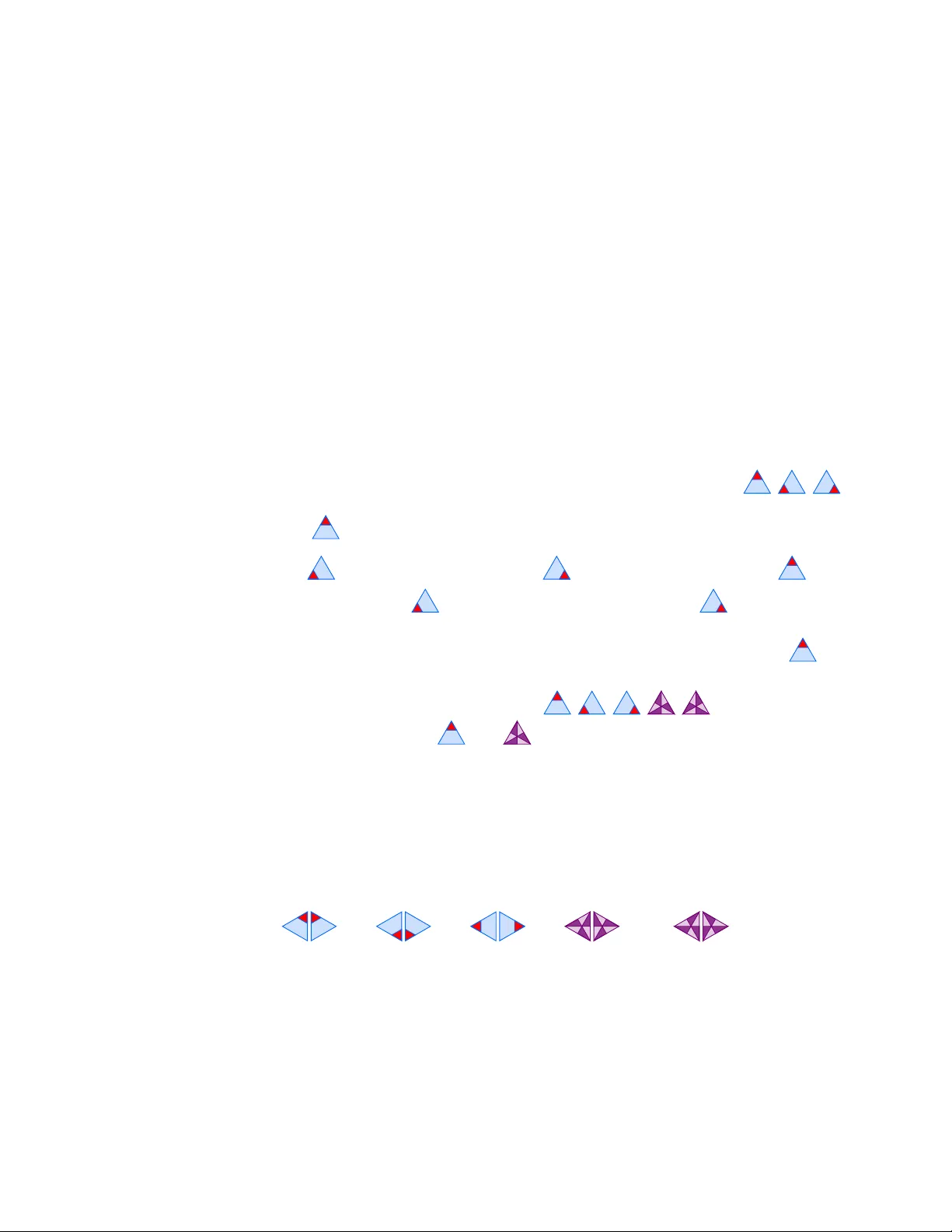
A Jump in the Co degree T ur´ an Densities of Long Tigh t Cycles J´ ozsef Balogh ∗ Haoran Luo † Ma ya Sank ar ‡ Abstract W e study the codegree T ur´ an densit y of C r ℓ , the r -uniform h yp ergraph tigh t cycle of length ℓ . A result of Han, Lo, and Sanhueza-Matamala states that if ℓ is sufficiently large and r / gcd( r , ℓ ) is ev en, then the co degree T ur´ an densit y of C r ℓ is 1 / 2. W e prov e that whenev er the latter assumption is not satisfied, there is a significan t drop in the co degree T ur´ an densit y . That is, if ℓ is sufficien tly large and r / gcd( r , ℓ ) is o dd, then the co degree T ur´ an densit y of C r ℓ can b e at most 1 / 3. Moreo ver, this bound is tight for infinitely many uniformities r and all sufficien tly large ℓ in the corresp onding residue classes mo dulo r . Our pro of makes use of a group-theoretic connection betw een T ur´ an-t yp e theorems for tigh t cycles and “oriented colorings” of the edge set of a hypergraph. 1 In tro duction F or a family F of r -uniform hypergraphs (henceforth abbreviated as r -gr aphs ), the T ur´ an numb er of F , denoted b y ex( n, F ), is the maxim um n um b er of edges in an n -v ertex r -graph that con tains no mem b er of F (i.e., is F - fr e e ). In man y cases, it is out of reac h to determine this n um b er exactly , and instead, many results fo cus on determining the asymptotic density of the extremal constructions. This is encapsulated in the T ur´ an density of F , whic h is defined to b e π ( F ) : = lim n →∞ ex( n, F ) / n r ; the limit is kno wn to exist. When F = {H} , w e simply write ex( n, H ) and π ( H ). Determining the T ur´ an n umbers and T ur´ an densities of r -graphs is a central problem in extremal com binatorics. F or graphs (the case r = 2), w e ha v e a reasonably goo d understanding of this problem, as the fundamen tal theorem of Erd˝ os–Stone–Simonovits [9, 8] shows that π ( F ) = 1 − 1 χ ( F ) − 1 , where χ ( F ) is the minim um chromatic n umber of a graph in F . The low er b ound comes from a balanced complete ( χ ( F ) − 1)-partite graph, which clearly contains no graph of chromatic n umber at least χ ( F ). Con versely , for hypergraphs (the case r ⩾ 3), understanding T ur´ an densities is a notoriously difficult problem, and very little is known. F or example, denote by K 3 4 the complete 3-graph on 4 ∗ Departmen t of Mathematics, Univ ersity of Illinois Urbana-Champaign, Urbana, IL, USA, and Extremal Com- binatorics and Probability Group (ECOPRO), Institute for Basic Science (IBS), Daejeon, South Korea. Partially supp orted by NSF gran ts R TG DMS-1937241, FR G DMS-2152488, (UIUC Campus Researc h Board Award RB26026), the Simons F ellowship, Simons Collaboration grant [SFI-MPS-TSM-00013107, JB], and the Institute for Basic Science (IBS-R029-C4). Email: jobal@illinois.edu . † Departmen t of Mathematics, Statistics and Computer Science, Universit y of Illinois Chicago, Chicago, Illinois 60607, USA. Researc h was partially p erformed while Luo was at the Universit y of Illinois Urbana-Champaign and supp orted in part by Dr. James J. W o eppel F ello wship. Email: haoranl8@uic.edu . ‡ Sc ho ol of Mathematics, Institute for Adv anced Study , Princeton, New Jersey 08540, USA. Research was partially p erformed while Sank ar was at Stanford Universit y and supported in part by NSF GRFP Grant DGE-1656518 and a Hertz fello wship. Email: mayars@ias.edu . 1 v ertices, and K 3 − 4 the h yp ergraph obtained by removing a h yp eredge from a K 3 4 . T ur´ an famously conjectured π ( K 3 4 ) = 5 / 9, see [25] for prop osing the general problem. Later, F rankl and F ¨ uredi [12] pro ved that π ( K 3 − 4 ) ⩾ 2 / 7, and it is conjectured to b e an equality . Despite considerable efforts and the seeming simplicit y of these hypergraphs, b oth conjectures remain widely op en to this da y . F or further discussion of results and tec hniques in this area, we refer the reader to the surveys by Keev ash [15] and Balogh, Clemen, and Lidic k´ y [1]. In this pap er, w e study a v ariant called c o de gr e e T ur´ an density , in tro duced by Mubayi and Zhao [20]. Unlik e graphs, hypergraphs admit several differen t notions of degree . In an r -graph H , it is natural to define the degree d ( S ) of a set S of vertices, whic h is the num ber of edges e con taining S . Similarly , for each 1 ⩽ i ⩽ r − 1, we define the minimum i -degree δ i ( H ) to b e the minim um d ( S ) o v er all S subsets of vertices of size i . In this pap er, w e are primarily in terested in δ r − 1 ( H ), which we usually call the minimum c o de gr e e of a hypergraph H . F or a family F of r -graphs, the c o de gr e e T ur´ an numb er ex r − 1 ( n, F ) is the maximum p ossible v alue of δ r − 1 ( H ) ov er all n -vertex F -free r -graphs H . Similarly to the standard T ur´ an num b er, this quan tity is also usually infeasible to b e determined exactly . Instead, w e study the c o de gr e e T ur´ an density γ ( F ) = lim n →∞ ex r − 1 ( n, F ) /n , whic h is w ell-defined, see Proposition 1.2 in [20]. When F consists of a clique, symmetrization arguments imply that π ( F ) = γ ( F ). F or r ⩾ 3, similarly , the degrees of an extremal hypergraph are differing b y at most O ( n r − 1 ) holds under the analogous assumption that each H ∈ F c overs p airs (see [15]). Again, for such F , we can rein terpret π ( F ) as the limiting density , as n → ∞ , of an F -free r -graph G on n vertices which maximizes δ 1 ( G ). Viewed from this p erspective, it is natural to study F -free r -graphs maximizing other notions of minim um degree, and the minim um co degree is a natural candidate. Determining the codegree T ur´ an densit y of a family of h yp ergraphs F is a challenging problem, and it has a very differen t flav or from the corresp onding ordinary T ur´ an problem. A conjecture of Czygrino w and Nagle [6] is that γ ( K 3 4 ) = 1 / 2. Using the flag algebra metho d of Razb orov [22], F algas-Ra vry , Pikhurk o, V aughan, and V olec [10] prov ed that γ ( K 3 − 4 ) = 1 / 4. See T able 1 in [1] for more results and conjectures. There are several kinds of h yp ergraph cycles: tigh t cycles, loose cycles, Berge cycles, etc., with man y differen t extr emal behaviors. The fo cus of this pap er is tigh t cycles. Given a length ℓ > r ⩾ 2, the tight r -uniform cycle C r ℓ of length ℓ is the r -graph with vertex set { 0 , 1 , . . . , ℓ − 1 } and edge set {{ i, i + 1 , . . . , i + r − 1 } : 0 ⩽ i < ℓ } , where the addition is modulo ℓ . Note that C 3 4 is exactly K 3 4 . The T ur´ an problem for tight cycles has dra wn considerable attention. When ℓ is a multiple of r , w e hav e that C r ℓ is r -partite, and a classical result of Erd˝ os [7] gives π ( C r ℓ ) = γ ( C r ℓ ) = 0. F or the case r = 3, it is conjectured that π ( C 3 5 ) = 2 √ 3 − 3, see [11, 19]. A recent breakthrough by Kam ˇ cev, Letzter, and P okrovskiy [14] gives π ( C 3 ℓ ) = 2 √ 3 − 3 for sufficiently large ℓ not divisible b y 3. Using the flag algebra method of Razb oro v [22], Bo dn´ ar, Le´ on, Liu, and Pikh urko [4] prov ed that π ( {K 3 4 , C 3 5 } ) = π ( C 3 ℓ ) = 2 √ 3 − 3 for every ℓ ⩾ 7 not divisible b y 3. Regarding co degree T ur´ an densit y , Piga, Sanh ueza-Matamala, and Schac ht [21] pro ved γ ( C 3 ℓ ) = 1 / 3 for every ℓ ∈ { 10 , 13 , 16 } and ev ery ℓ ⩾ 19 not divisible by 3, and Ma [17] prov ed γ ( C 3 ℓ ) = 1 / 3 when ℓ ∈ { 11 , 14 , 17 } . F or r = 4, Sank ar [23] pro v ed π ( C 4 ℓ ) = 1 / 2 for sufficiently large ℓ not divisible b y 4; her w ork also implies γ ( C 4 ℓ ) = 1 / 2 as an easy corollary . F or other v alues of r and ℓ , Han, Lo, and Sanh ueza-Matamala [13] pro ved γ ( C r ℓ ) = 1 / 2 if ℓ ⩾ 2 r 2 and r / gcd( r, ℓ ) is even. The extremal construction (a sp ecial case of Construction 2 b elo w) is the complete o ddly bipartite h yp ergraph — this is an r -graph H with v ertex set equipartitioned as V ( H ) = V 1 ⊔ V 2 , whose edges are those r -sets con taining an o dd n umber of v ertices from V 1 and, implicitly , an o dd n umber of v ertices from V 2 , as r is ev en. 2 W e remark that some other v ariations of T ur´ an problems ha v e also been studied for tigh t cycles, see for example [1, 5, 2]. As we mentioned earlier, Han, Lo, and Sanh ueza-Matamala [13] prov ed γ ( C r ℓ ) = 1 / 2 if ℓ ⩾ 2 r 2 and r / gcd( r, ℓ ) is even. In this pap er, we make progress on the case when r / gcd( r, ℓ ) is an o dd in teger. Our main theorem is the following. Theorem 1. F or every uniformity r ⩾ 2 and r esidue class k ≡ 0 (mo d r ) such that r / gcd( r, k ) is o dd, ther e is an inte ger L such that for every ℓ > L with ℓ ≡ k (mo d r ) , we have γ ( C r ℓ ) ⩽ 1 / 3 . This b ound is tigh t for infinitely man y pairs ( r , k ), as the follo wing construction sho ws. Construction 2 (See Construction 10.1 in [13]) . Fix a uniformity r and an integer p . Partition the vertex set V in to V 1 , . . . , V p suc h that their sizes differ by at most one. An r -set of v ertices { x 1 , x 2 , . . . , x r } , where x j ∈ V i j , is an edge if and only if P r j =1 i j ≡ 1 (mo d p ). Clearly , the h yp ergraph H in Construction 2 has minim um codegree (1 /p − o (1)) n . Additionally , w e sho w (see Lemma 4) that this hypergraph is C r ℓ -free for ev ery ℓ with gcd( r, ℓ ) | r /p . Th us, by Theorem 1, it follows that if ℓ is sufficiently large and the smallest prime divisor of r / gcd( r, ℓ ) is 3, then we ha ve γ ( C r ℓ ) = 1 / 3. F or example, for r = 6, the result of Han, Lo, and Sanhueza- Matamala [13] gives γ ( C 6 ℓ ) = 1 / 2 for ev ery ℓ ⩾ 72 congruen t to 1, 3, or 5 (mo d 6). W e ha ve no w that γ ( C 6 ℓ ) = 1 / 3 for every sufficien tly large ℓ congruent to 2 or 4 (mo d 6). Also, for r = 3 m , we ha ve γ ( C r ℓ ) = 1 / 3 for every sufficien tly large ℓ not divisible by r . These results reflect an in teresting phenomenon that γ ( C r ℓ ) can be v ery sensitive to the v alue of ℓ and/or the factorization of r . Our pro of for Theorem 1 first considers the case where an infinite family con taining C r ℓ is forbidden. This approac h was also used in [14, 3, 23]. Given t w o r -graphs H 1 , H 2 , a homomorphism from H 1 to H 2 is a map f from V ( H 1 ) to V ( H 2 ) which maps r -edges to r -edges. W e call H 2 a homomorphic image of H 1 if f induces a surjection from E ( H 1 ) to E ( H 2 ). F or a family F of r -graphs, let F -hom denote the family of all homomorphic images of r -graphs in F . Let C r ≡ k b e the (infinite) family of r -uniform tigh t cycles with length congruent to k mo dulo r . In [23], Sank ar ga ve a description of C r ≡ k -hom-free r -graphs using the language of group theory , generalizing the w ell-known description of C 2 ≡ 1 -hom-free graphs as bipartite. Roughly speaking, an r -graph is C r ≡ k - hom-free if and only if an “oriented coloring” can b e given to the ( r − 1)-tuples of vertices suc h that the colorings of the ( r − 1)-subtuples of an y r -edge satisfy a certain “consistency” requirement. W e discuss this in detail in Section 3. Using this description of C r ≡ k -hom-free r -graphs, we prov e that γ ( C r ≡ k -hom) ⩽ 1 / 3 if r/ gcd( r, k ) is o dd, see Theorem 13. Finally , a simple and standard observ ation (based on deep theorems in extremal combinatorics) sho ws that γ ( C r ℓ ) = γ ( C r ≡ k -hom) for sufficiently large ℓ ≡ k (mo d r ), see Lemma 12. The rest of this paper is organized as follo ws. In Section 2, w e sho w that the hypergraph in Construction 2 is C r ℓ -free if p divides r / gcd( r, ℓ ). In Section 3, w e explain the description of C r ≡ k -hom-free r -graphs. In Section 4, we give the pro of of Theorem 1, and in Section 5, we ha ve some concluding remarks. Notation. F or a positive in teger n , we write [ n ] for the set { 1 , . . . , n } . F or a set S and an element v , w e write S + v for the set S ∪ { v } and S − v for the set S \ { v } . F or a set S and a p ositiv e in teger i , an i -set of S is a subset of S of size i , and w e let S i b e the family of i -sets of S . F or 3 a hypergraph H = ( V ( H ) , E ( H )), w e often use H for its edge set, in particular, |H| for | E ( H ) | . Giv en a hypergraph H and sets of vertices S, X , let N X ( S ) : = { T ⊆ X \ S : T ∪ S ∈ E ( H ) } b e the link gr aph of S and d X ( S ) : = | N X ( S ) | b e the de gr e e of S , resp ectiv ely . When X = V ( H ), we often omit the subscript X and just use N ( S ) and d ( S ). F or tw o disjoint sets X , Y , we say T is an ( i, j )- set of ( X , Y ) if T ⊆ X ∪ Y , | T ∩ X | = i , and | T ∩ Y | = j . If X , Y are subsets of the v ertex set of some r -graph H , then an ( i, j )- e dge is an ( i, j )-set that is an edge of H . Remark 3. During the preparation of this manuscript, we learned that Ma and Rong [18] inde- p enden tly prov ed similar results, using a differen t method. Moreo v er, they provided an additional family of constructions that yields a b etter b ound than Construction 2 for many pairs ( r, k ). 2 Construction 2 is C r ℓ -free In this section, we pro ve that the r -graph in Construction 2 is C r ℓ -free for every ℓ with gcd( r , ℓ ) | r/p . In [13], it was pro ved that if p divides r but does not divide k , then the r -graph in Construction 2 is free of C r ℓ for every ℓ congruen t to k modulo r , see their Prop osition 10.2. Lemma 4 says that it is sufficient to only require that p divides r / gcd( r, ℓ ). Lemma 4. Given a uniformity r and some r esidue k ≡ 0 (mod r ) , let p b e a divisor of r / gcd( r, k ) and H b e the r -gr aph given by Construction 2. Then, H c ontains no memb er of C r ≡ k - hom . Pr o of. Supp ose for contradiction that H con tains a copy of C r ℓ -hom for some ℓ ≡ k (mod r ). Let x 1 , . . . , x ℓ b e the (not necessarily distinct) v ertices along suc h a cop y , and for 1 ⩽ j ⩽ ℓ , let V i j b e the part con taining x j . Hereafter, all subscripts containing j are taken mo dulo ℓ . W e first prov e that i j = i j +gcd( r,k ) for ev ery j . It suffices to prov e that i j = i j + r and i j = i j + k for ev ery j . By construction, for ev ery ( r − 1)-set of vertices, its neighborho o d is contained in a single set V i . Due to edges { x j , x j +1 , . . . , x j + r − 1 } and { x j +1 , . . . , x j + r − 1 , x j + r } , w e hav e i j = i j + r . Also, we trivially hav e i j = i j + ℓ . Because ℓ ≡ k (mo d r ) and i j = i j + r , we then hav e i j = i j + k . Since i j = i j +gcd( r,k ) for each j , w e hav e that i 1 + i 2 + . . . + i r = r gcd( r , k ) i 1 + . . . + i gcd( r,k ) . Because p divides r/ gcd( r, k ), this sum is 0 mo dulo p . How ev er, { x 1 , . . . , x r } ∈ E ( H ), so this sum is 1 modulo p b y the construction, yielding a contradiction. 3 C r ≡ k -hom-free h yp ergraphs As men tioned in Section 1, our proof for Theorem 1 relies on the analysis of C r ≡ k -hom-free h yp er- graphs. In this section, we describe the C r ≡ k -hom-free r -graphs. W e first give a brief in tro duction to the en tire theory and then focus on the parts w e need for the pro of of Theorem 1, see Lemma 9. 3.1 P erm utations and oriented colorings F or every uniformit y r ⩾ 2 and each residue k mo dulo r , Sank ar [23] ga ve an equiv alen t description of C r ≡ k -hom-free r -graphs as those admitting a certain type of “oriented coloring”. T o state the c haracterization, w e need some group theory . 4 An oriente d e dge of an r -graph H is an ordered r -tuple x = x 1 . . . x r whose supp ort { x 1 , . . . , x r } is an edge of H . Let E ( H ) be the set of all oriented edges of H . There is a natural action of the symmetric group S r on E ( H ) giv en b y π ( x 1 . . . x r ) = x π − 1 (1) . . . x π − 1 ( r ) for each p erm utation π ∈ S r and oriented edge x = x 1 . . . x r ∈ E ( H ). An S r -set is a set equipped with a group action by S r . One example is the set E ( H ) of oriented edges of an r -graph H mentioned ab o v e. Another example is, for a subgroup Γ ⊆ S r , the family S r / Γ of left cosets σ Γ := { σ γ : γ ∈ Γ } , where the action of π ∈ S r maps a coset σ Γ ∈ S r / Γ to ( π σ )Γ. If A and B are S r -sets, a map χ : A → B is called S r -e quivariant if it preserv es the structure of the S r action, i.e., if π ( χ ( a )) = χ ( π ( a )) for each a ∈ A and π ∈ S r . With this in mind, w e ma y define orien ted colorings. Definition 5. Let H b e an r -graph. An oriente d c oloring of H by an S r -set A , also called an A -c oloring , is an S r -equiv arian t map χ : E ( H ) → A . Each orbit of A is called a c olor , and the color of an edge e ∈ E ( H ) is the orbit con taining χ ( x ) for eac h orientation x of e . T o see wh y this migh t b e considered a coloring, l et r = 3 and consider the set A = n , , o of pictograms. Then S 3 acts on A by p erm uting the three v ertices of the triangle. If χ is an A - coloring with χ ( x 1 x 2 x 3 ) = for some orien ted edge x = x 1 x 2 x 3 then χ ( x 2 x 1 x 3 ) = (12) χ ( x ) = , χ ( x 3 x 2 x 1 ) = (13) χ ( x ) = , χ ( x 1 x 3 x 2 ) = (23) χ ( x ) = , χ ( x 3 x 1 x 2 ) = (123) χ ( x ) = , and χ ( x 2 x 3 x 1 ) = (132) χ ( x ) = . One may rein terpret this as the edge { x 1 , x 2 , x 3 } b eing colored by A in the orientation x 1 x 2 x 3 . In fact, ev ery S r -set is isomorphic to a set of rotations/reflections of coloring(s) of the ( r − 1)- simplex. A more complicated example is the S 3 -set A ′ = n , , , , o , which con tains t wo colors corresp onding to the pictograms and (up to rotation/reflection). Definition 6. Let χ : E ( H ) → A b e an orien ted coloring of an r -graph H . W e sa y that χ is ac c or dant if, for any tw o orien ted edges x = x 1 . . . x r and x ′ = x 1 . . . x i − 1 x ′ i x i +1 . . . x r in E ( H ) differing by exactly one (arbitrary) co ordinate, it holds that χ ( x ) = χ ( x ′ ). Pictorially , a coloring is accordan t if, for an y set e ′ = { x 1 , . . . , x r − 1 } , all edges of the form e ′ ∪ { y } receiv e the same coloring in the same orientation. Using the 3-uniform example A ′ ab o v e, in an accordant A ′ -coloring, t wo edges { x 1 , x 2 , y } and { x 1 , x 2 , y ′ } ov erlapping on tw o v ertices m ust b e colored as either x 1 x 1 x 2 y y ′ , x 1 x 1 x 2 y y ′ , x 1 x 1 x 2 y y ′ , x 1 x 1 x 2 y y ′ , or x 1 x 1 x 2 y y ′ . Accordance is harder to visualize when r ⩾ 4, but admits a simple combinatorial description for particularly nice S r -sets, see [23, 24]. Let us no w state Theorem 7, which uses accordan t colorings to characterize C r ≡ k -hom-free r - graphs. T o streamline the statement of the theorem, w e need one more piece of terminology . F or a p erm utation π ∈ S r and a subgroup Γ ⊆ S r , w e say Γ is π -c onjugate avoiding if Γ contains no conjugate σπ σ − 1 of π . Let G π b e the set of all maximal π -conjugate a v oiding subgroups of S r . Note 5 that G π can b e partitioned as F m j =1 [Γ j ], where Γ 1 , . . . , Γ m are subgroups of S r and [Γ j ] denotes the family of all conjugates of Γ j in S r . Define A π : = F m j =1 ( S r / Γ j ), recalling that S r / Γ j is the S r -set of left cosets of Γ j acted on by left multiplication by S r . In this setting, w e find it notationally simpler to refer to colors S r / Γ i b y their asso ciate groups Γ i . Theorem 7 (Theorem 3.4 in [23]) . Fix a uniformity r ⩾ 2 and a r esidue k mo dulo r . L et cyc = (12 . . . r ) ∈ S r denote the cyclic shift p ermutation. We have that an r -gr aph H is C r ≡ k -hom-fr e e if and only if ther e is an ac c or dant A cyc k -c oloring χ : E ( H ) → A cyc k . Example 8. When ( r , k ) = (2 , 1), the S 2 -set A (12) is isomorphic to the set { , } acted on b y p ermuting the t w o endp oints. Then, Theorem 7 says that a graph H is C 2 ≡ 1 -hom-free if and only if one can color eac h edge of H half white and half black such that either all or none of the edges inciden t to a giv en v ertex are blac k at that v ertex. This corresponds to a blac k–white bipartition of the graph. F or a uniformity r ⩾ 2 and a residue k mo dulo r , w e sa y that the colors available for C r ≡ k -hom are the cyc k -conjugate a voiding groups Γ j defined abov e. Given an oriented coloring of an r -graph H and an edge x = { x 1 , . . . , x r } ∈ H , w e say x is colored with Γ if χ ( x 1 . . . x r ) ∈ S r / Γ; the color Γ is independent of the ordering of the edge. F or a C r ≡ k -hom-free r -graph H , when w e sa y that H is colored, w e mean that w e fix a map χ from E ( H ) to A cyc k , and w e sa y a C r ≡ k -hom a v ailable color Γ is use d in H if at least one edge in H is colored with Γ. 3.2 Accordan t colorings b y S i × S r − i The coloring describ ed in Theorem 7 is easier to visualize when the only groups Γ j used are of the form S i × S r − i for some 1 ⩽ i < r . In this case, the S r -set S r / ( S i × S r − i ) is isomorphic to the set of rotations or reflections of an ( r − 1)-simplex colored so that some set of i vertices is in terchangeable and the remaining set of r − i vertices is also interc hangeable. Examples include for S 3 / ( S 2 × S 1 ), for S 4 / ( S 3 × S 1 ) and for S 4 / ( S 2 × S 2 ). Consider the S r -set A = F r i =1 S r / ( S i × S r − i ) comprising these colors, and fix an r -graph H equipp ed with an accordant A -coloring χ : E ( H ) → A . Given an r -edge e = { x 1 , . . . , x r } colored b y S i × S r − i , define the partition e = h + i ( e ) ⊔ h − i ( e ) so that h + i ( e ) is the set of i interc hangeable v ertices and h − i ( e ) is the set of r − i interc hangeable vertices. In particular, if x = x 1 . . . x r and y is obtained from x by p erm uting v ertices within each part h ± i ( e ), then χ ( x ) = χ ( y ). Additionally , if edge e ′ = { x 1 , . . . , x r − 1 , x ′ r } intersects e in r − 1 v ertices, then accordance implies that h + i ( e ′ ) = ( h + i ( e ) if x r / ∈ h + i ( e ) , h + i ( e ) ∪ { x ′ r } − { x r } if x r ∈ h + i ( e ) , (1) and the same for h − i . Note that b eing colored with S i × S r − i is the same as b eing colored with S r − i × S i , while h ± i = h ∓ r − i . T ec hnically , if i = r / 2, then the c hoice of h + i ( e ) and h − i ( e ) is not uniquely determined, as both parts hav e the same size. Nevertheless, accordance still lets us c ho ose partitions h ± i ( e ) satisfying (1) for any t w o edges e, e ′ in tersecting in r − 1 vertices. F or example, if r = 4 and i = 2, then h + 2 could alwa ys corresp ond to the t wo v ertices on the yello w edge of and h − 2 to the red edge. W e use similar notation for an y ( r − 1)-set W : fix an arbitrary edge e con taining W , and say the color of W is the color of e and define h + i ( W ) = h + i ( e ) ∩ W and h − i ( W ) = h − i ( e ) ∩ W . By the definition of being accordan t, h + i ( W ) and h − i ( W ) are indep endent of the edge e , see Figure 1. 6 + + + + − − − + e 1 e 2 Figure 1: Two edges e 1 , e 2 colored with S 4 × S 3 in a 7-graph. The vertices + and − are the v ertices in h + i and h − i , resp ectiv ely . The shared 6-tuple is of the same coloring in these t wo edges. Note that the signs ± represent colorings within e 1 and e 2 ; if there were an edge e 3 con taining the rightmost fiv e v ertices and t w o extra v ertices, then e 3 is not necessarily ev en colored with S 4 × S 3 . 3.3 Restricting to colors of the form S i × S r − i The previous subsection shows that the accordant oriented coloring describ ed in Theorem 7 has a relatively straightforw ard combinatorial description if the only groups Γ j used are of the form S i × S r − i . The first key step in our pro of of Theorem 1 is to sho w that these are the only groups used when coloring C r ≡ k -hom-free r -graphs H of large minim um co degree. Lemma 9. L et H b e an n -vertex C r ≡ k - hom -fr e e r -gr aph with δ r − 1 ( H ) > n/ 3 and let χ : E ( H ) → A cyc k b e the ac c or dant oriente d c oloring guar ante e d by The or em 7. If Γ is use d in H , then Γ is a c onjugate of S i × S r − i for some 1 ⩽ i < r . Pr o of. Let Γ tr b e the subgroup of Γ generated b y all transp ositions in Γ. W e first pro v e that Γ tr ∼ = S i × S r − i for some i ∈ [ r − 1]. Define the relation ∼ Γ on [ r ] b y a ∼ Γ b if ( ab ) ∈ Γ; this is transitive: if ( ab ) , ( bc ) ∈ Γ, then ( ac ) = ( bc )( ab )( bc ) is also in Γ. Th us, this relation partitions [ r ] into sets I 1 ∪ . . . ∪ I m and hence Γ contains S | I 1 | × . . . × S | I m | . Clearly m ⩾ 2, or else Γ = S r w ould con tain cyc k . Next, we use the minim um co degree assumption to sho w m = 2. Supp ose for contradiction that m ⩾ 3 and assume without loss of generalit y that 1 ∈ I 1 , 2 ∈ I 2 , and 3 ∈ I 3 . Let x = x 1 . . . x r b e an oriented edge in H with χ ( x ) = Γ ∈ S r / Γ (viewing Γ as a left coset of itself ). F or j = 1 , 2 , 3, define X j = N ( { x 1 , . . . , x r } − { x j } ); note that x j ∈ X j . W e claim that X 1 , X 2 , X 3 are pairwise disjoin t. Indeed, if e.g. there w as v ∈ X 1 ∩ X 2 , then (12) χ ( x ) = (12) χ ( v x 2 . . . x r ) = χ ((12)( v x 2 . . . x r )) = χ ( x 2 v . . . x r ) = χ ( x 1 v . . . x r ) = χ ( x ) , where the second-to-last equality uses accordance. This w ould yield (12)Γ = Γ and hence (12) ∈ Γ, con tradicting the assumption that 1 ∼ Γ 2. Th us, the sets X 1 , X 2 , X 3 are pairwise disjoint, yielding the contradiction n = | V ( H ) | ⩾ | X 1 | + | X 2 | + | X 3 | ⩾ 3 · δ r − 1 ( H ) > 3 · n/ 3 = n. Th us, m = 2. Setting I = I 1 and J = I 2 , we ma y write Γ tr = S I × S J . Claim 10. Either Γ = Γ tr or Γ c ontains an r -cycle. Pr o of. F or the pro of of this claim only , we will use the notation [ a, b ] : = ( ab ) to denote the p erm u- tation transp osing a and b . Supp ose Γ tr is a prop er subgroup of Γ. W e first prov e that Γ contains a p erm utation mapping I to J bijectiv ely , whic h in particular implies that | I | = | J | = r / 2. Assume without loss of ge neralit y 7 that | I | ⩾ | J | . Choose π ∈ Γ − ( S I × S J ); it follo ws that π maps some a ∈ I to b : = π ( a ) ∈ J . F or an y other a ′ ∈ I , observe that [ π ( a ′ ) , b ] = [ π ( a ′ ) , π ( a )] = π ◦ [ a, a ′ ] ◦ π − 1 ∈ Γ . Th us, π ( a ′ ) ∼ Γ b so π ( a ′ ) ∈ J . It follows that π maps I injectively in to J ; moreov er, this is a bijection b ecause | I | ⩾ | J | . Let i = r/ 2 and assume without loss of generality that I = { 1 , . . . , i } and J = { i + 1 , . . . , r } , and that Γ con tains the p erm utation π mapping a to a + i for every a ∈ I . Let g b e the cycle (12 . . . i ). Then, w e hav e π g = (1(2 + i )2(3 + i )3 . . . (2 i ) i (1 + i )) , so Γ con tains an r -cycle. By Claim 10, either Γ = Γ tr ∼ = S | I | × S | J | or Γ contains an r -cycle π ′ . Ho wev er, the latter case is imp ossible as ( π ′ ) k w ould be a conjugate of cyc k . 4 Pro of of the main theorem In this section, we prov e Theorem 1. W e first observe (Lemma 12) that γ ( C r ℓ ) = γ ( C r ≡ k -hom) for sufficien tly large ℓ congruent to k mo dulo r . Then, w e can fo cus on C r ≡ k -hom-free r -graphs and apply the coloring results for C r ≡ k -hom-free r -graphs discussed in Section 3. Theorem 1 follows easily from Theorem 13, a c haracterization of the pairs ( r, k ) such that γ ( C r ≡ k -hom) > 1 / 3. Lemma 12 connects the co degree T ur´ an densities of C r ℓ and C r ≡ k -hom. W e include the pro of here for completeness, but we note that this w as essentially prov ed in [23] (see Prop ositions 2.3 and 4.1 and Corollary 4.2) and presented in a more general form in [24] (see Theorem 7.3.3 and Lemma 7.5.2). F or the case r = 3, this was also essen tially prov ed in [14] (see Theorem 6.2 and Prop ositions 6.3–6.4). Lemma 11. L et F b e any finite family of r -gr aphs. Then γ ( F ) = γ ( F - hom) . Pr o of. Given an r -graph H , its t -blowup H [ t ] is formed b y replacing eac h v ertex of H b y an indep en- den t set of size t and replacing each edge of H with a copy of the complete r -partite r -graph K ( r ) t,...,t . W rite F [ t ] = {H [ t ] : H ∈ F } . Observ e that if H ′ ∈ F -hom is a homomorphic image of H ∈ F , then H ⊆ H ′ [ t ] for any t ⩾ | V ( H ) | . Thus, for t 0 = max H∈F | V ( H ) | , w e hav e γ ( F ) ⩽ γ ( F -hom[ t 0 ]). Also, a w ell-known fact is that the codegree T ur´ an densit y of an y finite family is the same as the co degree T ur´ an densit y of its blow-up, see Lemma 2.3 in [16], so w e hav e γ ( F ) ⩽ γ ( F -hom[ t 0 ]) = γ ( F -hom). The other direction γ ( F -hom) ⩽ γ ( F ) holds b y definition. Lemma 12. F or every uniformity r ⩾ 2 and r esidue class k ≡ 0 (mo d r ) , ther e is an inte ger L such that for every ℓ ⩾ L with ℓ ≡ k (mo d r ) , we have γ ( C r ℓ ) = γ ( C r ≡ k - hom) . Pr o of. Let L be sufficien tly large and fix an integer ℓ ⩾ L with ℓ ≡ k (mod r ). As C r ℓ ∈ C r ≡ k -hom, w e ha v e γ ( C r ≡ k -hom) ⩽ γ ( C r ℓ ). By Lemma 11, it suffices to prov e that γ ( C r ℓ -hom) ⩽ γ ( C r ≡ k -hom). Let C r ≡ k, 1 / 3. Theorem 13. Fix a uniformity r ⩾ 2 and a r esidue class k ≡ 0 (mod r ) . If r is even and S i × S r − i is available for C r ≡ k - hom for every o dd i ∈ [1 , r − 1] , then γ ( C r ≡ k - hom) = 1 / 2 . Otherwise, γ ( C r ≡ k - hom) ⩽ 1 / 3 . Pr o of of The or em 1 assuming The or em 13. Given the uniformity r and residue class k , by Lem- ma 12, it suffices to prov e that γ ( C r ≡ k -hom) ⩽ 1 / 3, and b y Theorem 13, we just need to pro ve that it cannot be the case that r is even and S i × S r − i is av ailable for ev ery odd i ∈ [1 , r − 1]. Supp ose for a contradiction, that it is the case. W rite m for gcd( r, k ); by our assumption in Theorem 1, r /m is o dd. Note that cyc k consists of m cycles, each of which has length r /m < r , and hence, S i × S r − i con tains a conjugate of cyc k if and only if r /m | i and r /m | r − i . No w, since r/m | r /m and r /m | ( r − r /m ), w e hav e that S r/m × S r − r /m con tains a conjugate of cyc k , a contradiction to Theorem 7. In the remaining part of this section, we prov e Theorem 13. The main idea is to analyze the structure of the link graphs of some ( r − 2)-sets, which will giv e a partition of all the vertices. A sk etch of the pro of will also b e giv en at the b eginning of our pro of for Theorem 13. W e first use this idea to pro ve an easy upp er b ound 1 / 2, which will b e used later. Recall that for every edge e and in teger i ∈ [1 , r − 1], h + i ( e ) is the set of vertices v ∈ e of S i and h − i ( e ) is the set of vertices v ∈ e of S r − i . Lemma 14. F or every uniformity r ⩾ 2 and r esidue k ≡ 0 (mo d r ) , we have γ ( C r ≡ k - hom) ⩽ 1 / 2 . Pr o of. Supp ose for a contradiction that γ ( C r ≡ k -hom) > 1 / 2. Let ε > 0 and n b e a sufficien tly large in teger, and assume that H is an n -vertex C r ≡ k -hom-free colored r -graph with δ r − 1 ( H ) > (1 / 2 + ε ) n . Fix an arbitrary edge e in H . By Lemma 9, we can assume that e is colored with S i × S r − i for some i ∈ [1 , r − 1]. W e assume that e = { a 1 , . . . , a i , b 1 , . . . , b r − i } , where A : = { a 1 , . . . , a i } = h + i ( e ), and B : = { b 1 , . . . , b r − i } = h − i ( e ). Let A ′ : = { a 1 , . . . , a i − 1 } , B ′ : = { b 1 , . . . , b r − i − 1 } , and let U : = A ′ ∪ B ′ . W e consider the coloring of eac h vertex v ∈ V ( H ) \ U in U + v . Define X + : = A ∪ { v ∈ V ( H ) \ e : h + i ( U + v ) = A ′ + v and h − i ( U + v ) = B ′ } , X − : = B ∪ { v ∈ V ( H ) \ e : h + i ( U + v ) = A ′ and h − i ( U + v ) = B ′ + v } , see Figure 2. Note that X + and X − are disjoin t, a i ∈ X + and b r − i ∈ X − . Also, note that N ( U + a i ) ⊆ X − b y the coloring of U + a i , so | X − | ⩾ d ( U + a i ) ⩾ δ r − 1 ( H ) > (1 / 2 + ε ) n. Similarly , we hav e | X + | > (1 / 2 + ε ) n . How ev er, this is a contradiction to the fact that X + and X − are disjoint. 9 X − X + a 1 a 2 a 3 b 1 b 2 b 3 e U Figure 2: r = 6 and i = 3. The coloring of every vertex v ∈ X + \ e in U + v is the same as a 3 in e . The coloring of ev ery v ertex v ∈ X − \ e in U + v is the same as b 3 in e . The following lemma will b e used later to sho w that some color has to b e used: it essentially sa ys that if there are tw o disjoint sets in an r -graph with lots of ( i, r − i )-edges, then the color S i × S r − i has to be used. Lemma 15. L et H b e an n -vertex C r ≡ k - hom -fr e e c olor e d r -gr aph in which al l c olors use d ar e in { S t × S r − t : t ∈ [ r − 1] } . L et X , Y b e two disjoint subsets of V ( H ) such that | X | , | Y | ⩾ r . L et i b e some fixe d inte ger in [ r − 1] . Supp ose that for every ( i − 1 , r − i ) -set W of ( X , Y ) , we have d X ( W ) > | X | / 2 . Then, S i × S r − i is use d in H . Pr o of. W e will prov e a stronger statement that all ( i, r − i )-edges of ( X, Y ) are colored with S i × S r − i . Supp ose for a contradiction that there is an ( i, r − i )-edge e of ( X , Y ) such that e is colored with S j × S r − j where j ∈ { i, r − i } . Then, h + j ( e ) ∩ X and h − j ( e ) ∩ X are b oth non-empt y or h + j ( e ) ∩ Y and h − j ( e ) ∩ Y are both non-empt y . W e claim that neither of them can happ en. If there are v ertices x 1 ∈ h + j ( e ) ∩ X and x 2 ∈ h − j ( e ) ∩ X , then let W 1 = e − x 1 , W 2 = e − x 2 , and U = e − x 1 − x 2 = W 1 ∩ W 2 , see Figure 3. By our assumption, w e ha ve d X ( W 1 ) > | X | / 2 and d X ( W 2 ) > | X | / 2, so there is a v ertex v ∈ N X ( W 1 ) ∩ N X ( W 2 ). Let W = U + v . Then, x 1 , x 2 ∈ N X ( W ), so W 1 = W − v + x 2 and W 2 = W − v + x 1 should be of the same coloring, whic h in particular, means that either x 1 ∈ h + j ( W 2 ) , x 2 ∈ h + j ( W 1 ) or x 1 ∈ h − j ( W 2 ) , x 2 ∈ h − j ( W 1 ), but this is a con tradiction to our assumption that x 1 ∈ h + j ( e ) and x 2 ∈ h − j ( e ). A similar argument holds for the second case. If there are vertices y 1 ∈ h + j ( e ) ∩ Y and y 2 ∈ h − j ( e ) ∩ Y , then fix vertices x ∈ e ∩ X , y ∈ Y \ e and let W 0 = e − x , W 1 = e − x − y 1 + y , W 2 = e − x − y 2 + y . Note that y 1 ∈ h + j ( W 0 ) and y 2 ∈ h − j ( W 0 ) b y our assumption. No w, since d X ( W 0 ) > | X | / 2 and d X ( W 1 ) > | X | / 2, there is a vertex v 01 ∈ N X ( W 0 ) ∩ N X ( W 1 ) and w e hav e edges W 0 + v 01 and W 1 + v 01 . Note that both of them con tain the same ( r − 1)-set W 0 − y 1 + v 01 = W 1 − y + v 01 , so W 0 and W 1 should b e of the same coloring, in particular, w e hav e y 2 ∈ h − j ( W 1 ) b y the assumption that y 2 ∈ h − j ( W 0 ). Similarly , w e ha ve y 1 ∈ h + j ( W 2 ). Ho wev er, since d X ( W 1 ) > | X | / 2 and d X ( W 2 ) > | X | / 2, there is a vertex v 12 ∈ N X ( W 1 ) ∩ N X ( W 2 ) and we hav e edges W 1 + v 12 and W 2 + v 12 . Hence, we hav e either y 1 ∈ h + j ( W 2 ) , y 2 ∈ h + j ( W 1 ) or y 1 ∈ h − j ( W 2 ) , y 2 ∈ h − j ( W 1 ), a con tradiction. Pr o of of The or em 13. If r is even and S i × S r − i is a v ailable for ev ery o dd i ∈ [1 , r − 1], then Lemma 14 gives that γ ( C r ≡ k -hom) ⩽ 1 / 2. F or the other direction, taking p = 2 in Construction 2 10 Y X U x 1 x 2 v W 2 W 1 W e Figure 3: r = 5 and i = 2. Both U + x 1 + v and U + x 2 + v are edges in H . Hence, the coloring of x 1 in U + x 1 should b e the same as the coloring of x 2 in U + x 2 . w orks. More precisely , let H be an n -v ertex r -graph whose v ertex set is partitioned in to tw o parts X 1 , X 2 of size ⌊ n/ 2 ⌋ , ⌈ n/ 2 ⌉ , respectively , and its edges are those r -sets whic h intersect b oth X 1 , X 2 in an o dd num b er of vertices. Clearly , δ r − 1 ( H ) = (1 / 2 − o (1)) n . F or an ( i, r − i )-edge e of ( X 1 , X 2 ), w e can color it with S i × S r − i where h + i ( e ) = e ∩ X 1 and h − i ( e ) = e ∩ X 2 . Then by Theorem 7, we ha ve that H is C r ≡ k -hom-free. This giv es that γ ( C r ≡ k -hom) ⩾ 1 / 2. No w, it suffices to pro ve that if γ ( C r ≡ k -hom) > 1 / 3, then r is ev en and S i × S r − i is av ailable for every o dd i ∈ [1 , r − 1]. Let ε > 0 and n b e sufficiently large. Assume that H is an n -vertex C r ≡ k -hom-free colored r -graph with δ r − 1 ( H ) > (1 / 3 + ε ) n . By Lemma 9, w e can assume that every color used in H is of the form S i × S r − i . A sk etch of the pro of is as follo ws. Our main claim is that if some S i × S r − i is used in H , then S i +2 × S r − i − 2 and S i − 2 × S r − i +2 are also used, see Claim 22. F or this purp ose, w e will choose an arbitrary edge colored with S i × S r − i and consider the link graph of a “go od” ( r − 2)-set U in W , lik e what w e did in the pro of of Lemma 14. This will give us a partition ( X + , X − ) of the v ertex set of H . W e then analyze the coloring of the ( i, r − i − 1)-sets and ( i − 1 , r − i )-sets of ( X + , X − ). By the coloring, w e can verify that there is no ( i + 1 , r − i − 1)-edges and ( i − 1 , r − i + 1)-edges of ( X + , X − ), which then forces the existence of man y ( i + 2 , r − i − 2)-edges and ( i − 2 , r − i + 2)-edges, due to the minimum co degree assumption. Using Lemma 15, we then get that S i +2 × S r − i − 2 and S i − 2 × S r − i +2 ha ve to b e used, as claimed. Additionally , a simple observ ation shows that S r − 2 × S 2 cannot b e used in H , see Claim 23. Putting these tw o claims together, we immediately conclude that r has to b e ev en and S i × S r − i is av ailable for ev ery odd i ∈ [1 , r − 1]. An ( r − 2)-set U is i -go o d if there is an ( r − 1)-set W ⊃ U such that W is colored with S i × S r − i , | U ∩ h + i ( W ) | = i − 1, and | U ∩ h − i ( W ) | = r − i − 1; w e sa y such W witnesses U . Recall that h ± i ( W ) is defined as h ± i ( e ) ∩ W for any edge e ⊇ W . F or every i -go od ( r − 2)-set U , define Y + i ( U ) : = { v ∈ V ( H ) \ U : v ∈ h + i ( U + v ) } , Y − i ( U ) : = { v ∈ V ( H ) \ U : v ∈ h − i ( U + v ) } . Claim 16. F or every i -go o d ( r − 2) -set U , we have (1 / 3 + ε ) n ⩽ | Y + i ( U ) | , | Y − i ( U ) | ⩽ (2 / 3 − ε ) n − ( r − 2) , and Y + i ( U ) , Y − i ( U ) form a p artition of V ( H ) \ U . Pr o of. Let W be an arbitrary ( r − 1)-set witnessing U and assume that U = W − v . W e hav e v ∈ Y + i ( U ) ∪ Y − i ( U ). F or the case v ∈ Y + i ( U ), b y the coloring, we hav e N ( W ) ⊆ Y − i ( U ), so 11 | Y − i ( U ) | ⩾ δ r − 1 ( H ) ⩾ (1 / 3 + ε ) n . Then, we can fix an arbitrary v ertex v ′ ∈ Y − i ( U ). W e also hav e N ( U + v ′ ) ⊆ Y + i ( U ) b y the coloring, so | Y + i ( U ) | ⩾ (1 / 3 + ε ) n . Note that Y + i ( U ) and Y − i ( U ) are disjoin t sets in V ( H ) \ U . W e then hav e | Y + i ( U ) | , | Y − i ( U ) | ⩽ (2 / 3 − ε ) n − ( r − 2). F or the case where v ∈ Y − i ( U ), a similar pro of holds by switc hing the + and − . Let Y ′ : = V ( H ) \ ( U ∪ Y + i ( U ) ∪ Y − i ( U )). Supp ose for a con tradiction that there is y ∈ Y ′ . Then, b y definition, U + y is not colored with S i × S r − i , so N ( U + y ) ∩ Y + i ( U ) = N ( U + y ) ∩ Y − i ( U ) = ∅ . Hence, N ( U + y ) ⊆ Y ′ , so | Y ′ | ⩾ (1 / 3 + ε ) n . How ev er, we ha ve a contradiction that n = | V ( H ) | ⩾ | Y + i ( U ) | + | Y − i ( U ) | + | Y ′ | ⩾ 3 · (1 / 3 + ε ) n > n. F or the conv enience of the following discussion, we will also partition U and add it to Y + i ( U ) and Y − i ( U ). W e need the following claim. Claim 17. F or every i -go o d ( r − 2) -set U and any two ( r − 1) -sets W 1 , W 2 witnessing U , we have h + i ( W 1 ) ∩ U = h + i ( W 2 ) ∩ U and h − i ( W 1 ) ∩ U = h − i ( W 2 ) ∩ U. Pr o of. Assume that U = W 1 − v 1 = W 2 − v 2 . First, consider the case v 1 , v 2 ∈ Y + i ( U ). Note that N ( W 1 ) , N ( W 2 ) ⊆ Y − i ( U ). By Claim 16 and the assumption on δ r − 1 ( H ), there is v ∈ Y − i ( U ) suc h that v ∈ N ( W 1 ) ∩ N ( W 2 ), so b y the coloring, h + i ( W 1 ) ∩ U = h + i ( W 2 ) ∩ U = h + i ( U + v ) ∩ U and h − i ( W 1 ) ∩ U = h − i ( W 2 ) ∩ U = h − i ( U + v ) ∩ U . Similar argument holds if v 1 , v 2 ∈ Y − i ( U ). If v 1 ∈ Y + i ( U ) and v 2 ∈ Y − i ( U ), then just fix an arbitrary vertex v ′ ∈ N ( W 2 ) ⊆ Y + i ( U ) and apply the pro of for the case that v 1 , v 2 are in the same set to v 1 , v ′ . By Claim 17, for an i -go o d ( r − 2)-set U , we can fix an arbitrary ( r − 1)-set W ⊃ U and define h + i ( U ) : = h + i ( W ) ∩ U , h − i ( U ) : = h − i ( W ) ∩ U . Let X + i ( U ) : = h + i ( U ) ∪ Y + i ( U ) and X − i ( U ) : = h − i ( U ) ∪ Y − i ( U ). W e often omit the subscript i when it is clear from the con text. By Claim 16, w e ha ve the following prop erties of X + i ( U ) , X − i ( U ). Claim 18. F or every i -go o d ( r − 2) -set U , we have (1 / 3 + ε ) n ⩽ | X + i ( U ) | , | X − i ( U ) | ⩽ (2 / 3 − ε ) n, and X + i ( U ) , X − i ( U ) form a p artition of V ( H ) . No w, w e analyze the colorings of ( i − 1 , r − i )-sets and ( i, r − i − 1)-sets of ( X + i ( U ) , X − i ( U )). Claim 19. L et U b e an i -go o d ( r − 2) -set. Supp ose W is an ( i, r − i − 1) -set or an ( i − 1 , r − i ) - set of ( X + ( U ) , X − ( U )) . Then W is c olor e d with S i × S r − i , and h + i ( W ) = W ∩ X + ( U ) and h − i ( W ) = W ∩ X − ( U ) . Pr o of. W e first ha ve the following claim. Sub claim 20. F or every i -go o d ( r − 2) -set U , let x b e an arbitr ary vertex in h + i ( U ) and v b e an arbitr ary vertex in X + ( U ) \ U . We have that U − x + v is also i -go o d. Mor e over, X + ( U − x + v ) = X + ( U ) , and X − ( U − x + v ) = X − ( U ) . Pr o of. Let U ′ b e the ( r − 2)-set U − x + v and W b e the ( r − 1)-set U ∪ U ′ = U + v . Claim 16 implies that W is colored with S i × S r − i , | U ∩ h + i ( W ) | = i − 1, and | U ∩ h − i ( W ) | = r − i − 1. Then, b y the assumption on x and v , w e hav e | U ′ ∩ h + i ( W ) | = | U ∩ h + i ( W ) | = i − 1 and | U ′ ∩ h − i ( W ) | = | U ∩ h − i ( W ) | = r − i − 1. Therefore, W witnesses U ′ , hence U ′ is i -go o d. Note that v ∈ h + i ( U ′ ). 12 By Claim 18, we ha ve that X + ( U ′ ) and X − ( U ′ ) also form a partition of V ( H ). Supp ose for a con tradiction that X + ( U ′ ) = X + ( U ) or X − ( U ′ ) = X − ( U ). Then, there is a v ertex y that is in X + ( U ) ∩ X − ( U ′ ) or in X − ( U ) ∩ X + ( U ′ ). Note that y / ∈ U ∪ U ′ . Let U ′′ : = U − x + y = U ′ − v + y . W e first claim that U ′′ is i -go o d. Indeed, similarly to the pro of that U ′ is go o d, if y ∈ X + ( U ), then U + y = U ′′ + x witnesses that U ′′ is go o d; if y ∈ X + ( U ′ ), then U ′ + y = U ′′ + v witnesses that U ′′ is goo d. Now, by Claim 17, y ∈ U ′′ should be of the same coloring in all ( r − 1)-sets con taining U ′′ , which, in particular, means that it is the same in U ′′ + x = U + y and in U ′′ + v = U ′ + y . Ho wev er, b y the assumption that either y ∈ X + ( U ) ∩ X − ( U ′ ) or y ∈ X − ( U ) ∩ X + ( U ′ ), w e hav e that y should b e of differen t colors in these tw o sets, a con tradiction. An analogous argumen t yields the follo wing claim. Sub claim 21. F or every i -go o d ( r − 2) -set U , let x b e an arbitr ary vertex in h − i ( U ) and v b e an arbitr ary vertex in X − ( U ) \ U . We have that U − x + v is also i -go o d. Mor e over, X + ( U − x + v ) = X + ( U ) , and X − ( U − x + v ) = X − ( U ) . No w, we prov e Claim 19. W e giv e the pro of for the case where W is an ( i, r − i − 1)-set of ( X + ( U ) , X − ( U )); the second case is similar. Let U ′ b e an arbitrary ( i − 1 , r − i − 1)-set of ( X + ( U ) , X − ( U )) contained in W . Note that U ′ can b e obtained from U by replacing some vertices in h + i ( U ) b y the same n umber of v ertices in X + ( U ) \ U and then replacing some vertices in h − i ( U ) b y the same num b er of v ertices in X − ( U ) \ U . Using Sub claim 20 a finite num ber of times, we conclude that U ′ is i -go od, X + ( U ′ ) = X + ( U ), and X − ( U ′ ) = X − ( U ). Then, the claim follows from the definition of X + ( U ′ ). Claim 22. We have the fol lowing claims. (1) F or every inte ger i ∈ [1 , r − 3] , if S i × S r − i is use d in H , then S i +2 × S r − i − 2 is use d in H . (2) F or every inte ger i ∈ [3 , r − 1] , if S i × S r − i is use d in H , then S i − 2 × S r − i +2 is use d in H . Pr o of. F or (1), see Figure 4 for a figure of the proof. Let e b e an edge colored with S i × S r − i . W e can fix U to b e an i -go od ( r − 2)-set in e . By Claim 19, for ev ery ( i, r − i − 1)-set W of ( X + ( U ) , X − ( U )), w e ha ve that W is colored with S i × S r − i , h + i ( W ) = W ∩ X + ( U ), and h − i ( W ) = W ∩ X − ( U ). Hence, b y the coloring, no ( i + 1 , r − i − 1)-set can b e an edge in H , so for every ( i + 1 , r − i − 2)-set W ′ of ( X + ( U ) , X − ( U )), we ha ve d X + ( U ) ( W ′ ) = d ( W ′ ) ⩾ δ r − 1 ( H ) C laim 18 > | X + ( U ) | / 2 . Therefore, by Lemma 15, S i +2 × S r − i − 2 is used. Statemen t (2) is pro ved analogously . Claim 23. S r − 2 × S 2 is not use d in H . Pr o of. Supp ose for a contradiction that there is an edge e ∈ E ( H ) colored with S r − 2 × S 2 . In e , w e can fix a go o d ( r − 2)-set U . As in the pro of of Claim 22, we claim that no ( r − 1 , 1)-set of ( X + ( U ) , X − ( U )) can b e an edge. Indeed, b y Claim 19, for ev ery ( r − 2 , 1)-set of ( X + ( U ) , X − ( U )), w e ha v e that W is colored with S r − 2 × S 2 , h + r − 2 ( W ) = W ∩ X + ( U ), and h − r − 2 ( W ) = W ∩ X − ( U ). Therefore, by the coloring, no ( r − 1 , 1)-set can be an edge in H , as claimed. No w, for every ( r − 1)-set W of X + ( U ), we hav e d ( W ) = d X + ( U ) ( W ). Ho wev er, Lemma 14 yields δ r − 1 ( H [ X + ( U ))] ⩽ (1 / 2 + o (1)) | X + ( U ) | . Thus, there is an ( r − 1)-set W of X + ( U ) such that d ( W ) = d X + ( U ) ( W ) ⩽ (1 / 2 + o (1)) · | X + ( U ) | C laim 18 ⩽ (1 / 2 + o (1)) · (2 / 3 − ε ) n < n/ 3 , 13 X − ( U ) X + ( U ) + + + + − − − − Figure 4: r = 8 and i = 3. Let e b e an edge colored with S 3 × S 5 and U b e a 3-go od set in e . By Claim 19, w e ha ve that all the (3 , 4)-sets of ( X + ( U ) , X − ( U )) are of S 3 × S 5 , in which vertices in X + ( U ) are of S 3 and v ertices in X − ( U ) are of S 5 . Hence, b y the coloring, no (4 , 4)-set of ( X + ( U ) , X − ( U )) can be an edge. a contradiction. Fix an arbitrary edge e ∈ E ( H ) and assume that e is colored with S i 0 × S r − i 0 , so in particular, w e ha ve that S i 0 × S r − i 0 is used in H . By Claims 22 and 23, w e hav e that { i 0 + 2 j : j ∈ Z } ∩ [1 , r − 1] = { 1 , 3 , . . . , r − 1 } . Therefore, r is ev en and S i × S r − i is av ailable for ev ery odd i ∈ [1 , r − 1]. 5 Concluding remarks It is natural to try to push the method of this pap er further in order to sho w that som e tigh t cycles C r ℓ ha ve smaller codegree T ur´ an density . One ma jor difficult y is that, once the minim um codegree drops b elo w n/ 3, it is no longer clear ho w to obtain a vertex partition as in Claim 18. Moreo ver, ev en if one could give an appropriate partition of the vertex set, it seems difficult to derive an analogue of Claim 22. With only tw o parts, the absence of certain edges can immediately force the existence of certain types of edges, due to the minimum co degree assumption. How ever, with three or more parts, then there are man y differen t wa ys to satisfy the minimum co degree requiremen t. As discussed in [23, Section 7], results akin to Theorem 7 in Section 3 hold for the far broader family of “twisted” tight cycles, and there are additional coloring results for tigh t cycles min us edges. W e b eliev e that the orien ted coloring approac h holds a lot of promise for other extremal problems regarding hypergraphs free of these families. An y further results in this direction, particularly determining the (co degree) T ur´ an densities of more cycles in these families w ould b e v ery in teresting. Ac kno wledgments. This w ork w as partially done when Luo and Sank ar attended the 2025 Join t Mathematics Meetings and when all authors participated in the IAS/Park City Mathematics Institute in Summer 2025. References [1] J. Balogh, F. C. Clemen, and B. Lidick´ y. Hyp ergraph Tur´ an problems in ℓ 2 -norm. In Surveys in c ombinatorics 2022 , v olume 481 of L ondon Math. So c. L e ctur e Note Ser. , pages 21–63. Cam bridge Univ. Press, Cambridge, 2022. 14 [2] J. Balogh, A. Halfpap, B. Lidick´ y, and C. P almer. Positiv e co-degree densities and jumps. Innov. Gr aph The ory , 3:1–36, 2026. [3] J. Balogh and H. Luo. T ur´ an density of long tight cycle minus one h yp eredge. Combinatoric a , 44(5):949–976, 2024. [4] L. Bo dn´ ar, J. Le´ on, X. Liu, and O. Pikhurk o. The Tur´ an density of short tigh t cycles. arXiv:2506.03223 , 2025. [5] M. Buci´ c, J. W. Co op er, D. Kr´ al ’, S. Mohr, and D. Munh´ a Correia. Uniform Tur´ an density of cycles. T r ans. Amer. Math. So c. , 376(7):4765–4809, 2023. [6] A. Czygrino w and B. Nagle. A note on codegree problems for h yp ergraphs. Bul l. Inst. Combin. Appl. , 32:63–69, 2001. [7] P . Erd˝ os. On extremal problems of graphs and generalized graphs. Isr ael J. Math. , 2:183–190, 1964. [8] P . Erd˝ os and M. Simonovits. A limit theorem in graph theory . Studia Sci. Math. Hungar. , 1:51–57, 1966. [9] P . Erd˝ os and A. H. Stone. On the structure of linear graphs. Bul l. A mer. Math. So c. , 52:1087– 1091, 1946. [10] V. F algas-Ra vry , O. Pikh urko, E. V aughan, and J. V olec. The co degree threshold of K − 4 . J. L ond. Math. So c. (2) , 107(5):1660–1691, 2023. [11] V. F algas-Ravry and E. R. V aughan. T ur´ an H -densities for 3-graphs. Ele ctr on. J. Combin. , 19(3):P ap er 40, 26, 2012. [12] P . F rankl and Z. F ¨ uredi. An exact result for 3-graphs. Discr ete Math. , 50(2-3):323–328, 1984. [13] J. Han, A. Lo, and N. Sanhueza-Matamala. Co vering and tiling hypergraphs with tight cycles. Combin. Pr ob ab. Comput. , 30(2):288–329, 2021. [14] N. Kamˇ cev, S. Letzter, and A. Pokro vskiy . The Tur´ an density of tight cycles in three-uniform h yp ergraphs. Int. Math. R es. Not. IMRN , (6):4804–4841, 2024. [15] P . Keev ash. Hypergraph Tur´ an problems. In Surveys in c ombinatorics 2011 , v olume 392 of L ondon Math. So c. L e ctur e Note Ser. , pages 83–139. Cam bridge Univ. Press, Cam bridge, 2011. [16] P . Keev ash and Y. Zhao. Co degree problems for pro jectiv e geometries. J. Combin. The ory Ser. B , 97(6):919–928, 2007. [17] J. Ma. On codegree Tur´ an densit y of the 3-uniform tigh t cycle C 11 . , 2024. [18] J. Ma and M. Rong. The codegree Tur´ an densit y of tigh t cycles. , 2025. [19] D. Muba yi, O. Pikhurk o, and B. Sudak o v. Hyp ergraph Tur´ an problem: some op en questions. In AIM workshop pr oblem lists , page 166, 2011. [20] D. Muba yi and Y. Zhao. Co-degree densit y of h yp ergraphs. J. Combin. The ory Ser. A , 114(6):1118–1132, 2007. [21] S. Piga, N. Sanh ueza-Matamala, and M. Schac ht. The co degree Tur´ an density of 3-uniform tigh t cycles. J. Combin. The ory Ser. B , 176:1–6, 2026. [22] A. A. Razb orov. Flag algebras. J. Symb olic L o gic , 72(4):1239–1282, 2007. [23] M. Sank ar. The Tur´ an Density of 4-Uniform Tigh t Cycles. , 2024. [24] M. Sank ar. T op olo gic al Appr o aches to Extr emal Combinatorics . PhD thesis, Stanford Univ er- sit y , 2025. [25] P . T ur´ an. Researc h problems. Magyar T ud. A kad. Mat. Kutat´ o Int. K¨ ozl. , 6:417–423, 1961. 15
Original Paper
Loading high-quality paper...
Comments & Academic Discussion
Loading comments...
Leave a Comment