Quantitative concentration inequalities for the uniform approximation of the IDS
The integrated density of states (IDS) is a fundamental spectral quantity for quantum Hamiltonians modeling condensed matter systems, describing how densely energy levels are distributed. It can be interpreted as a volume-averaged spectral distributi…
Authors: Max Kämper, Christoph Schumacher, Fabian Schwarzenberger
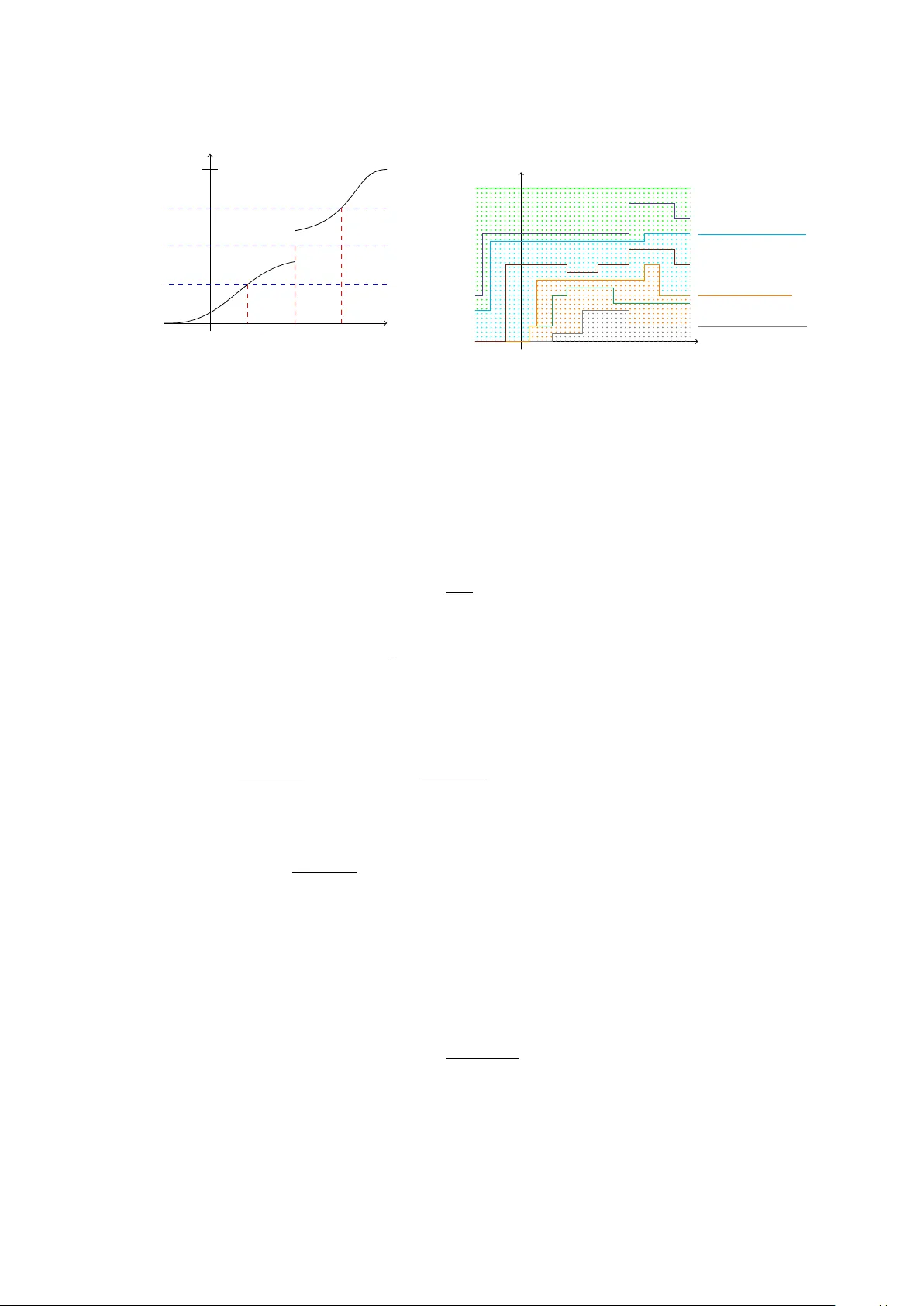
Quantitative concentration inequalities fo r the unifo rm app ro ximation of the IDS Max K¨ amp er Christoph Sc h umac her F abian Sc h w arzen b erger ∗ Iv an V eseli ´ c † F ebruary 23, 2026 The in tegrated densit y of states (IDS) is a fundamen tal sp ectral quan tity for quan- tum Hamiltonians mo deling condensed matter systems, describing ho w densely en- ergy lev els are distributed. It can b e in terpreted as a v olume-av eraged sp ectral distribution. Hence, there are tw o equiv alent definitions of the IDS related by the P astur–Shubin form ula: an op erator-theoretic trace formula and a limit of normal- ized eigen v alue counting functions on finite v olumes. W e study a discrete random Sc hr¨ odinger op erator with b ounded random p otentials of finite-range correlations and pro ve a quan titative concen tration inequalit y ensuring, with explicit high prob- abilit y , that the empirical IDS (normalized eigenv alue coun ting function) uniformly appro ximates the abstract IDS trace form ula within a prescrib ed error, thereby im- plying confidence regions for the IDS. MSC: 47B80, 60B12, 62E20, 82B10 Keyw ords: Statistical mechanics, Anderson mo del, Integrated densit y of states, Uniform conv ergence, Empirical measures, Concentration inequalit y , En tropy bound 1 Intro duction The in tegrated density (IDS) of states is a k ey sp ectral c haracteristic of quantum Hamiltoni- ans H ω mo delling condensed matter. It is the volume-normalized or volume-a veraged sp ectral distribution function of suc h Hamiltonians, where some form of translation inv ariance, at least ergo dicit y is assumed. Naiv ely sp eaking it informs us where the spectrum is more dense and where less so. It can b e used to calculate all basic thermo dynamic quan tities of the corresponding non-in teracting man y-particle system. There are t wo a priori indep enden t w a ys to define the IDS. One is a closed form ula of op erator algebraic fla v our and the other a limit form ula. The former one reads R ∋ E 7→ T r[ 1 ( −∞ ,E ] ( H ω ) 1 Λ ] (1) ∗ F akult¨ at f ¨ ur Informatik/Mathematik, HTW Dresden, 01069 Dresden, German y † F akult¨ at f ¨ ur Mathematik, TU Dortmund, 44221 Dortmund, Germany 1 where T r denotes the trace, 1 ( −∞ ,E ] ( H ω ) the sp ectral pro jector on the energy interv al ( −∞ , E ] and 1 Λ the multiplication op erator with the indicator function of the unit cub e Λ = [ − 1 / 2 , 1 / 2) d . The second definition is R ∋ E 7→ lim L →∞ N Λ L ω ( E ) (2) where N Λ L ω denotes the normalized eigenv alue counting function of H Λ L ω , some appropriate restriction of the Hamiltonian to the b ox Λ L := [ − L/ 2 , L/ 2) d . Clearly , the equalit y of these t wo expressions is a v arian t of the law of large num b ers or ergo dic theorem. The id entit y is asso ciated with the names of L.A. Pastur and M.A. Sh ubin, who established this formula for somewhat differen t classes of op erators in their groundbreaking work, see for instance [Shu79, Pas80], the monographs [CL90, PF91, Sto01, V es08, A W15] and the references therein. More recen tly there has b een in terest in establishing a strong v ersion of the P astur-Shubin form ula where con v ergence holds uniformly in the energy parameter E , see for instance [Len02, LS05, LMV08, L V09, LSV10, PS12, Sch 12, ASV13, SSV17, SSV18]. Since all arguments (kno wn to us) used in this con text rely on the interlacing prop ert y of finite rank p erturbations w e will restrict ourselves in the rest of the pap er to Hamiltonians defined on ℓ 2 of some translation in v ariant graph. (Most ideas ha v e b een extended to quan tum graphs of the same form, in particular to one-dimensional contin uum random Schr¨ odinger operators.) Ob viously , uniform con vergence w.r.t. energy is stronger than p oin twise (a.e.) con vergence. Moreov er, uniform con vergence of probabilit y distribution functions induces a natural top ology on the space of measures. F rom the empirical point of view only the quan tity (2) is accessible. Since one aims to iden tify the underlying measure defined b y (1) from the limiting pro cedure the following questions are natural: • How pr e cisely c an one pr e dict or estimate the IDS b ase d on a sample of lab or atory me asur e- ments or, mor e r e alistic al ly, a numb er of c omputational physics simulations? How many me asur ements or iter ations ar e ne c essary to b e able to do so with a pr e descib e d ac cur acy and c onfidenc e? • In the language of statistics we ar e asking for a c onfidenc e r e gion of the IDS. An alternative sc enario would b e that a c ertain IDS is hyp othesize d for a material or Hamiltonian and a test is p erforme d b ase d on a numb er of samples. Then the question is, how many samples ar e ne c essary, to distingush the hyp othesize d me asur e? T o give an idea how our results can answer suc h questions we form ulate a consequence of the theorems obtained in the pap er for a particulary simple mo del: Let H ω = − ∆ + V ω : ℓ 2 ( Z d ) → ℓ 2 ( Z d ), where ∆ is the discrete Laplacian and ( V ω φ )( k ) = ω k φ ( k ) the m ultiplication op erator by a sequence of i.i.d. bounded random v ariables ω k indexed b y k ∈ Z d . Denote the distribution of ω k b y µ and P = N Z d µ . Let H Λ L ω = p Λ L H ω i Λ L b e the compression to the subspace ℓ 2 (Λ L ) and N Λ L ω its normalized eigen v alue coun ting function. Our results imply the following confidence region estimate: Theorem 1 F or d ≥ 3 and al l α, β ∈ (0 , 1) sup µ P {∥ N Λ L ω − N ∥ ∞ > β } < α 2 pr ovide d L > max ( C β + 1 2 , (log (2 /α ) K ) 2 / ( d − 2) + 1 2 , 16 ) (3) wher e C = 40 d + 104 · 2 d − 51 and K = 480 log(3 / 2) + 16 log(2) < 1207 . Her e the supr emum is taken over al l Bor el pr ob ability me asur es µ on R with b ounde d supp ort. Hence the α − confidence region corresp onding to the measurement ω ∈ R Z d is ρ ∈ B | ρ isotone , N Λ L ω − ρ ∞ ≤ β , pro vided (3) is satisfied. Here B is the space of bounded right-con tinuous functions. The rest of the pap er ist organised as follows: W e present the framew ork of our general mo del in Section 2 and our main results in Section 3, concluding with a discussion of the results and an outline of the pro of. The latter is split in to tw o parts: The geometric one is presen ted in Section 4 and the probabilistic in Section 5 . The pro ofs of the main theorems are completed in Section 6, whereas Section 7 discuses some extensions, in particular to random Sc hr¨ odinger operators on finitely generated amenable groups and Laplace op erators on long-range p ercolation graphs. More general results and detailed pro ofs are a v ailable in the dissertation [K¨ a24], which is freely access ible online. Accordingly , w e present here some arguments only under simplfying conditions rather than in full detail, and rather fo cus on explaining how the statements for the more sp ecific situation considered in this pap er follo w from the general framework developed in the thesis. 2 Notation, mo del assumptions, and some basic p rop erties Here w e fix some notation, state assumptions (M1) and (M2) on the probabilit y space under con- sideration, and thereafter establish fundamental prop erties of the eigen v alue counting functions, denoted here (A1) to (A6). Let ∥ x ∥ 1 = P d i =1 | x i | denote the ℓ 1 -norm in Z d with the asso ciated metric d Z d : Z d × Z d → N 0 , d Z d ( x, y ) = ∥ x − y ∥ 1 . F or Λ 1 , Λ 2 ⊆ Z d w e define the distance b etw een Λ 1 and Λ 2 as d set (Λ 1 , Λ 2 ) := min { d Z d ( x, y ) | x ∈ Λ 1 , y ∈ Λ 2 } . F or an y Λ ⊂ Z d w e denote the num b er of p oin ts in Λ by | Λ | . Let Ω = ( R Z d , B ( R Z d ) , P ), where B ( R Z d ) is the Borel σ -algebra of R Z d and P a probability measure suc h that the following hold: 3 (M1) T ranslation inv ariance : The translations γ z : Ω → Ω , ( γ z ω ) y := ω y + z . (4) are measurable and P ◦ γ z = P for each z ∈ Z d . (M2) Indep endence at a distance : There is an r ≥ 0 suc h that for all k ∈ N if • Λ(1) , ..., Λ( k ) are finite subsets of Z d , • | Λ( i ) | = 0 for all 1 ≤ i ≤ k and • min { d set (Λ( i ) , Λ( j )) | i = j } > r then the pro jections Π Λ( i ) 1 ≤ i ≤ k Π Λ : Ω → Ω Λ , Π Λ ( ω ) := ω Λ := ( ω z ) z ∈ Λ . are independent, where Ω Λ = ( R Λ , B ( R Λ ) , P Λ ) with the image measure P Λ = P ◦ Π − 1 Λ . The operator H ω = − ∆ + V ω : ℓ 2 ( Z d ) → ℓ 2 ( Z d ) with H ω Ψ( x ) := X y ∈ Z d : | y − x | =1 (Ψ( x ) − Ψ( y )) + ω x Ψ( x ) (5) for ω ∈ Ω is called the Anderson op erator . The Anderson op erator can be compressed to a finite subset Λ of Z d , resulting in the restricted Anderson op erator H Λ ω : ℓ 2 (Λ) → ℓ 2 (Λ) , H Λ ω = p Λ H ω i Λ . Here, i Λ : ℓ 2 (Λ) → ℓ 2 ( Z d ) and p Λ : ℓ 2 ( Z d ) → ℓ 2 (Λ) are the embedding of ℓ 2 (Λ) in to ℓ 2 ( Z d ) and the pro jection from ℓ 2 ( Z d ) to ℓ 2 (Λ) with i Λ ϕ ( z ) = ( ϕ ( z ) z ∈ Λ 0 z / ∈ Λ , p Λ φ ( z ) = φ ( z ) ∀ z ∈ Λ . The restricted Anderson op erator is a hermitian matrix operator, since H ω is self-adjoint and ℓ 2 (Λ) is finite dimensional. Th us, the op erator has a finite num b er of real eigen v alues. The functions N (Λ , ω ) : R → [0 , 1] , N (Λ , ω )( x ) := # eigen v alues of H Λ ω ≤ x (6) ¯ N (Λ , ω ) : R → [0 , 1] , ¯ N (Λ , ω )( x ) := N (Λ , ω ) | Λ | . (7) are called the eigenv alue coun ting function (evcf ) and the normalized eigen v alue counting function for a restricted Anderson operator H Λ ω , resp ectiv ely . All eigenv alues are alwa ys counted with their multiplicit y . W e wan t to inv estigate the conv ergence of this function for larger and larger sets Λ. In order to discuss certain useful prop erties of the ev cf, we first in tro duce some notation. Let C be the set of all finite subsets of Z d . W e call ∂ r (Λ) := { x ∈ Λ : d set ( x, Z d \ Λ) ≤ r } ∪ { x ∈ Z d \ Λ : d set ( x, Λ) ≤ r } 4 the r -b oundary of a set Λ ⊂ Z d and define Λ r := Λ \ ∂ r (Λ) = { x ∈ Λ | d set ( x, Z d \ Λ) > r } . F or sets Λ i with an index we use the shorthand Λ r i = (Λ i ) r . W e call an y in teger translate of { x ∈ Z d : 0 ≤ x i < n ∀ 1 ≤ i ≤ d } a cube of side length n , which alwa ys con tains n d elemen ts. In the following we will heavily use the fact that every sequence Λ k , k ∈ N , of cub es of strictly increasing side length is a so called Følner sequence , meaning | ∂ r (Λ k ) | | Λ k | − − − → i →∞ 0 (8) for all r ∈ N . No w w e can formulate a num b er of prop erties of the eigenv alue counting function that we will use later. (A1) translation in v ariance : F or Λ ∈ C , z ∈ Z d and ω ∈ Ω we hav e N (Λ + z , ω ) = N (Λ , γ z ω ) . (A2) lo calit y : F or all Λ ∈ C and ω , ω ′ ∈ Ω with Π Λ ( ω ) = Π Λ ( ω ′ ) w e ha v e N (Λ , ω ) = N (Λ , ω ′ ) . (A3) almost additivity : F or all ω ∈ Ω, all pairwise disjoin t Λ(1) , ..., Λ( n ) ∈ C and Λ := S n i =1 Λ( i ) w e ha v e N (Λ , ω ) − n X i =1 N (Λ( i ) , ω ) ∞ ≤ n X i =1 b (Λ( i )) with b (Λ) := 8 Λ \ Λ 1 b satisfies • for all Λ ∈ C and z ∈ Z d w e ha ve b (Λ) = b (Λ + z ) • b (Λ) ≤ 8 | Λ | for all Λ ∈ C • if (Λ( n )) n ∈ N is a sequence of cub es with strictly increasing side length, then lim n →∞ b (Λ( n )) | Λ( n ) | = 0 (A4) b oundedness : sup ω ∈ Ω ∥ N ( { 0 } , ω ) ∥ ∞ = 1 (A5) monotonicity : The function N (Λ , ω ) is monotone increasing, i.e. ∀ Λ ∈ C , ω ∈ Ω : x < y = ⇒ N (Λ , ω )( x ) ≤ N (Λ , ω )( y ) . (A6) p oin t-wise measurabilit y : The function N (Λ , · )( x ) : R Z d , B R Z d → ( R , B ( R )) is measurable for all x ∈ R and Λ ∈ C , where B ( R ) is the Borel σ -algebra of R . 5 Pr o of. F or the pro of of (A1) to (A5) see [SSV17, Lemma 7.1]. T o show (A6), let λ ↓ j ( H Λ ω ) b e the j-th largest eigenv alue of H Λ ω , counted with multiplicities. W e use Corollary I I I.2.6 of [Bha13], which shows that for all Λ ∈ C and ω = ω ′ ∈ Ω w e ha v e max j =1 ,..., | Λ | λ ↓ j ( H Λ ω ) − λ ↓ j ( H Λ ω ′ ) ≤ H Λ ω − H Λ ω ′ where the last norm is the op erator norm. F rom the definition of the restricted Anderson op erator follows H Λ ω − H Λ ω ′ = ∥ p Λ ( V ω − V ω ′ ) i Λ ∥ = ∥ p Λ ( V ω − ω ′ ) i Λ ∥ = ω Λ − ω ′ Λ ∞ . Th us, λ ↓ j ( H Λ · ) : Ω Λ → R is contin uous and therefore measurable for all j . This in turn means that { ω ∈ Ω : λ ↓ j ( H Λ ω ) ≤ x } is a measurable set for all x ∈ R and all 1 ≤ j ≤ | Λ | , and consequen tly the functions 1 n λ ↓ j ( H Λ ω ) ≤ x o are also measurable. Finally N (Λ , ω )( x ) = | Λ | X j =1 1 n λ ↓ j ( H Λ ω ) ≤ x o , whic h sho ws that ω 7→ N (Λ , ω )( x ) is measurable for all x ∈ R and Λ ∈ C . 3 Main results: Concentration inequalites fo r the evcf With the notation in place w e are now able to state our main results. First is a concentration inequalit y for normalized eigenv alue coun ting functions. This result is an adaption of [K¨ a24, Corollary 7.3]. Theorem 2 L et d ≥ 3 , M ≥ 2 and Ω = ( R Z d , B ( R Z d ) , P ) b e a pr ob ability sp ac e satisfying (M1) and (M2) with r the smal lest c onstant such that (M2) is satisfie d. L et N b e the IDS and ¯ N (Λ n , ω ) b e the normalize d eigenvalue c ounting function of an Anderson op er ator as in (5) for a cub e Λ n ⊂ Z d of side length n ∈ N . Then ther e is a set A M ,n ∈ B ( R Z d ) such that ¯ N (Λ n , ω ) − N ∞ ≤ 32 d 1 n + 104 2 d − 1 1 √ n + 8 d + 4 r (2 d − 1) + 72 dr + 1 1 √ n − 1 (9) for al l ω ∈ A M ,n and P ( A M ,n ) ≥ 1 − M exp − p ⌊ n/ ⌊ √ n ⌋⌋ d ⌊ √ n ⌋ K M ! (10) pr ovide d n > (2 r + 1) 2 and n > 16 , wher e K M = 40( M + 1) log(3 / 2)( M − 1) + 4 log( M ) ∞ X q =0 2 − q p 2 + 2 q log(2) < 16 10( M + 1) log(3 / 2)( M − 1) + 1 log( M ) . 6 R emark 3 . Theorem 1 is a direct consequence of Theorem 2. First w e c ho ose M = 2 and r = 0, then note that (9) implies ¯ N (Λ n , ω ) − N ∞ < C √ n − 1 and (10) implies P ( A 2 ,n ) ≥ 1 − 2 exp − ( √ n − 1) d/ 2 − 1 K ! with C and K as in the statem en t of Theorem 1. Then w e just hav e to choose n large enough to ensure C √ n − 1 ≤ β , P ( A 2 ,n ) ≥ 1 − α as well as the conditions n > (2 r + 1) 2 and n > 16 necessary for Theorem 2, leading to the b ound given in Theorem 1. R emark 4 (What is differen t for dimensions one and t wo?) . F or dimensions b elo w three the concen tration inequality needs to hav e a slightly differen t scaling in n . The corresp onding result to Theorem 2 for d = 1 and d = 2 pro vides an error b ound differing from (9) only in the last term, namely ¯ N (Λ n , ω ) − N ∞ ≤ 32 d 1 n + 104 2 d − 1 1 n 1 − 1 /k + 8 d + 4 r (2 d − 1) + 72 dr + 1 k √ n − 1 (11) for all ω ∈ A ′ M ,n where no w the even t A ′ M ,n satisfies P A ′ M ,n ≥ 1 − M exp − p ⌊ n/ ⌊ k √ n ⌋⌋ d ⌊ k √ n ⌋ K M ! where k = ( 4 for d = 1 3 for d = 2 but the other constants are unc hanged. F or a pro of see [K¨ a24, Corollary 7.3]. With some c hanges of the probabilistic parts of the pro ofs of the previous results it is also p ossible to sho w a concen tration inequalit y where the exponent is impro v ed to ⌊ n/ ⌊ k √ n ⌋⌋ d ⌊ k √ n ⌋ (instead of √ ⌊ n/ ⌊ k √ n ⌋⌋ d ⌊ k √ n ⌋ ) under a stronger assumption on the size of n . Theorem 5 L et d ∈ N as wel l as k = 2 for d ≥ 5 and k > 4+ d d for d < 5 . In the setting of The or em 2 ther e is a set B n ∈ B ( R Z d ) such that (11) is true for al l ω ∈ B n and P ( B n ) ≥ 1 − exp − 1 24 ⌊ n/ ⌊ k √ n ⌋⌋ d ⌊ k √ n ⌋ pr ovide d n > max 16 , (2 r + 1) k , (12 K 2 ) 2 /d + 1 dk dk − d − 4 wher e K 2 = 120 log(3 / 2) + 4 log(2) ∞ P q =0 2 − q p 2 + 2 q log(2) < 480 log(3 / 2) + 16 log(2) . 7 3.1 Discussion of achievements and limitations of our new findings Our results establish that the abstract sp ectral distribution function R ∋ E 7→ T r[ 1 ( −∞ ,E ] ( H ω ) 1 Λ ] allo ws for explicit confidence regions based on sampling data. This is to our knowledge the first rigorous result for estimating the IDS in the space of measures in the language of statistics. Our strong error b ound result from to the use of concen tration inequalities based on en- trop y and brack eting num b ers, together with the observ ation that due of the structure of the eigen v alue counting functions, brack eting cov ers inherit fa vorable prop erties, leading in turn to efficien t complexity b ounds. The construction of brack et co verings for eigenv alue coun ting func- tions are to the best of our knowledge an en tirely new contribution of this pap er, respectively the Dissertation [K¨ a24]. Our result certainly does not pro vide sharp bounds on the appro ximation error, or the n umber of necessary samples, resp ectiv ely . The b ounds are too large to b e relev ant for computational ph ysicists. This is on one hand due to the fact that w e gav e aw a y muc h when estimating the constan ts in the proof. Even more imp ortan tly , the geometric error is at least of the order of magnitude n − 1 / 2 , requiring a huge size of the individual samples. This geometric error of order n − 1 / 2 is the b ottlenec k for an y improv ement of our estimates. Possibly an improv e men t could b e ac hiev ed by some kind of plane-wa ve or quasi-momen tum disintegration of the states in the ℓ 2 space and a v eraging ov er quasi-p erio dic boundary conditions in the vein of Klopp’s approach in [Klo99]. F urthermore, the Hamiltonian we consider is already an appro ximation, since it is a one- electron Schr¨ odinger op erator, and is considered in the discretized version. In computational ph ysics one w ould turn at an earlier stage to an dimension-reduced effectiv e model and determine confidence regions for suc h effectiv e mo dels. Suprem um norms ma y not be the to ol of c hoice there. 3.2 Strategy of the p ro ofs and outline fo r the remainder of the pap er Our general strategy follo ws [SSV18], whic h is in turn inspired by earlier w orks, e.g. [LMV08] and [LSV10]. The tec hniques can b e divided into tw o groups. The first is the sub ject of Section 4 and is based on almost-additivit y and the geometry of Z d . T he second is dev oted to a quantifi- cation of the law of large num b ers based on concen tration inequalities and is co vered in Section 5. Here w e use a different approac h than in the earlier men tioned w orks [LMV08], [LSV10], and [SSV18]. The proofs of the final concen tration inequalities in turn consist of three steps: W e first appro ximate N (Λ n ,ω ) | Λ n | b y a normalized sum o v er a large num b er of indep enden t, iden- tically distributed random v ariables in Lemma 6 of Section 4. Then we introduce the Orlicz norm in Section 5 and use it to outline a probabilistic argument (Theorem 13) to show that this av eraged sum conv erges almost surely uniformly to an exp ected v alue for n → ∞ . This is accomplished via brack et co v erings, which are the topic of Subsection 5.1. The argument yields explicit error b ounds in the form of tw o concentration inequalities, Corollaries 15 and 17. After that w e use once more geometric argumen ts (namely Theorem 7 of Section 4) to sho w that the sequence of exp ected v alues (asso ciated to the approximation of N (Λ n ,ω ) | Λ n | ) conv erges as well. In Section 6 all the pro vious steps are assembled to yield the main results. 8 Sym b olically , the strategy can b e summarised as follows: N (Λ n , ω ) | Λ n | ≈ 1 k ( n ) k ( n ) X i =1 N (Λ m,i , ω ) | Λ m,i | n →∞ − − − → a.s. E N (Λ m , ω ) | Λ m | m →∞ − − − − → N . (12) Here, Λ n is a cub e with side length n , k ( n ) < n is a n umber that grows monotonously with n , (Λ m,i ) 1 ≤ i ≤ k ( n ) are a series of cub es with side length m < 2 n that do not intersect. 4 Geometric appro ximation estimates W e start with the geometric appro ximation argumen t. Let Λ n := ([0 , n ) ∩ Z ) d b e a cub e with side length n ∈ N . W e “tile” this cub e by smaller cub es with side length m , such that 2 m < n and define the tiling set T m,n := { t ∈ T m : Λ m + t ⊂ Λ n } where T m := m Z d = { ( z ( i ) ) 1 ≤ i ≤ d ∈ Z d : z ( i ) mo d m = 0 ∀ 1 ≤ i ≤ d } . The cardinalit y of this set is | T m,n | = ⌊ n/m ⌋ d and all the sets Λ m + t with t ∈ T m are pairwise disjoint. The union Λ m,n := [ t ∈ T m,n (Λ m + t ) = Λ m + T m,n . satisfies Λ m,n = Λ ⌊ n/m ⌋ m . W e further define ˆ Λ m,n := Λ n \ Λ m,n . See Figure 1 for an illustration. Λ m Λ m,n = Λ ⌊ n/m ⌋ m Λ n T m,n ˆ Λ m,n Figure 1: Illustration of some lattice subsets for d = 2. The prop erties of the eigen v alue counting function e nsure that for all ω ∈ Ω, and all n, m, r ∈ N with n > 2 m , m > 2 r + 1 N (Λ n , ω ) | Λ n | − 1 | T m,n | X t ∈ T m,n N (Λ r m + t, ω ) | Λ m | ∞ ≤ b Λ ⌊ n/m ⌋ m Λ ⌊ n/m ⌋ m + 26 ( | Λ n | − | Λ m n | ) | Λ m n | + b (Λ m ) + b (Λ r m ) + 17 ( | Λ m | − | Λ r m | ) | Λ r m | . (13) 9 F or an explicit calculation see [K¨ a24, Lemma 5.1]. Next we wan t to make this expression more explicit in terms of n , m , r and d . Lemma 6 F or eigenvalue c ounting functions on d -dimensional cub es with n, m ∈ N , n > 4 m and m > 2 r + 1 we have N (Λ n , ω ) | Λ n | − 1 | T m,n | X t ∈ T m,n N (Λ r m + t, ω ) | Λ m | ∞ ≤ 32 d 1 n + 104 2 d − 1 m n (14) + 4 d + 2 r (2 d − 1) + 36 dr 1 m Pr o of. The boundary function b is b (Λ) = 8 Λ \ Λ 1 b y (A3) and additionally w e hav e | Λ n | = n d and | Λ r n | = ( n − 2 r ) d for cubes Λ n . Thus b Λ ⌊ n/m ⌋ m Λ ⌊ n/m ⌋ m = 8 Λ ⌊ n/m ⌋ m − Λ 1 ⌊ n/m ⌋ m Λ ⌊ n/m ⌋ m = 8 1 − ⌊ n/m ⌋ m − 2 ⌊ n/m ⌋ m d ! . and consequen tly N (Λ n , ω ) | Λ n | − 1 | T m,n | X t ∈ T m,n N (Λ r m + t, ω ) | Λ m | ∞ (15) ≤ 8 1 − ⌊ n/m ⌋ m − 2 ⌊ n/m ⌋ m d ! + 26 n n − 2 m d − 1 ! + m d − ( m − 2) d + ( m − 2 r ) d − ( m − 2 r − 2) d + 17( m d − ( m − 2 r ) d ) m d = 8 1 − 1 − 2 ⌊ n/m ⌋ m d ! + 26 1 + 2 m/n 1 − 2 m/n d − 1 ! + 1 − 1 − 2 m d ! + 1 − 2 r m d − 1 − 2 r + 2 m d ! + 17 1 − 1 − 2 r m d ! This expression only holds for m > 2 r + 1, since we exclude the edge case where (Λ r m ) 1 = ∅ but m − 2 r − 2 < 0 in fa vour of a unified expression. No w w e use Bernoulli’s inequality 1 − (1 − y ) d ≤ y d (16) for y ≤ 1 for the first, third and fifth term on the right of (15). Since ⌊ n/m ⌋ m ≥ n − m we hav e 1 ⌊ n/m ⌋ m ≤ 1 n − m ≤ 1 n 1 1 − m/n ≤ 2 n . if n > 2 m . If n ≥ 4 we can apply Bernoulli’s inequalit y and get the b ounds 1 − 1 − 2 ⌊ n/m ⌋ m d ! ≤ 2 d ⌊ n/m ⌋ m ≤ 4 d n , 1 − 1 − 2 m d ! ≤ 2 d m and 1 − 1 − 2 r m d ! ≤ 2 dr m 10 since m > 2 r + 1 and th us m ≥ 2 as w ell as m ≥ 2 r was already required. Next w e note that b y the binomial theorem (1 + x ) d = d X j =0 d j x j (17) w e ha ve (1 + x ) d − 1 ≤ | x | d X j =1 d j | x | j − 1 ≤ | x | d X j =1 d j = | x | (2 d − 1) for | x | ≤ 1. F rom z 1 − z ≤ 2 z ≤ 1 ⇔ z ≤ 1 2 follo ws 1 + 2 m/n 1 − 2 m/n d − 1 ! ≤ 4 m n 2 d − 1 as long as 4 m < n . F or the fourth term we use b oth (16) and (17) for 1 − 2 r m d − 1 − 2 r + 2 m d ≤ 2 d − 1 2 r m + d (2 r + 2) m = 2 r 2 d + 2 d ( r + 1) − 2 r m . In conclusion we get N (Λ n , ω ) | Λ n | − 1 | T m,n | X t ∈ T m,n N (Λ r m + t, ω ) | Λ m | ∞ ≤ 32 d 1 n + 104 2 d − 1 m n + 4 d + 2 r (2 d − 1) + 36 dr 1 m b y applying all the previous b ounds to (15). This result further yields the existence of a limit for the exp ected v alue of the normalized eigen v alue counting functions on growing cub es, namely Theorem 7 L et N b e the eigenvalue c ounting function, r, n ∈ N such that 2 r + 1 < n and Λ n := ([0 , n ) ∩ Z ) d . Then E N (Λ r n , · ) | Λ n | (define d p ointwise in R ) forms a ∥·∥ ∞ -Cauchy se quenc e and ther e exists a limit function N ∗ ∈ B that is monotonic al ly incr e asing. F urthermor e E N (Λ r n , · ) | Λ n | − N ∗ ∞ ≤ 4 d + 2 r (2 d − 1) + 36 dr 1 n . (18) Pr o of. First w e note that b ecause of (A1) and the assumed prop ert y (M1) of the probability space, the equation E N (Λ r m + t, · ) = E N (Λ r m , · ) ◦ γ t = E N (Λ r m , · ) 11 is true for all t ∈ Z d and m, r ∈ N with m > 2 r . Therefore E 1 | T m,n | X t ∈ T m,n N (Λ r m + t, · ) | Λ m | = 1 | T m,n | X t ∈ T m,n E N (Λ r m + t, · ) | Λ m | = E N (Λ r m , · ) | Λ m | . (19) holds as well. W e can th us reuse the b ound of Lemma 6 to b ound E N (Λ r n , · ) | Λ n | − E N (Λ r k , · ) | Λ k | ∞ as w ell. How ever, that b ound only holds for n > 4 m and w e need to establish a Cauc hy criterium for all n, m . F or the next step, let m < n ∈ N and δ > 0. Then b y (A3) and (8) there exists a k > 4 n that is divisible by n and m (resulting in ⌊ k /n ⌋ n = ⌊ k /m ⌋ m = k ) suc h that max ( b (Λ k ) | Λ k | , | ∂ n (Λ n k ) | Λ n k , | ∂ m (Λ m k ) | Λ m k ) < δ. W e use the triangle inequality and (19) to get E N (Λ r n , · ) | Λ n | − E N (Λ r m , · ) | Λ m | ∞ ≤ E 1 | T n,k | X t ∈ T n,k N (Λ r n + t, · ) | Λ n | − E N (Λ k , · ) | Λ k | ∞ + E N (Λ k , · ) | Λ k | − E 1 | T m,k | X t ∈ T m,k N (Λ r m + t, · ) | Λ m | ∞ . (20) Both terms on the right side can b e treated the same wa y by first considering a sp ecific x ∈ R and using (13) as well as the results of Lemma 6 for E 1 | T n,k | X t ∈ T n,k N (Λ r n + t, · )( x ) | Λ n | − E N (Λ k , · )( x ) | Λ k | ≤ E 1 | T n,k | X t ∈ T n,k N (Λ r n + t, · )( x ) | Λ n | − N (Λ k , · )( x ) | Λ k | ≤ E b (Λ k ) | Λ k | + 26 ( | Λ k | − | Λ n k | ) Λ n k + b (Λ n ) + b (Λ r n ) + 17 ( | Λ n | − | Λ r n | ) | Λ r n | ! ≤ 27 δ + b (Λ n ) + b (Λ r n ) + 17 ( | Λ n | − | Λ r n | ) | Λ r n | ≤ 27 δ + 4 d + 2 r (2 d − 1) + 36 dr 1 n . Since x was arbitrary , this results in E 1 | T n,k | X t ∈ T n,k N (Λ r n + t, · ) | Λ n | − E N (Λ k , · ) | Λ k | ∞ ≤ 27 δ + 4 d + 2 r (2 d − 1) + 36 dr 1 n (21) 12 where the second term on the right side conv erges to 0 for increasing n . Therefore, for ev ery ε > 0 there is an n 0 ∈ N suc h that 4 d + 2 r (2 d − 1) + 36 dr 1 n < ε ∀ n ≥ n 0 . (22) The bound (21) is also v alid if n is replaced b y m . Thus, if n, m ≥ N then E N (Λ r n , · ) | Λ n | − E N (Λ r m , · ) | Λ m | ∞ ≤ 54 δ + 2 ε whic h follows from (20), (21) and (22). This pro ves that E N (Λ r n , · ) | Λ n | is a Cauc hy sequence and has a uniform limit N ∗ . Since N (Λ r n ,ω ) | Λ n | is right-con tin uous, monotone increasing and b ounded by 1 for ev ery n and ev ery ω this is also true for its exp ected v alue b y the b ounded conv ergence theorem. Therefore, every E N (Λ r n , · ) | Λ n | lies in B and is monotone increasing, and as a uniform limit this is true for N ∗ as well. By taking the limit m → ∞ we can also obtain the b ound (18) for the difference of E N (Λ r n , · ) | Λ n | − N ∗ since δ w as arbitrary . 5 Probabilistic appro ximation estimates F ollo wing the preceding section w e can approximate the normalized eigen v alue coun ting function on a large cub e b y the av eraged sum ov er the normalized eigenv alue coun ting functions on smaller cub es with explicit control on the error of the approximation. Next we would like to inv estigate the behaviour of this av eraged sum. As an av eraged sum of indep enden t, identically distributed random v ariables we can hop e to find a conv ergence to an exp ected v alue. In more detail, as a consequence of the tw o geometric appro ximation estimates (14) and (18) we hav e N (Λ n , ω ) | Λ n | − N ∗ ∞ ≤ N (Λ n , ω ) | Λ n | − 1 | T m,n | X t ∈ T m,n N (Λ r m + t, ω ) | Λ m | ∞ + 1 | T m,n | X t ∈ T m,n N (Λ r m + t, ω ) | Λ m | − E N (Λ r m , · ) | Λ m | ∞ + E N (Λ r m , · ) | Λ m | − N ∗ ∞ ≤ 32 d 1 n + 104 2 d − 1 m n + 2 4 d + 2 r (2 d − 1) + 36 dr 1 m + 1 | T m,n | X t ∈ T m,n N (Λ r m + t, ω ) | Λ m | − E N (Λ r m , · ) | Λ m | ∞ . (23) for n, m ∈ N , n > 4 m and m > 2 r + 1. The last term on the righ t side is precisely the p oin t where we need to obtain a b ound for the difference of a random function to a deterministic one. It is the norm of the difference of an a veraged sample to an exp ected v alue, so at least for ev ery fixed x ∈ R the la w of large n umbers ensures 1 | T m,n | X t ∈ T m,n N (Λ r m + t, ω )( x ) | Λ m | → E N (Λ r m , · )( x ) | Λ m | for n → ∞ 13 for almost all ω ∈ Ω. The challenge left is to sharp en the conv ergence to uniform b ounds and quan tify them. T o simplify notation we will use sup x ∈ R 1 | T m,n | X t ∈ T m,n N (Λ r m + t, ω )( x ) | Λ m | − E N (Λ r m , · )( x ) | Λ m | = sup f ∈F ′ 1 s s X t =1 f ( X t ) − E f ( X t ) ! where F ′ = n N (Λ r m , · )( x ) | Λ m | : x ∈ R o , s = | T m,n | and X t = ( γ t ω ) Λ r m . Instead of a suprem um ov er the real n umbers we will instead treat the eigenv alue counting functions for each x as a separate function from Ω to R and then take the supremum o ver all of these functions. The quan tification w e ha v e in mind is of the form P sup f ∈F 1 s s X i =1 f ( X i ) − E f ( X 1 ) ≥ κ ! ≤ c 1 ( κ, s ) · exp ( c 2 ( κ, s )) for all κ > 0 with suitable c 1 ( κ, s ) and c 2 ( κ, s ). Related to such concentration inequalities is the Orlicz norm. Definition 8 (Orlicz norm) The Orlicz norm of a r e al r andom variable X asso ciate d to a monotone incr e asing, non- c onstant c onvex function Φ : R → R with 0 ≤ Φ(0) < 1 is ∥ X ∥ Φ := inf C > 0 : E Φ | X | C ≤ 1 wher e inf ( ∅ ) := ∞ . The Orlicz norm for Φ( x ) = x p is the usual L p -norm. If | X | ≤ | Y | almost surely , then ∥ X ∥ Φ ≤ ∥ Y ∥ Φ . Of sp ecial in terest are the Orlicz norms asso ciated to the functions ψ p,M ( x ) := 1 M e ( x p ) for p ≥ 1 and esp ecially p = 1 and p = 2. If M = 2, the resulting Orlicz norm is iden tical to the one for Ψ p ( x ) := e ( x p ) − 1 ≥ x p . In the rest of this pro of w e refer to these sp ecific functions with ψ p,M and Ψ p , while w e use Φ for general monotone increasing, non-constan t, conv ex functions with 0 ≤ Φ(0) < 1. The connection to exp onential concentration inequalities is made explicit b y t w o b ounds, whic h follo w from Marko v’s inequalit y for con vex functions and the lay er cake form ula, resp ectiv ely . F or a pro of see e.g. [K¨ a24, Lemma 6.2]. Lemma 9 L et Φ b e as in Definition 8. (O1) If ∥ X ∥ Φ ≤ D < ∞ then E Φ | X | ∥ X ∥ Φ ≤ 1 and P ( | X | ≥ y ) ≤ 1 Φ ( y D ) 14 (O2) If X is a r e al r andom variable with P ( | X | > x ) ≤ B e − C x p ∀ x > 0 with c onstants B , C > 0 and p ≥ 1 then ∥ X ∥ ψ p,M ≤ B + M − 1 ( M − 1) C 1 /p V an der V aart and W ellner (among others) established an estimate on the supremum of an (a veraged) empirical process. How ever, they use a slightly different normalization, namely b y 1 / √ s instead of 1 /s . In the following w e use their results with some arguments due to Pollard and adapt them to the presen t situation. Definition 10 (Empirical process ([vW96, Chapter 2.1])) L et s ∈ N and let X 1 , X 2 , ..., X s b e i.i.d. r andom variables taking values in a me asur able sp ac e Y with image me asur e P . Then the empiric al pr o c ess applie d to a P -inte gr able function f : Y → R is G s ( f ) := 1 √ s s X i =1 ( f ( X i ) − E f ( X i )) ! . (24) L et F b e a set of P -inte gr able functions f : Y → R then the map F ∋ f → G s ( f ) is c al le d the F -indexe d empiric al pr o c ess. The map f 7→ G s ( f ) is linear. If F is finite, the follo wing b ound holds. Lemma 11 L et G s b e as in Definition 10. L et F b e a finite set of me asur able b ounde d functions. Then for M ≥ 2 max f ∈F | G s ( f ) | ψ 1 ,M ≤ K ′ ψ ,M max f ∈F ∥ f ∥ ∞ √ s (2 + log( |F | )) + max f ∈F ∥ f ∥ L 2 ( P ) p 2 + log( |F | ) (25) wher e K ′ ψ ,M = 4( M +1) log(3 / 2)( M − 1) . The qualitativ e idea for the pro of is due to Lemma 2.2.10 in [vW96] by v an der V aart and W ellner. The pro of of the quantitativ e version can b e found in [K¨ a24, Lemma 6.4]. W e give a short sk etc h here. Sketch of the pr o of. The pro of mainly rests on tw o lemmas. The first is an adaption of Lemma 3.2 from [P ol90] that gives a b ound for the Orlicz norm of a suprem um o v er an empirical pro cess. F or p = 1 , 2 and real random v ariables X 1 , ..., X m , the inequality max 1 ≤ i ≤ m X i ψ p,M ≤ (2 + log( m )) 1 /p log(3 / 2) max 1 ≤ i ≤ m ∥ X i ∥ ψ p,M . (26) holds. The second is the Bernstein inequality , which states that for i.i.d. random v ariables X 1 , X 2 , ..., X s with | X i | ≤ C for all 1 ≤ i ≤ s , the inequality P s X i =1 ( X i − E X i ) ≥ x ! ≤ e − 1 2 x 2 σ 2 + cx 15 with σ 2 := P s i =1 E X 2 i and c = C 3 holds for all x > 0. Applied to empirical pro cesses the Bernstein inequalit y leads to P | G s ( f ) | 1 | G s ( f ) | ≤ b a > x ≤ 2e − x 2 4 b P | G s ( f ) | 1 | G s ( f ) | > b a > x ≤ 2e − x 4 a . where a := max f ∈F 2 3 ∥ f ∥ ∞ √ s ≤ max f ∈F ∥ f ∥ ∞ √ s , b := max f ∈F E ( f ( X 1 )) 2 = max f ∈F ∥ f ∥ 2 L 2 ( P ) . (O2) implies now | G s ( f ) | 1 | G s ( f ) | ≤ b a ψ 2 ,M ≤ r 4( M + 1) M − 1 b (27) | G s ( f ) | 1 | G s ( f ) | > b a ψ 1 ,M ≤ 4( M + 1) M − 1 a. Since the right side of b oth inequalities only depends on a and b , not f , it is now p ossible to b ound suprema ov er Orlicz norms of this type. In combination with (26) this allo ws b ounds on the Orlicz norm of the maxim um of truncated empirical pro cesses like those on the left sides of (27) indexed b y a finite set. By using some other properties of Orlicz norms it is p ossible to split maxima of empirical processes into t w o truncated parts, leading to the b ound stated in the lemma. Next we extend the b ound to countable sets of functions. W e do this by appro ximating the set with ev er larger finite sets, but for this strategy to succeed w e need some regularit y of the considered functions. The idea here is to pic k for any q ∈ N a collection of functions ( g q i ) 1 ≤ i ≤ N ( q ) that is getting progressively denser and ensures that for every f ∈ F there are indices 1 ≤ i ( f , q ) ≤ N ( q ) suc h that f = ∞ X q =2 g q i ( f ,q ) − g q − 1 i ( f ,q − 1) and g q i ( f ,q ) − g q − 1 i ( f ,q − 1) L 2 ( P ) < 2 − q is alw ays true, meaning that the functions ( g q i ) 1 ≤ i ≤ N ( q ) at “lev el” q can b e used to approximate an y f ∈ F up to an L 2 ( P )-error of 2 − q +1 . As a consequence of Lemma 11 w e need to control b oth the error in the L 2 ( P )- and the sup-norm, whic h complicates the argumen ts, in addition to the challenge of finding the g q i . F or the sake of illustration of the pro cedure let us assume for a moment that w e hav e for finite F a b ound like max f ∈F | G s ( f ) | ψ 1 ,M ≤ max f ∈F ∥ f ∥ L 2 p 2 + log( |F | ) instead the actual b ound (25) of Lemma 11 and were able to select g q i as ab ov e. Then we can try to treat countable sets F in this hypothetical simplified situation b y sup f ∈F | G s ( f ) | = sup f ∈F G s ∞ X q =2 g q i ( f ,q ) − g q − 1 i ( f ,q − 1) ≤ ∞ X q =2 sup f ∈F G s g q i ( f ,q ) − g q − 1 i ( f ,q − 1) . 16 Since w e only hav e finitely man y choices for each q ∈ N , the supremum o v er f ∈ F for eac h term of the sum is b ounded by supremum ov er the functions ( g q i ) 1 ≤ i ≤ N ( q ) . This is a suprem um o ver a finite set, and since w e assumed that g q i ( f ,q ) − g q − 1 i ( f ,q − 1) L 2 ( P ) < 2 − q is alwa ys true, our assumed to y mo del ab o ve would lead to max f ∈F | G s ( f ) | ψ 1 ,M ≤ ∞ X q =2 2 − q q 2 + log( |F q | ) where |F q | is the n umber of p ossible com binations g q i ( f ,q ) − g q − 1 i ( f ,q − 1) . If this sum conv erges we w ould get the b ound that w e w ant. Unfortunately , Lemma 11 is more complicated than this h yp othetical simplified mo del, but the general idea of replacing every function by a sum of small “links” with a c hoice from a finite set remains v alid, alb eit it is necessary to do some extra steps. The wa y we iden tify the functions g q i describ ed ab ov e and measure how many “links” we need for a given set of functions F will b e its brack eting num b er. Definition 12 (Brac keting Co ver) L et Y b e a me asur able sp ac e and let P b e a me asur e on Y . F or two functions l , u : Y → R with l ( y ) ≤ u ( y ) for al l y ∈ Y the br acket [ l , u ] is the set [ l, u ] = { f : Y → R | l ( y ) ≤ f ( y ) ≤ u ( y ) for al l y ∈ Y } . Her e, l is c al le d the lower b oundary function and u the upp er b oundary function of the br acket. L et F b e a set of functions f : Y → R . Then I = { [ l i , u i ] , 1 ≤ i ≤ N } is a monotone br acket- ing c over of F if (BC1) F or al l y ∈ Y and 1 ≤ i ≤ N we have u i ( y ) ≥ l i ( y ) and for al l y ∈ Y and 1 ≤ i ≤ N − 1 we have l i +1 ( y ) ≥ u i ( y ) . (BC2) F ⊂ ∪ N i =1 [ l i , u i ] . A se quenc e ( I q ) q ∈ N with I q = [ l q ,i , u q ,i ] , 1 ≤ i ≤ N [] ( q , F , P ) of monotone br acketing c overs with se quenc es of b oundary functions ( l q ,i ) 1 ≤ i ≤ N [] ( q , F ,P ) and ( u q ,i ) 1 ≤ i ≤ N [] ( q , F ,P ) in L 2 ( P ) is a neste d monotone br acketing c over (with r e gar d to P ) if (NBC1) ∥ u q ,i − l q ,i ∥ L 2 ( P ) < 2 − q for al l q ∈ N , 1 ≤ i ≤ N [] ( q , F , P ) , (NBC2) F or al l q , t ∈ N and 1 ≤ i ≤ N [] ( q , F , P ) we have l q ,i ∈ ( l q + t,j ) 1 ≤ j ≤ N [] ( q + t, F ,P ) u q ,i ∈ ( u q + t,j ) 1 ≤ j ≤ N [] ( q + t, F ,P ) . 17 We c al l the function q → N [] ( q , F , P ) the monotone br acketing function of the neste d mono- tone br acketing c over. Note that this definition is more restricted than brac ketings used in many other cases, which usually only require (BC2) and (NBC1). These are the crucial prop erties for the next theorem as w ell, but the other prop erties naturally hold for the eigenv alue coun ting functions we are in terested in and lead to b etter constants here. A rigorous analogon of the discussion ab ov e of the hypothetical simplified situation is the follo wing: Theorem 13 (Orlicz norm of countable set suprem um of the empirical pro cess) L et X 1 , X 2 , ... b e i.i.d. r andom variables taking values in a me asur able sp ac e Y , with image me asur e P , F a c ountable set of me asur able functions f : Y → [0 , 1] with a neste d monotone br acketing c over, and let N [] ( q , F , P ) b e the asso ciate d monotone br acketing function. Then for al l M ≥ 2 sup f ∈F 1 √ s s X i =1 ( f ( X i ) − E f ( X i )) ! ψ 1 ,M ≤ K ′′ ψ ,M ∞ X q =0 2 − q q 2 + log N [] ( q , F , P ) (28) holds, wher e ∥·∥ ψ 1 ,M is the Orlicz norm asso ciate d to ψ 1 ,M := 1 M e x , K ′ ψ ,M = 4( M +1) log(3 / 2)( M − 1) and K ′′ ψ ,M = (10 K ′ ψ ,M + 4 log( M ) ) . The qualitativ e version of this result w as established in Theorems 2.5.6 and 2.14.2 of [vW96], the quan titativ e v ersion and its pro of can b e found in [K¨ a24, Theorem 6.9]. 5.1 Brack et coverings for eigenvalue counting functions The next step now is to find a nested monotone brack eting cov er for (a countable subset of ) the set of functions F ′ = N (Λ r m , · )( x ) | Λ m | : x ∈ R . T o do this, w e will use some prop erties of the normalized eigen v alue counting functions, namely the boundedness (A4), the asymptotic b eha viour lim x →−∞ N (Λ r m , ω )( x ) | Λ m | = 0 and lim x →∞ N (Λ r m , ω )( x ) | Λ m | = | Λ r m | | Λ m | for all ω ∈ Ω , the monotonicit y (A5), and the p oin t-wise measurabilit y (A6). W e further define Φ : R → R , Φ( x ) := E N (Λ r m , · )( x ) | Λ m | whic h inherits the boundedness, limit b eha viour and monotonicity by dominated con vergence. Because of the limit b eha viour it is conv enient to define Φ( −∞ ) = 0 , Φ − ( ∞ ) = | Λ r m | | Λ m | . 18 x y ( j − 1) ϵ 2 j ϵ 2 ( j + 1) ϵ 2 Φ − ( ∞ ) Φ( x ) x j − 1 ( ε ) x j ( ε ) x j +1 ( ε ) ω y N (Λ r m ,ω )( x j − 1 ( ε )) | Λ m | N (Λ r m ,ω )( x j ( ε )) | Λ m | N (Λ r m ,ω )( x j +1 ( ε )) | Λ m | Figure 2: Illustration of the choice of x j ( ε ) (left) and a nested monotone brack eting cov er con- sisting of evcf (reight). W e further define Φ − 1 ( α ) := inf { λ ∈ R | Φ( λ ) ≥ α } , the quan til e function or generalized in v erse of Φ, and based on this x j ( ε ) := −∞ if j = 0 Φ − 1 ( j · ε · | Λ r m | | Λ m | ) if 0 < j < k ∞ if j = k for ε ∈ Q ∩ (0 , 1) and j = 0 , 1 , . . . , k := ⌈ 1 ε ⌉ . With these definitions we find the follo wing nested monotone brack eting cov er. Lemma 14 The br ackets F 2 − q ,j := N (Λ r m , · ) | Λ m | x j − 1 2 − 2 q , N (Λ r m , · ) | Λ m | x j 2 − 2 q , j ∈ { 1 , . . . , 2 2 q } form a neste d monotone br acketing c over of F := N (Λ r m , · ) | Λ m | ( x ) : Ω Λ → R | ∃ Q ∈ Q : x = Φ − 1 ( Q ) (29) with r e gar d to the me asur e P and monotone br acketing function N [] ( q , F , P ) ≤ 2 2 q . F or an illustration, see Figure 2. The left diagram sho ws ho w x j ( ε ) is chosen based on Φ, while the righ t diagram is an illustration of the brack eting that results. On the right the horizon tal axis corresp onds to an abstracted space of possible ω and the functions depicted are some ‘almost normalized ´ eigenv alue counting functions ω 7→ N (Λ r m ,ω )( x ) | Λ m | for different x . Eac h colored dotted area denotes one brac ket (with the color of its upp er b oundary function) and co v ers all p ossible function v alues for functions in this brac k et. 19 Pr o of. W e first prov e (BC2) and (NBC1) of Definition 12, but to av oid technical complications w e will only consider the case where Φ is contin uous. This already cov ers a large n umber of cases due to so called W egner estimates, see for example [Kir08, Chapter 5.5]. The general pro of without a contin uity assumption is technically more inv olv ed but follows the same ideas. It can b e found in [K¨ a24, Lemma 6.16]. All functions N (Λ r m , · ) | Λ m | x j 2 − 2 q are con tained in at least on brack et. F or ev ery x ∈ Φ − 1 ( Q ) \ { x 0 2 − 2 q , . . . , x k 2 − 2 q } there is a unique j ∈ { 1 , . . . , 2 2 q } such that x j − 1 2 − 2 q < x < x j 2 − 2 q . Thus N (Λ r m , ω ) | Λ m | x j − 1 2 − 2 q ≤ N (Λ r m , ω ) | Λ m | ( x ) ≤ N (Λ r m , · ) | Λ m | x j 2 − 2 q ∀ ω ∈ Ω Λ b ecause of the monotonicit y of N (Λ r m , ω )( x ) in the v ariable x , leading to N (Λ r m , · ) | Λ m | ( x ) ∈ F ε,j hence F ⊂ 2 2 q [ j =1 F 2 − 2 q ,j . Next observ e Φ(Φ − 1 ( α )) = α (30) b y the assumed con tinuit y of Φ. The normalized eigen v alue counting functions only take v alues in [0 , 1] and th us E N (Λ r m , · ) | Λ m | x j 2 − 2 q − N (Λ r m , · ) | Λ m | x j − 1 2 − 2 q ) 2 ! ≤ E N (Λ r m , · ) | Λ m | x j 2 − 2 q − N (Λ r m , · ) | Λ m | x j − 1 2 − 2 q = Φ x j 2 − 2 q − Φ x j − 1 2 − 2 q = j 2 − 2 q | Λ r m | | Λ m | − ( j − 1)2 − 2 q | Λ r m | | Λ m | ≤ 2 − 2 q holds, with the consequence that the L 2 ( P )-size of ev ery brac ket is less or equal to 2 − q . Condition (BC1) is automatically fulfilled by the monotonicity of N (Λ r m , ω ) and x j − 1 2 − 2 q ≤ x j 2 − 2 q . By the definition of x j 2 − 2 q w e ha v e x j ((2 − q ) 2 ) = x 4 j ((2 − ( q +1) ) 2 ) for all q ∈ N and 0 ≤ j ≤ 2 2 q , whic h ensures condition (NBC2). Every brack et for ε = 2 − q con tains exactly four brack ets for ε = 2 − ( q +1) . W e need at most k = ⌈ 1 2 − 2 q ⌉ sets to cov er F in the describ ed wa y , so we hav e N [] ( q , F , P ) ≤ ⌈ 1 2 − 2 q ⌉ = 2 2 q . 20 5.2 Concentration inequalities With the bound on the brac keting function established in Lemma 14, Theorem 13 applied to ev cfs giv es a concen tration inequalit y . Corollary 15 (Sub-ro ot-exp onen tial concen tration inequalit y) L et N b e the eigenvalue c ounting function as define d in (6) , and let Λ r m, 1 , ..., Λ r m,s b e tr anslates of Λ r m = [0 , m ) d ∩ Z d r = ∅ such that min { d set (Λ r m,i , Λ r m,j ) | i = j } > r . Then for M ≥ 2 , κ > 0 P sup x ∈ Φ − 1 ( Q ) 1 s s X i =1 N (Λ r m,i , ω )( x ) | Λ m | − E N (Λ r m , ω )( x ) | Λ m | ≥ κ ! ≤ M exp − √ sκ K M holds, wher e K M = 10 4( M + 1) log(3 / 2)( M − 1) + 4 log( M ) ∞ X q =0 2 − q p 2 + +2 q log(2) < ∞ . Pr o of. W e first define new functions N Λ r m : Ω Λ r m → B via N Λ r m ( ν )( x ) := N (Λ r m , i Λ r m ( ν ))( x ) for ν ∈ Ω Λ r m and x ∈ R , with the restricted probability space Ω Λ r m as defined in (M2). Here B is the space of b ounded right-con tin uous functions. F or fixed ν we still ha ve N Λ r m ( ν )( x ) ≤ N Λ r m ( ν )( y ) if x ≤ y . F urthermore by (A2) w e ha ve N Λ r m (Π Λ r m ( ω ))( x ) = N (Λ r m , i Λ r m (Π Λ r m ( ω )))( x ) = N (Λ r m , ω )( x ) (31) for all ω ∈ Ω and thus E P Λ r m N Λ r m ( · )( x ) = E N (Λ r m , · )( x ). As a consequence the brack eting established in Lemma 14 carries o ver to ˜ F := N Λ r m ( · ) | Λ m | ( x ) : Ω Λ → R | ∃ Q ∈ Q : x = Φ − 1 ( Q ) with N [] ( q , ˜ F , P Λ r m ) ≤ ⌈ 1 2 − 2 q ⌉ = 2 2 q . No w let z i ∈ Z d b e such that Λ r m,i = Λ r m + z i . Then by (M1) w e ha ve N (Λ r m,i , ω )( x ) = N (Λ r m , γ z i ω )( x ) = N Λ r m (Π Λ r m ( γ z i ω ))( x ) . (32) Note that since Π Λ r m + z ( ω ) = ( ω y ) y ∈ Λ r m + z and Π Λ r m ( γ z ω ) = ( ω y + z ) y ∈ Λ r m b oth Π Λ r m + z ( ω ) and Π Λ r m ( γ z ω ) contain the same v alues, just differen tly indexed. Therefore, Π Λ r m ◦ γ z i 1 ≤ i ≤ s are independent and identically distributed b y (M1) and (M2). 21 W e now apply Theorem 13 for the set ˜ F with the i.i.d. random v ariables X i := Π Λ r m ◦ γ z i , leading to sup x ∈ Φ − 1 ( Q ) 1 √ s s X i =1 N Λ r m (Π Λ r m ◦ γ z i )( x ) | Λ m | − E P Λ r m N Λ r m ( · )( x ) | Λ m | !! ψ 1 ,M ≤ K ′′ ψ ,M ∞ X q =0 2 − q p 2 + 2 q log(2) for all M ≥ 2 and K ′′ ψ ,M as in Theorem 13. Substituting back via (31) and (32) leads to sup x ∈ Φ − 1 ( Q ) 1 √ s s X i =1 N (Λ r m,i , ω )( x ) | Λ m | − E N (Λ r m , ω )( x ) | Λ m | ! ψ 1 ,M ≤ K ′′ ψ ,M ∞ X q =0 2 − q p 2 + 2 q log(2) =: K M . A t last w e use (O1) to establish for all η > 0 P sup x ∈ Φ − 1 ( Q ) 1 √ s s X i =1 N (Λ r m,i , ω )( x ) | Λ m | − E N (Λ r m , ω )( x ) | Λ m | ! ≥ η ! ≤ 1 ψ 1 ,M η K M = M e − η K M . Using η = κ √ s then leads to the stated inequality . W e can further impro ve the concentration inequality from an exp onen tial of the square ro ot of s to a sub-exp onential of s by using the following concentration inequality due in this form to Massart. Theorem 16 ([Mas07, Equation (5.45)]) L et T b e a c ountable set and let Z 1 , Z 2 , ..., Z s b e indep endent r andom ve ctors taking values in R T with E ( Z i,t ) = 0 and | Z i,t | ≤ 1 for al l 1 ≤ i ≤ s and t ∈ T , wher e Z i,t is the t -c o or dinate of Z i . L et σ 2 := sup t ∈ T P s i =1 E (( Z i,t ) 2 ) , U := sup t ∈ T P s i =1 ( Z i,t ) 2 and Z := sup t ∈ T | P s i =1 Z i,t | , then for any η > 0 P Z ≥ E Z + 2 p ( σ 2 + E U ) η + 2 η ≤ e − η . The result is the follo wing corollary . Corollary 17 (Sub-exp onential concen tration inequalit y) L et N b e the eigenvalue c ounting function as define d in (6) , and let Λ r m, 1 , ..., Λ r m,s b e tr anslates of Λ r m = ∅ such that min { d set (Λ r m,i , Λ r m,j ) | i = j } > r . Then P sup x ∈ Φ − 1 ( Q ) 1 s s X i =1 N (Λ r m,i , ω )( x ) | Λ m | − E N (Λ r m , ω )( x ) | Λ m | ≥ κ ! ≤ exp − 1 2 √ κ + 1 − 1 2 s + K 2 2 √ s ≤ exp − 1 12 κ 2 s + K 2 2 √ s 22 for al l 0 < κ ≤ 1 and s ≥ K 2 κ 2 , wher e K 2 = 120 log(3 / 2) + 4 log(2) ∞ X q =0 2 − q p 2 + +2 q log(2) < ∞ . F urthermor e we have for 0 < κ ≤ 1 P sup x ∈ Φ − 1 ( Q ) 1 s s X i =1 N (Λ r m,i , ω )( x ) | Λ m | − E N (Λ r m , ω )( x ) | Λ m | ≥ κ ! ≤ exp − κ 2 24 s . for s ≥ 12 K 2 κ 2 2 . Pr o of. W e apply Theorem 16 with X i := Π Λ r m ◦ γ z i , T = ˜ F , Z i = ( f ( X i ) − E ( f ( X i ))) f ∈ ˜ F = N Λ r m (Π Λ r m ◦ γ z i )( x ) | Λ m | − E P Λ r m N Λ r m ( · )( x ) | Λ m | ! x ∈ Φ − 1 ( Q ) and Z i,f = f ( X i ) − E f ( X i ), since then Z = sup f ∈F s X i =1 ( f ( X i ) − E f ( X i )) is up to normalization the supremum we are interested in. W e immediately see that E ( Z i,f ) = 0 and b ecause of 0 ≤ f ≤ 1 w e also hav e | Z i,f | ≤ 1. Since X 1 , ..., X s are indep endent and all f ∈ ˜ F are measurable, w e also kno w that Z 1 ,f , ..., Z s,f are indep enden t for each f . Therefore, the vectors Z 1 , ..., Z s are indep endent. The requirements of the theorem are th us satisfied and w e need to find b ounds on σ 2 and E U . W e ha ve σ 2 = sup f ∈ ˜ F s X i =1 V ar( f ( X i )) = sup f ∈ ˜ F s X i =1 E ( f ( X i ) 2 ) − ( E ( f ( X i ))) 2 ≤ sup f ∈ ˜ F s X i =1 E ( f ( X i ) 2 ) ≤ sup f ∈ ˜ F s X i =1 1 = s and U = sup f ∈ ˜ F s X i =1 ( f ( X i ) − E f ( X i )) 2 ≤ sup f ∈ ˜ F s X i =1 1 = s, b ecause ev ery f is p oin twise b etw een 0 and 1. This implies E U ≤ s . Now w e just need a b ound on E Z . As stated after Definition 8, the Orlicz norm generated b y ψ p, 2 is identical to the one generated b y Ψ p = e ( x p ) − 1 ≥ x p . Thus E X = ∥ X ∥ Φ( x )= x ≤ ∥ X ∥ Ψ 1 = ∥ X ∥ ψ 1 , 2 and b y the same argumen t as in Corollary 15 we ha ve E Z = √ s E sup x ∈ Φ − 1 ( Q ) 1 √ s s X i =1 N (Λ r m,i , ω )( x ) | Λ m | − E N (Λ r m , ω )( x ) | Λ m | ! ≤ √ sK 2 . 23 Applying Theorem 16 then leads to P sup f ∈ ˜ F 1 s s X i =1 ( f ( X i ) − E f ( X i )) ≥ =: κ ( x,s ) z }| { K 2 √ s + 2 √ 2 s √ x + 2 x s ≤ e − x . No w we need to find x ( κ, s ), the inv erse function of x → κ ( x, s ). Let y := √ x , then the equation w e ha ve to solv e is K 2 √ s + 2 √ 2 √ sy + 2 y 2 = κs ⇔ y 2 + √ 2 √ sy + K 2 2 √ s = κ 2 s ⇔ y + 1 √ 2 √ s 2 − 1 2 s + K 2 2 √ s = κ 2 s ⇔ y + 1 √ 2 √ s 2 = κ 2 s + 1 2 s − K 2 2 √ s | {z } has to b e ≥ 0 The equation can b e solv ed if s ≥ K 2 κ +1 2 and the solution is y = r κ + 1 2 s − K 2 2 √ s − 1 √ 2 √ s This has to b e p ositive, whic h is fulfilled if s ≥ K 2 κ 2 , which also implies the previous condition. Under this condition we hav e x = y 2 = κ + 2 2 s − K 2 2 √ s − √ 2 s v u u u t κ + 1 2 s − K 2 2 √ s | {z } ≤ κ +1 2 s ≥ κ + 2 2 − √ κ + 1 s − K 2 2 √ s = 1 2 √ κ + 1 − 1 2 s − K 2 2 √ s As a result P sup f ∈ ˜ F 1 s s X i =1 ( f ( X i ) − E f ( X i )) ≥ κ ! ≤ exp − κ + 2 2 s − K 2 2 √ s − √ 2 s r κ + 1 2 s − K 2 2 √ s !! ≤ exp − 1 2 √ κ + 1 − 1 2 s + K 2 2 √ s . Next we use that √ κ + 1 − 1 2 ≥ κ 2 / 6 for all 0 ≤ κ ≤ 1, which can b e verified by using a substitution ϑ = √ κ + 1. This gives us P sup f ∈ ˜ F 1 s s X i =1 ( f ( X i ) − E f ( X i )) ≥ κ ! ≤ exp − 1 12 κ 2 s + K 2 2 √ s . 24 W e get non-trivial results if − 1 12 κ 2 s + K 2 2 √ s ≤ 0 whic h is equiv alen t to s ≥ 6 K 2 κ 2 2 . F urthermore for s ≥ 12 K 2 κ 2 2 , w e get − 1 12 κ 2 s + K 2 2 √ s ≤ − 1 24 κ 2 s and therefore P sup f ∈ ˜ F 1 s s X i =1 ( f ( X i ) − E f ( X i )) ≥ κ ! ≤ exp − 1 12 κ 2 s + K 2 2 √ s ≤ exp − 1 24 κ 2 s whic h is the last statement of the Corollary . These concen tration inequalities can now b e combined with the geometric appro ximations of Section 4. 6 Pro ofs of the main results Here w e pro v e Theorem 2, Remark 4, and Theorem 5 sp elled out in Section 3. Pr o of of The or em 2. Applying Corollary 15 for n > 2 m with s = | T m,n | = ⌊ n/m ⌋ d and Λ r m,i 1 ≤ i ≤ s = (Λ r m + t ) t ∈ T m,n leads to P ( A M ,n,m,κ ) ≥ 1 − M exp − √ sκ K M for M ≥ 2 and K M as in Corollary 15, where A M ,n,m,κ = ω ∈ Ω : sup x ∈ Φ − 1 ( Q ) 1 | T m,n | X t ∈ T m,n N (Λ r m + t, ω )( x ) | Λ m | − E N (Λ r m , ω )( x ) | Λ m | < κ . No w we w an t to extend the statemen t from the coun table set of x to the whole energy axis. By a Gliv enk o-Cantelli-t yp e argumen t w e obtain ω ∈ A M ,n,m,κ ⇒ 1 | T m,n | X t ∈ T m,n N (Λ r m + t, ω )( x ) | Λ m | − E N (Λ r m , ω )( x ) | Λ m | ∞ ≤ κ, 25 mainly using monotonicit y (A5) and some prop erties of Φ. F or details see [K¨ a24, Lemma 6.18]. In com bination with (23) we hav e N (Λ n , ω ) | Λ n | − N ∗ ∞ ≤ 32 d 1 n + 104 2 d − 1 m n + 2 4 d + 2 r (2 d − 1) + 36 dr 1 m + κ. (33) for ω ∈ A M ,n,m,κ and n > 4 m and m > 2 r + 1. No w we wan t to choose m and κ as functions of n with the fastest conv ergence of the uniform error possible. Since n > m the first term on the righ t side do es not dominate the error, the relev ant terms for the con v ergence are only m n , 1 m and κ . The optimal choice for the first tw o of these is m = √ n , since an y other choice will either increase the first or the second. As m needs to b e a natural num b er w e will choose m ( n ) = ⌊ √ n ⌋ . F rom this follows that we can choose κ ( n ) = 1 ⌊ √ n ⌋ without slo wing the conv ergence. But now we need to chec k whether p ⌊ n/m ( n ) ⌋ d κ ( n ) still grows in n , otherwise there is no concen tration. W e hav e q ⌊ n/m ( n ) ⌋ d κ ( n ) ≥ q ⌊ n/ √ n ⌋ d 1 ⌊ √ n ⌋ = ⌊ √ n ⌋ d/ 2 − 1 , so our choice w orks for d ≥ 3, but not for d = 1 , 2. [W e exclude these sp ecial cases here as w e would need to choose differen t functions for m ( n ) and κ ( n ). The results for these cases are listed in Remark 4 and a pro of can b e found in [K¨ a24, Corollary 7.3].] W e required m > 2 r + 1 b efore, so n > m is true as long as n > (2 r + 1) k . W e also need to ensure n > 4 m , but since n m = n ⌊ k √ n ⌋ ≥ n 1 − 1 k ≥ √ n this is achiev ed by n > 16. The result we arrive at with this choice is N (Λ n , ω ) | Λ n | − N ∗ ∞ ≤ 32 d 1 n + 104 2 d − 1 ⌊ √ n ⌋ n + 8 d + 4 r (2 d − 1) + 72 dr + 1 1 ⌊ √ n ⌋ ≤ 32 d 1 n + 104 2 d − 1 1 √ n + 8 d + 4 r (2 d − 1) + 72 dr + 1 1 √ n − 1 as claimed in (9) The iden tification of N ∗ with N was already established in [SSV17, Theorem 7.2]. Pr o of of R emark 4. T o chec k what we hav e to change for d = 1 and d = 2 we start out with a general case of m ( n ) ∼ n j for some j < 1 / 2 ∈ R and κ ( n ) = 1 /m ( n ). The conv ergence of the uniform bound will then b e dominated by n − j , since m n ∼ n − (1 − j ) . W e hav e to ensure that q ⌊ n/m ( n ) ⌋ d κ ( n ) ∼ n d (1 − j ) 2 − j gro ws in n , i.e. j < d 2(1 + d/ 2) = ( 1 3 for d = 1 1 2 for d = 2 . Th us, w e c ho ose d = 1 : m ( n ) = ⌊ 4 √ n ⌋ , κ ( n ) = 1 ⌊ 4 √ n ⌋ d = 2 : m ( n ) = ⌊ 3 √ n ⌋ , κ ( n ) = 1 ⌊ 3 √ n ⌋ . 26 and arriv e at N (Λ n , ω ) | Λ n | − N ∞ ≤ 32 d 1 n + 104 2 d − 1 ⌊ k √ n ⌋ n + 8 d + 4 r (2 d − 1) + 72 dr + 1 1 ⌊ k √ n ⌋ ≤ 32 d 1 n + 104 2 d − 1 1 n 1 − 1 /k + 8 d + 4 r (2 d − 1) + 72 dr + 1 1 k √ n − 1 where k = ( 4 for d = 1 3 for d = 2 . Pr o of of The or em 5. The b ound in (11) follows just as in the pro of of Theorem 2, but using the concen tration inequality of Corollary 17 instead of Corollary 15. Just as in that pro of the b est c hoice for m ( n ) arising from the uniform b ound w ould b e m ( n ) = ⌊ √ n ⌋ , but we also need to ensure that • ⌊ n/m ( n ) ⌋ d /m ( n ) 2 is gro wing in n (whic h w ould b e satisfied by the same m ( n ) calculated for Theorem 2), • ⌊ n/m ⌋ d /m ( n ) 4 ≥ (12 K 2 ) 2 for the formulas from Corollary 17 to b e applicable. By setting m ( n ) ∼ n 1 /k for some yet to b e determined k we get ⌊ n/m ⌋ d m ( n ) 4 ∼ n d (1 − 1 /k ) − 4 /k , and thus need to ensure that d (1 − 1 /k ) − 4 /k > 0 which is equiv alen t to k > 4+ d d . Our fav oured case k = 2 satisfies this condition only for d ≥ 5. W e ha v e ⌊ n/m ⌋ d m ( n ) 4 ≥ n 1 − 1 /k − 1 d n 4 /k and ensure the applicability if n 1 − 1 /k − 1 ≥ n 4 / ( dk ) (12 K 2 ) 2 /d or equiv alen tly n 1 − 1 /k − 4 / ( dk ) − n − 4 / ( dk ) ≥ (12 K 2 ) 2 /d . Since n 1 − 1 /k − 4 / ( dk ) − n − 4 / ( dk ) ≥ n 1 − 1 /k − 4 / ( dk ) − 1 this is guaranteed if n 1 − 1 /k − 4 / ( dk ) − 1 ≥ (12 K 2 ) 2 /d or equiv alen tly n > (12 K 2 ) 2 /d + 1 d d − ( d +4) k as claimed. 27 7 Extensions to other settings The setting discussed in this pap er only co vered eigenv alue counting functions for the discrete Sc hr¨ odinger operator on the lattice Z d with restrictions to cub es. With a few changes to the geo- metric appro ximations used it is also p ossible to c ho ose an y monotiling Følner sequence instead of cub es. These changes can b e found in [K¨ a24, Section 5.2], and the results corresp onding to our main results can b e found in [K¨ a24, Section 7.2]. Instead of Z d it is also p ossible to consider Cayley graphs of finitely generated amenable groups and eigenv alue coun ting functions on a nested Følner sequences, whic h is co v ered in [K¨ a24, Section 8.1]. Here w e need to resort to ε -quasi tilings, leading to sligh tly less exact quan tifications. In the proofs presen ted here w e often used the fact that the Sc hr¨ odinger operator has a finite hopping range, but this is assumption can b e w eakened. F or instance, w e can also derive con- cen tration inequalities for eigenv alue counting functions of the Laplace op erator on long-range p ercolation graphs. This is done in [K¨ a24, Section 8.2] for Z d and cubes. Ackno wledgements W ork on this pap er w as partially supp orted by the Deutsche F orschungsgemeinschaft through gran t no. VE 253:9-1 R andom Schr¨ odinger op er ators with non-line ar influenc e of r andomness and through the GRK 2131 High-dimensional Phenomena in Pr ob ahility - Fluctuations and Disc ontinuity References [ASV13] S. Ayadi, F. Sch w arzenberger, and I. V eseli´ c. Uniform Existence of the In tegrated Densit y of States for Randomly W eighted Hamiltonians on Long-Range P ercolation Graphs. Math Phys Anal Ge om , 16:309–330, 2013. , doi:10.1007/ s11040- 013- 9133- 2 . [A W15] M. Aizenman and S. W arzel. R andom Op er ators . Graduate Studies in Mathematics. American Mathematical So ciety , 2015. doi:10.1090//gsm/168 . [Bha13] R. Bhatia. Matrix A nalysis . Graduate T exts in Mathematics. Springer New Y ork, 2013. doi:10.1007/978- 1- 4612- 0653- 8 . [CL90] R. Carmona and J. Lacroix. Sp e ctr al The ory of R andom Schr¨ odinger Op er ators . Prob- abilit y and Its Applications. Birkh¨ auser, Boston, MA, 1st ed. 1990 edition, 1990. doi:10.1007/978- 1- 4612- 4488- 2 . [Kir08] W. Kirsc h. An in vitation to random Sc hr¨ odinger op erators. 25:1–119, 2008. With an app endix by F r´ ed´ eric Klopp. [Klo99] F. Klopp. Internal Lifshits tails for random perturbations of p erio dic Schr¨ odinger op erators. Duke Math. J. , 98(2):335–396, 1999. [K¨ a24] M. K¨ amp er. Explicit Conc entr ation Ine qualities for Eigenvalue-c ounting F unc- tions in the Anderson Mo del . Dissertation, TU Dortm und, 2024. doi:10.17877/ DE290R- 25115 . 28 [Len02] D. Lenz. Uniform ergo dic theorems on subshifts o v er a finite alphab et. Er go dic The ory and Dynamic al Systems , 22(1):245–255, 2002. arXiv:math/0005067 , doi:10.1017/ S0143385702000111 . [LMV08] D. Lenz, P . M ¨ uller, and I. V eseli´ c. Uniform existence of the in tegrated densit y of states for mo dels on Z d . Positivity , 12:571–589, 11 2008. arXiv:math- ph/0607063 , doi:10.1007/s11117- 008- 2238- 3 . [LS05] D. Lenz and P . Stollmann. An ergo dic theorem for Delone dynamical systems and existence of the in tegrated density of states. Journal d Analyse Math´ ematique , 97:1–24, 11 2005. arXiv:math- ph/0310017 , doi:10.1007/BF02807400 . [LSV10] D. Lenz, F. Sch w arzenberger, and I. V eseli ´ c. A Banach space-v alued ergo dic theo- rem and the uniform approximation of the integrated density of states. Ge ometriae De dic ata , 150(1):1–34, 2010. , doi:10.1007/s10711- 010- 9491- x . [L V09] D. Lenz and I. V eseli ´ c. Hamiltonians on discrete structures: Jumps of the in tegrated densit y of states and uniform con v ergence. Mathematische Zeitschrift , 263:813–835, 12 2009. , doi:10.1007/s00209- 008- 0441- 3 . [Mas07] P . Massart. Conc entr ation Ine qualities and Mo del Sele ction: Ec ole D’Et´ e de Pr ob a- bilit ´ es de Saint-Flour XXXIII - 2003 . Lecture Notes in Mathematics. Springer, 2007. doi:10.1007/978- 3- 540- 48503- 2 . [P as80] L. A. P astur. Sp ectral prop erties of disordered systems in the one-b o dy approx- imation. Communic ations in Mathematic al Physics , 75(2):179 – 196, 1980. doi: 10.1007/BF01222516 . [PF91] L. A. P astur and A. Figotin. Sp e ctr a of R andom and Almost-Perio dic Op er a- tors . Springer Berlin, Heidelb erg, 1991. URL: https://link.springer.com/book/ 9783642743481 . [P ol90] D. P ollard. Empirical Pro cesses: Theory and Applications. NSF-CBMS R e gional Confer enc e Series in Pr ob ability and Statistics , 2:i–86, 1990. doi:10.1214/cbms/ 1462061091 . [PS12] F. P ogorzelski and F. Sch warzen b erger. A Banach space-v alued ergodic theorem for amenable groups and applications. Journal d’Analyse Math´ ematique , 130, 05 2012. arXiv:1205.3649 , doi:10.1007/s11854- 016- 0028- 6 . [Sc h12] F. Sc hw arzenberger. Uniform Appro ximation of the In tegrated Densit y of States for Long-Range Percolation Hamiltonians. J Stat Phys , 146:1156–1183, 2012. arXiv: 1011.4192v1 , doi:10.1007/s10955- 012- 0431- z . [Sh u79] M. A. Shubin. The sp ectral theory and the index of elliptic op erators with almost p eriodic co efficients. Russian Mathematic al Surveys , 34(2):109, apr 1979. doi:10. 1070/RM1979v034n02ABEH002908 . [SSV17] C. Sch umac her, F. Sc hw arzenberger, and I. V eseli´ c. A Gliv enko–Can telli theorem for almost additive functions on lattices. Sto chastic Pr o c esses and their Applic ations , 127(1):179–208, 2017. , doi:10.1016/j.spa.2016.06.005 . 29 [SSV18] C. Sch umacher, F. Sch w arzenberger, and I. V eseli´ c. Gliv enko–Can telli theory , Orn- stein–W eiss quasi-tilings, and uniform ergo dic theorems for distribution-v alued fields o ver amenable groups. The A nnals of Applie d Pr ob ability , 28(4):2417 – 2450, 2018. doi:10.1214/17- AAP1361 . [Sto01] P . Stollmann. Caught by Disor der: Bound States in R andom Me dia . Caugh t b y Disorder: Bound States in Random Media. Birkh¨ auser, 2001. doi:10.1007/ 978- 1- 4612- 0169- 4 . [V es08] I. V eseli´ c. Existenc e and R e gularity Pr op erties of the Inte gr ate d Density of States of R andom Schr¨ odinger Op er ators . 2008. doi:10.1007/978- 3- 540- 72691- 3 . [vW96] A. v an der V aart and J. A. W ellner. We ak c onver genc e and empiric al pr o c esses. With applic ations to statistics. New Y ork, NY: Springer, 1996. doi:10.1007/ 978- 3- 031- 29040- 4 . 30
Original Paper
Loading high-quality paper...
Comments & Academic Discussion
Loading comments...
Leave a Comment