Time consistent portfolio strategies for a general utility function
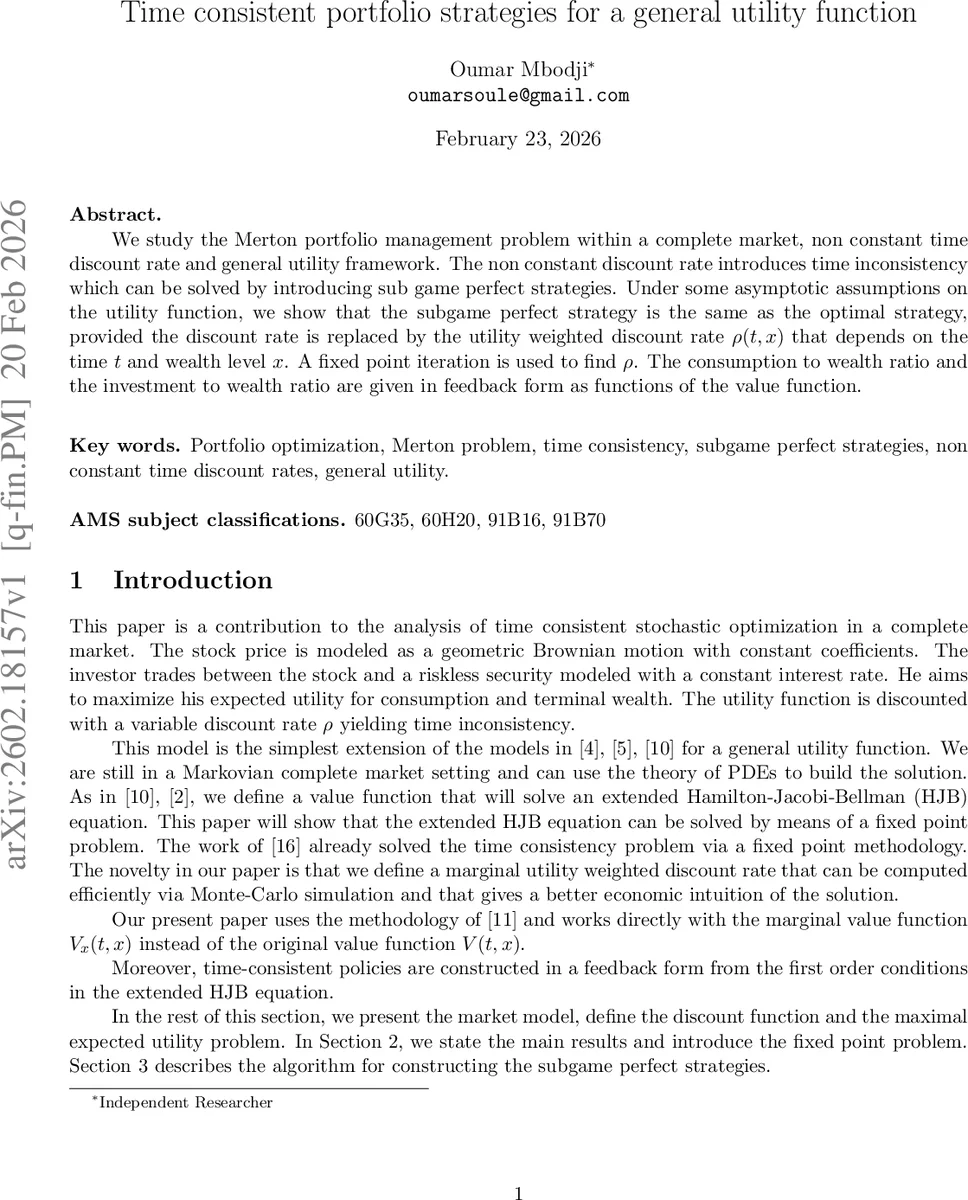
We study the Merton portfolio management problem within a complete market, non constant time discount rate and general utility framework. The non constant discount rate introduces time inconsistency which can be solved by introducing sub game perfect strategies. Under some asymptotic assumptions on the utility function, we show that the subgame perfect strategy is the same as the optimal strategy, provided the discount rate is replaced by the utility weighted discount rate $ρ(t,x)$ that depends on the time $t$ and wealth level $x$. A fixed point iteration is used to find $ρ$. The consumption to wealth ratio and the investment to wealth ratio are given in feedback form as functions of the value function.
💡 Research Summary
The paper investigates the classic Merton portfolio‑consumption problem in a complete market when the discount rate is allowed to vary over time and the investor’s utility function is completely general (subject only to standard regularity, monotonicity, concavity and Inada conditions). A non‑constant discount function h(t,s) induces time inconsistency: the optimal policy derived at the initial date ceases to be optimal at later dates because the agent’s intertemporal preferences change. To restore consistency the authors adopt the sub‑game‑perfect (time‑consistent) framework: at each instant the decision‑maker commits to a strategy that will be optimal for all future selves, given that they will follow the same rule.
The market consists of a risk‑free asset with constant rate r and a single risky asset following a geometric Brownian motion dS_t = S_t(μ dt + σ dW_t). The investor chooses a proportion π(t) of wealth to invest in the risky asset and a consumption‑to‑wealth ratio c(t). Wealth evolves according to
dX_t =
Comments & Academic Discussion
Loading comments...
Leave a Comment