Demonstrating Restraint
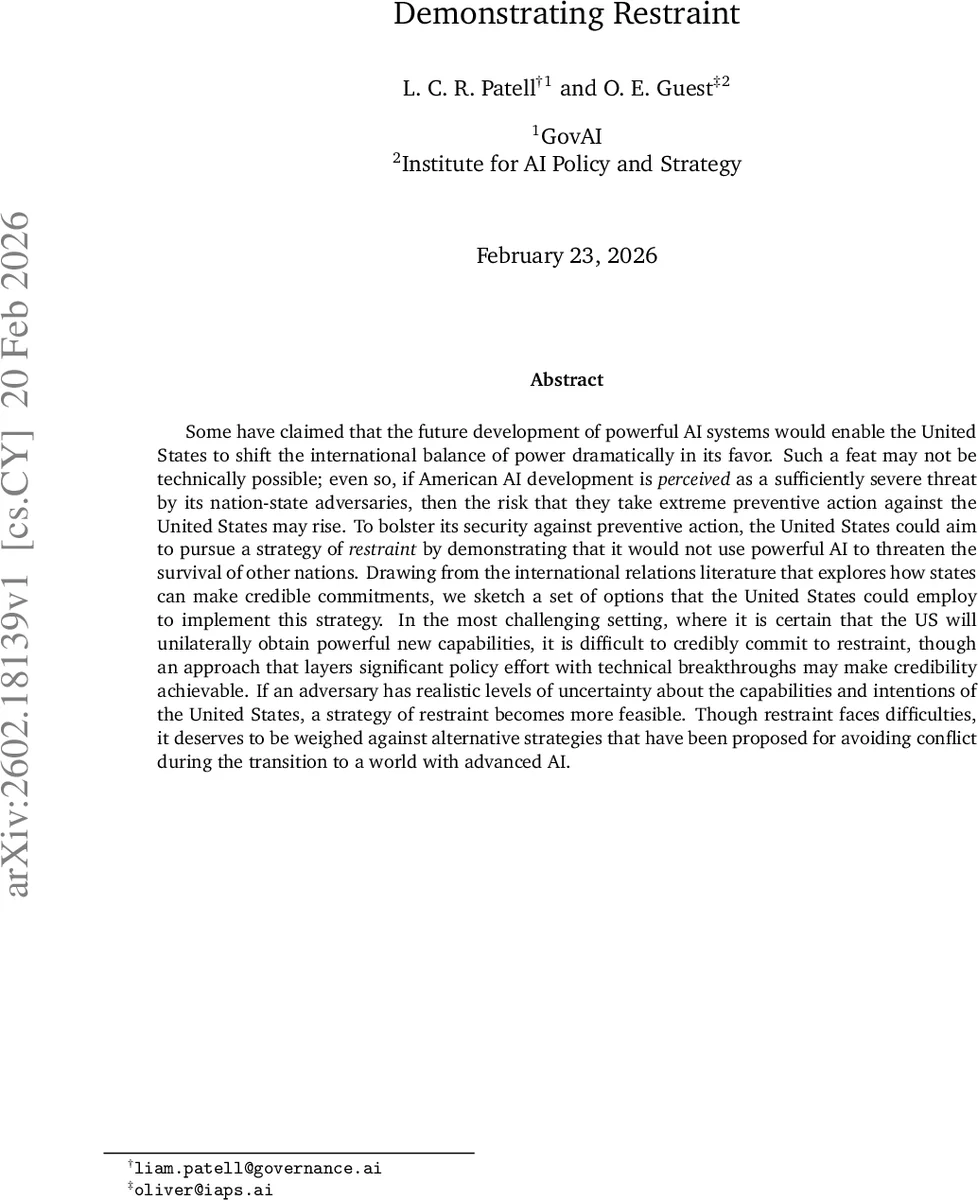
Some have claimed that the future development of powerful AI systems would enable the United States to shift the international balance of power dramatically in its favor. Such a feat may not be technically possible; even so, if American AI development is perceived as a sufficiently severe threat by its nation-state adversaries, then the risk that they take extreme preventive action against the United States may rise. To bolster its security against preventive action, the United States could aim to pursue a strategy of restraint by demonstrating that it would not use powerful AI to threaten the survival of other nations. Drawing from the international relations literature that explores how states can make credible commitments, we sketch a set of options that the United States could employ to implement this strategy. In the most challenging setting, where it is certain that the US will unilaterally obtain powerful new capabilities, it is difficult to credibly commit to restraint, though an approach that layers significant policy effort with technical breakthroughs may make credibility achievable. If an adversary has realistic levels of uncertainty about the capabilities and intentions of the United States, a strategy of restraint becomes more feasible. Though restraint faces difficulties, it deserves to be weighed against alternative strategies that have been proposed for avoiding conflict during the transition to a world with advanced AI.
💡 Research Summary
The paper “Demonstrating Restraint” explores how the United States can reduce the risk of preventive war by signaling and committing to a policy of restraint in the face of potentially powerful artificial intelligence (AI) capabilities. The authors begin by noting that while the technical feasibility of an AI‑enabled decisive strategic advantage (DSA) – a situation where a single state could dominate across all levers of power – remains uncertain, the perception of such a capability by rival states could nonetheless trigger extreme preventive actions. If adversaries believe the United States might use a future AI‑driven DSA to “trample” their survival, they may consider pre‑emptive conflict despite the high probability that the United States would win such a war.
To counter this perception, the authors propose a “restraint” strategy: the United States publicly and credibly commits not to use powerful AI to threaten the existence of other nations, even if it possesses the technical means to do so. Drawing on international relations literature on credible commitments, the paper outlines two complementary mechanisms for achieving credible restraint: (1) costly signaling and (2) foreclosure guarantees.
Costly signaling involves creating or manipulating costs that make a restraint pledge believable. The authors categorize four types of costs: (a) tying‑hands – institutional or legal constraints that bind future actions; (b) sunk costs – irreversible investments that make backing away from restraint prohibitively expensive; (c) installment costs – ongoing expenditures that must be sustained to maintain restraint; and (d) reducible costs – mechanisms that lower the marginal cost of restraint over time, enhancing long‑term feasibility. By shouldering these costs, the United States can convey to rivals that any deviation toward aggressive AI use would entail severe political, economic, or military penalties, thereby shaping both information and incentive structures.
Foreclosure guarantees aim to make the aggressive option physically or technically unavailable. The paper suggests embedding “sovereignty clauses” directly into AI model specifications, designing hardware that blocks the deployment of AI systems with certain dangerous capabilities, and establishing special‑access programs that strictly limit internal usage. Institutional designs such as dedicated personnel, internal usage protocols, and legally codified limits on “war powers” further embed restraint into the bureaucratic fabric, reducing the likelihood of unilateral escalation.
Implementation is broken into three policy domains. First, diplomatic measures—transparent agreements, joint research frameworks, and confidence‑building steps—signal restraint to the international community. Second, technical interventions on AI systems—model‑level sovereignty constraints and hardware‑level capability filters—provide concrete barriers to misuse. Third, institutional design—personnel assignments, internal processes, special‑access programs, and war‑power restrictions—creates internal cost structures that make restraint self‑reinforcing.
The most challenging scenario is one in which the United States unilaterally attains a powerful AI and a credible DSA. In such a case, costly signals alone may be insufficient. The authors therefore advocate a layered approach that combines policy, cost, and technical safeguards. Speculative mechanisms such as escrow arrangements (where critical AI components are held under international supervision), active shields (real‑time monitoring systems that automatically disable dangerous behavior), and automatic degradation (self‑limiting performance over time) are discussed as future‑oriented tools that could further ensure that any attempt to exploit a DSA would be automatically curtailed.
Finally, the paper outlines a research agenda: quantitative modeling of signaling costs, technical feasibility studies of foreclosure mechanisms, design of international legal frameworks for AI restraint, and empirical work on how rival states perceive and respond to U.S. restraint signals.
Overall, “Demonstrating Restraint” offers a novel policy paradigm that shifts the focus from building ever‑greater AI dominance to building credible trust. By integrating costly signaling with structural foreclosure guarantees, the United States can credibly assure adversaries that it will not use powerful AI to threaten their survival, thereby lowering the incentive for preventive conflict and contributing to strategic stability in the emerging AI era.
Comments & Academic Discussion
Loading comments...
Leave a Comment