Geometric Backstepping Control of Omnidirectional Tiltrotors Incorporating Servo-Rotor Dynamics for Robustness against Sudden Disturbances
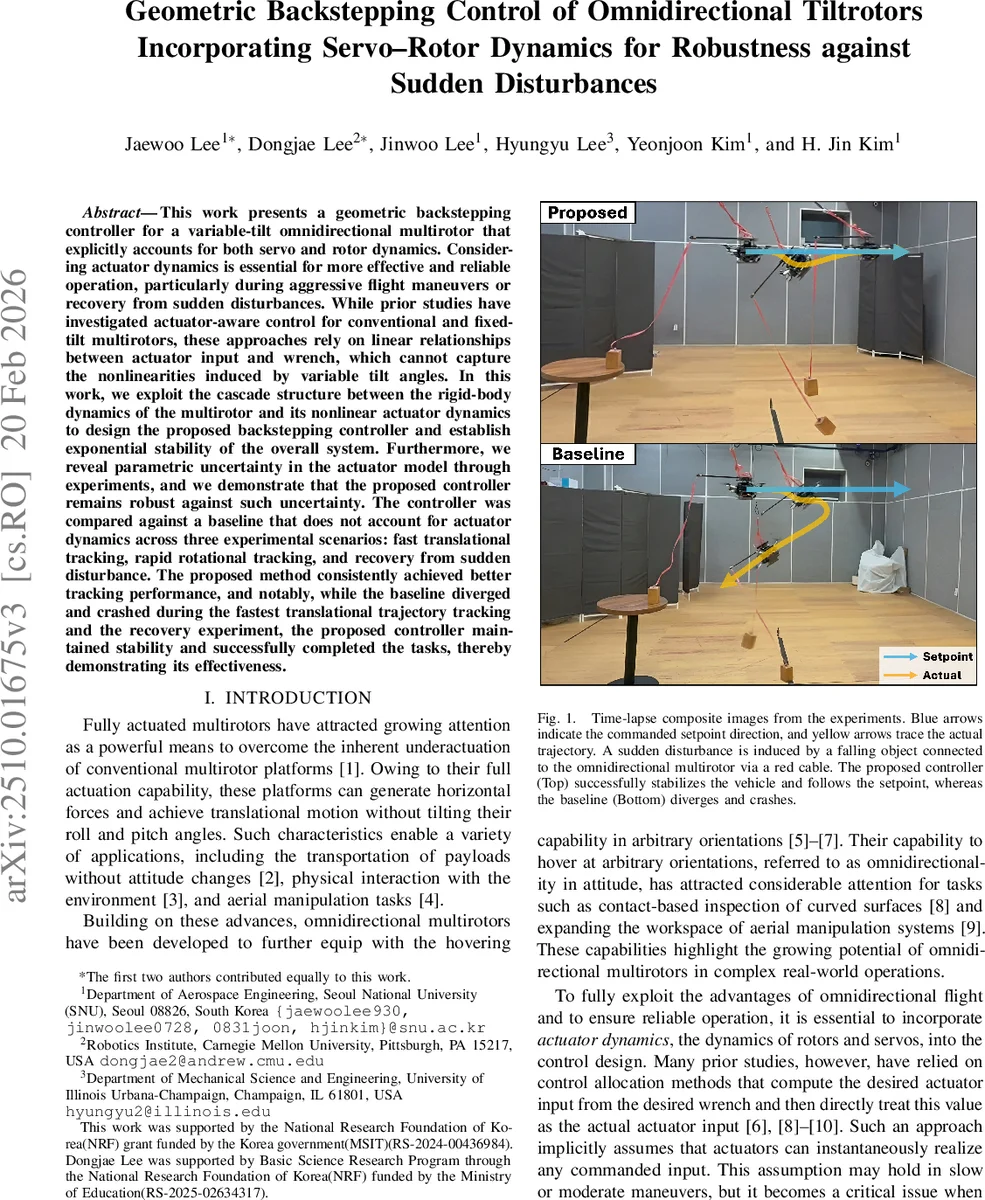
This work presents a geometric backstepping controller for a variable-tilt omnidirectional multirotor that explicitly accounts for both servo and rotor dynamics. Considering actuator dynamics is essential for more effective and reliable operation, particularly during aggressive flight maneuvers or recovery from sudden disturbances. While prior studies have investigated actuator-aware control for conventional and fixed-tilt multirotors, these approaches rely on linear relationships between actuator input and wrench, which cannot capture the nonlinearities induced by variable tilt angles. In this work, we exploit the cascade structure between the rigid-body dynamics of the multirotor and its nonlinear actuator dynamics to design the proposed backstepping controller and establish exponential stability of the overall system. Furthermore, we reveal parametric uncertainty in the actuator model through experiments, and we demonstrate that the proposed controller remains robust against such uncertainty. The controller was compared against a baseline that does not account for actuator dynamics across three experimental scenarios: fast translational tracking, rapid rotational tracking, and recovery from sudden disturbance. The proposed method consistently achieved better tracking performance, and notably, while the baseline diverged and crashed during the fastest translational trajectory tracking and the recovery experiment, the proposed controller maintained stability and successfully completed the tasks, thereby demonstrating its effectiveness.
💡 Research Summary
This paper addresses a critical gap in the control of variable‑tilt omnidirectional multirotors: the explicit inclusion of both servo‑motor and rotor dynamics in the feedback loop. Traditional approaches either assume instantaneous actuator response or model only one of the two actuator subsystems, which is insufficient for platforms where thrust direction is actively reoriented by tilting servos. The authors first formulate the full vehicle dynamics, separating the rigid‑body equations from the first‑order actuator models (time constants α_f for rotor thrust and α_θ for servo angle). By recognizing the cascade relationship—actuator states generate the wrench that drives the rigid body—they adopt a geometric backstepping methodology.
The design proceeds in two layers. A nominal wrench μ_d is generated using only the rigid‑body dynamics, employing standard position, velocity, attitude, and angular‑velocity error terms together with saturation functions to guarantee exponential convergence when the actuator error e_μ = μ – μ_d is zero. To handle the non‑zero actuator error, the authors augment the Lyapunov candidate with a quadratic term ½e_μᵀe_μ, yielding V = ½e_μᵀe_μ + V₁ + V₂, where V₁ and V₂ are the translational and rotational Lyapunov functions from prior geometric controllers. By differentiating V along the closed‑loop dynamics and solving for the actuator command u_c, they obtain a closed‑form expression:
u_c = η⁻¹ B⁺ ( μ̇_d – B ζ – k_μ e_μ – κ ),
where B is the allocation matrix, B⁺ its pseudo‑inverse, η and ζ capture the nonlinear mapping from actuator commands to wrench rates, k_μ is a positive gain, and κ compensates for the coupling between wrench errors and rigid‑body errors. This backstepping step explicitly drives the actuator states so that the generated wrench tracks μ_d despite the first‑order lag.
Stability analysis is carried out under two scenarios. When the actuator time constants are exactly known, the authors prove exponential stability of the full closed‑loop system (Theorem 1) by showing that V̇ ≤ –c‖z‖² – k_μ‖e_μ‖² for appropriate gain choices, where z aggregates the translational and rotational error norms. When the exact values of α_f and α_θ are unknown but bounded, they establish ultimate boundedness (Theorem 2), demonstrating that the system trajectories remain within a small invariant set whose size depends on the bound of the uncertainty. The analysis relies on a set of gain conditions (inequalities (16)) that ensure positive‑definiteness of the matrices appearing in the Lyapunov bounds.
Experimental validation is performed on a hardware prototype equipped with multiple tiltable rotors. Three benchmark tasks are considered: (1) fast translational trajectory tracking, (2) rapid rotational tracking, and (3) recovery from a sudden external disturbance generated by a falling mass attached via a cable. The proposed controller is compared against a baseline that ignores actuator dynamics and directly feeds the desired wrench into the allocation routine. Results show that the baseline diverges and crashes during the most aggressive translational task and during disturbance recovery, whereas the backstepping controller maintains stability, achieves lower tracking errors, and successfully completes all missions. Time‑history plots of position, attitude, and actuator inputs illustrate that the proposed method respects the physical limits of servos and rotors, smoothly compensating for their lag.
Key contributions of the work are:
- A unified geometric backstepping framework that simultaneously incorporates first‑order servo and rotor dynamics for variable‑tilt omnidirectional platforms.
- Rigorous Lyapunov‑based proofs of exponential stability for known actuator parameters and of robustness (ultimate boundedness) under bounded parametric uncertainty.
- Real‑world experimental evidence that the controller outperforms a conventional wrench‑only approach in high‑speed and disturbance‑rejection scenarios, confirming its practical relevance for aggressive aerial robotics.
Overall, the paper provides a solid theoretical and experimental foundation for future high‑performance omnidirectional multirotor systems, demonstrating that accounting for actuator dynamics is indispensable for safe, precise, and robust flight in demanding applications.
Comments & Academic Discussion
Loading comments...
Leave a Comment