HL-IK: A Lightweight Implementation of Human-Like Inverse Kinematics in Humanoid Arms
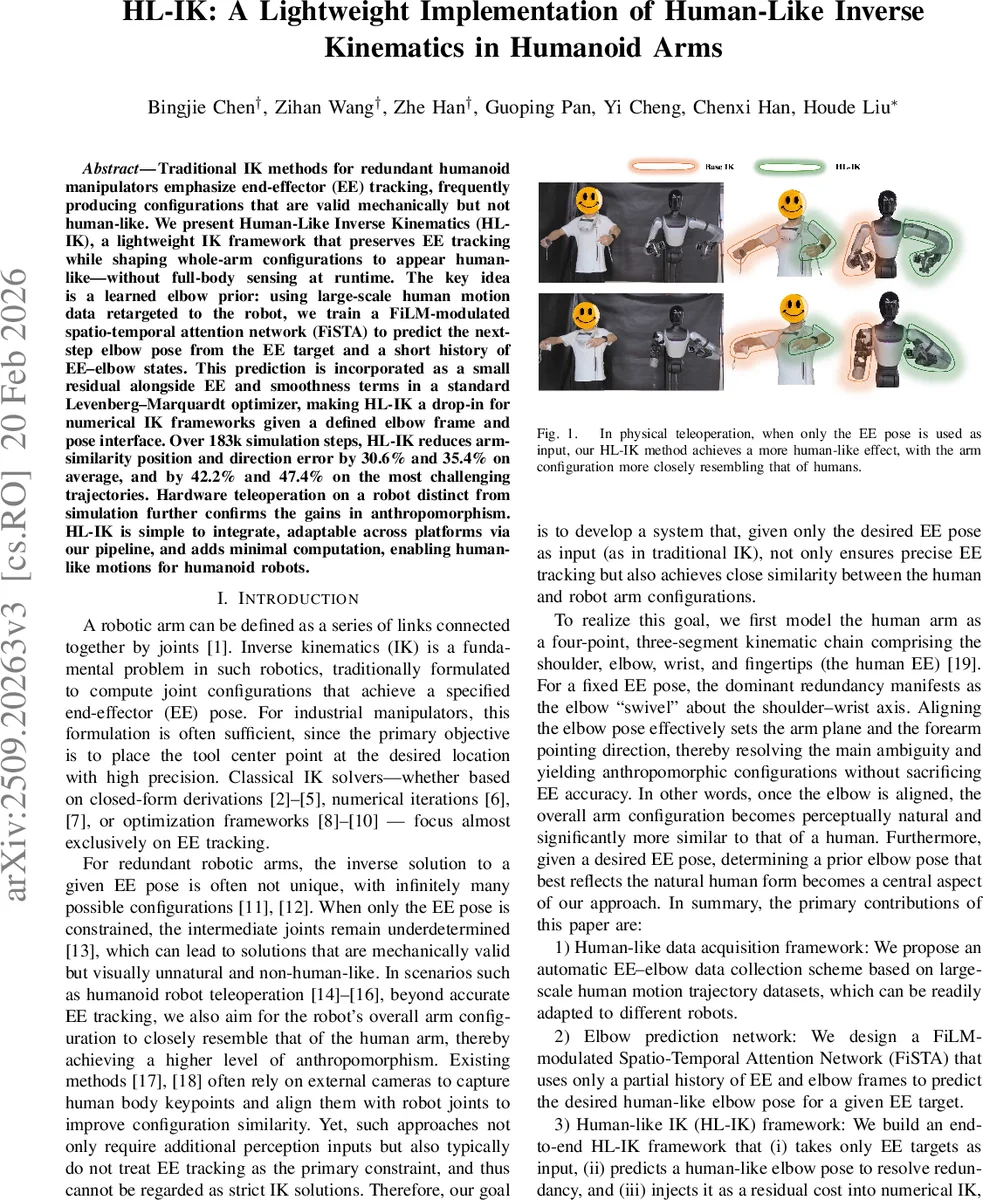
Traditional IK methods for redundant humanoid manipulators emphasize end-effector (EE) tracking, frequently producing configurations that are valid mechanically but not human-like. We present Human-Like Inverse Kinematics (HL-IK), a lightweight IK framework that preserves EE tracking while shaping whole-arm configurations to appear human-like, without full-body sensing at runtime. The key idea is a learned elbow prior: using large-scale human motion data retargeted to the robot, we train a FiLM-modulated spatio-temporal attention network (FiSTA) to predict the next-step elbow pose from the EE target and a short history of EE-elbow states.This prediction is incorporated as a small residual alongside EE and smoothness terms in a standard Levenberg-Marquardt optimizer, making HL-IK a drop-in addition to numerical IK stacks. Over 183k simulation steps, HL-IK reduces arm-similarity position and direction error by 30.6% and 35.4% on average, and by 42.2% and 47.4% on the most challenging trajectories. Hardware teleoperation on a robot distinct from simulation further confirms the gains in anthropomorphism. HL-IK is simple to integrate, adaptable across platforms via our pipeline, and adds minimal computation, enabling human-like motions for humanoid robots.
💡 Research Summary
The paper addresses a long‑standing limitation of conventional inverse kinematics (IK) for redundant humanoid arms: while end‑effector (EE) tracking is accurate, the resulting joint configurations often look mechanical and non‑human. HL‑IK (Human‑Like Inverse Kinematics) proposes a lightweight framework that preserves precise EE tracking yet shapes the whole‑arm pose to appear human‑like, without requiring full‑body sensing at runtime.
The core idea is to learn an elbow prior from large‑scale human motion capture data (AMASS). Human motions are retargeted to the target robot using a gradient‑based shape fitting, producing paired EE‑elbow trajectories expressed in the shoulder frame. From these, a dataset of four SE(3) poses per frame (shoulder‑to‑EE, shoulder‑to‑elbow for each arm) is built.
A FiLM‑modulated Spatio‑Temporal Attention network (FiSTA) is trained to predict the next‑step elbow pose given (i) a short history (default 5 frames) of EE and elbow poses in the shoulder frame, and (ii) the desired EE target for the next step. FiSTA consists of:
- A GRU temporal encoder that compresses the history into a feature vector.
- A lightweight self‑attention module that processes the most recent EE and elbow tokens to capture instantaneous spatial coupling.
- A Goal Modulator that maps the EE target into FiLM scale‑and‑shift parameters, conditioning the temporal features on the imminent goal.
- A fusion MLP that outputs a 7‑D elbow pose (position + unit quaternion).
The predicted elbow pose is incorporated as a residual cost term into a standard Levenberg‑Marquardt (LM) optimizer. The total cost vector stacks three residuals: EE pose error, elbow pose error, and a smoothness term on joint velocities. Each residual is expressed as a 6‑D twist via the SE(3) logarithm, and weighted by diagonal matrices. The LM iteration solves a damped least‑squares problem, yielding a joint configuration that simultaneously minimizes EE tracking error, aligns the elbow to the learned human‑like pose, and (optionally) smooths motion.
Experimental evaluation proceeds in three parts. First, network comparisons on the ACCAD subset show FiSTA achieving the lowest validation MSE (0.00178) versus LSTM, GRU, Transformer, and MLP baselines, confirming the benefit of separating spatial and temporal processing and using FiLM goal conditioning. Ablation studies reveal that removing spatial attention, temporal encoding, or FiLM each degrades performance (4.5 %, 2.3 %, and 6.0 % loss increase respectively). History length experiments identify five frames as optimal: shorter windows lack dynamic context, longer windows introduce irrelevant past information.
Runtime profiling on an RTX 4070 shows the full pipeline (network inference + LM solver) takes 7.08 ms per step, only 2 ms more than a pure Jacobian‑based IK, supporting >140 Hz control rates.
In simulation, HL‑IK is tested on 183 k steps across three diverse human motion datasets (ACCAD, CMU, SFU). Compared with a baseline EE‑only IK, HL‑IK reduces arm‑similarity position error by 30.6 % and direction error by 35.4 % on average; on the most challenging trajectories the reductions reach 42.2 % and 47.4 % respectively. Hardware teleoperation experiments on a robot different from the simulation platform confirm visual anthropomorphism improvements and similar quantitative error reductions.
The contributions are threefold: (1) an automatic EE‑elbow data collection pipeline that can be adapted to any robot via retargeting; (2) the FiSTA network that efficiently predicts human‑like elbow poses from minimal history and a goal; (3) the HL‑IK framework that integrates this prediction as a lightweight residual in a generic numerical IK solver, requiring only an elbow frame definition.
Overall, HL‑IK demonstrates that a learned, goal‑conditioned elbow prior can be seamlessly fused with existing IK solvers to produce human‑like arm motions in real time, without extra perception hardware. This opens the door for more natural teleoperation, collaborative manipulation, and service‑robot interactions where anthropomorphic motion is desirable.
Comments & Academic Discussion
Loading comments...
Leave a Comment