The Galaxy Activity, Torus, and Outflow Survey (GATOS): N. Unveiling physical processes in local active galaxies. Unsupervised hierarchical clustering of JWST MIRI/MRS observations
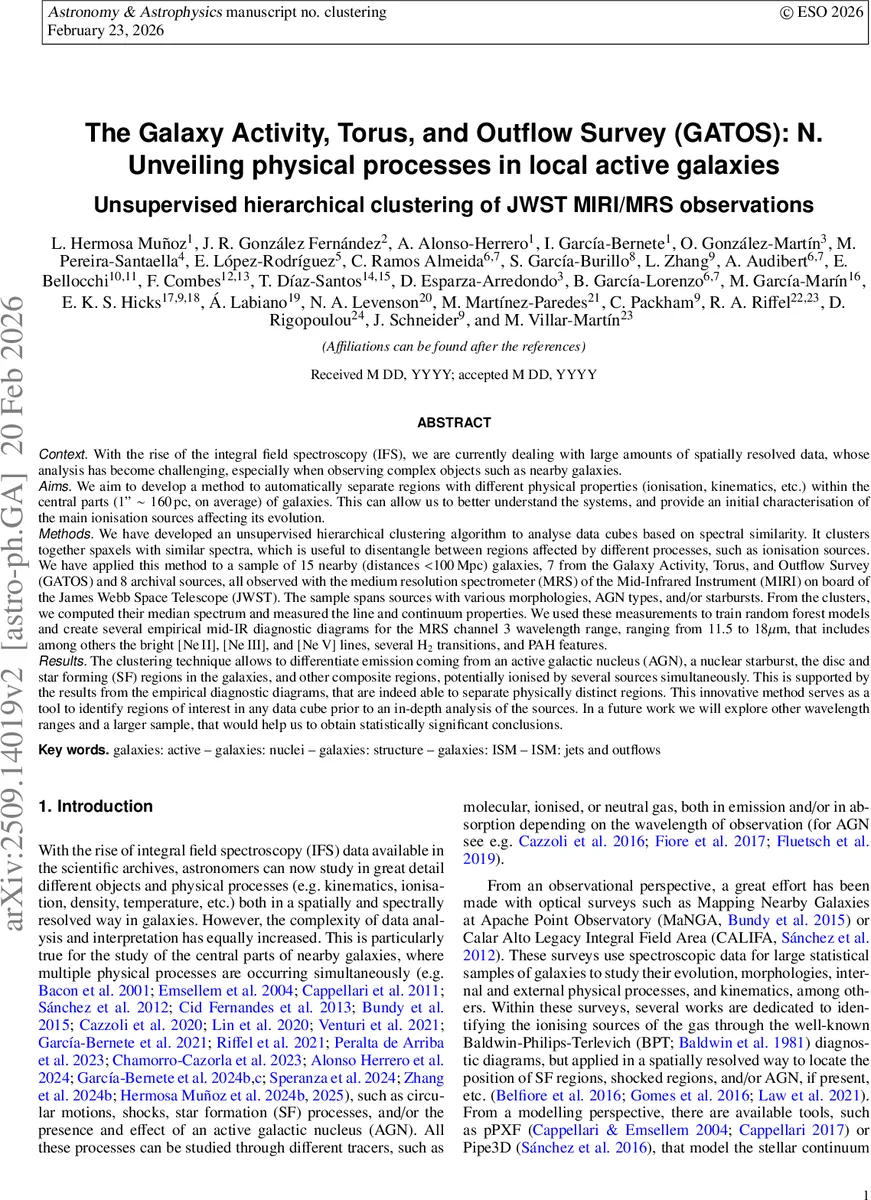
With the rise of the integral field spectroscopy, we are currently dealing with large amounts of spatially resolved data, whose analysis has become challenging, especially when observing complex objects such as nearby galaxies. We aim to develop a method to automatically separate different physical regions within the central parts (1"~160 pc, on average) of galaxies. This can allow us to better understand the systems, and provide an initial characterisation of the main ionisation sources affecting its evolution. We have developed an unsupervised hierarchical clustering algorithm to analyse data cubes based on spectral similarity. It clusters together spaxels with similar spectra, which is useful to disentangle between different physical processes. We have applied this method to a sample of 15 nearby (distances <100 Mpc) galaxies, 7 from the Galaxy Activity, Torus, and Outflow Survey (GATOS) and 8 archival sources, all observed with the medium resolution spectrometer (MRS) of the Mid-Infrared Instrument (MIRI) on board of the JWST. From the clusters, we computed their median spectrum and measured the line and continuum properties. We used these measurements to train random forest models and create several empirical mid-IR diagnostic diagrams for the MRS channel 3 wavelength range, including among others the bright [Ne II], [Ne III], and [Ne V] lines, several H2 transitions, and PAH features. The clustering technique allows to differentiate emission coming from an AGN, the disc, and star forming regions in galaxies, and other composite regions, potentially ionised by several sources simultaneously. This is supported by the results from the empirical diagnostic diagrams, that are indeed able to separate physically distinct regions. This innovative method serves as a tool to identify regions of interest in any data cube prior to an in-depth analysis of the sources. [abridged]
💡 Research Summary
**
The paper presents a novel, fully automated approach to dissect the central regions of nearby galaxies using integral‑field spectroscopy from the JWST Mid‑Infrared Instrument (MIRI) Medium‑Resolution Spectrometer (MRS). The authors develop an unsupervised hierarchical clustering algorithm that groups spaxels solely on the basis of their normalized spectral shape, thereby removing the influence of absolute flux differences and focusing on relative line and continuum features. After normalising each spaxel’s spectrum by its total integrated flux, Euclidean distances are computed between all spectra, and Ward’s linkage is applied to build a dendrogram. The optimal number of clusters is selected using silhouette scores and an elbow analysis, typically yielding four to six physically meaningful groups per galaxy.
The study analyses a sample of fifteen nearby galaxies (distances < 100 Mpc), comprising seven objects from the Galaxy Activity, Torus, and Outflow Survey (GATOS) and eight archival sources. All observations are taken with MIRI/MRS channel 3 (11.5–18 µm), which contains the key diagnostic lines
Comments & Academic Discussion
Loading comments...
Leave a Comment