Constellation Shaping for OFDM-ISAC Systems: From Theoretical Bounds to Practical Implementation
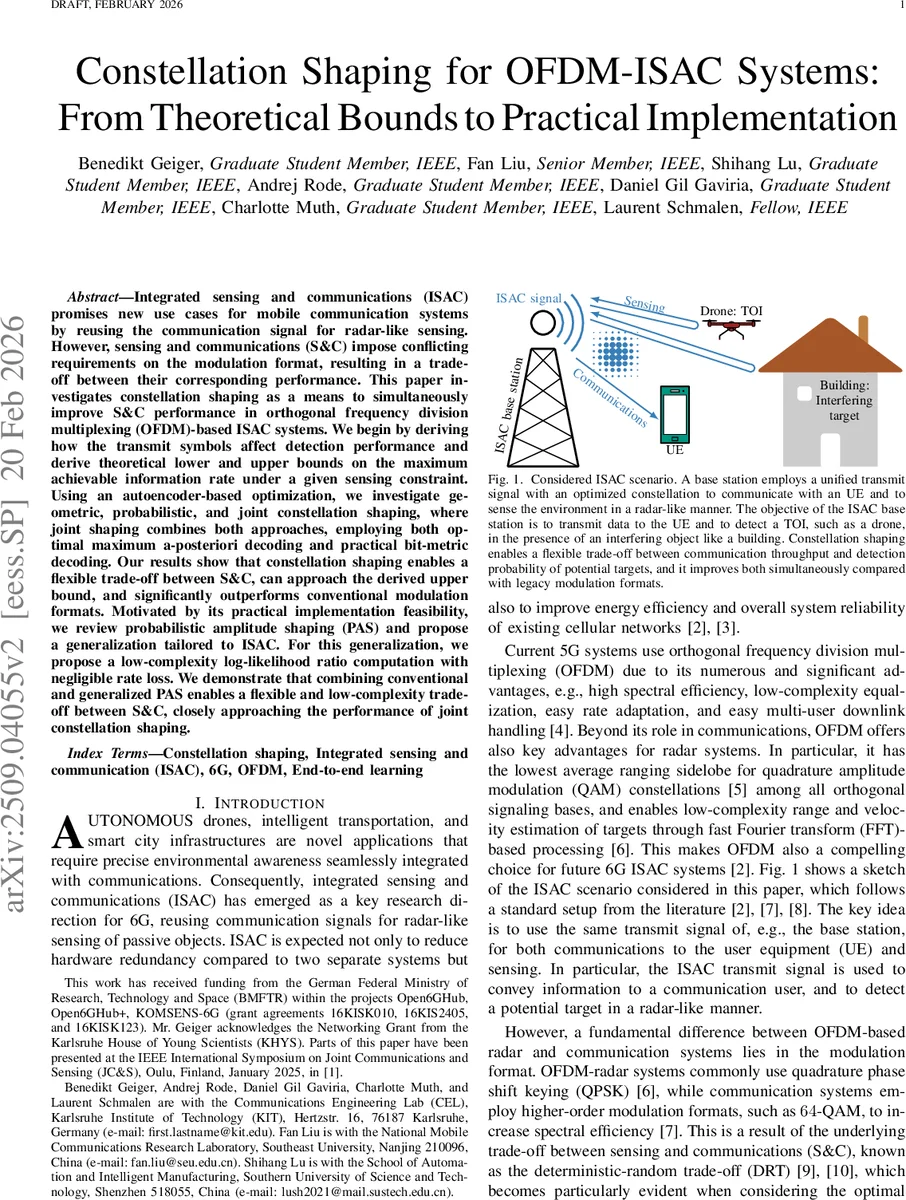
Integrated sensing and communications (ISAC) promises new use cases for mobile communication systems by reusing the communication signal for radar-like sensing. However, sensing and communications (S&C) impose conflicting requirements on the modulation format, resulting in a tradeoff between their corresponding performance. This paper investigates constellation shaping as a means to simultaneously improve S&C performance in orthogonal frequency division multiplexing (OFDM)-based ISAC systems. We begin by deriving how the transmit symbols affect detection performance and derive theoretical lower and upper bounds on the maximum achievable information rate under a given sensing constraint. Using an autoencoder-based optimization, we investigate geometric, probabilistic, and joint constellation shaping, where joint shaping combines both approaches, employing both optimal maximum a-posteriori decoding and practical bit-metric decoding. Our results show that constellation shaping enables a flexible trade-off between S&C, can approach the derived upper bound, and significantly outperforms conventional modulation formats. Motivated by its practical implementation feasibility, we review probabilistic amplitude shaping (PAS) and propose a generalization tailored to ISAC. For this generalization, we propose a low-complexity log-likelihood ratio computation with negligible rate loss. We demonstrate that combining conventional and generalized PAS enables a flexible and low-complexity tradeoff between S&C, closely approaching the performance of joint constellation shaping.
💡 Research Summary
This paper investigates how constellation shaping can be used to simultaneously improve communication throughput and radar‑like sensing performance in OFDM‑based integrated sensing and communications (ISAC) systems. The authors first derive a closed‑form relationship between the statistical kurtosis of the transmitted symbols and the probability of detecting a target of interest (TOI) in the presence of strong interferers. Using this relationship, they establish lower and upper bounds on the maximum achievable mutual information (MI) when a detection‑probability constraint is imposed, thereby defining a fundamental deterministic‑random trade‑off (DRT) for ISAC.
To approach these limits, a binary autoencoder (AE) framework is employed to jointly optimize the constellation points (geometric shaping), their a‑priori probabilities (probabilistic shaping), or both (joint shaping). The AE is trained to maximize either MI (ideal symbol‑metric decoding) or the generalized mutual information (GMI) associated with practical bit‑metric decoding (BMD), while satisfying constraints on detection probability and false‑alarm rate. Results show that joint shaping nearly reaches the theoretical upper bound, outperforming pure geometric or probabilistic designs and providing a flexible knob to move along the S&C trade‑off curve. In the high‑SNR regime the gap between MI and GMI is modest, confirming that the gains are realizable with conventional binary forward error correction.
Recognizing that practical deployment requires low‑complexity implementations, the paper revisits probabilistic amplitude shaping (PAS), the state‑of‑the‑art method for communication‑only systems. The authors argue that standard PAS, which fixes the set of amplitude levels, limits the ability to control kurtosis and thus hampers sensing performance. They propose a generalized ISAC‑PAS that allows a flexible amplitude set while preserving the binary labeling required for FEC integration. To keep receiver complexity low, a novel log‑likelihood ratio (LLR) approximation based on a simplified log‑sum operation is introduced, incurring negligible AIR loss (≤0.01 bit/s/Hz).
Simulation studies compare four schemes: (i) conventional 64‑QAM, (ii) geometric shaping, (iii) probabilistic shaping, (iv) joint shaping, and (v) the hybrid of conventional PAS and the proposed ISAC‑PAS. Under a fixed detection‑probability constraint, joint shaping achieves up to 1.4 bit/s/Hz higher MI than 64‑QAM, while the hybrid PAS approach attains nearly the same GMI gain with far lower computational burden. The low‑complexity LLR implementation reduces the number of arithmetic operations by roughly 30 % relative to exact LLR computation, making the solution attractive for real‑time base‑station hardware.
In summary, the paper makes three major contributions: (1) a theoretical characterization of the DRT for OFDM‑ISAC, linking constellation kurtosis to sensing performance and providing MI bounds; (2) an AE‑driven systematic comparison of geometric, probabilistic, and joint shaping, demonstrating that joint shaping can closely approach the derived upper bound even with practical BMD receivers; and (3) a practical, low‑complexity PAS‑based implementation tailored to ISAC that preserves the implementation advantages of PAS while substantially improving the sensing‑communication trade‑off. These results bridge the gap between information‑theoretic limits and hardware‑friendly designs, offering a clear pathway for future 6G ISAC deployments.
Comments & Academic Discussion
Loading comments...
Leave a Comment