A Novel Method to Determine Total Oxidant Concentration Produced by Non-Thermal Plasma Based on Image Processing and Machine Learning
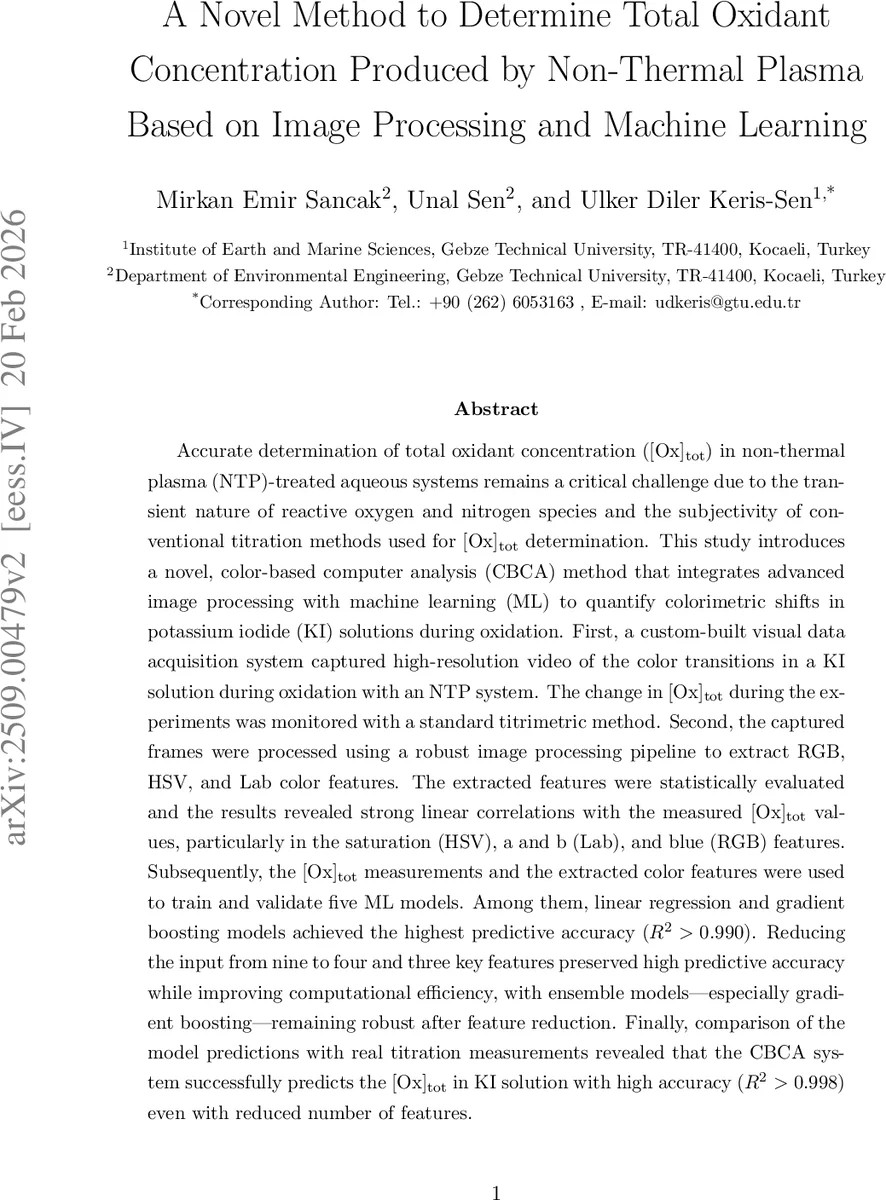
Accurate determination of total oxidant concentration [Ox]tot in nonthermal plasma treated aqueous systems remains a critical challenge due to the transient nature of reactive oxygen and nitrogen species and the subjectivity of conventional titration methods used for [Ox]tot determination. This study introduces a color based computer analysis method that integrates advanced image processing with machine learning to quantify colorimetric changes in potassium iodide solutions during oxidation. A custom built visual acquisition system recorded high resolution video of the color transitions occurring during plasma treatment while the change in oxidant concentration was simultaneously monitored using a standard titrimetric method. Extracted image frames were processed through a structured pipeline to obtain RGB, HSV, and Lab color features. Statistical analysis revealed strong linear relationships between selected color features and measured oxidant concentrations, particularly for HSV saturation, Lab a and b channels, and the blue component of RGB. These features were subsequently used to train and validate multiple machine learning models including linear regression, ridge regression, random forest, gradient boosting, and neural networks. Linear regression and gradient boosting demonstrated the highest predictive accuracy with R2 values exceeding 0.99. Dimensionality reduction from nine features to smaller feature subsets preserved predictive performance while improving computational efficiency. Comparison with experimental titration measurements showed that the proposed system predicts total oxidant concentration in potassium iodide solution with very high accuracy, achieving R2 values above 0.998 even under reduced feature conditions.
💡 Research Summary
This paper presents a novel, image‑based computer analysis (CBCA) approach for quantifying the total oxidant concentration (
Comments & Academic Discussion
Loading comments...
Leave a Comment