Work from Home and Job Satisfaction: Differences by Disability Status among Healthcare Workers
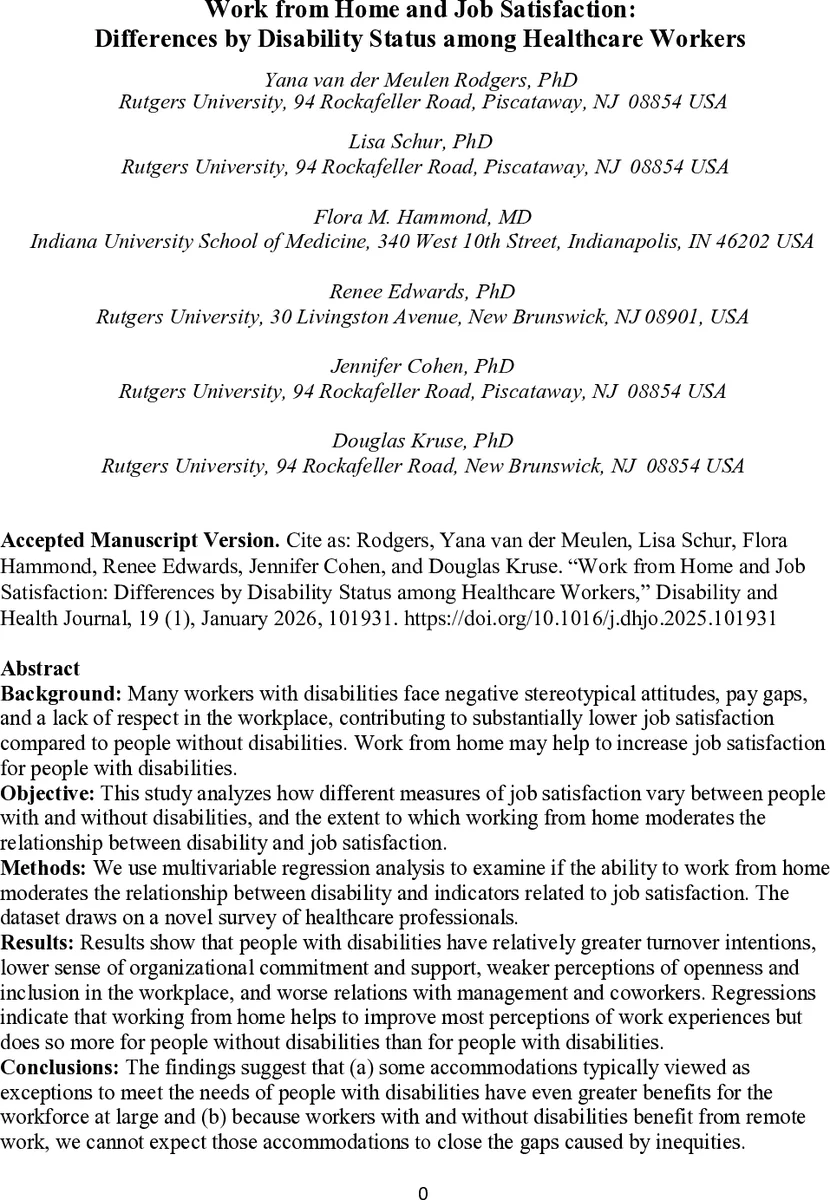
Background: Many workers with disabilities face negative stereotypical attitudes, pay gaps, and a lack of respect in the workplace, contributing to substantially lower job satisfaction compared to people without disabilities. Work from home may help to increase job satisfaction for people with disabilities. Objective: This study analyzes how different measures of job satisfaction vary between people with and without disabilities, and the extent to which working from home moderates the relationship between disability and job satisfaction. Methods: We use multivariable regression analysis to examine if the ability to work from home moderates the relationship between disability and indicators related to job satisfaction. The dataset draws on a novel survey of healthcare professionals. Results: Results show that people with disabilities have relatively greater turnover intentions, lower sense of organizational commitment and support, weaker perceptions of openness and inclusion in the workplace, and worse relations with management and coworkers. Regressions indicate that working from home helps to improve most perceptions of work experiences but does so more for people without disabilities than for people with disabilities. Conclusions: The findings suggest that (a) some accommodations typically viewed as exceptions to meet the needs of people with disabilities have even greater benefits for the workforce at large and (b) because workers with and without disabilities benefit from remote work, we cannot expect those accommodations to close the gaps caused by inequities.
💡 Research Summary
This study investigates whether working from home (WFH) can reduce the well‑documented gap in job satisfaction and related workplace experiences between healthcare workers with disabilities and those without. Using a novel survey administered between May and July 2023 to employees of a large state‑affiliated health system, the authors collected responses from 1,405 staff members; after cleaning, 993 remained for analysis. Disability status was defined using the six standard Census functional‑limitation questions plus two additional items on long‑term health problems and social‑interaction challenges, resulting in a relatively high prevalence of 23 % (compared with the national estimate of about 9 %). Approximately half of the respondents who reported a disability had disclosed it to their employer.
The questionnaire measured a single global job‑satisfaction item and ten composite indices reflecting turnover intention, organizational commitment, perceived organizational support, citizenship behavior, workplace openness to differences, inclusion climate, treatment of people with disabilities, and relationships with managers and coworkers. Each index was scaled from 0 to 1. WFH exposure was captured as three dummy variables: never, less than three days per week, and three or more days per week. The authors estimated a series of ordinary least‑squares regressions of the form
Outcome = β₀ + β₁ Disability + β₂ WFH + β₃ Disability × WFH + β₄ Controls + ε,
where controls included age, gender, race/ethnicity, marital status, education, income above $75 k, number of children, managerial role, full‑time status, and tenure.
Descriptive results showed no statistically significant difference in the single global job‑satisfaction item between the two groups, but substantial gaps across all ten ancillary indices. Employees with disabilities reported higher turnover intentions (0.420 vs 0.323, p < 0.01), lower organizational commitment (0.459 vs 0.530, p < 0.05), weaker perceived organizational support (0.309 vs 0.403, p < 0.01), and lower scores on workplace openness (0.453 vs 0.561, p < 0.01) and inclusion climate (0.348 vs 0.416, p < 0.05). While the overall perception of how people with disabilities are treated did not differ dramatically, detailed items revealed that disabled workers more often sensed bias and believed non‑disabled colleagues received better treatment.
Regression analyses confirmed that disability status was associated with poorer outcomes on most indices (negative β₁ coefficients). WFH had a generally positive main effect (positive β₂) on many outcomes, indicating that remote work improves perceived autonomy, support, and inclusion for the workforce as a whole. However, the interaction term (β₃) was either non‑significant or substantially smaller for disabled workers than for non‑disabled workers. In other words, the benefit of WFH was attenuated for the disability group; remote work did not close the existing gaps and, in some cases, even widened them relative to the non‑disabled cohort.
The authors discuss several limitations. The sample is drawn from a single health system, limiting external validity. Self‑report data may be subject to social desirability bias, and the disability measure, while broader than the Census, still omits certain conditions (e.g., mental health, neurodiversity). The binary classification of WFH frequency does not capture quality of remote‑work accommodations (technology, ergonomic support, managerial flexibility). Moreover, unobserved factors such as specific job duties, departmental culture, or prior experiences of discrimination could confound the observed relationships.
Policy implications are clear: while expanding remote‑work options can raise overall employee well‑being, it is insufficient as a stand‑alone accommodation for workers with disabilities. Employers should pair remote‑work policies with targeted interventions—accessible communication tools, proactive manager training, explicit anti‑bias initiatives, and mechanisms for disability disclosure without fear of retaliation. Such a layered approach is necessary to move beyond “one‑size‑fits‑all” accommodations and to genuinely narrow the satisfaction and inclusion gap for disabled healthcare workers, ultimately benefiting the entire organization’s productivity and climate.
Comments & Academic Discussion
Loading comments...
Leave a Comment