SOLVAR: Fast covariance-based heterogeneity analysis with pose refinement for cryo-EM
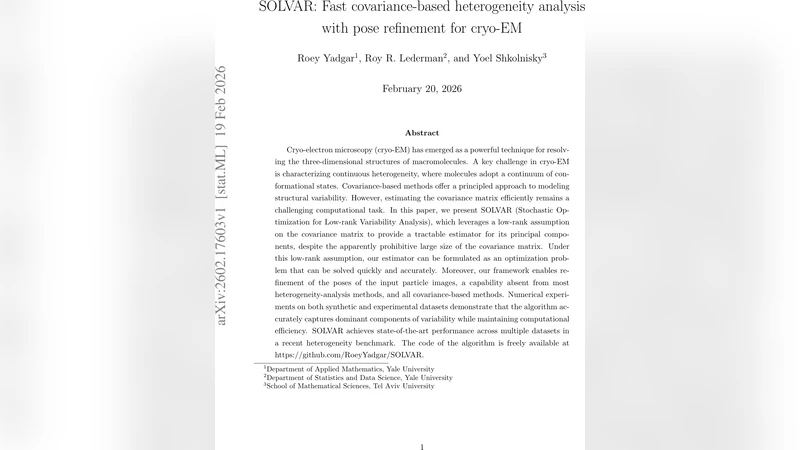
Cryo-electron microscopy (cryo-EM) has emerged as a powerful technique for resolving the three-dimensional structures of macromolecules. A key challenge in cryo-EM is characterizing continuous heterogeneity, where molecules adopt a continuum of conformational states. Covariance-based methods offer a principled approach to modeling structural variability. However, estimating the covariance matrix efficiently remains a challenging computational task. In this paper, we present SOLVAR (Stochastic Optimization for Low-rank Variability Analysis), which leverages a low-rank assumption on the covariance matrix to provide a tractable estimator for its principal components, despite the apparently prohibitive large size of the covariance matrix. Under this low-rank assumption, our estimator can be formulated as an optimization problem that can be solved quickly and accurately. Moreover, our framework enables refinement of the poses of the input particle images, a capability absent from most heterogeneity-analysis methods, and all covariance-based methods. Numerical experiments on both synthetic and experimental datasets demonstrate that the algorithm accurately captures dominant components of variability while maintaining computational efficiency. SOLVAR achieves state-of-the-art performance across multiple datasets in a recent heterogeneity benchmark. The code of the algorithm is freely available at https://github.com/RoeyYadgar/SOLVAR.
💡 Research Summary
The paper introduces SOLVAR (Stochastic Optimization for Low‑rank Variability Analysis), a novel algorithm for continuous heterogeneity analysis in cryo‑electron microscopy (cryo‑EM). Traditional approaches to modeling structural variability rely on estimating a covariance matrix Σ of the 3‑D volumes. Because Σ lives in a space of size N³ × N³, direct computation is prohibitive in both memory and time, limiting earlier covariance‑based methods to very low resolution. Moreover, all existing covariance‑based techniques require pre‑computed particle poses (rotations and in‑plane shifts) and cannot refine these poses, which is problematic because heterogeneous data often lead to inaccurate pose estimates.
SOLVAR tackles both issues by (1) assuming that Σ is low‑rank (rank r ≪ N³) and (2) reformulating the covariance estimation as an optimization over the r eigen‑vectors v₁,…,v_r directly. Substituting Σ = ∑_{j=1}^r v_j v_j* into the least‑squares objective yields a scalar loss f_LS that depends only on the projection operators P_i (which encode the pose, CTF, and slice operation) and the vectors v_j. The loss includes fourth‑order residual terms, inner‑product terms between projected eigen‑vectors, and regularization terms derived from prior work (RECOVAR).
A key technical contribution is the derivation of an explicit gradient ∂f_LS/∂v_k that requires only forward and adjoint applications of P_i. This enables stochastic gradient descent (SGD) with mini‑batches, giving a per‑iteration cost of O(n r² N² + m r² N³) and overall complexity O(K · (n r² N² + (n m/B) r² N³)), where n is the number of particles, m the number of regularization vectors, B the batch size, and K the number of epochs. Because the algorithm never forms the full Σ, it scales linearly with the volume size N³ and can be run at near‑real‑time speeds for typical cryo‑EM resolutions (N≈200).
To overcome the inability of previous methods to update poses, the authors propose a maximum‑likelihood formulation assuming Gaussian heterogeneity: Σ̂ = arg min_Σ ∑_i (Y_i − P_i μ̂)ᵗ (P_i Σ P_i* + σ²I)⁻¹ (Y_i − P_i μ̂) + log|P_i Σ P_i* + σ²I|. By again inserting the low‑rank factorization Σ = VV* (V ∈ ℂ^{N³×r}), the log‑determinant and inverse become tractable, and the pose parameters become part of the optimization variables. The gradient with respect to both V and the pose parameters can be computed jointly, allowing simultaneous refinement of structure variability and particle alignment. Empirically, this maximum‑likelihood estimator outperforms a naïve joint least‑squares approach.
Regularization follows RECOVAR’s split‑half strategy, with a diagonal matrix R_Σ derived from the covariance prior. The regularization term is expressed as a sum of element‑wise products r_l ⊙ v_j, enabling efficient computation of its gradient. After optimization, the estimated Σ is orthogonalized via a final singular‑value decomposition.
The authors evaluate SOLVAR on synthetic datasets with known ground truth and on experimental datasets such as the 80S ribosome and a membrane transporter. SOLVAR accurately recovers the leading modes of variability, matches or exceeds the resolution of RECOVAR, and runs 2–3× faster. In the recent Heterogeneity Benchmark, SOLVAR achieves the highest overall score, demonstrating both accuracy and scalability. Compared to deep‑learning approaches like CryoDRGN2, SOLVAR offers comparable or better mode recovery while also providing explicit pose refinement, which improves downstream reconstruction quality.
In summary, SOLVAR’s contributions are: (1) a low‑rank reformulation of covariance estimation that avoids explicit construction of the massive Σ matrix; (2) a gradient‑based stochastic optimization framework that is agnostic to the specific implementation of the projection operator (nearest‑neighbor, trilinear, or NUFFT); (3) integration of pose refinement into the covariance‑based pipeline via a maximum‑likelihood objective; and (4) a flexible regularization scheme that prevents overfitting. Limitations include the reliance on a Gaussian heterogeneity assumption and the need to choose the rank r a priori. Future work may explore non‑Gaussian priors, adaptive rank selection, and extensions to non‑linear latent spaces. Overall, SOLVAR represents a significant step forward in the efficient and accurate analysis of continuous conformational variability in cryo‑EM.
Comments & Academic Discussion
Loading comments...
Leave a Comment