IRIS: Learning-Driven Task-Specific Cinema Robot Arm for Visuomotor Motion Control
Robotic camera systems enable dynamic, repeatable motion beyond human capabilities, yet their adoption remains limited by the high cost and operational complexity of industrial-grade platforms. We present the Intelligent Robotic Imaging System (IRIS), a task-specific 6-DOF manipulator designed for autonomous, learning-driven cinematic motion control. IRIS integrates a lightweight, fully 3D-printed hardware design with a goal-conditioned visuomotor imitation learning framework based on Action Chunking with Transformers (ACT). The system learns object-aware and perceptually smooth camera trajectories directly from human demonstrations, eliminating the need for explicit geometric programming. The complete platform costs under $1,000 USD, supports a 1.5 kg payload, and achieves approximately 1 mm repeatability. Real-world experiments demonstrate accurate trajectory tracking, reliable autonomous execution, and generalization across diverse cinematic motions.
💡 Research Summary
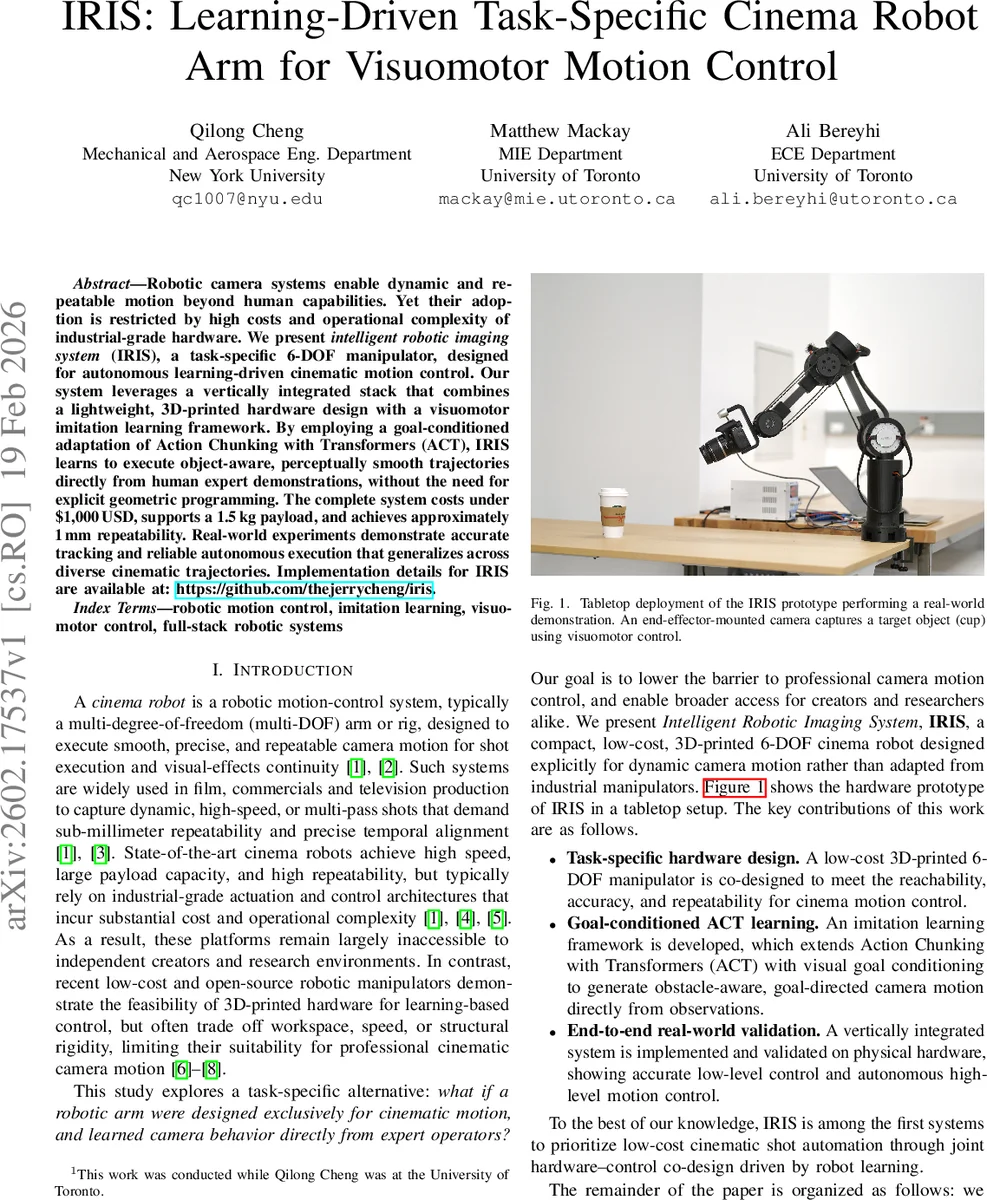
The paper introduces the Intelligent Robotic Imaging System (IRIS), a low‑cost, task‑specific 6‑DOF robotic arm designed exclusively for cinematic camera motion. By co‑designing hardware and control, the authors achieve a system that costs under $1,000, can carry a 1.5 kg payload, reaches roughly one meter, and delivers about 1 mm repeatability—performance that rivals much more expensive commercial cinema robots.
Hardware design
IRIS uses a quasi‑direct‑drive (QDD) architecture with brushless DC motors (Unitree GO‑M8010‑6) mounted near the base. An HTD‑5M timing belt transmits motion to the elbow pitch joint, while a differential wrist driven by two motors provides pitch and roll without placing motors at the end‑effector, dramatically reducing distal inertia. The structure consists of carbon‑fiber tubes and 24 custom 3‑D‑printed parts, yielding a total mass of 8.5 kg. The system runs on a 24 V Li‑Po battery (≈100 W average draw) and can be controlled either by an onboard Jetson Nano or a high‑end GPU workstation for low‑latency inference.
Software and low‑level control
A ROS‑based stack bridges the Unitree SDK, MuJoCo simulation, and the learning pipeline. Joint states and commands are exchanged at 200 Hz, with an impedance controller that filters commands (α = 0.08) and applies velocity‑limited ramping. A numerical Jacobian‑based inverse kinematics solver with damped least squares handles redundancy and singularities, and an exponential moving average smooths the resulting joint commands.
Simulation and sim‑to‑real transfer
A high‑fidelity MuJoCo model reproduces the arm’s kinematics, inertial properties, and collision geometry. Actuator dynamics (damping, friction, armature inertia) are tuned to match empirical step‑response data, minimizing the reality gap. Classical planners such as RRT* are implemented in simulation for baseline comparison.
Learning‑driven visuomotor control
The core contribution is a goal‑conditioned adaptation of Action Chunking with Transformers (ACT). The problem is cast as a partially observable Markov decision process where each observation consists of an RGB image from an end‑effector‑mounted Intel RealSense D435 and the current 6‑D joint state. The user supplies a single target image (the desired framing); the policy must generate a smooth, obstacle‑aware trajectory that brings the camera to that framing.
The architecture augments ACT with a conditional variational auto‑encoder (CVAE) to capture multimodal cinematic styles. An encoder‑decoder transformer (4 layers each, d_model = 256, 8 heads) processes the observation‑goal pair and outputs action “chunks” that span several hundred milliseconds. Training uses only real‑world expert demonstrations (≈30 Hz images, 200 Hz joint data). The loss combines reconstruction of the goal image, KL‑regularization for the CVAE, and a smoothness term on the action sequence.
Experiments
The authors collected ten distinct cinematic shots (e.g., tracking a moving cup, sweeping pans, obstacle‑avoiding arcs) performed by a human operator. On the physical robot, IRIS achieved average positional error of 0.9 mm and rotational error of 0.2°, with a maximum speed of 3.3 m/s and acceleration of 15 m/s². Compared to a classical potential‑field planner, the learned policy produced smoother acceleration profiles and maintained more stable framing (image‑difference < 2 % per frame).
Generalization tests showed that providing a novel target image (different object or background) resulted in plausible zero‑shot trajectories that respected obstacle constraints, demonstrating the policy’s ability to infer high‑level cinematographic intent rather than simply memorizing trajectories.
Contributions
- A purpose‑built, low‑cost 6‑DOF cinema robot that meets professional‑grade reach, payload, speed, and repeatability requirements.
- A goal‑conditioned ACT framework that learns obstacle‑aware, perceptually smooth camera motions directly from RGB observations and expert demonstrations.
- An end‑to‑end system integrating high‑fidelity simulation, ROS‑based low‑level control, and real‑world deployment, validated through extensive quantitative and qualitative experiments.
The work demonstrates that co‑design of hardware and learning‑based control can democratize high‑quality cinematic automation, opening the door for independent creators, research labs, and educational settings to employ robot‑assisted camera work without prohibitive expense. Future directions include multi‑camera coordination, dynamic scene understanding for on‑the‑fly goal updates, and integration of focus/lighting control.
Comments & Academic Discussion
Loading comments...
Leave a Comment