A Phase Description of Mutually Coupled Chaotic Oscillators
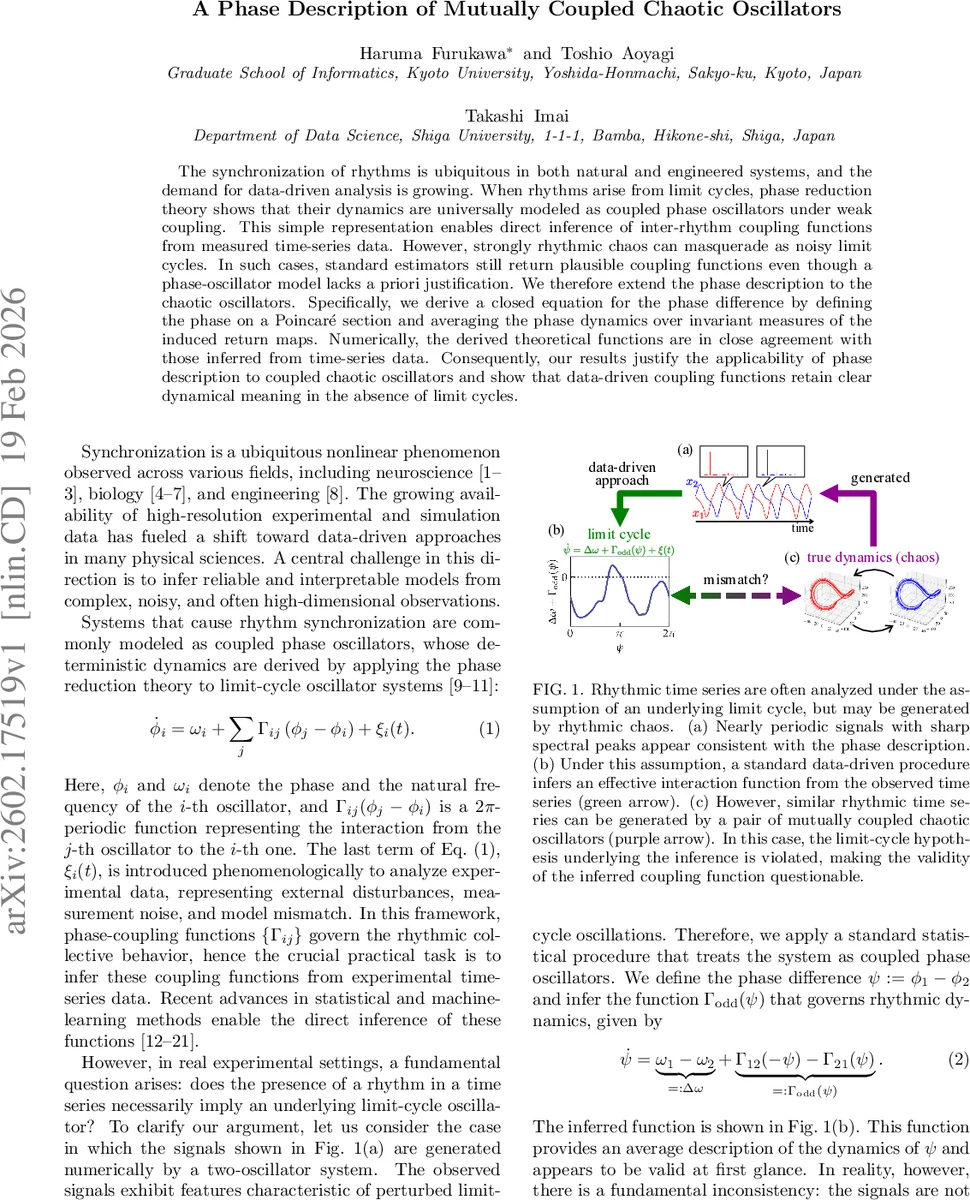
The synchronization of rhythms is ubiquitous in both natural and engineered systems, and the demand for data-driven analysis is growing. When rhythms arise from limit cycles, phase reduction theory shows that their dynamics are universally modeled as coupled phase oscillators under weak coupling. This simple representation enables direct inference of inter-rhythm coupling functions from measured time-series data. However, strongly rhythmic chaos can masquerade as noisy limit cycles. In such cases, standard estimators still return plausible coupling functions even though a phase-oscillator model lacks a priori justification. We therefore extend the phase description to the chaotic oscillators. Specifically, we derive a closed equation for the phase difference by defining the phase on a Poincaré section and averaging the phase dynamics over invariant measures of the induced return maps. Numerically, the derived theoretical functions are in close agreement with those inferred from time-series data. Consequently, our results justify the applicability of phase description to coupled chaotic oscillators and show that data-driven coupling functions retain clear dynamical meaning in the absence of limit cycles.
💡 Research Summary
The paper tackles a fundamental limitation of classical phase‑reduction theory, which is rigorously justified only for weakly coupled limit‑cycle oscillators. In many real‑world situations, however, strongly rhythmic chaotic dynamics can produce time series that look like noisy limit cycles, leading practitioners to apply phase‑oscillator models without a solid theoretical basis. The authors ask whether a phase description can be extended to mutually coupled chaotic oscillators and, if so, whether the resulting coupling functions retain a clear dynamical meaning.
To answer this, they consider two weakly coupled chaotic systems
\
Comments & Academic Discussion
Loading comments...
Leave a Comment