Auditing Reciprocal Sentiment Alignment: Inversion Risk, Dialect Representation and Intent Misalignment in Transformers
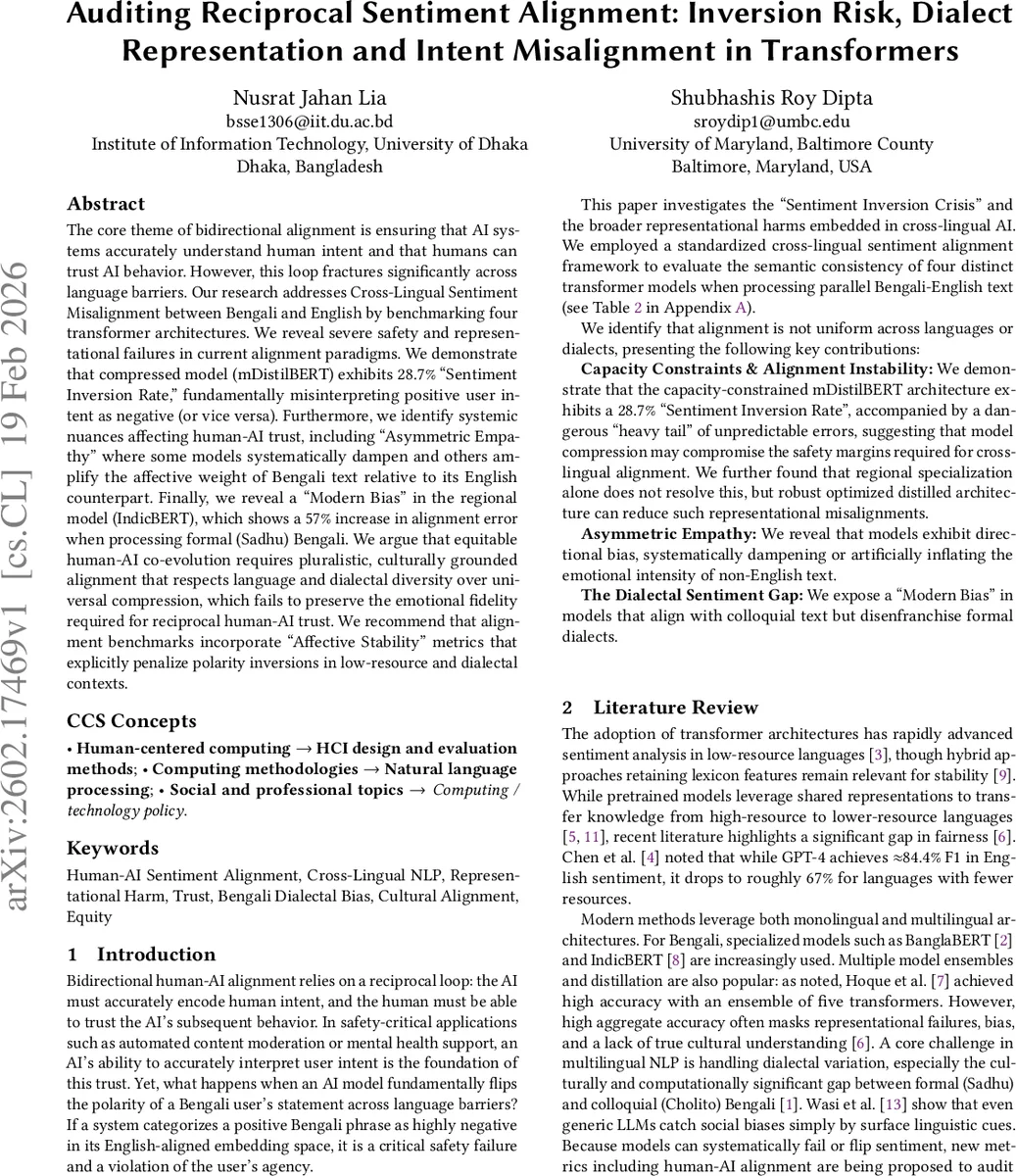
The core theme of bidirectional alignment is ensuring that AI systems accurately understand human intent and that humans can trust AI behavior. However, this loop fractures significantly across language barriers. Our research addresses Cross-Lingual Sentiment Misalignment between Bengali and English by benchmarking four transformer architectures. We reveal severe safety and representational failures in current alignment paradigms. We demonstrate that compressed model (mDistilBERT) exhibits 28.7% “Sentiment Inversion Rate,” fundamentally misinterpreting positive user intent as negative (or vice versa). Furthermore, we identify systemic nuances affecting human-AI trust, including “Asymmetric Empathy” where some models systematically dampen and others amplify the affective weight of Bengali text relative to its English counterpart. Finally, we reveal a “Modern Bias” in the regional model (IndicBERT), which shows a 57% increase in alignment error when processing formal (Sadhu) Bengali. We argue that equitable human-AI co-evolution requires pluralistic, culturally grounded alignment that respects language and dialectal diversity over universal compression, which fails to preserve the emotional fidelity required for reciprocal human-AI trust. We recommend that alignment benchmarks incorporate “Affective Stability” metrics that explicitly penalize polarity inversions in low-resource and dialectal contexts.
💡 Research Summary
The paper investigates cross‑lingual sentiment alignment between Bengali and English using four transformer architectures: the large multilingual XLM‑R, the regional IndicBERT, a compressed mDistilBERT, and an optimized variant called Tabularis. A parallel corpus of 7,350 sentence pairs (balanced across the formal “Sadhu” and colloquial “Cholito” Bengali registers) serves as the test bed. Each model processes the Bengali and English sentences independently with identical weights, and predictions are normalized to a continuous sentiment score in the range
Comments & Academic Discussion
Loading comments...
Leave a Comment