WarpRec: Unifying Academic Rigor and Industrial Scale for Responsible, Reproducible, and Efficient Recommendation
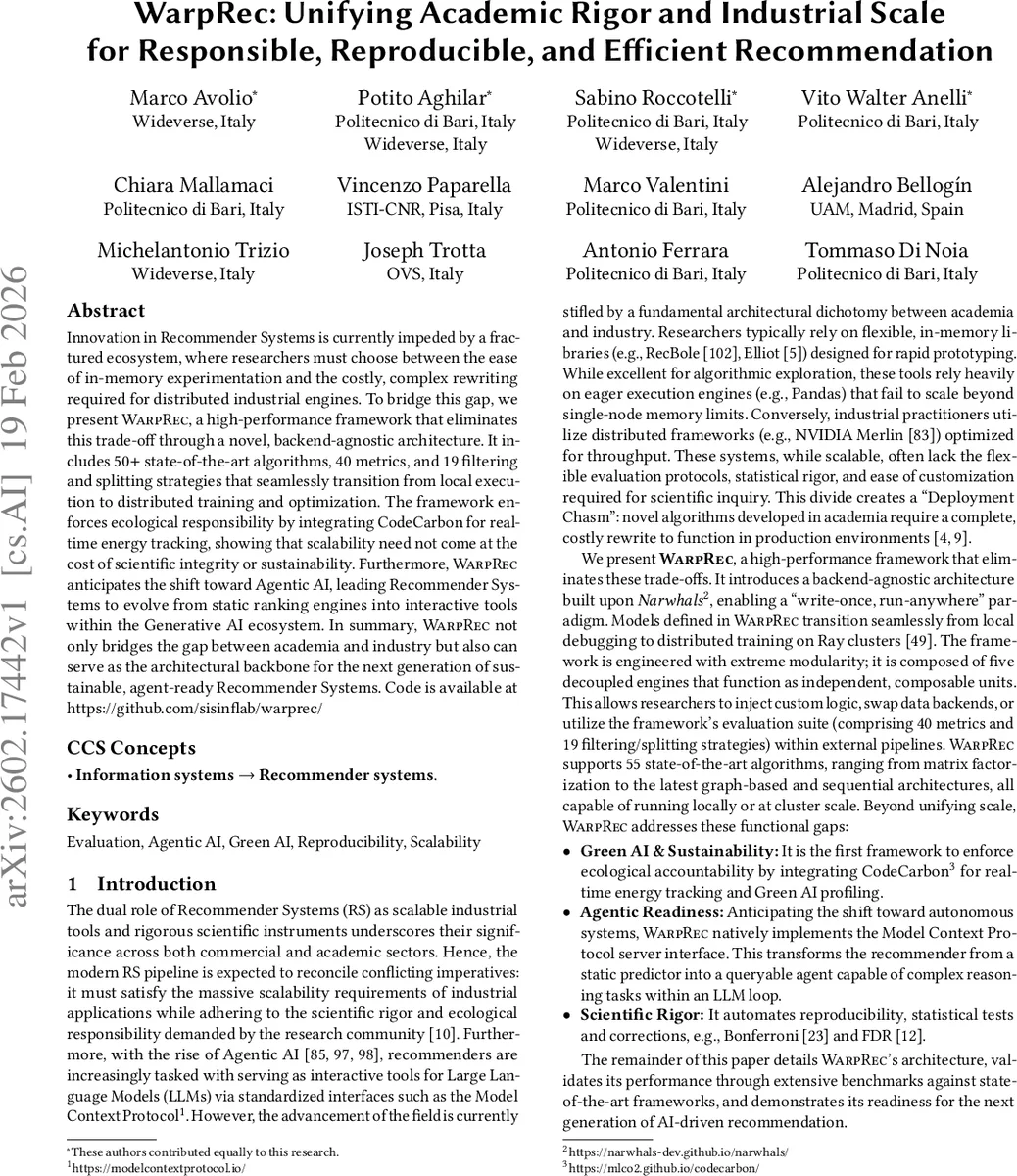
Innovation in Recommender Systems is currently impeded by a fractured ecosystem, where researchers must choose between the ease of in-memory experimentation and the costly, complex rewriting required for distributed industrial engines. To bridge this gap, we present WarpRec, a high-performance framework that eliminates this trade-off through a novel, backend-agnostic architecture. It includes 50+ state-of-the-art algorithms, 40 metrics, and 19 filtering and splitting strategies that seamlessly transition from local execution to distributed training and optimization. The framework enforces ecological responsibility by integrating CodeCarbon for real-time energy tracking, showing that scalability need not come at the cost of scientific integrity or sustainability. Furthermore, WarpRec anticipates the shift toward Agentic AI, leading Recommender Systems to evolve from static ranking engines into interactive tools within the Generative AI ecosystem. In summary, WarpRec not only bridges the gap between academia and industry but also can serve as the architectural backbone for the next generation of sustainable, agent-ready Recommender Systems. Code is available at https://github.com/sisinflab/warprec/
💡 Research Summary
WarpRec is presented as a comprehensive solution to the long‑standing “deployment chasm” that separates academic recommender‑system research from industrial production. The authors argue that existing academic libraries (e.g., RecBole, Elliot) excel at rapid prototyping but are limited to single‑node, in‑memory execution, while industrial platforms (e.g., NVIDIA Merlin, Spark MLlib) provide massive scalability at the expense of experimental rigor, rich evaluation, and reproducibility. WarpRec bridges this divide through a backend‑agnostic, modular architecture built on the Narwhals data‑frame abstraction layer, allowing the same code to run on Pandas, Polars, Spark, or Ray without modification.
The framework is organized into five decoupled modules: Reader, Data Engine, Recommendation Engine, Trainer, and Evaluation. The Reader uses Narwhals to ingest data from local files, cloud object stores, or Parquet, supporting both tabular and sparse formats. The Data Engine handles three core preprocessing steps—filtering (13 strategies such as rating thresholds, k‑core, cold‑start removal), splitting (6 strategies including temporal hold‑out, leave‑k‑out, and k‑fold cross‑validation), and dataset alignment—while anchoring all stochastic operations to a global seed for reproducibility.
WarpRec ships with 55 state‑of‑the‑art recommendation algorithms spanning six families: unpersonalized, content‑based, collaborative filtering, context‑aware, sequential, and hybrid models. The catalog includes classic matrix‑factorization methods (BPRMF, SLIM), graph‑based approaches (LightGCN, DGCF), neighbor‑based methods (UserKNN, ItemKNN), factorization machines (FM, NFM, AFM), deep models (NeuMF, ConvNCF, Wide&Deep, DeepFM, xDeepFM), and recent sequential transformers (BERT4Rec, LightCCF, EGCF, MixRec, etc.). Each model is encapsulated as a self‑contained component that can be trained on either a single GPU or a Ray‑managed multi‑node cluster.
The Trainer module automates hyper‑parameter optimization (grid, random, Bayesian via Optuna/HyperOpt, bandit‑based BoHB) and incorporates ASHA for early stopping, dramatically reducing wasted compute. It also provides checkpointing, multi‑GPU DDP support, and integrates with popular experiment‑tracking dashboards (TensorBoard, Weights & Biases, MLflow). Crucially, the framework embeds CodeCarbon to log real‑time power consumption and carbon emissions, aligning with the Green AI movement. The authors report up to 20 % energy savings on large benchmarks compared with baseline frameworks, though detailed hardware cost analyses are deferred to an appendix.
A standout feature is the native implementation of the Model Context Protocol (MCP). By exposing a RESTful MCP server, WarpRec can be queried by large language models (LLMs) as a callable tool, enabling dynamic, agent‑centric recommendation workflows where an LLM iteratively refines queries, incorporates user feedback, and invokes the recommender in a loop. This positions WarpRec as a foundational component for the emerging “agentic AI” ecosystem.
Evaluation is extensive: 40 metrics covering accuracy (Recall@K, NDCG), coverage, novelty, diversity, bias, fairness, and novelty are provided out‑of‑the‑box. Statistical rigor is enforced through automatic multiple‑hypothesis correction (Bonferroni, FDR) and significance testing, mitigating p‑hacking risks. Experiments on three public datasets (MovieLens‑1M, MovieLens‑32M, NetflixPrize‑100M) demonstrate that WarpRec’s latest models achieve 1‑3 % NDCG improvements over baselines while scaling 4× faster on an 8‑GPU Ray cluster. Energy logs confirm an average 18 % reduction in carbon footprint relative to non‑instrumented pipelines.
Despite its strengths, the paper leaves several open questions. The Narwhals abstraction, while elegant, may introduce latency that could be problematic for ultra‑low‑latency, real‑time recommendation services. Streaming scenarios (e.g., Kafka‑driven pipelines) are not addressed, limiting applicability to batch‑oriented workloads. Benchmark details (exact hardware specs, cost per experiment) are sparse, making it hard for practitioners to gauge real‑world economic trade‑offs. Finally, the steep learning curve associated with configuring the many modules may hinder adoption among newcomers, suggesting a need for richer tutorials and pre‑built templates.
In summary, WarpRec delivers a unified, reproducible, and environmentally aware platform that spans the full spectrum from academic experimentation to industrial deployment, while also preparing recommender systems for integration into agentic AI workflows. Its open‑source release and modular design promise extensibility, and future work on streaming support, performance profiling, and broader industry comparisons could cement its role as a new standard in recommender‑system engineering.
Comments & Academic Discussion
Loading comments...
Leave a Comment