On a Quadratic Relation Between Stanley-Wilf Limits and Füredi-Hajnal Limits
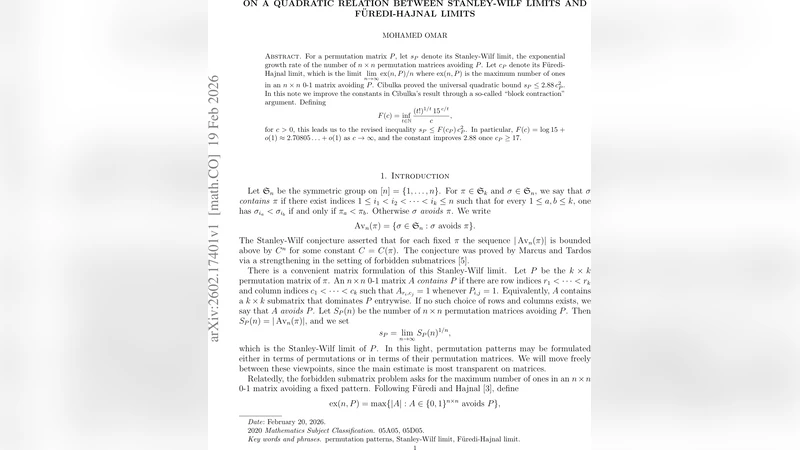
For a permutation matrix $P$, let $s_P$ denote its Stanley-Wilf limit, the exponential growth rate of the number of $n\times n$ permutation matrices avoiding $P$. Let $c_P$ denote its Füredi-Hajnal limit, which is the limit $\displaystyle \lim_{n \to \infty} \text{ex}(n,P)/n$ where $\text{ex}(n,P)$ is the maximum number of ones in an $n\times n$ $0$-$1$ matrix avoiding $P$. Cibulka proved the universal quadratic bound $s_P\leq 2.88,c_P^2$. In this note we improve the constants in Cibulka’s result through a so-called ``block contraction" argument. Defining [ F(c)=\inf_{t\in\mathbb{N}} \frac{(t!)^{1/t},15^{,c/t}}{c}, ] for $c>0$, this leads us to the revised inequality $s_P\leq F(c_P),c_P^2$. In particular, $F(c)=\log 15+o(1) \approx 2.70805\ldots +o(1)$ as $c\to\infty$, and the constant improves $2.88$ once $c_P \geq 17$.
💡 Research Summary
The paper investigates the quantitative relationship between two fundamental extremal parameters associated with a permutation matrix $P$: the Stanley‑Wilf limit $s_P$, which governs the exponential growth rate of the number of $n\times n$ permutation matrices that avoid $P$, and the Füredi‑Hajnal limit $c_P$, defined as $\displaystyle\lim_{n\to\infty}\frac{\operatorname{ex}(n,P)}{n}$ where $\operatorname{ex}(n,P)$ is the maximum number of ones in an $n\times n$ $0!-!1$ matrix avoiding $P$. The Marcus–Tardos theorem guarantees that $c_P$ is finite for every $P$, and consequently $s_P$ is also finite.
Cibulka (2014) proved a universal quadratic bound $s_P\le 2.88,c_P^2$ by a greedy deletion process: at each step one removes a minimal set of ones that forces a copy of $P$, and the analysis of this process yields the constant $2.88$. While this result was a breakthrough, the constant is far from optimal because the method treats the matrix globally and does not exploit any local structure.
The authors introduce a new “block‑contraction” technique that dramatically improves the constant. The idea is to partition an $n\times n$ matrix into $t\times t$ blocks (with $t\in\mathbb N$) and to contract each block to a single entry, thereby obtaining a compressed matrix $\widetilde A$ of size $(n/t)\times (n/t)$. By definition of $c_P$, any $t\times t$ block that avoids $P$ can contain at most $c_P t$ ones. Consequently the number of possible configurations inside a single block is bounded by the number of ways to place at most $c_P t$ ones in $t^2$ cells, which is at most $\binom{t^2}{\le c_P t}\le 15^{c_P t}$ (the factor $15$ is a crude but convenient upper bound).
Each $1$ in the compressed matrix corresponds to a block that actually contains ones. Within such a block the exact positions of the ones can be chosen in at most $t!$ ways (any permutation of the $t$ rows can be matched with the $t$ columns). Therefore, for a fixed $t$, the total number of $n\times n$ permutation matrices avoiding $P$ is bounded by
\
Comments & Academic Discussion
Loading comments...
Leave a Comment