Controlled dripping from a grooved condensing plate
Condensed water on vertical surfaces ultimately leaves the substrate at the lower edge, where accumulated liquid detaches as drops. While droplet growth and surface transport have been extensively stu
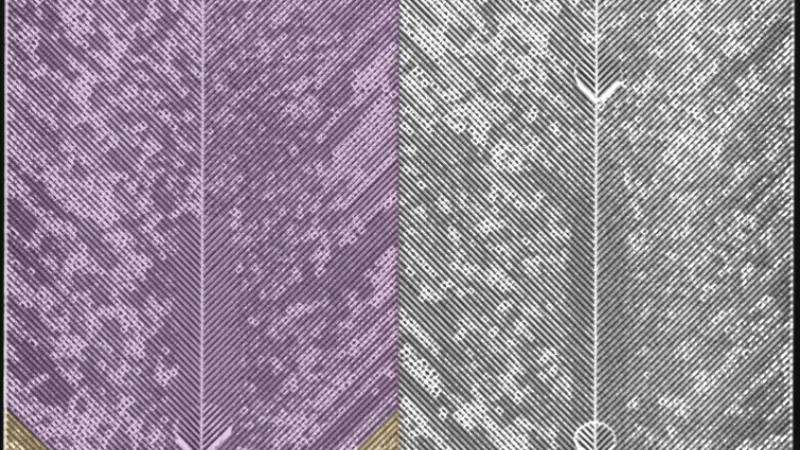
Condensed water on vertical surfaces ultimately leaves the substrate at the lower edge, where accumulated liquid detaches as drops. While droplet growth and surface transport have been extensively studied, this final release step remains poorly understood and largely uncontrolled. Yet this boundary event determines how and when condensed water is removed. We ask whether geometry can replace randomness as the governing mechanism of edge dripping. By engraving vertical grooves upstream, we redirect water from surface flow into groove-guided drainage toward the boundary. This switch in transport mode changes how liquid accumulates and detaches at the edge. Using rapid forced condensation and high-resolution imaging, we systematically vary groove spacing s, aspect ratio d/w, and orientation. We then analyse how these geometric parameters influence the formation, stability, and spatial organization of droplets hanging below the edge. Smooth substrates exhibit irregular, impact-driven detachment. Grooved substrates produce localized and steady dripping points. When grooves converge, dripping occurs at fixed, geometry-defined locations. For convergent designs, a simple condensation-capillarity model captures the dependence of the dripping period on the area of the drainage basin. Together, these results demonstrate that geometry alone can transform stochastic edge dripping into spatially organized and temporally regular release, with implications for dew harvesting, passive cooling, and millifluidic transport.
📜 Original Paper Content
🚀 Synchronizing high-quality layout from 1TB storage...