Far-field heat transfer and monochromatic thermal currents in a cylindrical nonreciprocal cavity
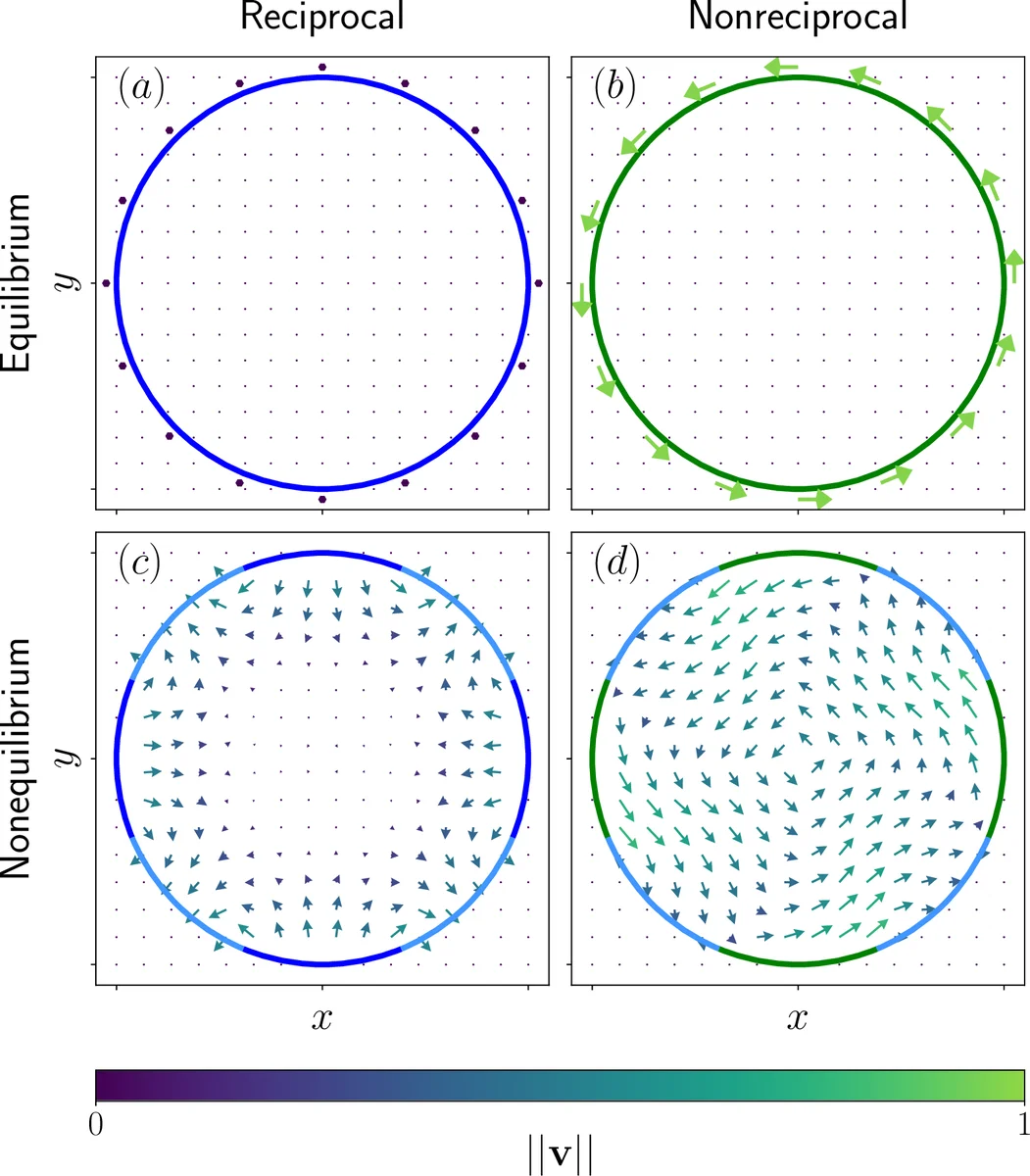
Breaking Kirchhoff’s law of thermal radiation yields new opportunities in one-way radiative thermal transport and circuitry. We investigate its consequences in the far-field regime in cylindrical cavities, by employing a specular ray-tracing algorithm. At thermal equilibrium, we show that violation of Kirchhoff’s law yields non-vanishing heat rectification coefficients within different sections of the cavity, which can be tuned for perfect rectification and circulation, while internal monochromatic currents vanish due to the intrinsic coupling between emission and absorption at specular surfaces. This constraint is lifted under nonequilibrium conditions, where rotational heat fluxes within the cavity can be precisely controlled by appropriately combining reciprocal and nonreciprocal materials. These findings open new avenues for thermal management and provide design principles for nonreciprocal photonic devices.
💡 Research Summary
The paper investigates far‑field radiative heat transfer in a cylindrical cavity that contains non‑reciprocal (time‑reversal‑symmetry‑breaking) materials. By implementing a specular ray‑tracing algorithm, the authors model how photons travel, reflect, and are absorbed on perfectly specular walls while experiencing the asymmetric electromagnetic response of the non‑reciprocal media. In the conventional picture, Kirchhoff’s law guarantees that emissivity equals absorptivity, leading to symmetric heat exchange. Here, the law is deliberately broken: the non‑reciprocal material introduces direction‑dependent transmission and reflection coefficients, so that a photon’s trajectory after a reflection depends on its incident direction and polarization in a non‑symmetric way.
First, the authors examine the system at thermal equilibrium (uniform temperature throughout the cavity). Even though the net heat flow must vanish globally, they find that the heat flux between distinct sections of the cavity (e.g., top vs. bottom, or left vs. right halves) can be highly asymmetric. They define a rectification coefficient (R = (Q_{AB} - Q_{BA})/(Q_{AB} + Q_{BA})) and show that, by tuning material parameters (magnetization strength, off‑diagonal components of the permittivity‑permeability tensors) and geometric variables (radius, length, position of internal partitions), (R) can approach unity. In other words, the cavity can act as a perfect thermal diode for far‑field radiation, allowing heat to flow preferentially in one direction while the opposite direction is strongly suppressed.
Second, the study reveals a fundamental constraint on monochromatic (single‑frequency) thermal currents inside a perfectly specular cavity. Because specular reflection preserves the angle and polarization of each ray, any photon emitted at a given frequency is inevitably re‑absorbed along the same ray after a round‑trip. Consequently, despite the violation of Kirchhoff’s law, the net monochromatic current vanishes at equilibrium; emission and absorption remain intrinsically coupled. This result underscores that non‑reciprocity alone does not generate a steady‑state single‑frequency heat flow unless detailed balance is broken.
The authors then move to non‑equilibrium conditions by imposing different temperatures on separate cavity sections or by adding external heat sources. By interleaving reciprocal (ordinary) and non‑reciprocal materials, they create a composite structure where the temperature gradient and the direction‑dependent scattering combine to produce a circulating heat flux around the cylinder’s axis. The direction (clockwise or counter‑clockwise) and magnitude of this rotational flux can be precisely controlled: increasing the non‑reciprocal strength or the temperature difference linearly enhances the circulation speed, while adjusting the proportion of non‑reciprocal material changes the fraction of total heat that participates in the vortex. The authors demonstrate that even a modest 30 % inclusion of a magneto‑optical layer can drive more than 70 % of the total radiative power into a unidirectional swirl.
From a device perspective, these findings suggest several novel thermal‑photonic components. A cavity engineered for perfect rectification functions as a far‑field thermal diode, useful for passive heat‑flow control in spacecraft or high‑temperature electronics. The rotational heat vortex can be harnessed as a “thermal turbine” that converts temperature gradients into mechanical torque via radiation pressure, or as a building block for thermal logic circuits where heat currents play the role of electrical signals. The paper also outlines practical routes to realize the required non‑reciprocal media, such as magnetized ferrites, gyrotropic semiconductors, or dynamically modulated metasurfaces, and discusses experimental verification strategies based on infrared thermography and angle‑resolved spectroscopy.
In summary, the work extends radiative heat‑transfer theory beyond Kirchhoff’s symmetric framework by providing a clear, ray‑optics based methodology to quantify non‑reciprocal effects in the far field. It establishes design rules linking material non‑reciprocity, cavity geometry, and temperature boundary conditions to achieve targeted functionalities—perfect rectification, controlled circulation, and tunable heat‑current pathways. These insights open a pathway toward sophisticated thermal management systems and non‑reciprocal photonic devices that exploit direction‑biased radiation for energy‑efficient applications.