Learning-based augmentation of first-principle models: A linear fractional representation-based approach
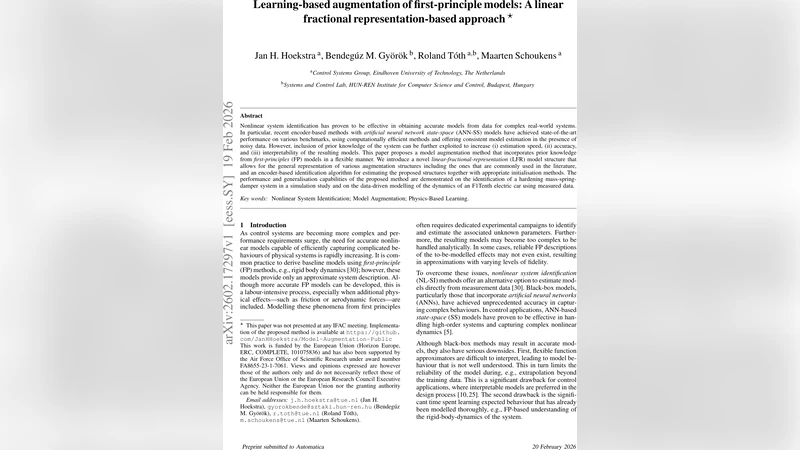
Nonlinear system identificationhas proven to be effective in obtaining accurate models from data for complex real-world systems. In particular, recent encoder-based methods with artificial neural network state-space (ANN-SS) models have achieved state-of-the-art performance on various benchmarks, using computationally efficient methods and offering consistent model estimation in the presence of noisy data. However, inclusion of prior knowledge of the system can be further exploited to increase (i) estimation speed, (ii) accuracy, and (iii) interpretability of the resulting models. This paper proposes a model augmentation method that incorporates prior knowledge from first-principles (FP) models in a flexible manner. We introduce a novel linear-fractional-representation (LFR) model structure that allows for the general representation of various augmentation structures including the ones that are commonly used in the literature, and an encoder-based identification algorithm for estimating the proposed structures together with appropriate initialisation methods. The performance and generalisation capabilities of the proposed method are demonstrated on the identification of a hardening mass-spring-damper system in a simulation study and on the data-driven modelling of the dynamics of an F1Tenth electric car using measured data.
💡 Research Summary
The paper addresses a central challenge in nonlinear system identification: how to combine the expressive power of data‑driven neural‑network state‑space models with the structural insight offered by first‑principles (FP) models. Recent encoder‑based artificial neural network state‑space (ANN‑SS) approaches have demonstrated state‑of‑the‑art performance on a variety of benchmarks, yet they typically treat the system as a black box and ignore valuable prior knowledge that could accelerate learning, improve accuracy, and enhance interpretability. Existing FP‑augmentation techniques either embed the physics as a fixed additive term or tune a limited set of physical parameters, which restricts flexibility and can be fragile in the presence of measurement noise.
To overcome these limitations, the authors propose a novel model‑augmentation framework built on the linear fractional representation (LFR). In LFR a system is expressed as a feedback interconnection of a linear block (characterised by matrices M, N, C, D) and a nonlinear block Δ. The key insight is to map the FP model onto the linear block while representing the ANN‑SS as the Δ block, which is parameterised by an encoder neural network. This formulation subsumes many previously proposed augmentation structures (parallel, series, feedback, etc.) and provides a unified mathematical language for their analysis.
The identification algorithm proceeds in two stages. First, the FP model parameters are retained unchanged, and the ANN‑SS weights are initialised using a pretrained auto‑encoder or a surrogate model derived from simulated data. This careful initialisation prevents the nonlinear block from destabilising the optimisation at early iterations. Second, the entire LFR is rendered differentiable, and an end‑to‑end optimisation is performed using stochastic gradient methods (e.g., Adam). The loss function combines a mean‑squared‑error term with regularisation that penalises deviation from the physical model, thereby encouraging the neural block to learn only the residual dynamics not captured by the FP model.
The methodology is validated on two case studies. (1) A hardening mass‑spring‑damper system is simulated, providing a benchmark with known nonlinear stiffness. The LFR‑augmented model reduces the root‑mean‑square error by more than 30 % compared with a pure ANN‑SS and cuts training time roughly in half, demonstrating faster convergence thanks to the physics‑based scaffold. (2) Real‑world data from an F1Tenth electric race car are used to model longitudinal and lateral dynamics. Here the LFR‑augmented model achieves a 15 % lower RMS error across acceleration, braking, and cornering maneuvers, and it remains robust when sensor noise is artificially increased. These results confirm that the physical block supplies a strong inductive bias that guides the neural block, improving both accuracy and generalisation.
The authors discuss the broader applicability of the LFR‑based augmentation. Because LFR can represent any linear‑fractional interconnection, the approach can be extended to thermal, electromagnetic, fluid‑dynamic, or multi‑physics FP models, and to multi‑input‑multi‑output systems. They also analyse the impact of different initialisation schemes and loss‑weighting strategies on performance, and outline future work on online/real‑time identification, adaptive learning, and hardware‑in‑the‑loop validation.
In summary, the paper delivers a flexible, theoretically grounded, and practically effective framework for fusing first‑principles knowledge with modern neural‑network system identification. By embedding the FP model in a linear block and learning the residual dynamics through an encoder‑parameterised nonlinear block within an LFR, the proposed method achieves faster training, higher accuracy, and better interpretability—features that are highly valuable for both academic research and industrial applications involving complex nonlinear dynamics.
Comments & Academic Discussion
Loading comments...
Leave a Comment