Bilateral parking procedures
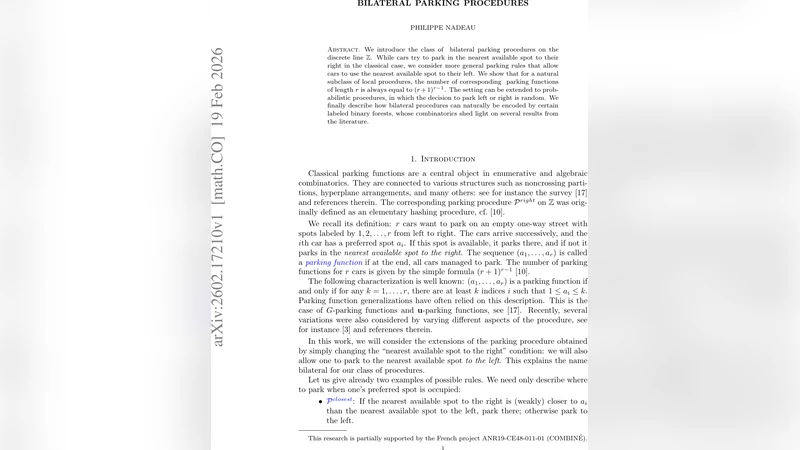
We introduce the class of bilateral parking procedures on the integer line. While cars try to park in the nearest available spot to their right in the classical case, we consider more general parking rules that allow cars to use the nearest available spot to their left. We show that for a natural subclass of local procedures, the number of corresponding parking functions of length $r$ is always equal to $(r+1)^{r-1}$. The setting can be extended to probabilistic procedures, in which the decision to park left or right is random. We finally describe how bilateral procedures can naturally be encoded by certain labeled binary forests, whose combinatorics shed light on several results from the literature.
💡 Research Summary
The paper introduces a novel combinatorial model called bilateral parking procedures, which generalizes the classical parking‑function framework on the integer line. In the traditional setting each car arrives with a preferred spot and, if that spot is occupied, proceeds to the nearest empty spot strictly to its right. The authors extend this rule by allowing a car to also move leftwards, parking at the nearest empty spot on either side of its current position. To keep the model tractable they impose a locality condition: a car may only inspect a bounded neighbourhood around its current location, and the order in which left and right directions are examined is fixed by a deterministic rule (for example, “closest distance first, break ties by a prescribed left‑right priority”).
The central combinatorial result concerns a natural subclass of these local procedures. The authors prove that for any length $r$, the number of admissible parking functions—i.e., sequences of preferences that lead to a successful parking of all $r$ cars—remains exactly $(r+1)^{,r-1}$, the same count that appears in the classical right‑only model. The proof proceeds in two main steps. First, each bilateral parking outcome is encoded as a binary choice tree: a decision to park to the right corresponds to a left child, a decision to park to the left corresponds to a right child. This tree records the order in which cars occupy spots and the direction of each move. Second, the binary choice trees are shown to be in bijection with labeled binary forests, where the labels record the arrival order of the cars and the forest structure captures the configuration of empty spots. The enumeration of labeled binary forests is a well‑known consequence of Cayley’s formula, yielding precisely $(r+1)^{,r-1}$ objects. Hence the bijection transfers the classical count to the bilateral setting.
Beyond the deterministic case, the paper explores a probabilistic extension. Each car now decides to search left or right according to a fixed probability $p$ (right) and $1-p$ (left). This introduces a Markov chain on the space of partial parking configurations. The authors compute the expected number of cars that successfully park, the distribution of the total distance travelled, and the variance of these quantities as explicit functions of $p$. In the symmetric case $p=1/2$, the chain is uniform over all bilateral procedures, and the expected statistics converge to those of the classical model as $p\to1$. The probabilistic analysis demonstrates that the bilateral framework interpolates smoothly between the right‑only and fully symmetric regimes, offering a richer model for real‑world scenarios where drivers may prefer either side of a street.
A substantial portion of the work is devoted to the encoding via labeled binary forests. This perspective unifies several earlier results: it recovers the Gessel–Seo “parking‑function tree” representation, connects with Stanley’s theory of tree inversions, and clarifies why the same enumeration appears in seemingly different contexts. Moreover, the forest encoding readily adapts to further generalizations, such as bounded left/right search radii, higher‑dimensional lattices, or multiple streets linked by junctions. The authors sketch how these extensions preserve the bijective correspondence, suggesting that many variants of parking problems can be tackled with the same combinatorial machinery.
In summary, the paper makes four key contributions: (1) it defines bilateral parking procedures that allow both left and right moves; (2) it proves that a natural local subclass retains the classical count $(r+1)^{,r-1}$ for parking functions of length $r$; (3) it develops a probabilistic version that yields explicit performance metrics as functions of the left‑right bias $p$; and (4) it establishes a bijection with labeled binary forests, thereby linking the new model to a broad body of combinatorial literature. These results open a pathway for future research on more complex parking dynamics, stochastic traffic models, and algorithmic applications in robotics and network routing.
Comments & Academic Discussion
Loading comments...
Leave a Comment