Adjoint-based gradient methods for inverse design in a multiple fragmentation model
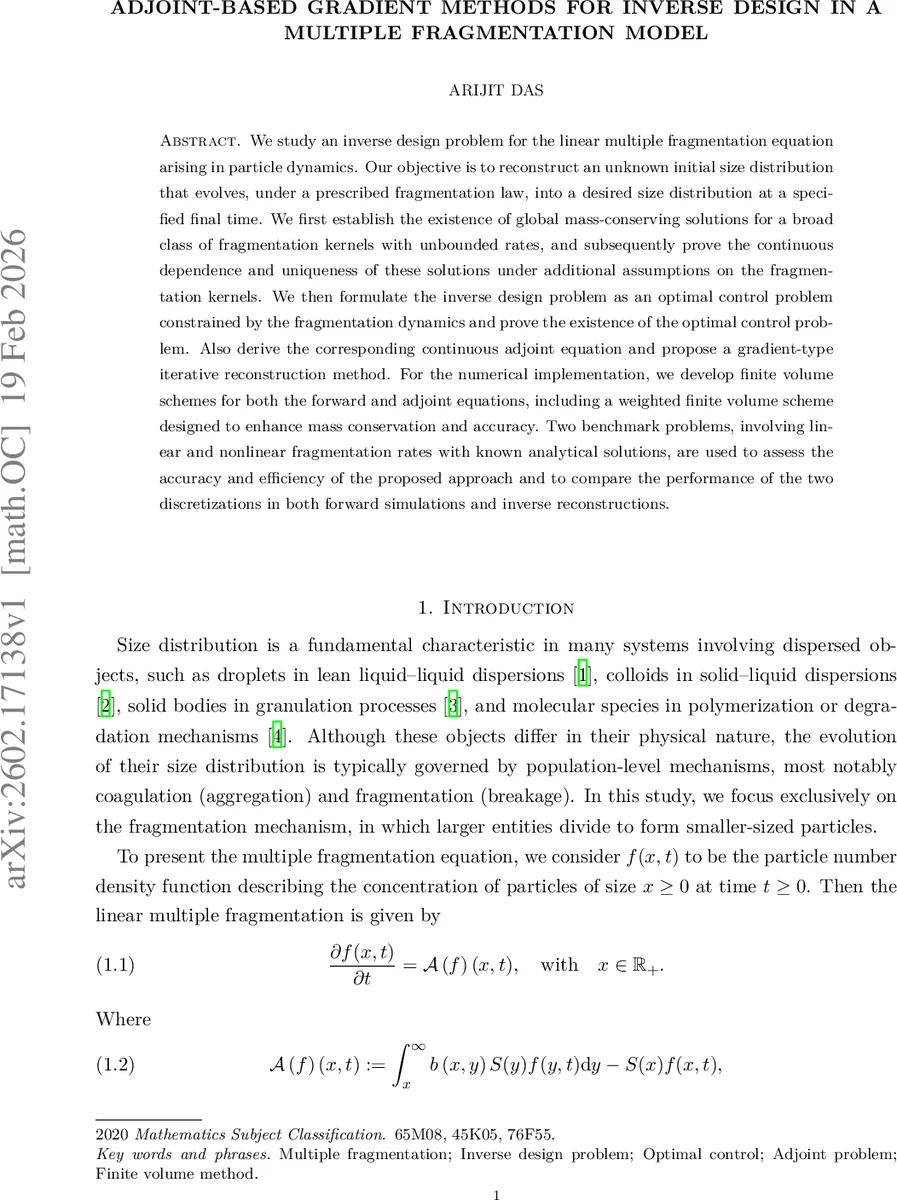
We study an inverse design problem for the linear multiple fragmentation equation arising in particle dynamics. Our objective is to reconstruct an unknown initial size distribution that evolves, under a prescribed fragmentation law, into a desired size distribution at a specified final time. We first establish the existence of global mass-conserving solutions for a broad class of fragmentation kernels with unbounded rates, and subsequently prove the continuous dependence and uniqueness of these solutions under additional assumptions on the fragmentation kernels. We then formulate the inverse design problem as an optimal control problem constrained by the fragmentation dynamics and prove the existence of the optimal control problem. Also derive the corresponding continuous adjoint equation and propose a gradient-type iterative reconstruction method. For the numerical implementation, we develop finite volume schemes for both the forward and adjoint equations, including a weighted finite volume scheme designed to enhance mass conservation and accuracy. Two benchmark problems, involving linear and nonlinear fragmentation rates with known analytical solutions, are used to assess the accuracy and efficiency of the proposed approach and to compare the performance of the two discretizations in both forward simulations and inverse reconstructions.
💡 Research Summary
The paper addresses the inverse design problem for the linear multiple fragmentation equation, a kinetic model describing how a population of particles breaks into smaller fragments over time. The forward model is given by
\
Comments & Academic Discussion
Loading comments...
Leave a Comment