A gauge theoretical generalization of Bryant's correspondence
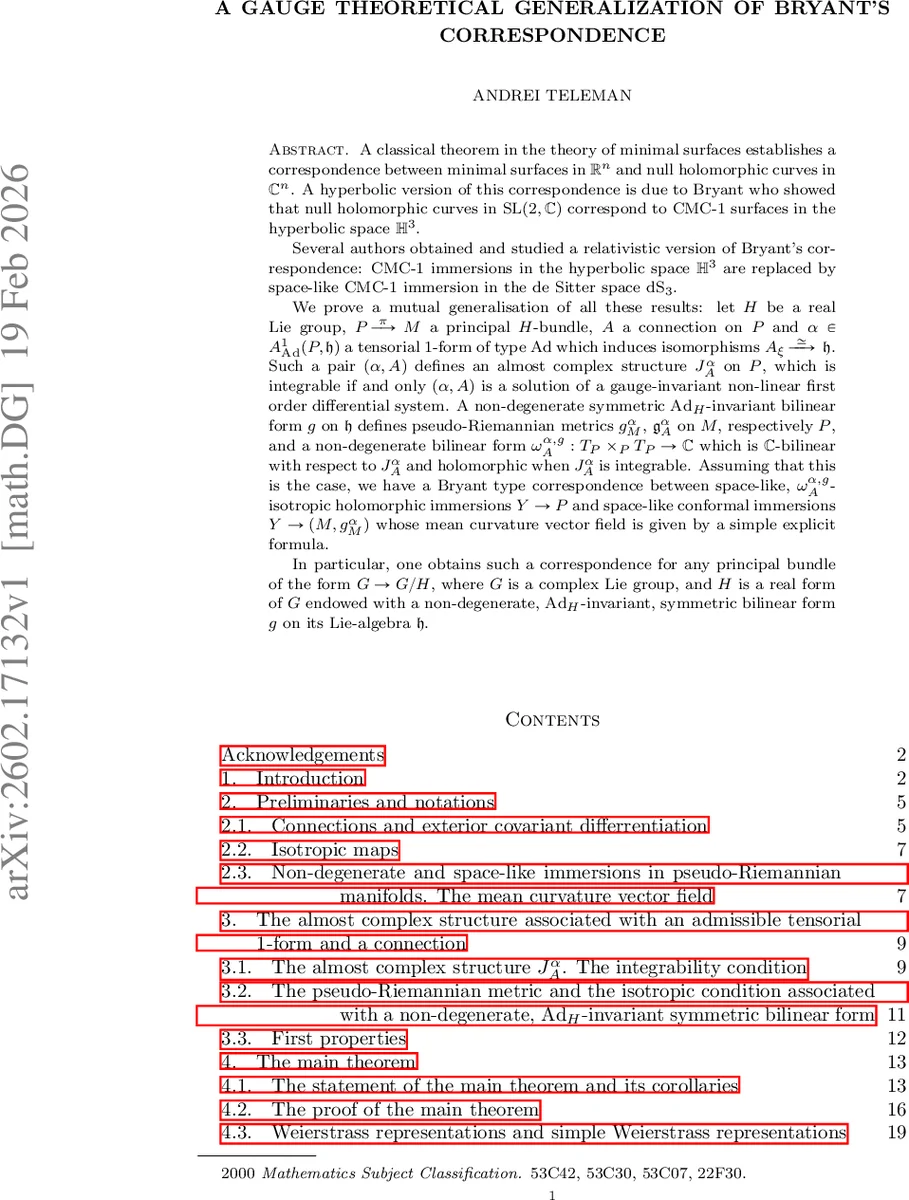
A classical theorem in the theory of minimal surfaces establishes a correspondence between minimal surfaces in $\mathbb{R}^n$ and null holomorphic curves in $\mathbb{C}^n$. A hyperbolic version of this correspondence is due to Bryant: null holomorphic curves in ${\rm SL}(2,\mathbb{C})$ correspond to CMC-1 surfaces in the hyperbolic space $\mathbb{H}^3$. We also have a relativistic Bryant type correspondence: CMC-1 immersions in the hyperbolic space are replaced by space-like CMC-1 immersion in the de Sitter space. We prove a mutual generalisation of all these results: let $H$ be a real Lie group, $π:P \to M$ a principal $H$-bundle, $A$ a connection on $P$ and $α\in A^1_{\rm Ad}(P,\mathfrak{h})$ a tensorial 1-form of type ${\rm Ad}$ which induces isomorphisms $A_ξ\to \mathfrak{h}$. Such a pair $(α,A)$ defines an almost complex structure $J^α_A$ on $P$, which is integrable if and only $(α,A)$ solves a gauge-invariant first order differential system. A non-degenerate symmetric ${\rm Ad}_H$-invariant bilinear form $g$ on $\mathfrak{h}$ defines pseudo-Riemannian metrics $g^α_M$, $\mathfrak{g}^α_A$ on $M$, respectively $P$, and a non-degenerate bilinear form $ω^{α,g}_A:T_P\times_P T_P\to \mathbb{C}$ which is holomorphic when $J^α_A$ is integrable. Assuming that this is the case, we have a Bryant type correspondence between space-like, $ω^{α,g}_A$-isotropic holomorphic immersions $Y\to P$ and space-like conformal immersions $Y\to (M,g^α_M)$ whose mean curvature vector field is given by a simple explicit formula. In particular, one obtains such a correspondence for any principal bundle of the form $G\to G/H$, where $G$ is a complex Lie group, and $H$ is a real form of $G$ endowed with a non-degenerate, ${\rm Ad}_H$-invariant, symmetric bilinear form $g$ on its Lie-algebra $\mathfrak{h}$.
💡 Research Summary
The paper presents a comprehensive gauge‑theoretic framework that unifies several classical correspondences between holomorphic curves and constant mean curvature (CMC) surfaces. The classical Weierstrass representation links minimal surfaces in Euclidean space ℝⁿ with null (isotropic) holomorphic curves in ℂⁿ. Bryant’s hyperbolic analogue replaces ℝⁿ by hyperbolic 3‑space ℍ³ and null holomorphic curves in SL(2,ℂ) by CMC‑1 surfaces in ℍ³. A relativistic version further replaces ℍ³ by de Sitter space dS³ and SL(2,ℂ) by its split real form SL(2,ℝ).
The author abstracts these results to the setting of a principal H‑bundle π : P → M, where H is a real Lie group (not necessarily connected) and dim H = dim M. Two key ingredients are introduced:
- An admissible tensorial 1‑form α ∈ A¹_Ad(P,𝔥) of type Ad, which at each point ξ ∈ P gives an isomorphism between the vertical subspace V_ξ and the Lie algebra 𝔥.
- A connection A on P, providing a horizontal distribution complementary to V.
From (α, A) the author defines an almost complex structure J_A^α on the total space P. This structure interchanges the horizontal and vertical subbundles. Crucially, J_A^α is integrable if and only if the pair (α, A) satisfies a gauge‑invariant first‑order nonlinear system (the “integrability equations” originally studied by Zeidler and further developed by the author).
A non‑degenerate, Ad‑invariant symmetric bilinear form g on 𝔥 is then used to induce:
- A pseudo‑Riemannian metric g_M^α on the base M.
- A pseudo‑Riemannian metric 𝔤_A^α on the total space P.
- A complex‑bilinear 2‑form ω_A^{α,g} : TP ⊗ TP → ℂ, which is of type (1,0) with respect to J_A^α and becomes holomorphic precisely when J_A^α is integrable.
The central result (Theorem 4.1) establishes a Bryant‑type correspondence under these conditions:
- Holomorphic side: a space‑like, ω_A^{α,g}‑isotropic holomorphic immersion f : Y → P, where Y is a Riemann surface.
- Geometric side: a space‑like conformal immersion φ : Y → (M, g_M^α) whose mean curvature vector field is given explicitly by
\
Comments & Academic Discussion
Loading comments...
Leave a Comment