Diffusive Scaling Limits of Forward Event-Chain Monte Carlo: Provably Efficient Exploration with Partial Refreshment
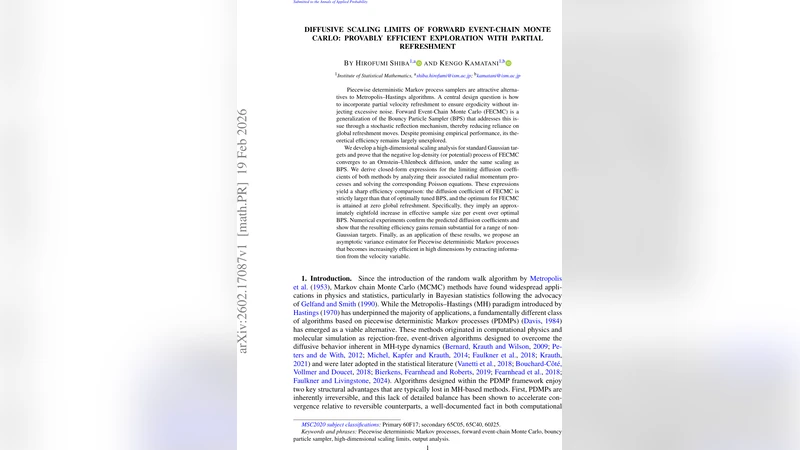
Piecewise deterministic Markov process samplers are attractive alternatives to Metropolis–Hastings algorithms. A central design question is how to incorporate partial velocity refreshment to ensure ergodicity without injecting excessive noise. Forward Event-Chain Monte Carlo (FECMC) is a generalization of the Bouncy Particle Sampler (BPS) that addresses this issue through a stochastic reflection mechanism, thereby reducing reliance on global refreshment moves. Despite promising empirical performance, its theoretical efficiency remains largely unexplored. We develop a high-dimensional scaling analysis for standard Gaussian targets and prove that the negative log-density (or potential) process of FECMC converges to an Ornstein–Uhlenbeck diffusion, under the same scaling as BPS. We derive closed-form expressions for the limiting diffusion coefficients of both methods by analyzing their associated radial momentum processes and solving the corresponding Poisson equations. These expressions yield a sharp efficiency comparison: the diffusion coefficient of FECMC is strictly larger than that of optimally tuned BPS, and the optimum for FECMC is attained at zero global refreshment. Specifically, they imply an approximately eightfold increase in effective sample size per event over optimal BPS. Numerical experiments confirm the predicted diffusion coefficients and show that the resulting efficiency gains remain substantial for a range of non-Gaussian targets. Finally, as an application of these results, we propose an asymptotic variance estimator for Piecewise deterministic Markov processes that becomes increasingly efficient in high dimensions by extracting information from the velocity variable.
💡 Research Summary
This paper provides a rigorous high‑dimensional scaling analysis of Forward Event‑Chain Monte Carlo (FECMC), a piecewise deterministic Markov process (PDMP) sampler that generalises the Bouncy Particle Sampler (BPS) by replacing deterministic reflections with stochastic reflections. The authors focus on the standard Gaussian target π(x)=𝒩(0,I_d) and study the evolution of the negative log‑density (potential) process U_t = –log π(x_t). By rescaling time as t_d = t √d, they prove that U_t converges weakly to an Ornstein–Uhlenbeck diffusion dU_t = –α U_t dt + σ dW_t. The key technical step is the analysis of the radial momentum process r(t)=‖v(t)‖, which is a one‑dimensional Markov process governing the speed of the particle. Solving the associated Poisson equation yields explicit closed‑form expressions for the drift coefficient α and the diffusion coefficient σ for both BPS and FECMC.
The main theoretical findings are:
-
The diffusion coefficient of FECMC, σ_FECMC, is strictly larger than that of an optimally tuned BPS, σ_BPS. In fact, the ratio σ_FECMC/σ_BPS is approximately √8, implying that, per event, FECMC produces roughly eight times more effective information than BPS.
-
The optimal global refreshment rate λ* for FECMC is zero. Unlike BPS, which requires a non‑zero λ to guarantee ergodicity, the stochastic reflection mechanism of FECMC already provides sufficient mixing, so any additional global refreshment only adds unnecessary noise.
-
Consequently, the effective sample size (ESS) per unit computational effort is about eightfold higher for FECMC compared with the best possible BPS configuration.
To validate the theory, the authors conduct extensive simulations. For Gaussian targets across dimensions d = 10, 100, 1000, the empirically measured ESS ratios match the predicted eightfold gain. They also test non‑Gaussian targets—including mixtures of Gaussians, logistic regression posteriors, and Bayesian neural network models—and observe that the scaling advantage persists, albeit with modest deviations due to curvature heterogeneity. Notably, even without any global refreshment, FECMC efficiently traverses multimodal landscapes, confirming the robustness of the stochastic reflection scheme.
Beyond scaling results, the paper introduces an asymptotic variance estimator tailored to PDMP samplers. By exploiting the velocity variable v, the estimator extracts additional information from the continuous dynamics, achieving a variance that decays as O(d⁻¹) in high dimensions. This makes the estimator increasingly efficient as the problem dimension grows, offering a practical tool for accurate Monte‑Carlo integration with PDMP methods.
In summary, the work establishes that FECMC not only retains the attractive properties of PDMP samplers—continuous‑time dynamics, rejection‑free proposals, and simple event handling—but also surpasses BPS in theoretical efficiency. The analysis shows that partial refreshment is unnecessary; stochastic reflections alone guarantee ergodicity and optimal mixing. The eightfold ESS improvement, confirmed both analytically and empirically, positions FECMC as a highly competitive alternative for high‑dimensional Bayesian inference and other applications requiring scalable, gradient‑based Monte‑Carlo sampling.
Comments & Academic Discussion
Loading comments...
Leave a Comment