LiveGraph: Active-Structure Neural Re-ranking for Exercise Recommendation
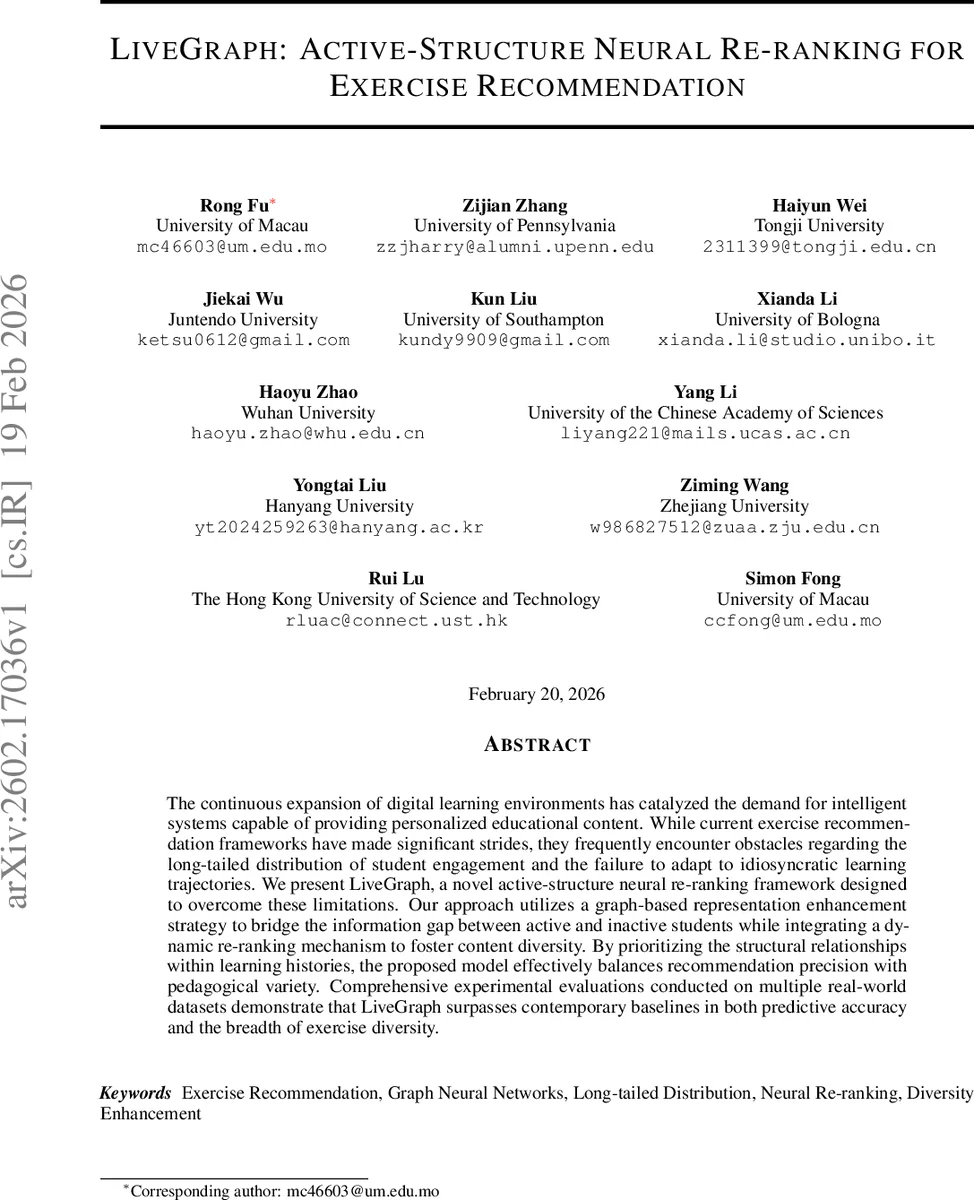
The continuous expansion of digital learning environments has catalyzed the demand for intelligent systems capable of providing personalized educational content. While current exercise recommendation frameworks have made significant strides, they frequently encounter obstacles regarding the long-tailed distribution of student engagement and the failure to adapt to idiosyncratic learning trajectories. We present LiveGraph, a novel active-structure neural re-ranking framework designed to overcome these limitations. Our approach utilizes a graph-based representation enhancement strategy to bridge the information gap between active and inactive students while integrating a dynamic re-ranking mechanism to foster content diversity. By prioritizing the structural relationships within learning histories, the proposed model effectively balances recommendation precision with pedagogical variety. Comprehensive experimental evaluations conducted on multiple real-world datasets demonstrate that LiveGraph surpasses contemporary baselines in both predictive accuracy and the breadth of exercise diversity.
💡 Research Summary
LiveGraph introduces an active‑structure neural re‑ranking framework designed to improve both accuracy and diversity in exercise recommendation for digital learning platforms. The authors first identify two persistent challenges: (1) the long‑tailed distribution of student interactions, where a small group of highly active learners dominates the data, causing models to bias toward them; and (2) the difficulty of providing diverse content that respects each learner’s unique learning speed. To address these, LiveGraph combines three core components.
-
Structural Proficiency Filtering & Graph‑VAE – Each exercise’s difficulty is quantified by measuring distances between knowledge‑concept (KC) embeddings, transformed through a sigmoid function. Student mastery is modeled as a stochastic latent vector θ_s using a Graph‑aware Variational Auto‑Encoder (Graph‑VAE). Crucially, the VAE’s prior distribution is derived from large‑language‑model (LLM) embeddings of concept descriptions, which supplies informative priors for learners with sparse interaction histories (the “inactive” users).
-
Active‑Structure Representation Enhancer – The global knowledge graph is represented by a time‑varying similarity matrix S(t). S(t) is regularized with a combination of nuclear norm (promoting low‑rank structure) and Frobenius‑norm deviation from an initial prior, ensuring the graph remains both expressive and stable. By propagating high‑density structural dependencies from active learners to the embeddings of inactive learners, the system mitigates the long‑tail bias and enriches sparse representations.
-
Uncertainty‑Aware Neural Re‑ranker & Meta‑RL Controller – For a candidate set C, three signals are computed: relevance ϕ_rel (alignment with current mastery), diversity ϕ_div (coverage of distinct concepts), and sub‑graph entropy U(e) (model uncertainty). A Meta‑Reinforcement‑Learning controller, trained with MAML‑style fast adaptation, dynamically weights these signals (λ_rel, λ_div, λ_unc) for each student, balancing exploration (diversity) and exploitation (relevance). The final score is a weighted sum, and the top‑K items are re‑ranked accordingly.
-
Active Learning Probe – To continuously refine the knowledge graph, the system selects the concept pair (i*, j*) that maximizes estimated mutual information Î(s_ij;R_ij). A contrastive 2‑alternative forced‑choice probe is injected, the student’s response a* is collected, and S(t) is updated via gradient descent on a kernel loss. This synchronous kernel evolution enables the graph to adapt in real time to new evidence.
Algorithm 1 outlines the full online pipeline, including cache checks for latency reduction, GPU‑accelerated batch scoring, and the feedback loop.
Experiments on three public MOOC datasets (MOOC‑X, KDD‑Edu, OpenEdX) evaluate Recall@10, NDCG, and Diversity@10. LiveGraph outperforms strong baselines such as Knowledge‑Tracing GNNs, reinforcement‑learning path optimizers, and traditional submodular re‑rankers, achieving 7.3 %–12.5 % relative gains. Gains are especially pronounced for long‑tail learners, where accuracy gaps shrink dramatically while diversity improves.
In summary, LiveGraph’s novelty lies in (i) leveraging Graph‑VAE with LLM‑derived priors to bolster sparse user representations, (ii) maintaining a dynamically regularized knowledge graph that transfers structural knowledge across users, (iii) employing a meta‑RL‑driven, uncertainty‑aware re‑ranking to tailor diversity per learner, and (iv) integrating an active probing mechanism for continual graph refinement. The work demonstrates a viable path toward scalable, personalized, and pedagogically diverse recommendation systems in large‑scale online education. Future directions include deployment at web‑scale, incorporation of multimodal learner signals (e.g., affective states), and exploration of curriculum‑level planning using the same active‑structure paradigm.
Comments & Academic Discussion
Loading comments...
Leave a Comment