Divergence-form equations admitting nowhere $C^1$ Lipschitz weak solutions
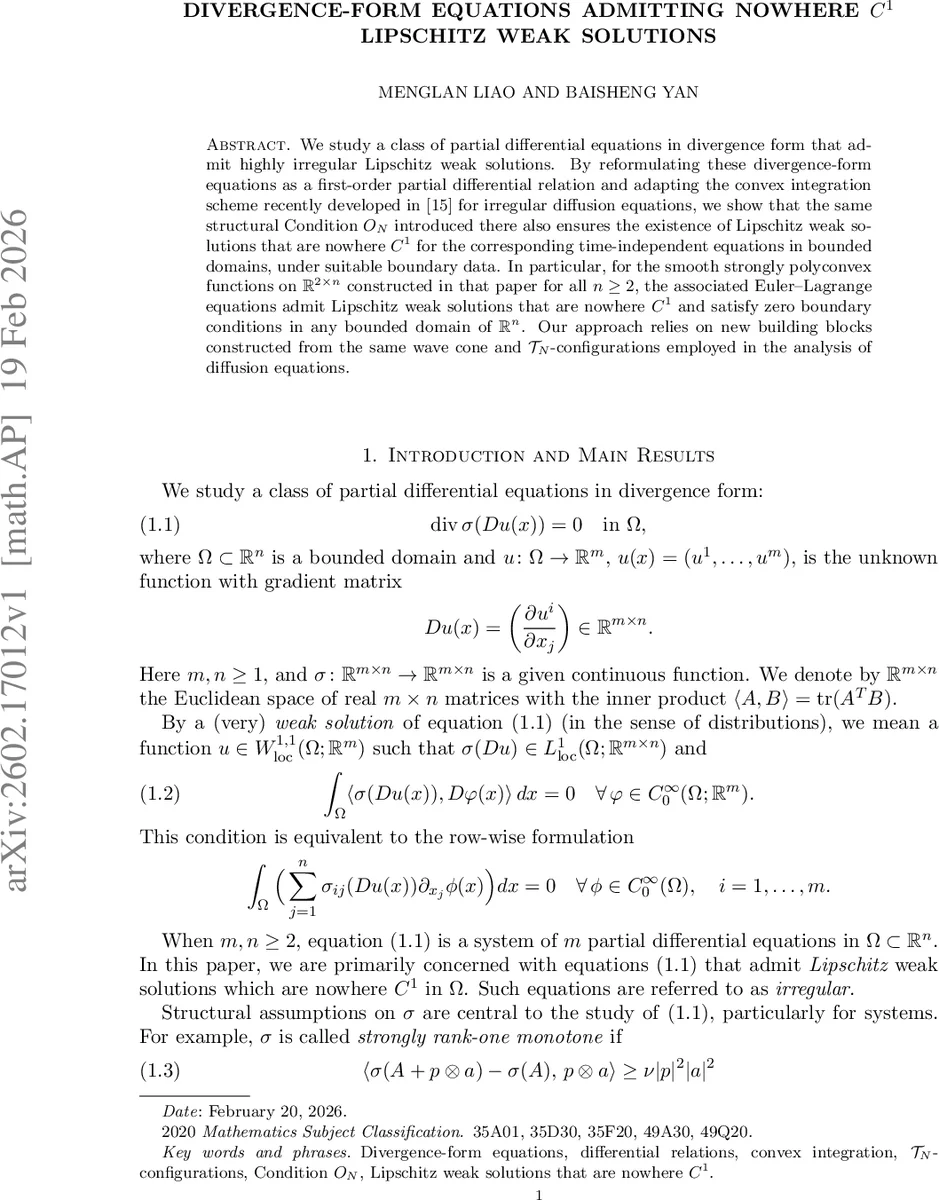
We study a class of partial differential equations in divergence form that admit highly irregular Lipschitz weak solutions. By reformulating these divergence-form equations as a first-order partial differential relation and adapting the convex integration scheme recently developed in \cite{GKY26} for irregular diffusion equations, we show that the same structural Condition~$O_N$ introduced there also ensures the existence of Lipschitz weak solutions that are nowhere $C^1$ for the corresponding time-independent equations in bounded domains, under suitable boundary data. In particular, for the smooth strongly polyconvex functions on $\mathbb{R}^{2\times n}$ constructed in that paper for all $n \ge 2$, the associated Euler–Lagrange equations admit Lipschitz weak solutions that are nowhere $C^1$ and satisfy zero boundary conditions in any bounded domain of $\mathbb{R}^n$. Our approach relies on new building blocks constructed from the same wave cone and $\mathcal{T}_N$-configurations employed in the analysis of diffusion equations.
💡 Research Summary
The paper investigates a class of divergence‑form partial differential equations
div σ(Du)=0 in Ω⊂ℝⁿ,
where σ:ℝ^{m×n}→ℝ^{m×n} is a continuous mapping, and u:Ω→ℝ^m is the unknown. Classical regularity theory tells us that if σ satisfies strong monotonicity, rank‑one monotonicity, or strong quasimonotonicity (conditions (1.3)–(1.5)), any Lipschitz weak solution enjoys partial C^{1,α} regularity. The authors ask whether, by weakening these structural assumptions, one can produce Lipschitz solutions that are nowhere C¹ – that is, solutions that are highly irregular despite being globally Lipschitz.
The central structural hypothesis introduced is Condition Oₙ (N≥2). Roughly speaking, Condition Oₙ requires that the graph K={ (A,σ(A)) } contains a rich family of points arranged in an N‑tuple Tₙ‑configuration. A Tₙ‑configuration consists of points ξ₁,…,ξ_N∈ℝ^{m×n}×ℝ^{m×n} that can be written as a common base ρ plus a sequence of wave‑cone vectors γ_i∈Γ, each scaled by a factor κ_i>1, with the additional algebraic constraint Σγ_i=0. The wave cone Γ is defined by
Γ = { (p⊗a, B) | p∈ℝ^m, a∈ℝⁿ{0}, B∈ℝ^{m×n}, B a=0 }.
This cone captures the rank‑one directions along which oscillations can be inserted without violating the divergence‑free condition.
The authors reformulate the original second‑order equation as a first‑order differential relation:
div V=0, (Du, V)∈K a.e. in Ω,
where V plays the role of σ(Du). This brings the problem into the framework of convex integration for differential inclusions. The key technical tool is Lemma 2.1, which constructs, for any γ∈Γ and any λ∈
Comments & Academic Discussion
Loading comments...
Leave a Comment