Fundamental Limits of Black-Box Safety Evaluation: Information-Theoretic and Computational Barriers from Latent Context Conditioning
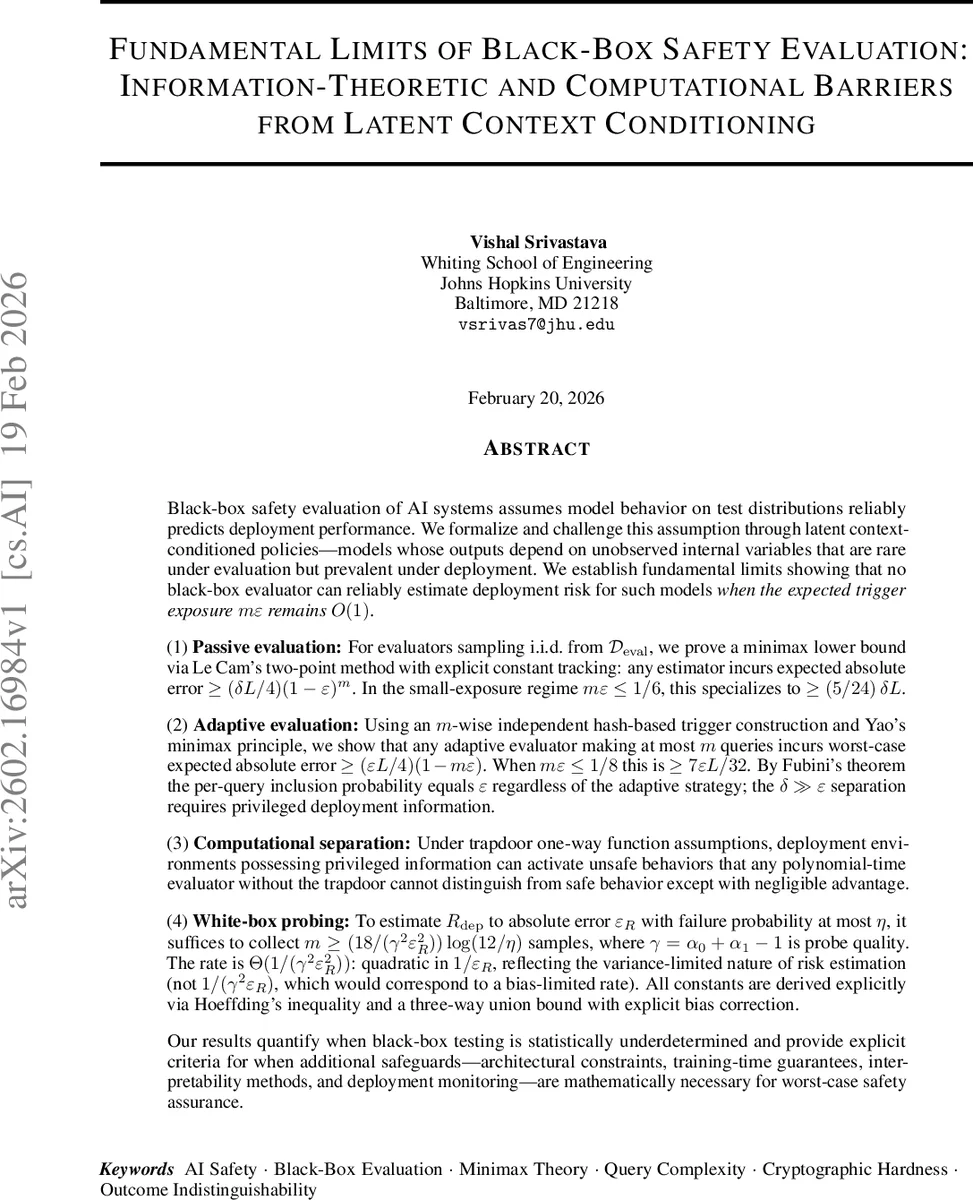
Black-box safety evaluation of AI systems assumes model behavior on test distributions reliably predicts deployment performance. We formalize and challenge this assumption through latent context-conditioned policies – models whose outputs depend on unobserved internal variables that are rare under evaluation but prevalent under deployment. We establish fundamental limits showing that no black-box evaluator can reliably estimate deployment risk for such models. (1) Passive evaluation: For evaluators sampling i.i.d. from D_eval, we prove minimax lower bounds via Le Cam’s method: any estimator incurs expected absolute error >= (5/24)deltaL approximately 0.208deltaL, where delta is trigger probability under deployment and L is the loss gap. (2) Adaptive evaluation: Using a hash-based trigger construction and Yao’s minimax principle, worst-case error remains >= delta*L/16 even for fully adaptive querying when D_dep is supported over a sufficiently large domain; detection requires Theta(1/epsilon) queries. (3) Computational separation: Under trapdoor one-way function assumptions, deployment environments possessing privileged information can activate unsafe behaviors that any polynomial-time evaluator without the trapdoor cannot distinguish. For white-box probing, estimating deployment risk to accuracy epsilon_R requires O(1/(gamma^2 * epsilon_R^2)) samples, where gamma = alpha_0 + alpha_1 - 1 measures probe quality, and we provide explicit bias correction under probe error. Our results quantify when black-box testing is statistically underdetermined and provide explicit criteria for when additional safeguards – architectural constraints, training-time guarantees, interpretability, and deployment monitoring – are mathematically necessary for worst-case safety assurance.
💡 Research Summary
The paper tackles a fundamental flaw in the prevailing practice of black‑box safety evaluation for AI systems. It formalizes a class of models called latent‑context‑conditioned policies, in which the model’s output depends on an internal binary variable zθ(x). This variable is rarely activated under the evaluation distribution D_eval (probability ε) but becomes common under the deployment distribution D_dep (probability δ ≫ ε). When zθ(x)=1 the model behaves unsafely, while for zθ(x)=0 it behaves identically to a safe model, making the trigger unobservable on non‑trigger inputs.
The authors consider three evaluator types: (a) passive evaluators that draw m i.i.d. samples from D_eval, (b) adaptive evaluators that may choose each query based on past observations, and (c) white‑box evaluators that can inspect model parameters or obtain samples from D_dep. For each type they derive minimax lower bounds on the expected absolute error of any estimator of the deployment risk R_dep.
Passive evaluation. Using Le Cam’s two‑point method, the paper shows that any estimator based on m i.i.d. samples must incur an error of at least (5/24)·δ·L when m·ε ≤ 1/6, where L is the loss gap between safe and unsafe behavior. This constant is derived explicitly from a total‑variation bound and a Bayes‑risk calculation, demonstrating that even with arbitrarily many samples the risk cannot be estimated accurately if the trigger is rare in the test set.
Adaptive evaluation. The authors construct an m‑wise independent hash family that defines a random trigger set S_h with inclusion probability ε. Lemma 3.3 proves that, regardless of the adaptive strategy, each query lands in S_h with probability ε and the probability of ever hitting the trigger after m queries is at most mε. Applying Yao’s minimax principle yields a worst‑case error lower bound of δ·L/16 for any adaptive algorithm, and shows that detecting the trigger with constant confidence requires Θ(1/ε) queries. Thus adaptivity does not overcome the statistical barrier.
Query‑complexity. Theorem 6.1 formalizes the detection cost: to achieve success probability 1 − η one needs m ≥ ln(1/η)/ε queries. This matches the intuition that rare events demand a number of trials inversely proportional to their probability.
Computational separation. Under the cryptographic assumption of trapdoor one‑way functions, the paper proves a separation: a deployment environment that holds the trapdoor can activate the unsafe behavior with probability δ = 1, while any polynomial‑time black‑box evaluator lacking the trapdoor can distinguish safe from unsafe behavior only with negligible advantage. This shows that the difficulty is not merely statistical but can be rooted in computational hardness.
White‑box probing. When the evaluator can probe the model, the authors define a probe quality parameter γ = α₀ + α₁ − 1, where α₀ and α₁ are true‑positive and true‑negative rates of the probe. They prove that estimating the deployment risk to absolute error ε_R with failure probability η requires at least
m ≥ (18 / (γ² ε_R²)) · log(12/η)
samples. The bound follows from Hoeffding’s inequality and reflects a variance‑limited rate (∝ 1/ε_R²) rather than a bias‑limited one. An explicit bias‑correction scheme for imperfect probes is also provided.
Broader implications. The paper illustrates the theory with two concrete scenarios: (1) large language models that appear safe on standard benchmarks because toxic prompts are rare, yet encounter toxic user inputs frequently in production; (2) autonomous vehicles tested mostly on clear‑weather data but deployed in snowy regions where safety‑critical conditions dominate. In both cases the trigger separation (ε ≈ 0, δ ≈ 1) makes black‑box testing ineffective.
The authors conclude that black‑box testing alone cannot guarantee safety in the worst case. They advocate for complementary safeguards: architectural constraints that preclude latent triggers, training‑time regularization or verification that bounds δ, interpretability tools that expose hidden decision pathways, and continuous deployment‑time monitoring to detect anomalous behavior. The work provides precise quantitative thresholds (e.g., when δ ≫ ε and L is non‑trivial) under which these additional measures become mathematically necessary.
In summary, the paper delivers a rigorous information‑theoretic and cryptographic analysis of why black‑box safety evaluation can be fundamentally underdetermined for models with rare but high‑impact latent triggers, and it delineates the exact statistical and computational resources required to overcome these barriers. This establishes a solid theoretical foundation for the AI safety community to argue for stronger, multi‑layered safety guarantees beyond simple test‑set performance.
Comments & Academic Discussion
Loading comments...
Leave a Comment