On the Lagarias Inequality and Superabundant Numbers
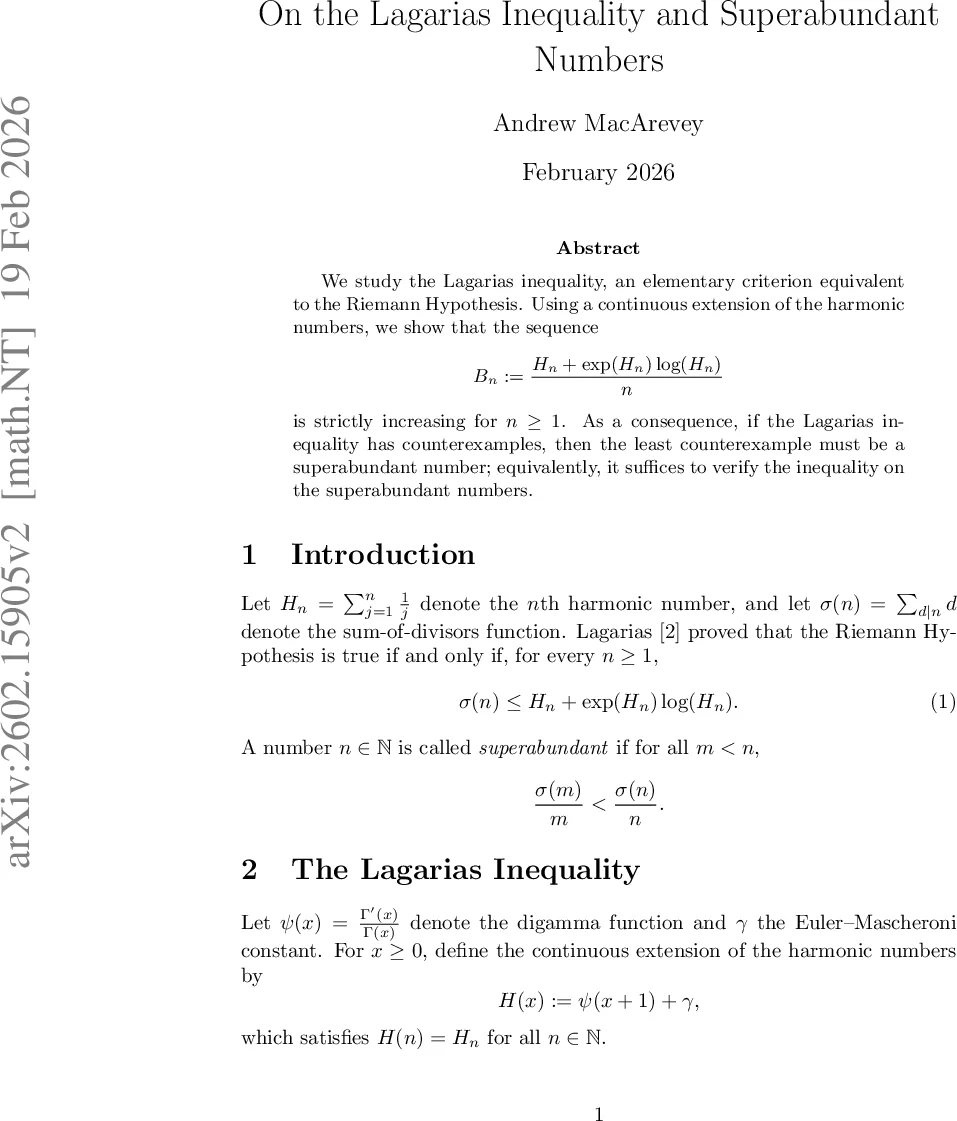
We study the Lagarias inequality, an elementary criterion equivalent to the Riemann Hypothesis. Using a continuous extension of the harmonic numbers, we show that the sequence $B_n=\frac{H_n+e^{H_n}\log(H_n)}{n}$ is strictly increasing for $n\ge 1$. As a consequence, if the Lagarias inequality has counterexamples, then the least counterexample must be a superabundant number; equivalently, it suffices to verify the inequality on the superabundant numbers.
💡 Research Summary
The paper revisits the Lagarias inequality σ(n) ≤ Hₙ + e^{Hₙ}·log Hₙ, an elementary reformulation that is equivalent to the Riemann Hypothesis. The author introduces a continuous extension of the harmonic numbers, H(x)=ψ(x+1)+γ, where ψ is the digamma function and γ the Euler–Mascheroni constant. This extension satisfies H(n)=Hₙ for integer n and is differentiable on
Comments & Academic Discussion
Loading comments...
Leave a Comment