Observing quantum many-body dynamics in emergent curved spacetime using programmable quantum processors
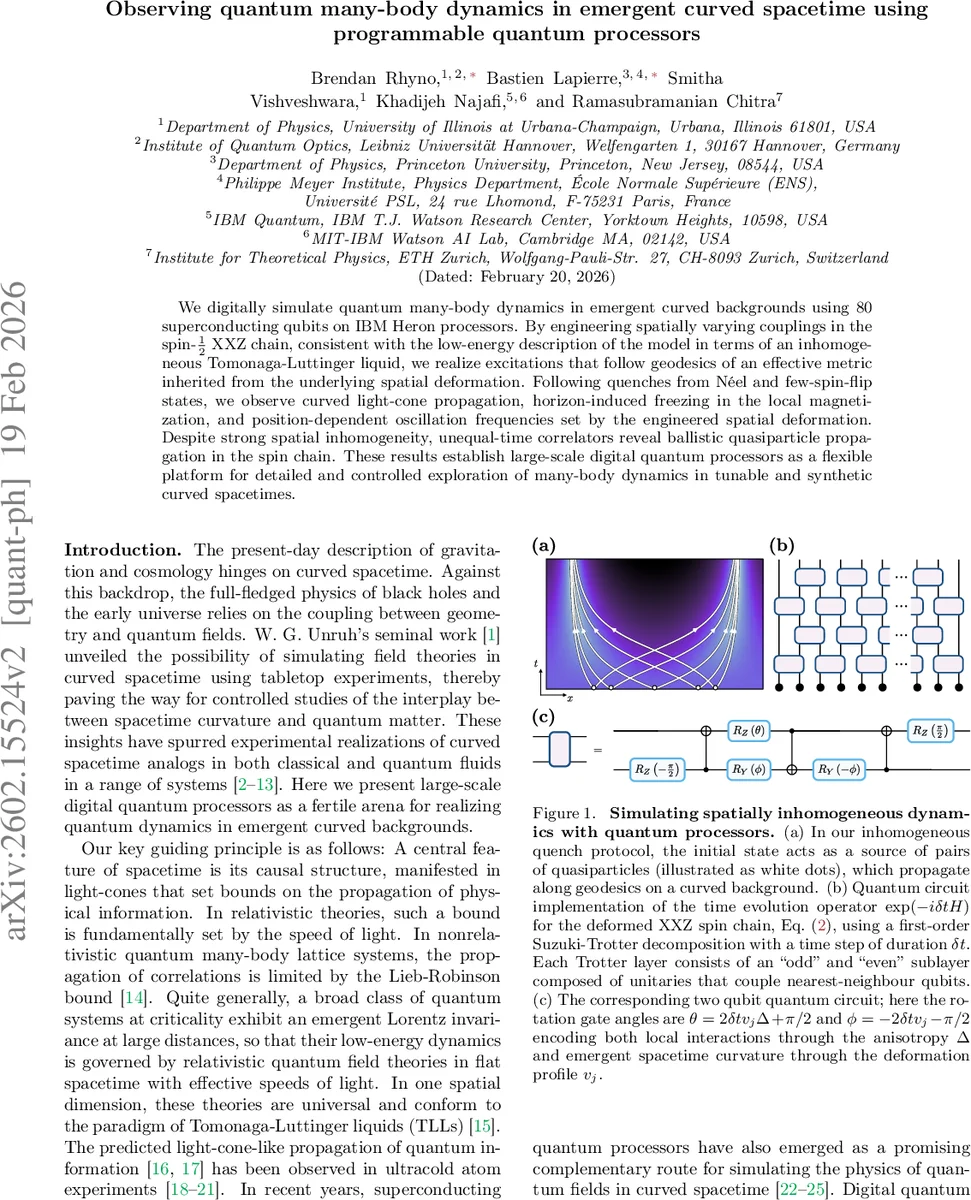
We digitally simulate quantum many-body dynamics in emergent curved backgrounds using 80 superconducting qubits on IBM Heron processors. By engineering spatially varying couplings in the spin-$\frac12$ XXZ chain, consistent with the low-energy description of the model in terms of an inhomogeneous Tomonaga-Luttinger liquid, we realize excitations that follow geodesics of an effective metric inherited from the underlying spatial deformation. Following quenches from Néel and few-spin-flip states, we observe curved light-cone propagation, horizon-induced freezing in the local magnetization, and position-dependent oscillation frequencies set by the engineered spatial deformation. Despite strong spatial inhomogeneity, unequal-time correlators reveal ballistic quasiparticle propagation in the spin chain. These results establish large-scale digital quantum processors as a flexible platform for detailed and controlled exploration of many-body dynamics in tunable and synthetic curved spacetimes.
💡 Research Summary
In this work the authors demonstrate that large‑scale digital quantum processors can be used to simulate quantum many‑body dynamics in an emergent curved spacetime. They program a spatially varying coupling profile (v_j) into a spin‑½ XXZ chain of 80 superconducting transmon qubits on IBM’s Heron hardware. The Hamiltonian \
Comments & Academic Discussion
Loading comments...
Leave a Comment