On silting complexes associated to n-silting modules
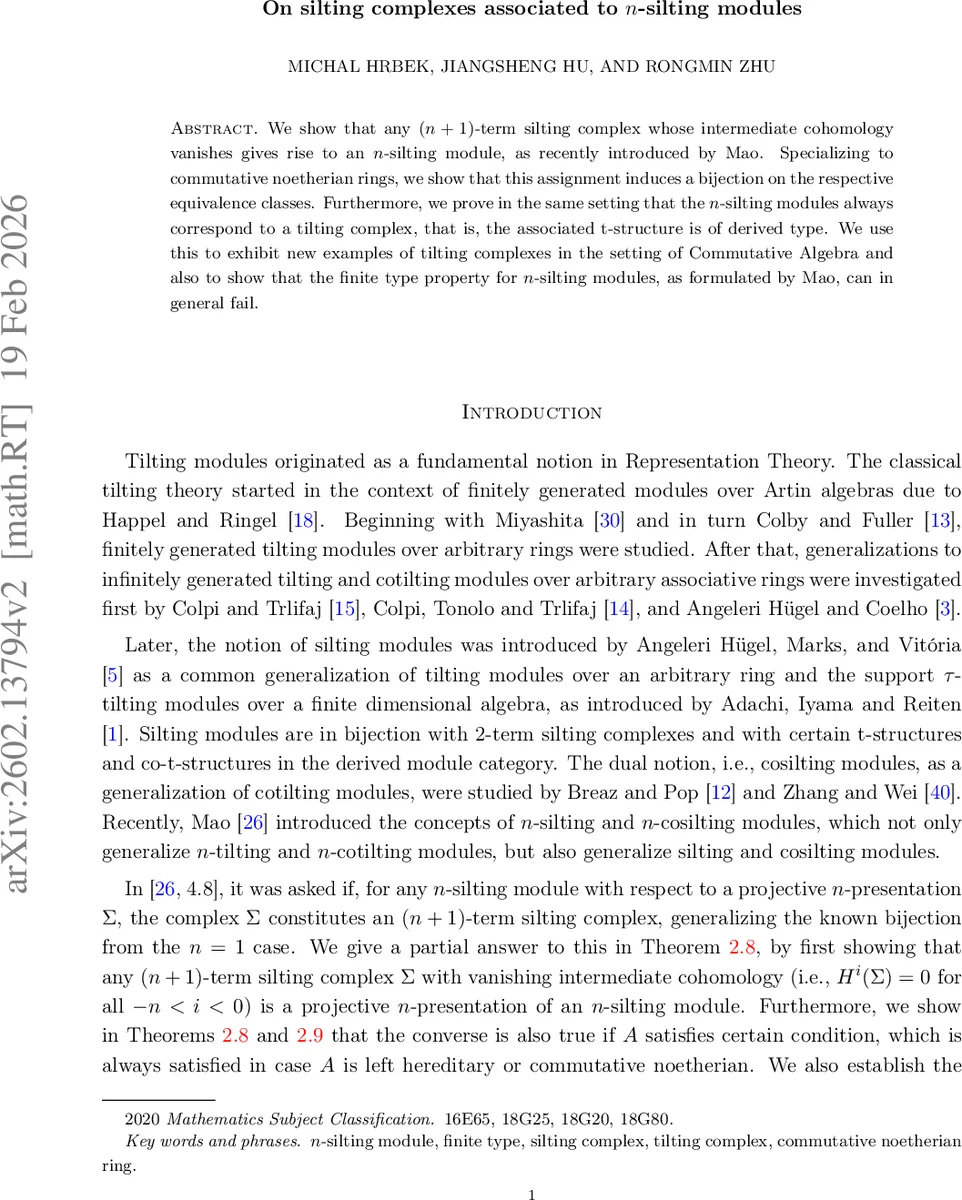
We show that any (n+1)-term silting complex whose intermediate cohomology vanishes gives rise to an n-silting module, as recently introduced by Mao. Specializing to commutative noetherian rings, we show that this assignment induces a bijection on the respective equivalence classes. Furthermore, we prove in the same setting that the n-silting modules always correspond to a tilting complex, that is, the associated t-structure is of derived type. We use this to exhibit new examples of tilting complexes in the setting of Commutative Algebra and also to show that the finite type property for n-silting modules, as formulated by Mao, can in general fail.
💡 Research Summary
The paper investigates the relationship between (n + 1)-term silting complexes and the recently introduced notion of n‑silting modules. The authors first establish that any (n + 1)-term silting complex Σ whose intermediate cohomology vanishes (i.e. Hⁱ(Σ)=0 for –n < i < 0) yields a projective n‑presentation of a module T = H₀(Σ), and that T satisfies the defining condition of an n‑silting module (Presⁿ⁻¹(T) = D_Σ). This is proved in Theorem 2.8 by analysing the cotorsion pair generated by Σ and showing that the class of modules generated by Σ coincides with the n‑silting class of T.
Conversely, the authors show that an n‑silting module T gives rise to a (n + 1)-term silting complex Σ provided the base ring A satisfies certain homological conditions. These conditions are automatically fulfilled when A is left hereditary or, more importantly for the paper, when A is a commutative noetherian ring. In this case Theorem 2.9 furnishes a bijection between equivalence classes of (n + 1)-term silting complexes with vanishing intermediate cohomology and equivalence classes of n‑silting modules.
Specialising to commutative noetherian rings, the authors prove a stronger statement: the silting complex associated to any n‑silting module is always a tilting complex, i.e. the associated t‑structure is of derived type. Consequently the derived category D(A) is triangle‑equivalent to the heart of this t‑structure (Theorem 3.2). This generalises earlier results known only for the case n = 1 (Pavón and Vitória) to arbitrary n, and provides a systematic method for constructing new tilting complexes in commutative algebra.
The paper also supplies concrete examples. Using classical constructions of Sharp, the authors exhibit (n + 1)-term silting complexes over certain local rings whose intermediate cohomology vanishes but which are not cotilting; nevertheless, the associated t‑structure is of derived type, confirming the previous theorem. These examples illustrate how the theory yields new tilting complexes that are not obtainable from traditional tilting modules.
Finally, the authors address the “finite type” property proposed by Mao for n‑silting modules (the existence of a set of finitely generated projective presentations whose associated D‑classes generate the whole n‑silting class). In Section 3.4 they construct a counterexample over a commutative noetherian ring, showing that an n‑silting module need not be of finite type. This demonstrates that the finite type condition, which holds for n‑tilting and for 1‑silting modules, fails in general for higher n.
Overall, the work bridges silting complexes and n‑silting modules, establishes a bijective correspondence in the commutative noetherian setting, proves that every n‑silting module gives a tilting complex, and clarifies the limitations of the finite type hypothesis. These contributions deepen the understanding of silting/tilting theory and open new avenues for constructing tilting objects in algebraic contexts.
Comments & Academic Discussion
Loading comments...
Leave a Comment