Mystery of the 175 cm$^{-1}$ Raman Mode in MnTe Altermagnet
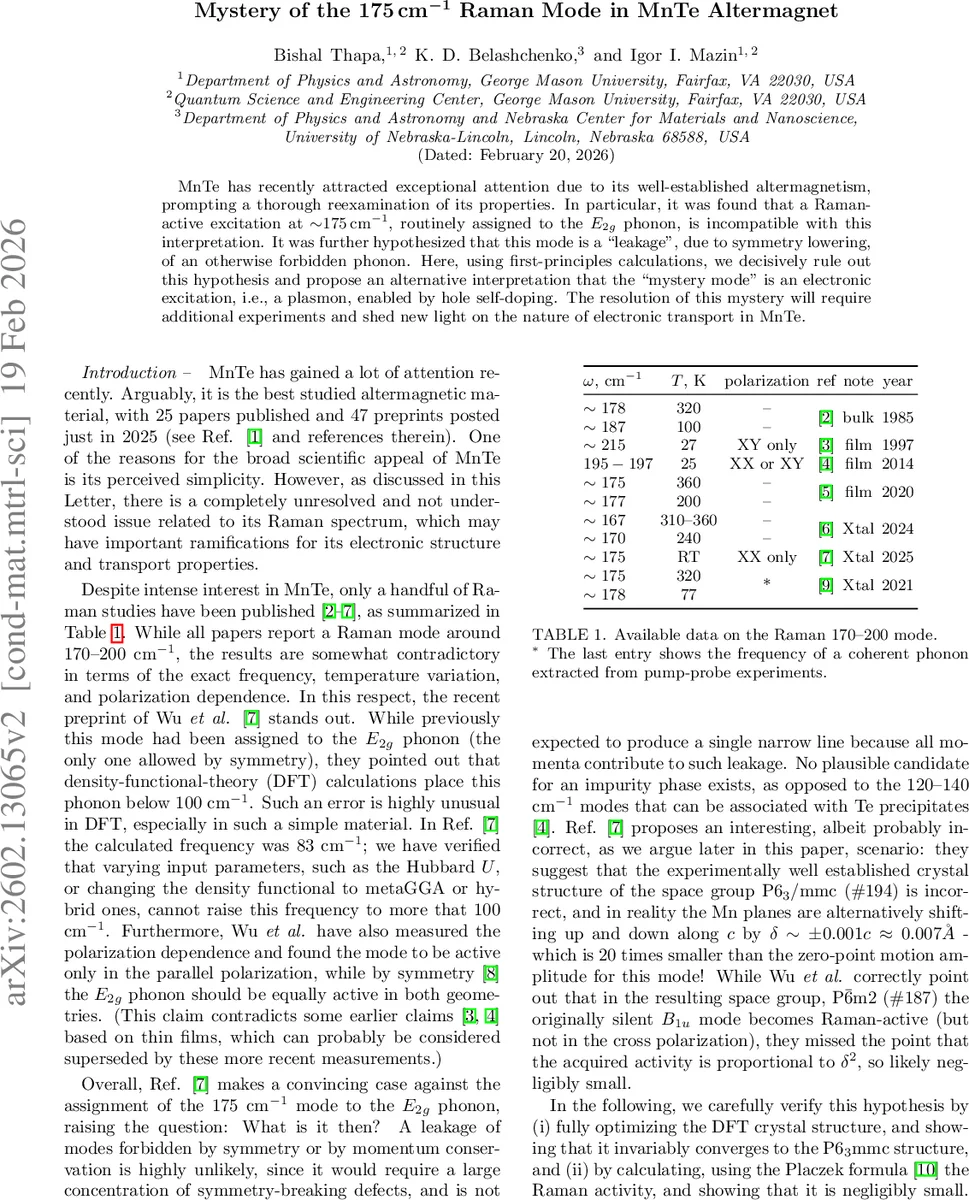
MnTe has recently attracted exceptional attention due to its well-established altermagnetism, prompting a thorough reexamination of its properties. In particular, it was found that a Raman-active excitation at ~175 cm$^{-1}$, routinely assigned to the E2g phonon, is incompatible with this interpretation. It was further hypothesized that this mode is a “leakage”, due to symmetry lowering, of an otherwise forbidden phonon. Here, using first-principles calculations, we decisively rule out this hypothesis and propose an alternative interpretation that the “mystery mode” is an electronic excitation, i.e., a plasmon, enabled by hole self-doping. The resolution of this mystery will require additional experiments and shed new light on the nature of electronic transport in MnTe.
💡 Research Summary
MnTe has emerged as a prototypical altermagnet, yet a long‑standing puzzle persists in its Raman spectrum: a strong, well‑defined peak around 175 cm⁻¹ that has traditionally been assigned to the E₂g phonon. Recent density‑functional theory (DFT) work by Wu et al. showed that the calculated E₂g frequency lies below 100 cm⁻¹, far from the experimental value, and that the observed peak appears only in parallel (XX) polarization, contrary to the symmetry‑allowed E₂g selection rules which predict equal intensity in both parallel and crossed geometries. Wu et al. therefore proposed a “leakage” scenario: a minute symmetry‑lowering distortion (δ≈±0.001 c) that converts the silent B₁u mode into a Raman‑active one in the lower‑symmetry space group P¯6m2 (#187).
In the present study the authors rigorously test this hypothesis. They perform exhaustive DFT+U, meta‑GGA, and hybrid‑functional calculations, varying the Hubbard U, k‑point density, and plane‑wave cutoff. In every case the structure relaxes back to the high‑symmetry P6₃/mmc (#194) configuration, indicating that the proposed distortion is not energetically stable. Using the Placzek formalism they compute the Raman tensors for both the E₂g (now called E′) and the symmetry‑broken B₁u‑derived A′₁ mode. Because the Raman intensity scales as δ², the calculated A′₁ intensity is roughly two orders of magnitude weaker than that of the E′ mode and comparable to the negligible out‑of‑plane component, far below the experimentally observed strength. Hence the “leakage” explanation is quantitatively ruled out.
Turning to an electronic origin, the authors note that MnTe is a p‑type semiconductor with self‑doped hole concentrations reported between 6 × 10¹⁸ and 1.1 × 10¹⁹ cm⁻³. They construct a four‑band k·p model around the A point, incorporating the dominant Te pₓ/p_y characters and spin‑orbit coupling. Effective masses are mₗₕ≈0.13 m₀ (light holes) and mₕₕ≈0.53 m₀ (heavy holes), with an out‑of‑plane mass m*⊥≈1.14 m₀. Using the standard definition of the plasma‑frequency tensor, \
Comments & Academic Discussion
Loading comments...
Leave a Comment