Around the 'Fundamental Theorem of Algebra' (extended version)
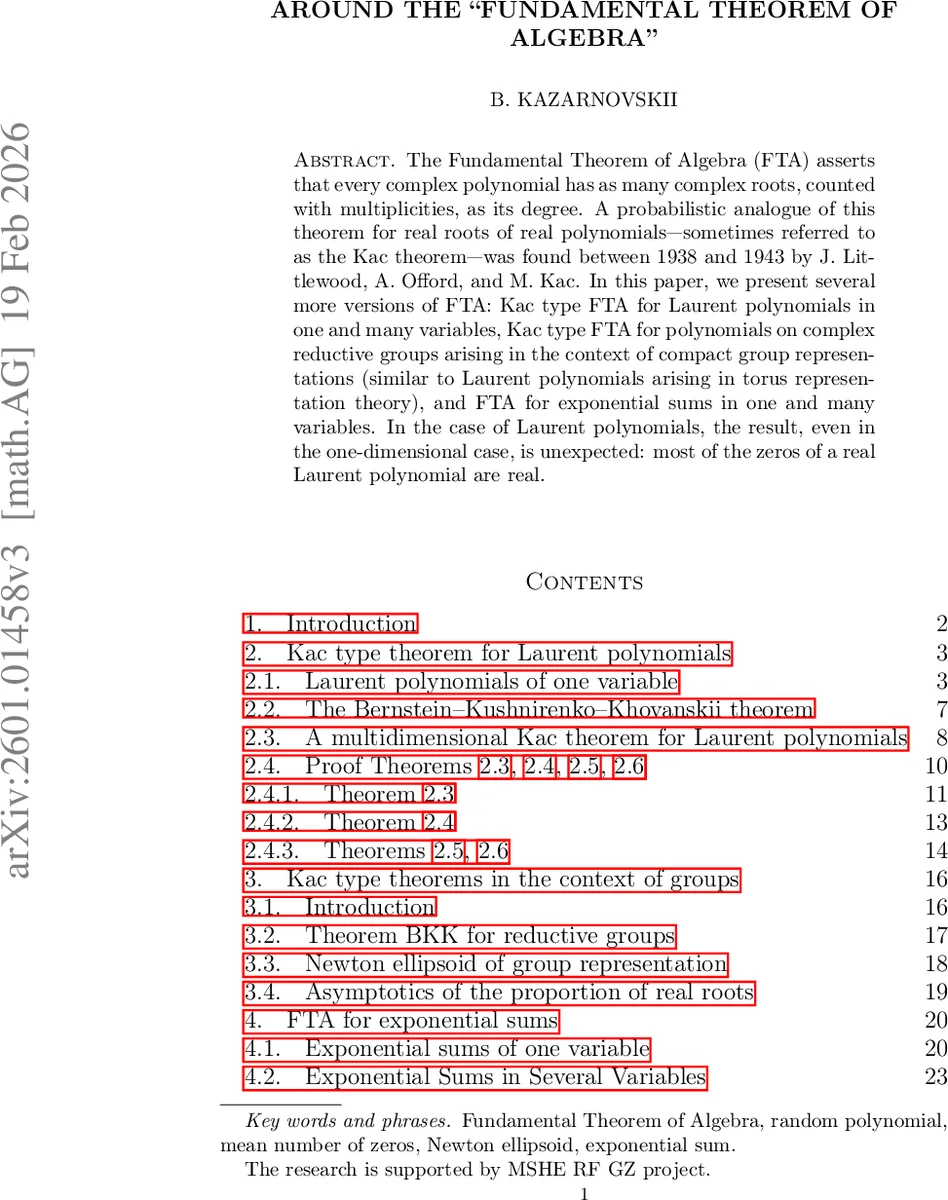
The Fundamental Theorem of Algebra (FTA) asserts that every complex polynomial has as many complex roots, counted with multiplicities, as its degree. A probabilistic analogue of this theorem for real roots of real polynomials, sometimes referred to as the Kac theorem, was found between 1938 and 1943 by J. Littlewood, A. Offord, and M. Kac. In this paper, we present several more versions of FTA: Kac type FTA for Laurent polynomials in one and many variables, Kac type FTA for polynomials on complex reductive groups arising in the context of compact group representations (similar to Laurent polynomials arising in torus representation theory), and FTA for exponential sums in one and many variables. In the case of Laurent polynomials, the result, even in the one-dimensional case, is unexpected: most of the zeros of a real Laurent polynomial are real. This text is a supplemented and more detailed version of \cite{arx}.
💡 Research Summary
The paper expands the classical Fundamental Theorem of Algebra (FTA) from a deterministic statement about complex roots to a suite of probabilistic analogues that apply to real roots of random objects. Starting from the well‑known Kac theorem—originally proved by Littlewood, Offord and Kac for random real polynomials—the author develops Kac‑type results for four broader classes: (i) Laurent polynomials in one variable, (ii) multivariate Laurent polynomials, (iii) polynomials on complex reductive groups (which behave like Laurent polynomials attached to torus representations), and (iv) exponential sums in several complex variables.
One‑variable Laurent polynomials.
A Laurent polynomial (P(z)=\sum_{\lambda\in\Lambda}a_\lambda z^\lambda) with a finite integer spectrum (\Lambda\subset\mathbb Z) is called real if its restriction to the unit circle (S^1) is real‑valued; this forces the coefficient symmetry (a_\lambda=a_{-\lambda}). Random real Laurent polynomials are obtained by endowing the finite‑dimensional space of trigonometric polynomials (\operatorname{Trig}(\Lambda)\subset L^2(S^1)) with the standard Gaussian measure. The main result (Theorem 2.1) shows that the expected number of real zeros equals
\
Comments & Academic Discussion
Loading comments...
Leave a Comment