Studying AC-LGAD strip sensors from laser and testbeam measurements
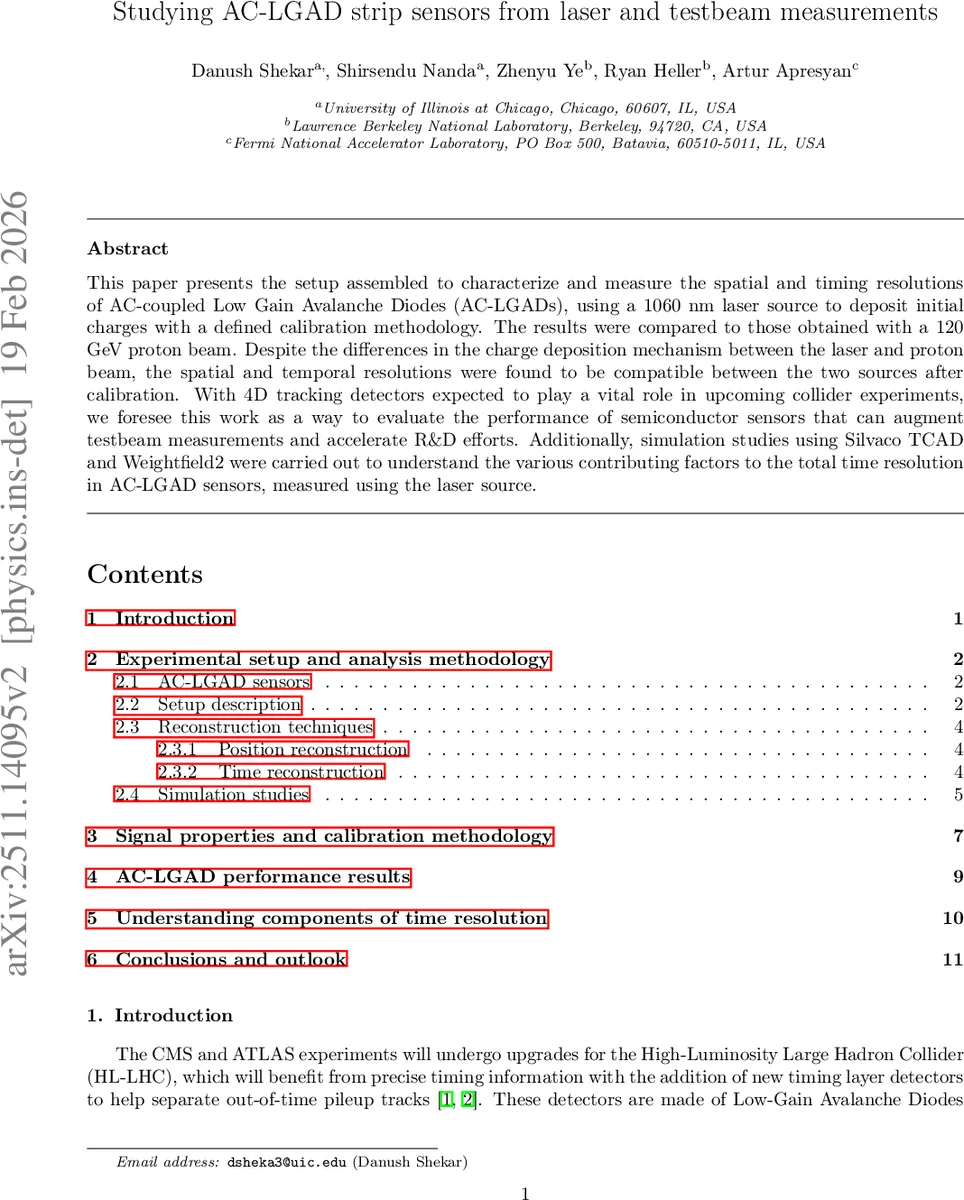
This paper presents the setup assembled to characterize and measure the spatial and timing resolutions of AC-coupled Low Gain Avalanche Diodes (AC-LGADs), using a 1060 nm laser source to deposit initial charges with a defined calibration methodology. The results were compared to those obtained with a 120 GeV proton beam. Despite the differences in the charge deposition mechanism between the laser and proton beam, the spatial and temporal resolutions were found to be compatible between the two sources after calibration. With 4D tracking detectors expected to play a vital role in upcoming collider experiments, we foresee this work as a way to evaluate the performance of semiconductor sensors that can augment testbeam measurements and accelerate R$&$D efforts. Additionally, simulation studies using Silvaco TCAD and Weightfield2 were carried out to understand the various contributing factors to the total time resolution in AC-LGAD sensors, measured using the laser source.
💡 Research Summary
This paper presents a comprehensive study of AC‑coupled Low‑Gain Avalanche Diode (AC‑LGAD) strip sensors, focusing on their spatial and temporal performance as measured with two distinct experimental approaches: a laboratory‑based infrared laser system and a high‑energy test‑beam facility. The authors assembled a dedicated setup that uses a 1060 nm pulsed laser (NKT Photonics PILAS D‑X) with sub‑3 ps timing jitter and a motorized XYZ stage capable of 0.1 µm positioning accuracy. By scanning the laser across the sensor surface in 50 µm (X) and 100 µm (Y) steps, they recorded waveforms from three out of ten strips per sensor using high‑bandwidth oscilloscopes (Keysight MSO7104B and Teledyne LeCroy WaveRunner 8208HD). The laser spot was focused to ~20 µm, providing a well‑controlled charge deposition that mimics a minimum‑ionizing particle (MIP) but with a different depth profile.
The AC‑LGAD devices under test are strip‑type sensors fabricated by Hamamatsu Photonics (HPK) and Brookhaven National Laboratory. Each strip is 1 cm long, 50 µm wide, with a 500 µm pitch; ten strips are wire‑bonded, though only three are read out. The sensors differ in sheet resistance, coupling capacitance, and active thickness, allowing the authors to explore how these parameters affect performance.
Spatial reconstruction exploits the intrinsic charge‑sharing of AC‑LGADs. For each event the two strips with the highest amplitudes (a₁, a₂) are identified, and the amplitude fraction f = a₁/(a₁ + a₂) is calculated. A pre‑computed template h(f), derived from a reference tracker in test‑beam data, maps f to an impact parameter relative to the leading strip. This “two‑strip” method yields position resolutions on the order of 10 µm, consistent with the analytical expectation σₓ = P·N·|dh/df|/(a₁ + a₂) (Eq. 2), where P is the strip pitch and N the noise amplitude. The authors note that the laser photons do not penetrate the metalized strips, limiting reconstruction near strip edges, a nuance that is explicitly accounted for in their analysis.
Temporal reconstruction uses a constant‑fraction discrimination (CFD) algorithm with a 50 % threshold applied to the laser trigger output to obtain a reference time t₀. The time‑of‑arrival (ToA) for the leading and sub‑leading strips is extracted in the same way, and a weighted average t = (a₁·t₁ + a₂·t₂)/(a₁ + a₂) (Eq. 3) provides a multi‑channel timestamp. Position‑dependent propagation delays in the resistive n⁺ layer are corrected offline using a map generated from the known stage positions. The final time resolution is defined as Δt = t − t₀.
To benchmark the laser results, the same sensor types were previously measured in a 120 GeV proton test‑beam (reference
Comments & Academic Discussion
Loading comments...
Leave a Comment