Krylov Complexity Meets Confinement
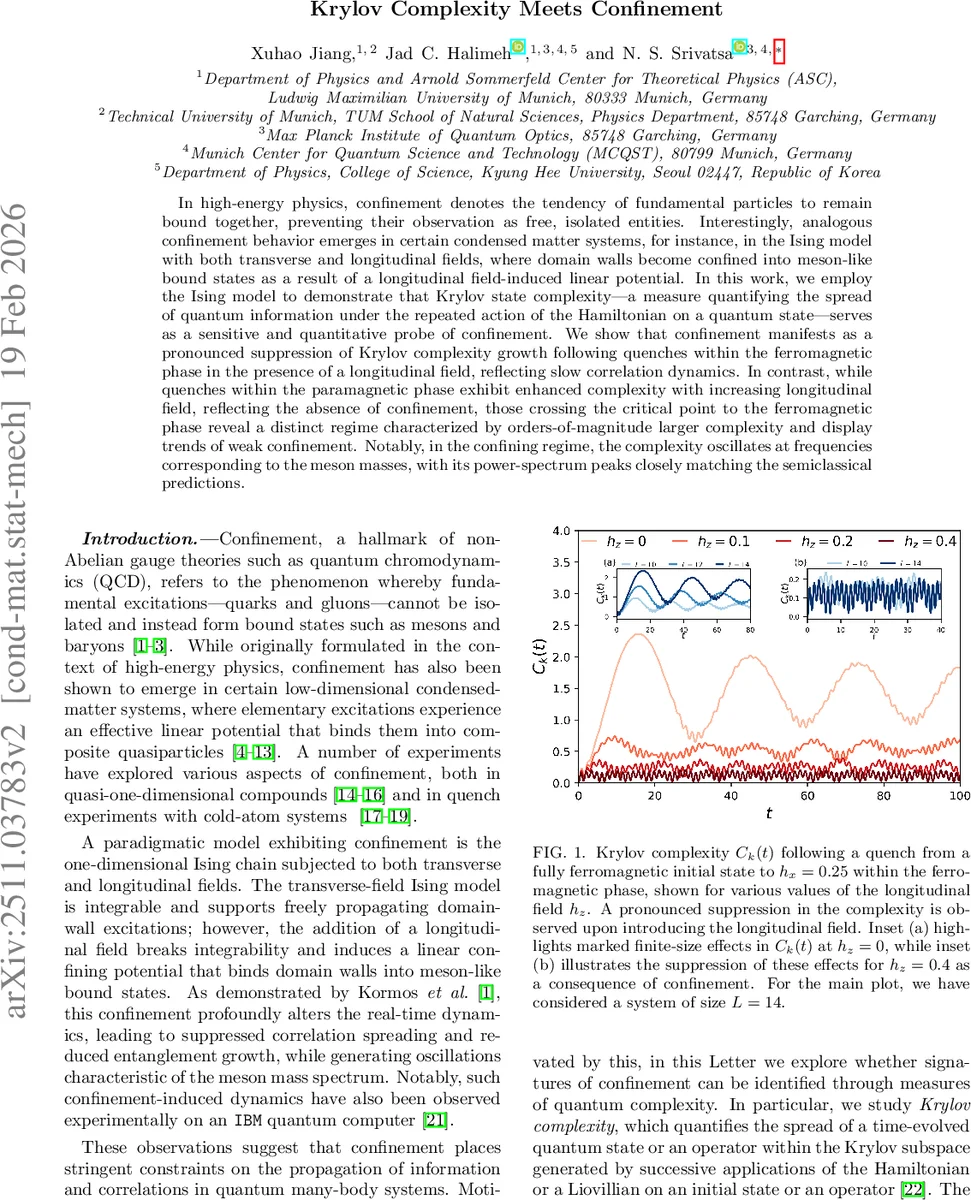
In high-energy physics, confinement denotes the tendency of fundamental particles to remain bound together, preventing their observation as free, isolated entities. Interestingly, analogous confinement behavior emerges in certain condensed matter systems, for instance, in the Ising model with both transverse and longitudinal fields, where domain walls become confined into meson-like bound states as a result of a longitudinal field-induced linear potential. In this work, we employ the Ising model to demonstrate that Krylov state complexity–a measure quantifying the spread of quantum information under the repeated action of the Hamiltonian on a quantum state–serves as a sensitive and quantitative probe of confinement. We show that confinement manifests as a pronounced suppression of Krylov complexity growth following quenches within the ferromagnetic phase in the presence of a longitudinal field, reflecting slow correlation dynamics. In contrast, while quenches within the paramagnetic phase exhibit enhanced complexity with increasing longitudinal field, reflecting the absence of confinement, those crossing the critical point to the ferromagnetic phase reveal a distinct regime characterized by orders-of-magnitude larger complexity and display trends of weak confinement. Notably, in the confining regime, the complexity oscillates at frequencies corresponding to the meson masses, with its power-spectrum peaks closely matching the semiclassical predictions.
💡 Research Summary
This paper investigates how Krylov state complexity can serve as a sensitive probe of confinement in the one‑dimensional transverse‑field Ising chain with an additional longitudinal field. In the absence of the longitudinal field (h_z = 0) the model is integrable, maps to free fermions, and exhibits a quantum critical point at transverse field h_x = 1 separating a ferromagnetic (h_x < 1) and a paramagnetic (h_x > 1) phase. Adding a longitudinal field breaks the Z₂ symmetry, generates a linear confining potential between domain‑wall excitations, and binds them into meson‑like quasiparticles.
The authors construct the Krylov subspace generated by successive applications of the Hamiltonian on an initial state |Ψ₀⟩, orthogonalize it via the Lanczos algorithm, and obtain the tridiagonal coefficients α_n (diagonal) and β_n (off‑diagonal). The time‑dependent amplitudes ψ_n(t) obey a tight‑binding equation on a semi‑infinite chain, and the Krylov complexity is defined as C_k(t)=∑_n n|ψ_n(t)|², i.e. the average “position” of the wavefunction in Krylov space.
Three quench protocols are studied:
-
Ferromagnetic‑phase quenches (h_x < 1) from a fully polarized ferromagnetic state to h_x = 0.25. With h_z = 0 the complexity displays large‑amplitude oscillations that grow with system size, reflecting ballistic spreading of free domain walls. Introducing even a weak longitudinal field dramatically suppresses the growth, reduces the oscillation amplitude, and increases the frequency. The suppression becomes stronger with larger h_z, indicating that the mesons acquire a heavy effective mass and the quench energy is insufficient to set them in motion. Moreover, the dynamics becomes essentially size‑independent, confirming the absence of correlation spreading.
-
Paramagnetic‑phase quenches (h_x > 1) from a paramagnetic state at h_x = 2 to h_x = 1. Without a longitudinal field the complexity remains small with only minor fluctuations, characteristic of free‑fermion dynamics. As h_z is increased, the complexity rapidly grows and exhibits irregular fluctuations, signalling enhanced quantum chaotic behavior due to interactions. Since the paramagnetic phase does not support bound mesons, the increase of complexity with h_z reflects the lack of confinement.
-
Critical‑crossing quenches from the paramagnetic side (h_x = 2) to deep in the ferromagnetic phase (h_x = 0.25). Here the complexity reaches values orders of magnitude larger than in the intra‑phase quenches, because the quench excites a broad continuum of modes and delocalizes the state strongly in Krylov space. Initially C_k(t) grows with h_z, but for sufficiently large h_z it turns over and begins to decrease, suggesting the emergence of weak confinement: heavy mesons limit further spreading despite the large initial energy injection.
To characterize long‑time behavior, the authors compute the time‑averaged complexity ⟨C_k⟩_T = (1/T)∫₀ᵀ C_k(t) dt. In the ferromagnetic intra‑phase quenches, ⟨C_k⟩ scales approximately as h_z⁻¹, i.e. an inverse power law, confirming that stronger confinement suppresses state delocalization. In the paramagnetic intra‑phase quenches, ⟨C_k⟩ grows exponentially with h_z, reflecting the chaotic, de‑confining dynamics. For the critical‑crossing quenches no simple scaling emerges; instead a non‑monotonic behavior with an eventual plateau is observed, consistent with weak confinement limiting the spread.
A particularly striking result is the analysis of the power spectrum S_k(ω)=|∫dt e^{iωt} C_k(t)|². In the ferromagnetic quenches with confinement, sharp peaks appear at frequencies that match the meson masses obtained from a semiclassical Bohr‑Sommerfeld quantization of two fermions in a linear potential. For example, at h_x = 0.25 and h_z = 0.2 the semiclassical analysis predicts meson masses m₁≈4.025 J and m₂≈4.702 J; the peaks in S_k(ω) occur precisely at these values. This demonstrates that Krylov complexity does not merely quantify the spread of the state but also encodes detailed spectral information about bound‑state excitations.
Overall, the study establishes Krylov state complexity as a powerful, global diagnostic of confinement in many‑body quantum systems. It captures several hallmarks: (i) suppression of complexity growth in the confining regime, (ii) characteristic oscillation frequencies set by meson masses, (iii) distinct scaling of long‑time averaged complexity with the confining field, and (iv) a direct spectral fingerprint of the bound‑state spectrum. Compared with traditional probes such as correlation functions or entanglement entropy, Krylov complexity accesses the full Hilbert‑space structure and provides a complementary, experimentally accessible observable (e.g., via Loschmidt echo or quantum simulators). The authors suggest that extending this approach to larger systems, higher dimensions, or other confining models could further illuminate the universal aspects of confinement in quantum many‑body dynamics.
Comments & Academic Discussion
Loading comments...
Leave a Comment